Chapter I
At Manor Farm, Mr. Jones drunkenly stumbles to bed one night without properly securing the farm. This creates an opportunity for all the farm animals to gather in the big barn for a meeting called by Old Major, a highly respected prize boar. The animals arrive one by one - including the horses Boxer and Clover, the dogs, various pigs, hens, pigeons, sheep, cows, the goat Muriel, Benjamin the cynical donkey, Mollie the vain mare, and the cat - all except Moses the raven.
Old Major delivers a powerful speech about the miserable lives of farm animals under human control. He explains how humans exploit animals, consuming without producing, stealing their produce, and ultimately killing them when they are no longer useful. He points out specific examples, such as the milk taken from cows, eggs from hens, and how horses are sold to knackers when they grow old. Old Major argues that Man is the root cause of all animal suffering and that only through rebellion can animals achieve freedom and prosperity.
The speech culminates with Old Major sharing his dream of a future where animals are free from human tyranny. He establishes basic principles for this future society: all two-legged creatures are enemies, all four-legged or winged creatures are friends, and all animals are equal. He warns against adopting human vices and sets forth proto-commandments about not wearing clothes, sleeping in beds, drinking alcohol, or engaging in trade. The assembly votes to consider rats as comrades, showing the first signs of collective decision-making among the animals.
The chapter concludes with Old Major teaching the animals a revolutionary song called 'Beasts of England,' which envisions a future where animals are free from human oppression. The song immediately captures the animals' imagination, and they sing it five times in succession with wild excitement until Mr. Jones, awakened by the noise, fires his gun into the darkness, causing the animals to quickly disperse to their sleeping places.
Key Events
- Mr. Jones's drunken negligence allows animals to meet secretly
- Old Major delivers revolutionary speech to farm animals
- Animals vote to consider rats as comrades
- Old Major teaches 'Beasts of England' song
- Meeting is disrupted by Mr. Jones firing his gun
Characters Introduced
- Mr. Jones
- Mrs. Jones
- Old Major
- Boxer
- Clover
- Benjamin
- Bluebell
- Jessie
- Pincher
- Muriel
- Mollie
- Moses
Themes
- Revolutionary ideology and awakening
- Human exploitation of animal labor
- The power of collective action
- Establishment of proto-communist principles
- The role of propaganda and song in revolution
- Class consciousness among the oppressed
Chapter II
Three nights after his revolutionary speech, Old Major dies peacefully in his sleep and is buried in the orchard. His ideas live on through the pigs, particularly two young boars named Snowball and Napoleon, who develop his teachings into a formal system called Animalism. Along with a persuasive pig named Squealer, they begin holding secret meetings to spread these ideas among the other animals, though they initially face resistance and skepticism from some who remain loyal to Mr. Jones.
The rebellion occurs sooner than expected when Mr. Jones, having fallen into alcoholism and negligence, fails to feed the animals one day. The hungry animals break into the feed store, prompting Jones and his men to attack them with whips. This triggers a spontaneous uprising where the animals drive Jones, his wife, and Moses the raven off the farm. In their triumph, the animals destroy the tools of their oppression - whips, chains, bits, and other implements of control - and rename Manor Farm to Animal Farm.
The pigs, having secretly taught themselves to read and write, establish the Seven Commandments of Animalism on the barn wall, codifying Old Major's principles into law. These rules establish that two-legged creatures are enemies, four-legged or winged creatures are friends, and set forth prohibitions against adopting human behaviors like wearing clothes, sleeping in beds, drinking alcohol, or killing other animals. The animals agree to preserve the farmhouse as a museum, though Mollie shows concerning behavior by trying on Mrs. Jones's ribbons.
As the animals prepare for their first harvest as free creatures, a telling incident occurs with the cows' milk. After the cows are milked, Napoleon takes charge of the five buckets of milk, promising to 'attend to it' later. When the animals return from the hayfield that evening, the milk has mysteriously disappeared, foreshadowing future concerns about the pigs' leadership.
Key Events
- Old Major's death
- Development of Animalism by the pigs
- Spontaneous rebellion against Mr. Jones
- Establishment of Animal Farm and the Seven Commandments
- Mysterious disappearance of the cows' milk
Characters Introduced
- Snowball
- Napoleon
- Squealer
Themes
- Revolution and rebellion
- Power and corruption
- Ideology and indoctrination
- Class hierarchy
- Leadership and manipulation
Chapter III
The animals of Animal Farm prove themselves capable of managing the farm independently, completing the harvest more efficiently than Jones and his men ever did. The pigs, though not engaging in physical labor themselves, assume leadership roles due to their intelligence and organizational skills. Boxer emerges as an exceptional worker, adopting the motto 'I will work harder!' and inspiring others with his dedication, while most animals contribute according to their abilities. However, some exceptions emerge - Mollie often makes excuses to avoid work, and the cat regularly disappears during working hours.
The farm establishes new routines and ceremonies, including Sunday meetings where they raise a green flag designed by Snowball and discuss farm business. These meetings reveal growing tensions between Snowball and Napoleon, who consistently oppose each other's suggestions. Snowball initiates various committees and educational programs, including reading and writing classes, though many of his projects prove unsuccessful. The animals achieve varying levels of literacy, with the pigs being the most proficient, while others struggle or show limited interest.
Napoleon begins to show his own leadership style, focusing on the education of the young rather than Snowball's committees. In a move that will prove significant, he takes nine puppies from Jessie and Bluebell for private education, keeping them isolated in a loft where no other animals can access them. Meanwhile, the mystery of the disappeared milk is resolved - it is being mixed into the pigs' food along with windfall apples. When other animals question this arrangement, Squealer justifies it by claiming that the pigs, as brainworkers, require these foods to maintain their health and prevent Jones's return. The other animals, fearful of Jones's return, accept this explanation despite their misgivings.
Key Events
- Successful completion of harvest under animal management
- Establishment of Sunday meetings and flag ceremony
- Implementation of education programs and committees
- Napoleon's seizure of puppies for private education
- Resolution of milk mystery and establishment of pigs' food privileges
Themes
- Emergence of privileged ruling class
- Strategic manipulation through fear
- Education as means of future control
- The divide between intellectual and physical labor
- Early signs of authoritarian consolidation
Chapter IV
News of the rebellion at Animal Farm spreads across the county through Snowball and Napoleon's network of messenger pigeons, who teach other animals 'Beasts of England.' Meanwhile, Mr. Jones spends his time at the Red Lion pub in Willingdon, complaining about his misfortune. The neighboring farmers, Mr. Pilkington of Foxwood and Mr. Frederick of Pinchfield, though typically antagonistic toward each other, share concerns about the rebellion spreading to their own farms. They initially mock Animal Farm's efforts but later spread malicious rumors about cannibalism and torture when the farm proves successful.
The revolutionary spirit begins to spread beyond Animal Farm's boundaries, with previously docile animals on other farms becoming rebellious and 'Beasts of England' being sung throughout the countryside. The humans respond with harsh punishments for any animal caught singing the song, though they privately fear its message of revolution. The spreading rebellion creates a tense atmosphere across the region, with humans unable to fully suppress the growing unrest among their animals.
The tension culminates in the Battle of the Cowshed when Jones, accompanied by men from both Foxwood and Pinchfield, attempts to retake the farm. Snowball, having studied Julius Caesar's military campaigns, leads a sophisticated defense involving multiple waves of attacks. The initial diversionary tactics by the pigeons and geese are followed by a strategic retreat that lures the humans into an ambush. The battle turns violent, with Snowball being wounded, a sheep killed, and Boxer accidentally killing a stable-lad, which deeply distresses him despite Snowball's insistence that 'War is war.'
After the humans are driven away in a humiliating retreat, the animals celebrate their victory with ceremonies and new traditions. They create military decorations - 'Animal Hero, First Class' awarded to Snowball and Boxer, and 'Animal Hero, Second Class' awarded posthumously to the fallen sheep. Jones's abandoned gun is set up as a monument at the foot of the flagstaff, to be fired twice yearly in commemoration of both the Battle of the Cowshed and the original rebellion. The battle marks a decisive moment in securing Animal Farm's independence and establishing its military capability.
Key Events
- Spread of rebellion news and 'Beasts of England' to other farms
- Battle of the Cowshed - successful defense against Jones's attempt to retake the farm
- Creation of Animal Hero medals and establishment of commemorative traditions
- Death of a sheep and stable-lad during the battle
- Capture of Jones's gun and its installation as a monument
Characters Introduced
- Mr. Pilkington
- Mr. Frederick
Themes
- Spread of revolutionary ideas
- Violence and its moral implications
- Propaganda and counter-propaganda
- Military strategy and organization
- Creation of ceremonial traditions
Chapter V
Mollie's growing disloyalty to Animal Farm becomes increasingly problematic as she is caught fraternizing with humans from neighboring Foxwood and discovered hiding ribbons and sugar in her stall. Eventually abandoning the farm altogether to live with humans who pamper her, her desertion represents the first significant defection from Animal Farm's ideals, though the other animals choose never to mention her again.
The farm faces increasing tensions between Snowball and Napoleon as they constantly disagree on policy matters. Snowball focuses on improving the farm through education and technological advancement, particularly through his ambitious windmill project that would provide electricity to the farm. Napoleon, meanwhile, concentrates on building his power base, especially among the sheep, who frequently interrupt meetings with their bleating of 'Four legs good, two legs bad.' The dispute over the windmill becomes the most contentious issue, with Snowball arguing it would reduce work to three days a week, while Napoleon insists food production should be the priority.
The conflict reaches its climax during a crucial vote on the windmill project. Just as Snowball's passionate speech seems to have won over the animals, Napoleon makes an unprecedented high-pitched sound, summoning nine fierce dogs - the puppies he had taken for 'education' - who chase Snowball from the farm. Napoleon then abolishes the Sunday Meetings, establishing instead a committee of pigs to make all decisions. When some animals attempt to protest, they are silenced by the threatening dogs and the sheep's repetitive bleating.
In the aftermath of Snowball's expulsion, Napoleon consolidates his power through Squealer's propaganda, which begins to rewrite history by questioning Snowball's role in the Battle of the Cowshed and painting him as a criminal. The animals, particularly Boxer, accept these changes with the new maxim 'Napoleon is always right.' In a final twist of irony, Napoleon announces that the windmill will be built after all, with Squealer explaining that the project was actually Napoleon's idea all along and that his previous opposition was merely a tactical maneuver to expose Snowball's true nature.
Key Events
- Mollie's desertion from Animal Farm
- The windmill debate between Snowball and Napoleon
- Snowball's violent expulsion by Napoleon's trained dogs
- Abolition of Sunday Meetings and establishment of pig committee
- Napoleon's reversal on windmill project
- Introduction of new maxim 'Napoleon is always right'
Themes
- Power corruption and manipulation
- Propaganda and historical revision
- Betrayal and loyalty
- The use of fear and intimidation in maintaining control
- The abandonment of democratic principles
Chapter VI
Napoleon's consolidation of power transforms Animal Farm into a labor camp as the animals endure grueling sixty-hour work weeks constructing the windmill, with additional 'voluntary' Sunday work that comes with the threat of reduced rations for non-participation. The construction proves especially challenging when they face the problem of breaking large stones into usable pieces. After weeks of struggle, they devise a system using gravity - dragging large boulders to the quarry's edge and letting them shatter below. Boxer emerges as the driving force behind the construction, working tirelessly and even arranging to wake earlier to do extra work, continuing to live by his twin mottos.
Despite the intense labor, the animals maintain relatively stable living conditions, though various shortages of manufactured goods begin to emerge. Napoleon announces a controversial new policy of trading with neighboring farms to acquire necessary supplies for the windmill, appointing Mr. Whymper as their human intermediary. When animals express unease about breaking their resolution against trading with humans, Squealer convinces them that such a resolution never existed, attributing their memories of it to Snowball's lies. The pigs further consolidate their privilege by moving into the farmhouse, with Squealer again manipulating the Fourth Commandment about beds by emphasizing that only beds 'with sheets' were forbidden.
As autumn arrives, the windmill is nearly half complete, and the animals take pride in their achievement despite their exhaustion and dwindling food stores. However, their hopes are shattered when a violent November storm destroys the windmill, reducing their year's work to ruins. Napoleon immediately blames Snowball for the destruction, claiming to find pig footprints near the scene, and pronounces a death sentence on him with rewards offered for his capture. The chapter ends with Napoleon rallying the animals to rebuild the windmill through the winter, transforming the disaster into an opportunity to further demonize Snowball while maintaining his own authority.
Key Events
- Construction of windmill begins with intense labor
- Introduction of trade with neighboring farms through Mr. Whymper
- Pigs move into farmhouse and modify commandment about beds
- Destruction of windmill in November storm
- Napoleon blames Snowball for windmill destruction and orders immediate rebuilding
Characters Introduced
- Mr. Whymper
Themes
- Manipulation of historical truth
- Gradual corruption of power
- Exploitation of labor
- Scapegoating and propaganda
- Erosion of revolutionary principles
Chapter VII
The harsh winter following the windmill's destruction brings severe hardship to Animal Farm. As the animals struggle to rebuild with thicker walls, they face dire food shortages, with their corn rations drastically reduced and the potato crop ruined by frost. Napoleon orchestrates an elaborate deception, using Mr. Whymper to spread false reports about the farm's prosperity while hiding the reality of their desperate situation by filling storage bins with sand topped with grain.
The crisis deepens when Napoleon demands that the hens surrender their eggs to fulfill a contract for four hundred eggs weekly. The hens stage a small rebellion by smashing their eggs rather than giving them up, but Napoleon's brutal response - cutting off their food and threatening death to anyone who helps them - forces them to capitulate after five days. Nine hens die in the process, though their deaths are officially attributed to disease.
The atmosphere on the farm grows increasingly paranoid as Napoleon and Squealer begin an extensive campaign against Snowball, claiming he sneaks onto the farm at night to commit sabotage. Every misfortune is blamed on Snowball, and Napoleon performs theatrical inspections with his dogs, claiming to smell Snowball's presence everywhere. The propaganda reaches its peak when Squealer reveals 'evidence' that Snowball had been Jones's secret agent from the beginning, even during the Battle of the Cowshed - a claim that troubles even the loyal Boxer.
The tension culminates in a shocking display of violence when Napoleon orders his dogs to seize four pigs who had previously questioned his authority. The pigs confess to collaborating with Snowball, followed by a wave of other animals making similar confessions under pressure. All are brutally executed on the spot, creating a scene of bloodshed unprecedented since Jones's expulsion. The surviving animals, deeply shaken, retreat to the knoll by the windmill site, where Clover silently reflects on how far they have strayed from Old Major's original vision.
The chapter concludes with a symbolic final blow to the revolution's ideals as Napoleon abolishes 'Beasts of England,' declaring it no longer necessary since the rebellion is complete. It is replaced with a new song by Minimus that simply praises Animal Farm, though the animals find it a poor substitute for their beloved revolutionary anthem.
Key Events
- Severe winter food shortage and deception with Mr. Whymper
- Hen rebellion over egg confiscation and its brutal suppression
- Escalation of anti-Snowball propaganda
- Mass confessions and executions of alleged traitors
- Abolition of 'Beasts of England' anthem
Themes
- Totalitarian control through violence and fear
- Historical revisionism and propaganda
- Loss of revolutionary ideals
- Betrayal of original principles
- Power corruption
Chapter VIII
In the aftermath of the executions, the animals discover that the Sixth Commandment has been subtly altered to read 'No animal shall kill any other animal without cause,' allowing Napoleon's actions to remain technically within the rules. Meanwhile, the farm intensifies its efforts to rebuild the windmill with twice-thick walls, though the animals work longer hours with no improvement in their food situation. Napoleon becomes increasingly reclusive, appearing rarely in public, attended by his dogs and a ceremonial cockerel, while developing an elaborate cult of personality with grand titles and constant praise from Squealer.
The farm becomes embroiled in complex negotiations over a pile of timber with Frederick and Pilkington. Napoleon orchestrates an elaborate deception, appearing to favor Pilkington while secretly dealing with Frederick. After selling the timber to Frederick, Napoleon discovers the payment was made in forged banknotes, effectively giving Frederick the timber for free. This betrayal leads to Frederick's armed attack on Animal Farm, during which the windmill is destroyed with explosives despite its reinforced construction.
The animals mount a fierce counterattack against Frederick's men, suffering casualties but ultimately driving them away in what becomes known as the Battle of the Windmill. Though the windmill lies in ruins, Squealer spins the outcome as a great victory, leading to two days of celebrations. In the aftermath, the pigs discover a case of whisky in the farmhouse cellars, leading to a night of drunken singing. Napoleon falls ill the next day, recovers, and subsequently modifies the Fifth Commandment to read 'No animal shall drink alcohol to excess' rather than prohibiting it entirely. The chapter ends with the revelation of this change, marked by a suspicious incident involving Squealer being found with a ladder and paint near the Seven Commandments.
Key Events
- Discovery of altered Sixth Commandment
- Sale of timber to Frederick and revelation of forged banknotes
- Frederick's attack and destruction of the windmill
- Battle of the Windmill and animals' victory
- Discovery of whisky and modification of alcohol commandment
- Napoleon's development of cult of personality
- Creation of Order of the Green Banner decoration
Themes
- Corruption of power
- Manipulation of truth and history
- Propaganda and deception
- Violence and intimidation
- Gradual erosion of revolutionary principles
Chapter IX
The animals continue rebuilding the windmill while Boxer, despite his injured hoof, pushes himself beyond his limits. Though Clover and Benjamin urge him to slow down, he remains determined to see the windmill completed before his upcoming retirement at age twelve. Meanwhile, living conditions deteriorate further as rations are repeatedly reduced for all animals except the pigs and dogs, with Squealer using manipulated statistics to convince everyone that they are actually better off than in Jones's time. The farm faces financial struggles, leading to increased egg quotas and the sale of hay and potatoes.
The pigs' privileges continue to expand as they begin receiving daily beer rations and special education for Napoleon's offspring. Napoleon institutes weekly 'Spontaneous Demonstrations' featuring marches, songs, and speeches celebrating Animal Farm's supposed triumphs. The farm is proclaimed a Republic with Napoleon as its president, and new documents mysteriously surface further vilifying Snowball, now claiming he actually led the human forces during the Battle of the Cowshed. Moses the raven returns after a long absence, still preaching about Sugarcandy Mountain, and is tolerated by the pigs who allow him to stay without working.
The chapter's tragic climax centers on Boxer's collapse while working on the windmill. When he falls ill, Napoleon promises to send him to a veterinary hospital in Willingdon. However, when the van arrives to collect him, Benjamin recognizes it as belonging to a horse slaughterer. Despite the animals' desperate attempts to save him, Boxer is taken away. Three days later, Squealer announces Boxer's death at the hospital, claiming to have been present for his supposedly peaceful passing and reporting fabricated final words praising Napoleon. The truth of Boxer's fate becomes clear when the pigs use the money from selling him to purchase whisky, which they consume during a raucous banquet held in his 'honor.'
Key Events
- Boxer's continued decline in health while working on windmill
- Implementation of 'Spontaneous Demonstrations'
- Animal Farm declared a Republic with Napoleon as president
- Moses's return to the farm
- Boxer's collapse and removal to the knacker's
- Squealer's fabricated account of Boxer's death
- Pigs' purchase of whisky with money from selling Boxer
Themes
- Betrayal of loyal workers
- Manipulation of truth and propaganda
- Increasing inequality between rulers and workers
- The role of religion in controlling the masses
- Sacrifice of individuals for supposed collective good
Chapter X
Years have passed since the early days of Animal Farm, and most of the original animals who remembered life before the rebellion have died, except for Clover, Benjamin, Moses, and some pigs. The farm has grown more prosperous, with new buildings, additional fields purchased from Pilkington, and a completed windmill - though it's used for milling corn rather than generating electricity as originally planned. Napoleon, now a mature boar, has abandoned earlier promises of luxury and comfort, instead preaching that true happiness lies in hard work and frugal living. While the farm's wealth has increased, only the pigs and dogs enjoy its benefits, with the other animals living in the same harsh conditions as always.
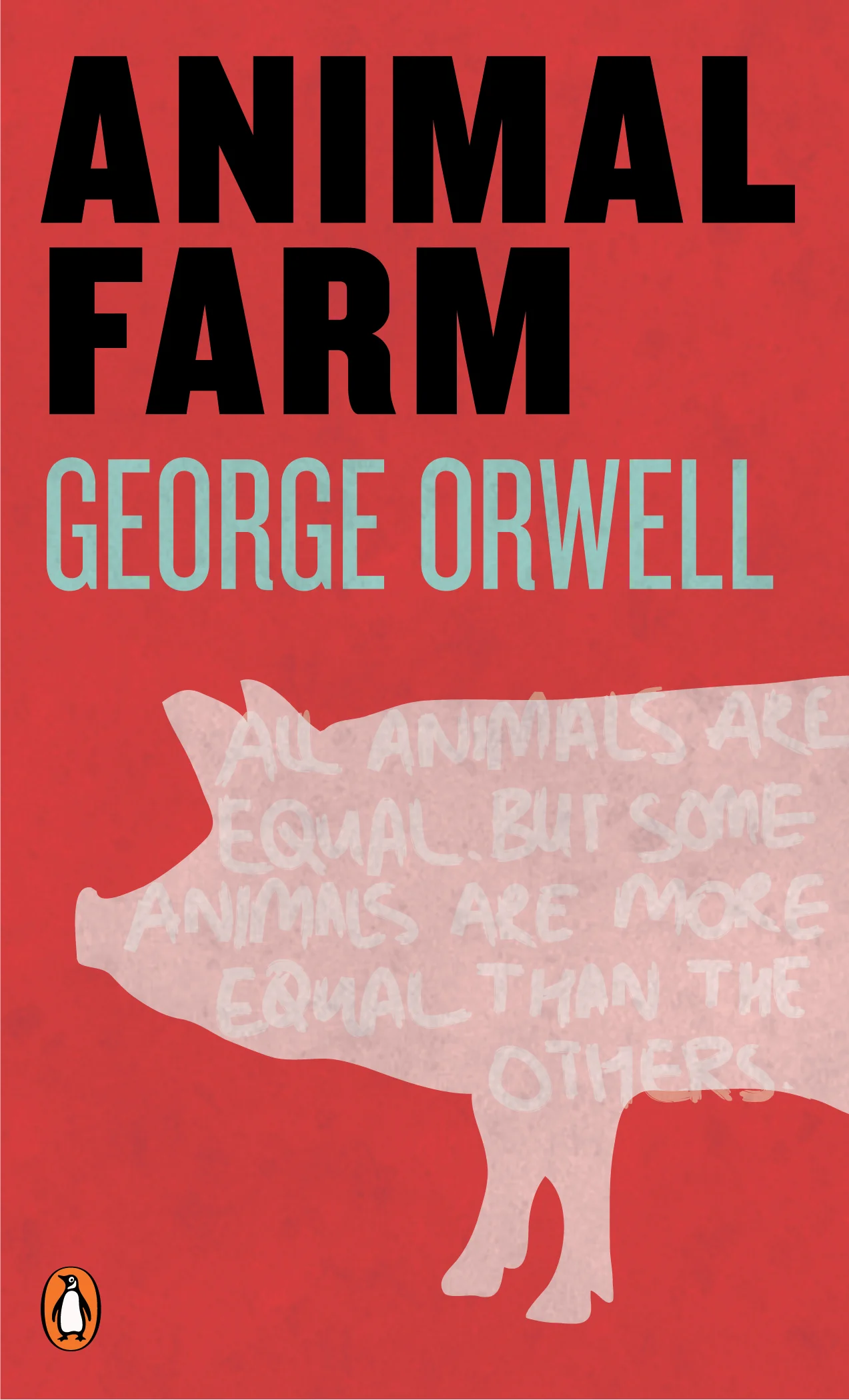
A dramatic transformation occurs when Squealer secretly trains the sheep for a week, teaching them a new slogan. Upon their return, the animals witness the shocking sight of pigs walking on their hind legs, led by Squealer and culminating with Napoleon himself striding upright while carrying a whip. When the other animals might have protested this clear violation of their founding principles, the sheep break into a new chant: 'Four legs good, two legs better!' The final corruption of Animalism is revealed when Clover and Benjamin discover that the Seven Commandments have been replaced by a single maxim: 'ALL ANIMALS ARE EQUAL BUT SOME ANIMALS ARE MORE EQUAL THAN OTHERS.'
The pigs' transformation completes itself as they begin wearing human clothes, living in the farmhouse, and adopting human habits like reading newspapers and smoking pipes. The final scene unfolds during a dinner party between the pigs and neighboring farmers, where Pilkington praises the farm's efficiency and strict control over its 'lower animals.' Napoleon announces the farm's name will revert to 'Manor Farm,' and as the animals watch through the window, they observe the pigs and humans playing cards and quarreling. In the chapter's haunting conclusion, the animals find themselves unable to distinguish between the pigs and the humans, as their faces seem to merge into one another.
Key Events
- Passage of many years and death of most original animals
- Completion of windmill for commercial corn milling
- Pigs begin walking on two legs
- Replacement of Seven Commandments with new maxim
- Pigs adopt human clothing and behaviors
- Dinner party between pigs and farmers
- Renaming of Animal Farm back to Manor Farm
- Final transformation of pigs becoming indistinguishable from humans
Themes
- Corruption of power
- Betrayal of revolutionary ideals
- Gradual normalization of oppression
- The cyclical nature of tyranny
- Loss of historical memory
- The merging of oppressor and oppressed