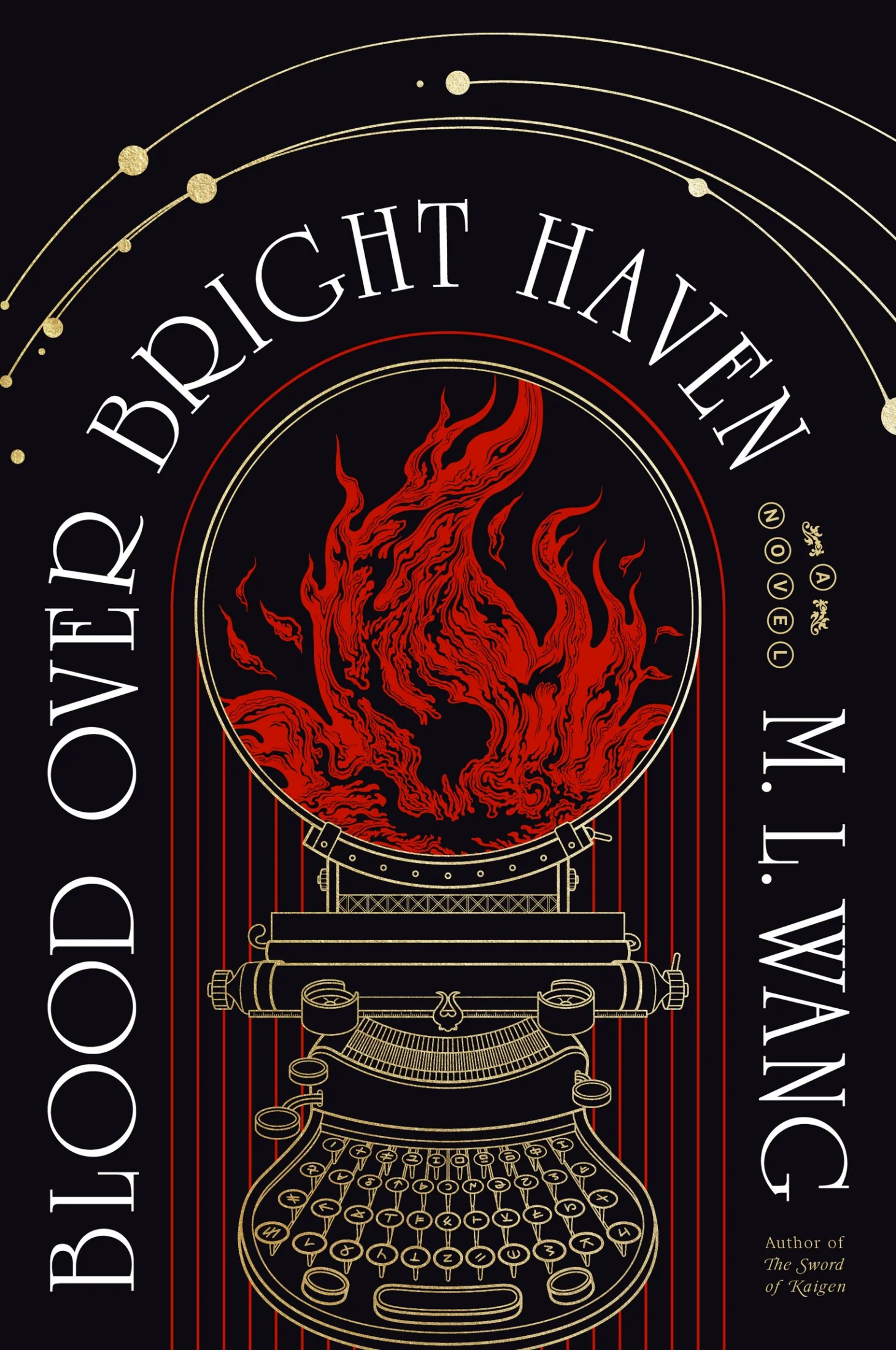
Chapter 1: A Field of Flowers
Thomil returns from a scouting trip to the remaining forty members of the Caldonnae, a Kwen tribe devastated by the Blight. They are preparing to cross two miles of frozen Lake Tiran to the city of Tiran, whose magical barrier protects those inside from the winter and Blight. Food shortages mean they cannot survive until the safer routes across the mountains open. Beyern, Thomil's uncle and the lead hunter, orders the group to leave their weapons behind and keep running even if relatives fall.
Blight strikes as they run across the lake, killing Drevan, Elra, and many others. Arras, who is carrying his four-year-old daughter Carra, is struck from behind. He calls for his wife Maeva to take Carra, and Maeva reaches the child just before Arras is killed. A strand of Blight burns Carra's face near her left eye and she loses consciousness. Thomil takes Carra from his grieving sister so they can keep moving. Near the far shore, the weakening ice breaks under the survivors. Beyern and the others fall into the water. Maeva surfaces long enough to tell Thomil to run; Blight then strikes the people trapped in the lake. Thomil runs on with Carra, breaking through shallow ice at the barrier's edge and reaching safety inside Tiran.
Thomil confirms that Carra still has a heartbeat but collapses from exhaustion and grief. Two Tiranish guards find them. One considers taking Thomil to a work camp if he recovers; the other threatens to send Carra away. Remembering Elder Sertha's warning that Tiranish religious law forbids separating parents from their children, Thomil claims Carra is his daughter rather than his niece. The guards permit them to go to the camp together. Thomil doubts he can raise Carra in the unfamiliar city but resolves to keep her alive as the only other surviving Caldonnae.
Key Events
- Forty surviving Caldonnae gather to cross frozen Lake Tiran because Blight and food shortages make remaining on the plains untenable.
- Blight kills members of the running tribe, including Arras; Maeva takes Carra from him, and Blight grazes Carra's face.
- Thomil takes the unconscious Carra while the ice breaks; Beyern and the other survivors fall into the water, and Maeva calls on Thomil to run.
- Thomil carries Carra through the barrier into Tiran and confirms she is alive, although her face is burned near the left eye.
- Tiranish guards threaten to separate them, but Thomil claims Carra is his daughter under Tiranish religious law and the guards allow them to go to a camp together.
Characters Appearing
- Thomil
- Beyern
- Maeva
- Arras
- Elder Sertha
- Carra
- Drevan
- Elra
- Mirach
- Rhiga
- Tarhem
- Landair
- Benny
Themes
- Survival after displacement
- Family obligation and loss
- Blight and the destruction of the Caldonnae
Chapter 2: A Woman Wanting
Sciona Freynan travels by train with her cousin Alba Livian to the University of Magics and Industry for the High Magistry examination. No woman of their generation has attempted the exam, and the Council considers a female candidate only once every ten years. Sciona fears that failing will be used to dismiss other women's qualifications for another decade. She has promised her aunt Winny that she will take a schoolteaching job if she fails, but she cannot imagine abandoning magical research. Alba challenges Sciona's stated concern for other women, pointing out that her cousin pays little attention to people around her, including Ansel, the baker's son who sent the scones they are eating. Sciona begins to question whether she is primarily concerned with others' opportunities or her own ambition.
The train arrives amid campaigns for the city chair elections, which are timed to coincide with highmage examinations. At the Magicentre, Sciona is overwhelmed by the expectations placed on her and the prominence of the male applicants from established families. Her mentor, Archmage Derrith Bringham, reassures her that she has the ability to pass and urges her to concentrate on the spellwork. He has advocated for her application and has his own reputation at stake. Bringham also invites Alba to watch, explaining that although women ordinarily do not accompany applicants into Leon's Hall, no rule prohibits her attendance.
Ten candidates seek the two open High Magistry positions under the supervision of the twelve archmages on the High Council. Jerrin Mordra, son of Archmage Mordra the Ninth, is examined first. Sciona assumes that his family connections will secure him a position, but his demonstrations are inconsistent. He disperses four hundred paper strips with excessive force, fails to maintain a levitating brick because of a sourcing problem, and sends a model automobile racing too far across the desk. His father repeatedly sets difficult tasks and rebukes him for touching examination materials. When Jerrin tries to bisect a granite slab, his first spell sends fragments through the hall and injures another examinee; he succeeds on a second attempt. Sciona explains to Alba that he can compose action spells but lacks the practical judgment required to source and control their energy. Other candidates demonstrate stronger skills.
As the examination continues, Sciona's initial dread turns into impatience to prove her own ability. She is the tenth and last candidate called. The chapter ends when Archmage Supreme Orynhel summons her and she steps into the testing circle, before she has performed any examination spells.
Key Events
- Sciona and Alba travel to the High Magistry examination; Sciona explains that the Council admits a female candidate to testing only once a decade and fears her failure would harm other women's chances.
- Alba challenges Sciona's professed concern for others and highlights her disregard of Ansel, who sent their scones; Sciona questions her own motives.
- At the Magicentre, Archmage Bringham encourages Sciona and invites Alba into Leon's Hall to observe despite the usual absence of female relatives.
- Ten applicants compete for two openings; Sciona believes Jerrin Mordra benefits from being a Council archmage's son, but the exam does not confirm that he will pass.
- Jerrin's imprecise sourcing disrupts his demonstrations, and his first attempt to bisect granite sends fragments into the audience, injuring an examinee; he succeeds on his second try.
- Sciona is called last and enters the examination circle; her actual spell demonstrations have not yet begun.
Characters Appearing
- Sciona Freynan
- Alba Livian
- Aunt Winny
- Ansel
- Archmage Derrith Bringham
- Jerrin Mordra
- Archmage Supreme Orynhel
- Archmage Thelanra
- Archmage Sireth Mordra (Mordra the Ninth)
- Archmage Gamwen
- Archmage Lynwick the Fourth
- Archmage Eringale
- Archmage Scywin
- Archmage Renthorn the Second
- Archmage Duris
- Archmage Capernai
- Archmage Faene the Eleventh
- Nerys (city chair candidate)
- Widmont (city chair candidate)
- Perramis (city chair candidate)
- Highmage Kamdyn (recently retired)
- Archmage Ardona (deceased)
Themes
- Gender exclusion from the High Magistry
- Individual ambition and responsibility to others
- Legacy advantage and technical merit
Chapter 3: Freynan the First
Sciona Freynan begins her High Magistry examination in Leon's Hall by describing her education at East Havendel Public School of Magics, her scholarship transfer to Danworth Academy, and seven years in Archmage Bringham's laboratories, including four as his lead manual sourcer. Her specialties are industrial siphoning and experimental mapping. She successfully ignites pine twigs at a controlled rate using the imprecise Kaedor mapping method. Bringham then asks her to divide a slab of obsidian. Unlike Jerrin Mordra's earlier attempt on granite, Sciona uses a precisely targeted cut and leaves two equal, smooth halves. Archmage Gamwen praises her distinct and superior composition, but Archmage Duris refuses to count it because she saw a similar prompt given earlier.
Duris next demands that she create an incendiary device from matter siphoned from the Otherrealm, although alchemy is not her specialty. Sciona blindly siphons material five times, analyzes it, and isolates enough carbon to form a ball. Rather than manufacture a chemical explosive, she writes an energy-powered spell drawing from Tiran's Reserve that will ignite around the ball once it rises fifteen feet above its original position. She throws it into the air, and the flames activate as specified before extinguishing when it descends. Sciona completes the subsequent prompts without outright failure. Duris then issues one final and much more dangerous challenge: levitate a massive industrial cauldron without using the Reserve.
Unable to determine the cauldron's weight, Sciona assumes it is far heavier than it is. She uses her own experimental mapping methods, combining features adapted from Kaedor, Leonic, and Erafin techniques, and simultaneously siphons energy from three coordinates. The excess force launches the cauldron through the painted ceiling of Leon's Hall, bringing down masonry before the cauldron crashes back to the floor. Realizing that the vessel weighs approximately a thousand pounds rather than the five thousand she estimated, Sciona immediately composes a second spell. Duris orders her to stop and threatens disqualification, but she completes the new casting and holds the cauldron motionless in the air. She then assumes that defying an archmage has cost her the examination and flees to the women's lavatory, where Alba comforts her as she vomits, cries, and fears being denied the career she has pursued.
Bringham finds Sciona and tells her that the Council has admitted her to the High Magistry, making her the first woman to attain the rank. He explains that Duris did not have the authority to end her examination because only Archmage Supreme Orynhel could do so. Bringham also admits that he planted the idea of the cauldron test with Duris to demonstrate Sciona's exceptional sourcing ability. He reveals that Tiran's proposed barrier expansion has been approved but is not yet public, and that the Magistry needs new mappers because its leading members are occupied with responsibilities left by the late Archmage Ardona. Sciona will be among several highmages proposing ways to obtain the energy required. The proposals are due at the next High Magistry meeting on Feryn's Eve, less than three months away.
Bringham cautions Sciona that colleagues may dismiss her achievements as favoritism or political appeasement and predicts City Chair Nerys's reelection, implying the Mage Council can influence the result. He also predicts that Perramis will unseat Amfre, prompting Sciona to think briefly of her estranged father without discussing him. Bringham urges her not to credit him for her success or yield to detractors. On the train home, Sciona repeats her new title to herself and imagines publishing her mapping method and becoming the woman who expands the barrier. These are ambitions, not accomplishments already achieved.
Key Events
- Sciona recounts her public-school scholarship transfer, seven years working for Bringham, and four years as his lead manual sourcer before beginning the examination.
- She lights pine twigs with controlled energy and divides an obsidian slab evenly; Gamwen praises the latter spell, while Duris refuses to count it.
- For a matter-siphoning challenge, Sciona collects carbon and uses a Reserve-powered ignition spell to make a ball catch fire when thrown fifteen feet upward.
- Duris orders her to levitate an industrial cauldron without the Reserve; Sciona's initial overpowered attempt drives it through the ceiling.
- Despite Duris's order to stop and his threat of disqualification, Sciona corrects the weight estimate and levitates the cauldron steadily.
- Sciona fears she has failed, but Bringham announces her acceptance as the first woman in the High Magistry and says only Orynhel could end the examination.
- Bringham admits steering Duris toward the cauldron challenge and discloses the approved barrier expansion and Sciona's opportunity to submit a sourcing proposal by Feryn's Eve.
- Bringham warns about political accusations against Sciona and predicts Nerys's reelection and Perramis's victory over Amfre; Sciona thinks of her father.
- Returning home, Sciona imagines creating the Freynan Method and helping expand the barrier, projects not yet completed.
Characters Appearing
- Keracy (historical female mage)
- Irma Mordra (historical female mage)
- Trethellyn (historical alchemist)
- The Widow Eringale (historical female mage)
- Amfre (city chair discussed by Bringham)
- Mordra the First (depicted in Leon's Hall ceiling mural)
Themes
- Gender exclusion and professional achievement
- Technical ingenuity and responsible energy sourcing
- Authority, dissent, and examination standards
Chapter 4: Just a Joke
Two weeks after Sciona Freynan becomes a highmage, Aunt Winny delays her departure for her first day at the University of Magics and Industry by fussing over her appearance and urging her to find a husband. Neighbors congratulate Sciona as she walks to the station. Ansel, the baker's son, gives her a basket of muffins, and Nora Idin, a young girl studying magic, asks her to sign her spellbooks. Sciona instead offers to get an archmage's signature and recommends books to improve Nora's study of mapping. These encounters nearly make Sciona miss her train. At the University, Sciona passes through the highmage-only security gate to the Magicentre's fourth floor, where she has been assigned a laboratory for sourcing research.
With the secretary absent, a Kwen janitor offers to guide Sciona to her laboratory. She initially doubts how well he understands Tiranish and feels uncomfortable walking alone with him because of her prejudices about the Kwen. They encounter Jerrin Mordra and highmages Yurith Tanrel, Cleon Renthorn, and Farion Halaros. Sciona recognizes Renthorn from their overlapping service in Bringham's laboratories and has long respected his mapping work. Tanrel expects the competing sourcing proposals for the barrier expansion to end with most of the highmages assisting Renthorn; Halaros will instead work on other projects. Mordra's assistant, Evnan, says he previously attended classes with Sciona, although she does not remember him. When Tanrel asks about Sciona's assistant, Renthorn mocks her by declaring that the janitor, whom he calls Tommy, has been promoted to the job rather than placing a qualified research mage under a woman. Tanrel objects to the joke, but Sciona avoids showing anger and leaves with Tommy.
Inside her new laboratory, Sciona recognizes that Renthorn's insult also humiliates Tommy. At first she releases him to return to his cleaning duties, then asks him to remain as her actual assistant. He suspects that she is continuing the joke, warns that he has never attended school, and explains that he learned to read Tiranish slowly from a former supervisor who needed help with inventory. Sciona insists that he can follow her instructions and that Renthorn, who has authority over staffing on the floor, must deal with the resulting vacancy in the cleaning staff. Tommy reluctantly accepts. She asks him to shelve her books alphabetically by author and gives him the muffins rather than sharing them with the other highmages.
Sciona discovers that the highmage floor has no women's restroom, so she goes downstairs and returns through the library's newly accessible highmage level. There she encounters Renthorn, who boasts of having four research-mage assistants and repeatedly addresses her as Miss Freynan rather than Highmage Freynan. When she corrects him, he alleges that she gained her position by sexually manipulating Bringham. He also reports that Tanrel attributes her admission to a political favor for City Chair Nerys and that Halaros believes Bringham wanted recognition for making history. Sciona rejects the accusations and proposes a direct test of their abilities: in eleven weeks, they will see whose sourcing plan the archmages choose for the barrier expansion. Renthorn dismisses his remarks as a joke and warns her against competing with him. Sciona returns to her laboratory and tells Tommy to leave the remaining boxes because they have work to do.
Key Events
- On her first day as a highmage, Sciona receives congratulations and pastries from Ansel, and gives the young Nora Idin advice about mapping books before nearly missing her train.
- Sciona enters the Magicentre's highmage floor and is guided by a Kwen janitor while displaying her own prejudices about the Kwen.
- Sciona meets Tanrel and Halaros, reunites with Renthorn, and learns that Evnan assists Jerrin Mordra; Tanrel expects Renthorn to lead the barrier-expansion sourcing work.
- Renthorn mockingly assigns the Kwen janitor Tommy as Sciona's assistant rather than assigning a qualified male research mage, insulting both of them.
- Although Tommy says he has no formal schooling and can read Tiranish only slowly, Sciona offers him the assistant position seriously; he accepts and begins shelving her books.
- Sciona discovers that her floor has no women's restroom and visits the highmage level of the library, where Renthorn boasts of his four research-mage assistants.
- Renthorn alleges that Sciona obtained her position through sexual manipulation of Bringham and relays other highmages' political or self-promotional explanations for her acceptance.
- Sciona challenges Renthorn to compare their barrier-expansion sourcing proposals in eleven weeks; after his dismissive response, she returns and orders Tommy to begin research work.
Characters Appearing
- Nora Idin
- Yurith Tanrel
- Cleon Renthorn (Renthorn the Third)
- Farion Halaros
- Evnan
- Tommy (Kwen janitor)
Themes
- Gender discrimination in the High Magistry
- Anti-Kwen prejudice and workplace hierarchy
- Professional competence and institutional favoritism
Chapter 5: Just a Drink
Immediately after Sciona's confrontation with Renthorn, she asks her new assistant, whom she knows as Tommy, to begin learning the basics of magic so they can work on the barrier-expansion project. She explains that Tiran's barrier both retains warmth and blocks Blight, and that expanding it will require a massive initial influx of energy followed by greater sustained energy use. Because Tiran's Reserve holds a limited supply, mages must map the Otherrealm and manually siphon additional energy. Sciona describes the differences between Leonite and Tirasian teachings, the action and sourcing portions of a spell, energy mapping, and spellwebs. Tommy follows her explanations and asks about controlling the amount of energy entering a spell. She explains that limiting an action spell's energy consumption cannot safely stop an excessive manual siphon: surplus energy may overwhelm the conduit or spell system.
Tommy connects the warning to the West Bend bridge collapse. Sciona knows that the University had minimized the magical cause of the accident and that Archmage Kamdyn was pressured to retire, but she did not know anyone had died. Tommy explains that the two Kwen laborers killed there were his neighbors and that their deaths received little public attention. Sciona promises she will not cut corners or take similar risks, but Tommy says his opinion cannot control a mage's actions. Comparing that powerlessness with the limits placed on women, Sciona argues that they can work together to prevent such disasters. She continues instructing him through the afternoon.
As work ends, Tanrel and Renthorn invite the newly admitted Jerrin Mordra out for the customary first-day drink, deliberately excluding Sciona. She intends to sleep on a bedroll in her laboratory during workweek nights rather than commute from her aunt's apartment. When Tommy respectfully addresses her as Highmage Freynan, she thanks him; he hesitantly offers to buy her a drink because nobody else has welcomed her. They agree instead to buy their own drinks and celebrate their promotions together. Sciona suggests the Dancing Wolf, a Kwen-owned bar affordable to Tommy and unlikely to attract her highmage colleagues, and leaves her white robe at the office.
At the Dancing Wolf, Sciona and Tommy sit together among Kwen and Tiranish patrons. The bartender recognizes Tommy by the name Thomil and, after hearing about Sciona's appointment as the first female highmage, offers her and her friends drinks without charge. He addresses her with the Kwen word 'Meidra,' which Tommy says is complimentary; Sciona does not learn its precise meaning. The bartender is called Raehem. Over several drinks, Sciona explains her compulsion to pursue magic and distinction: Alba thinks her ambition stems from growing up without parents, but Sciona insists she seeks the power magic gives her, especially in a society that excludes women from other sources of authority. Tommy says his own parents died when he was young and that his older sister raised him. Sciona becomes significantly more intoxicated than he does.
Late that night Tommy offers to walk Sciona back because the streets are unsafe. Drunk, she shows him a portable voice-activated conduit she made as a child and says its black marking indicates a smoke-producing spell, while the red-marked conduits on her belt are dangerous weapons. Tommy prevents her from demonstrating it. Sciona asks him to stop calling her 'ma'am' outside work, and he asks her not to call him Tommy. He explains that Tommy is the Tiranish version of his proper Caldonn name, Thomil Siernes-Caldonn, and that Kwen sons take their mother's clan name followed by their father's. Sciona practices his name, notes that she also bears her mother's surname, and introduces herself to him in return. She remembers only fragments of their trip back to the Magicentre and waking on her laboratory cot. She wonders whether Thomil carried her upstairs, but the chapter does not independently confirm exactly how she reached the cot.
Key Events
- Sciona begins teaching Tommy magic and explains the barrier-expansion energy requirement, finite Reserve, Otherrealm mapping, manual sourcing, and the danger of imposing hard energy limits on an excessive siphon.
- Tommy reveals that the two Kwen workers killed in the West Bend bridge collapse were his neighbors; Sciona did not know of their deaths and says they can avoid such failures through better work.
- Tanrel and Renthorn take Jerrin Mordra for the customary welcome drink but exclude Sciona, who plans to sleep in her laboratory during workweek nights.
- Tommy respectfully uses Sciona's new highmage title and offers to buy her a drink; they agree to visit the Dancing Wolf and each buy their own.
- At the Kwen-owned Dancing Wolf, bartender Raehem recognizes Tommy as Thomil, addresses Sciona as 'Meidra,' and offers drinks in recognition of her becoming the first female highmage.
- Over drinks, Sciona discusses her pursuit of power through magic and Alba's interpretation of her ambition, while Tommy says his parents died young and his older sister raised him.
- Intoxicated, Sciona displays a portable conduit marked for a smoke spell and mentions more dangerous red-marked weapons; Tommy prevents an unsafe demonstration.
- Tommy reveals his proper Caldonn name as Thomil Siernes-Caldonn, asks Sciona to use it, and explains Kwen matrilineal/patrilineal clan naming.
- Sciona only vaguely recalls being escorted back to her laboratory and cannot be certain how she reached her cot.
Characters Appearing
- Raehem (bartender at the Dancing Wolf)
Themes
- Unequal accountability for magical accidents
- Gender and anti-Kwen discrimination
- Control and limits of magical energy
Chapter 6: Suited to Serve
On the morning after their visit to the Dancing Wolf, Sciona wakes hungover in her laboratory but is pleased to realize that she considers Thomil a friend, an unfamiliar feeling after years of exclusion from classmates and colleagues. When Thomil arrives early, she is already working on the barrier-expansion problem. She gives him the brown-and-white assistant's coat she found in storage and explains that University policy does not explicitly require an assistant to be Tiranish or University educated. Because he lacks formal qualifications, she cannot pay him at the graduate assistant rate, but she expects his new wage to exceed his janitorial pay. Thomil hesitates before accepting the coat, then sits with her to learn mapping.
Sciona explains that mapping spells show the Otherrealm as shades of gray and white, indicating areas with little or abundant energy. She asks Thomil to choose sample coordinates, then rejects his first choice because it is a known dead zone and his second because it falls at the center of the grid. She explains that a region around the center includes continuously siphoned zones reserved for Tiran's energy supply and the Forbidden Coordinates, whose exploitation is prohibited by Leon's own religious law. When Thomil questions these restrictions, she recounts the case of Highmage Sabernyn, who used energy from the Forbidden Coordinates to murder other mages and was executed following a vote of the High Magistry. Sciona regards his crimes as a perversion of magic's potential for progress. Thomil chooses a permissible third set of coordinates, but their demonstration is interrupted before she activates it.
Archmage Bringham visits and sees the countdown clock he gave Sciona, which now displays seventy-six days until Feryn's Eve, when sourcing proposals are due. He knows her fellow highmages have not welcomed her. Although Sciona says their treatment is connected to her being a woman, Bringham frames it as competition for influence and says Renthorn is particularly threatened by her talent. He admits he prefers Sciona to Renthorn and warns her not to yield to his political maneuvering. When Bringham questions the assignment of a Kwen assistant and offers to demand a qualified replacement, Sciona declines. She claims they are ahead of schedule, and Thomil supports the claim without revealing that it is an exaggeration. Bringham concludes that an assistant who follows Sciona's instructions instead of competing with her may suit her, and praises the tea Thomil prepares.
Remembering the schoolbook Nora Idin asked Sciona to sign, Thomil places it before Bringham. Bringham signs it for the aspiring mage and insists that Sciona add her own signature, predicting that it will someday be valuable. After discussing his former laboratory's reduced productivity, Bringham leaves. Sciona tells Thomil that she did not advance through favoritism. He replies that, after more than a year cleaning the highmages' offices, he has never seen anyone care as much about the work as she does.
Thomil asks about Bringham's connection to textile production. When Sciona describes his factories' pervasive influence on Tiranish fabrics, Thomil says a woman he once courted worked at one of those factories. He does not explain what happened beyond saying their relationship did not work out. Sciona feels awkward and returns to teaching him. At the end of the day, he observes that she is a better teacher than she believes. Sciona realizes he listens closely rather than dismissing her explanations, but Thomil says his attentiveness reflects the demands of Kwen survival: Kwen who cannot work do not get to live. Sciona laughs and calls this melodramatic. Hurt or withdrawn, Thomil stops meeting her eyes and says he will simply listen. The chapter ends with this unresolved tension rather than unqualified mutual understanding.
Key Events
- Sciona wakes hungover but considers Thomil a new friend; she gives him an assistant's coat and explains University policy permits his employment at a lower rate than graduate assistants.
- During mapping instruction, Thomil proposes dead-zone and central-grid coordinates, prompting Sciona to explain the Reserve siphoning region and the religiously Forbidden Coordinates.
- Sciona recounts the execution of Highmage Sabernyn for using the Forbidden Coordinates to commit murders; Thomil then selects allowable coordinates before Bringham interrupts the demonstration.
- Bringham visits, sees his countdown clock showing seventy-six days to Feryn's Eve, and warns Sciona about competition and Renthorn's efforts to undermine her.
- Bringham offers to replace the Kwen assistant; Sciona refuses, claims she and Thomil are ahead of schedule, and Bringham concludes that a compliant assistant may suit her.
- Thomil brings Nora Idin's schoolbook for Bringham to sign, and Bringham urges Sciona to sign it as well.
- Thomil assures Sciona that her dedication, unlike other highmages' attitudes he has observed, demonstrates she did not obtain her role through favoritism.
- Thomil reveals that a woman he once courted worked in one of Bringham's textile factories, but says only that the relationship did not work out.
- After Thomil praises Sciona's teaching, he says Kwen must adapt to Tiranish expectations to survive; Sciona dismisses his account of Kwen precarity as melodrama, and he withdraws.
Themes
- Institutional exclusion and precarious Kwen labor
- Patronage and rivalry in magical research
- Religious prohibition and the ethics of sourcing
Chapter 7: Web Weaver
Over the next two weeks, Sciona Freynan and Thomil work largely undisturbed in her Magicentre laboratory because the other highmages avoid her. She has not significantly improved the hybrid mapping method she demonstrated at her examination, so she concentrates on designing an exceptional sourcing spellweb for Tiran's barrier expansion. She recognizes that Renthorn is a better spellweb composer but believes her superior mapping precision could compensate. Her design begins with 1,500 promising non-Reserve sourcing zones, organized by expected energy yield into five tiers and distributed across 300 branches, the maximum number that qualified mages could operate. Each branch offers a mage thirty seconds to select and siphon energy from the best candidate zone before the spellograph switches to the next tier. If all five options fail, the branch defaults to the Reserve. Three branches drawing on the Reserve could endanger Tiran's essential systems; more than five could be catastrophic, and more than ten might destroy rather than expand the barrier. Sciona spends days recalculating probabilities because expert predictions of Otherrealm energy distribution conflict.
As Sciona nears the end of her draft, an explosion shakes the Magicentre, shattering her laboratory windows and destroying equipment. Bringham's countdown clock survives and shows sixty-two days until Feryn's Eve. Thomil urges Sciona to check whether anyone is hurt, although she initially cares more about the interruption. The blast comes from Highmage Halaros's laboratory. Halaros is dazed and may have a concussion; a fallen table traps an assistant, whom Thomil and Evnan help free. Sciona and Renthorn independently inspect the one smoking spellograph. Its paper shows an ordinary Kaedor mapping spell, not an energy-use cap, and Sciona is puzzled that an experienced mapper could have caused such a violent failure. She recognizes the unusual machine as a Maclan Splendor 55, a model familiar from Bringham's research laboratories. Thomil advises evacuation because the building may be unstable, and Tanrel agrees despite Renthorn's contemptuous dismissal of Thomil.
After the building is evacuated and inspected, Renthorn's laboratory is declared usable, but Sciona's, Tanrel's, and Jerrin Mordra's need window repairs; Halaros's requires more extensive work. Tanrel and Mordra decide to join Renthorn's laboratory ahead of schedule, and Renthorn offers Halaros a place while his lab is repaired. He invites Sciona as well, but she refuses. She tells the group she is going to replace damaged equipment and leaves with Thomil. In fact, she is worried that Tanrel's theoretical mapping skill, assisted by Halaros's practical expertise and combined with Renthorn's stronger spellwebs, could produce a sourcing proposal superior to her own. When Thomil asks why she will not collaborate for the sake of Tiran, Sciona explains that women have historically been denied credit for their work and that she intends to secure recognition under her own name rather than surrender it to male colleagues.
Sciona also voices a suspicion about the explosion, not a proven accusation. Given that Halaros's Kaedor spell appears sound, she thinks the machine may have been damaged or deliberately cursed. The Maclan Splendor 55 is uncommon outside Bringham's laboratories, and among the local highmages, Renthorn is one of the few familiar enough with it to tamper with it. Thomil reasons that, had either Sciona or Halaros selected the machine, an explosion could have damaged neighboring Tanrel's laboratory and given Renthorn an opportunity to gather the other mages under his direction. Neither Sciona nor Thomil establishes that Renthorn sabotaged anything.
Rather than use the temporary space offered in Faene's Hall, Sciona heads toward Trethellyn Hall, where Bringham maintains his laboratories. She avoids Faene's Hall because city chairs meet there with archmages, and discussion with Thomil draws out her history with Perramis, her estranged father. After Sciona's mother died when Sciona was four, Perramis sent her to live with Aunt Winny, later married another woman, and had two sons. Sciona remembers her mother's devotion and suffering, and she believes she and her mother were denied the regard they deserved. Her desire to excel without taking Perramis's surname is partly an act of defiance against his rejection. Sciona says Bringham is someone she trusts to provide facilities without interfering. They arrive at Trethellyn Hall, named by Bringham in honor of an overlooked female mage, and Sciona tells Thomil that to remain competitive she must delegate more substantial work. She intends to have him begin practicing magic, but he has not yet performed it in this chapter.
Key Events
- Sciona plans a barrier-expansion sourcing spellweb using 1,500 non-Reserve zones in five tiers across 300 branches, with a thirty-second assessment window and dangerous limits on fallback to the Reserve.
- An explosion damages the Magicentre; the surviving countdown clock shows sixty-two days to Feryn's Eve, and Thomil urges Sciona to check for casualties.
- Sciona and Renthorn inspect Halaros's ruined laboratory; Halaros is dazed, an assistant is freed from debris, and an ordinary Kaedor spell is found on a rare Maclan Splendor 55.
- Thomil recommends evacuating the building; Tanrel agrees despite Renthorn's discriminatory dismissal, and an inspection rules several laboratories temporarily unusable.
- Renthorn gathers Tanrel, Mordra, and the injured Halaros into his undamaged laboratory and invites Sciona, who refuses.
- Sciona tells Thomil that she will not collaborate with Renthorn because she fears losing recognition for her work, and worries that Renthorn's combined team could outmatch her proposal.
- Sciona suspects, without proof, that a broken or cursed Maclan Splendor 55 might have been used to arrange damage that benefited Renthorn's efforts to combine the teams.
- Sciona avoids Faene's Hall because it hosts city chairs and reflects on her estranged father Perramis, her mother's death, and her determination to make her own name.
- Sciona and Thomil arrive at Bringham's Trethellyn Hall, where she intends to use his research facilities and start training Thomil to perform magic.
Themes
- Technical design and the risks of barrier-expansion sourcing
- Professional competition versus cooperation
- Attribution of women's research and personal ambition
Chapter 8: Rune Reader
More than two months into Sciona's research, Thomil advances from elementary copying to replicating her spells and successfully makes one of her smoke-producing conduits. Yet neither has improved her hybrid mapping method. Testing each change with twenty siphoning trials by Sciona and twenty by Thomil has left their accuracy at about 94 percent and 73 percent respectively. Sciona believes the remaining blur in the Otherrealm's visual representation originates in foundational Leonic spell lines that Faene the First forbade mages to alter. Thomil wonders whether the obscured view serves as protection, but also questions why Sciona, a Leonite working in a Tirasian institution, must follow Faene's additional rules. With only eight days to Feryn's Eve, and at least one day needed to adapt her spellweb to a final mapping composition, she seriously considers breaking the prohibition. Thomil vehemently objects when she suggests joining Renthorn's team instead, though he gives no full explanation for his dislike of Renthorn. Sciona affirms Thomil's abilities, particularly his understanding of spellweb contingencies. He connects those skills to hunting and trapping across vast stretches of the Blightlands, where he grew up before crossing Tiran's barrier ten years earlier. He becomes guarded when asked about the crossing.
Sciona goes to the library to study handwritten spells from the Age of Founders before altering their original lines. In her absence, Thomil recognizes symbols in Norwith's handwritten Leonic magic as resembling those used in ancient Venholt Endrastae naming and divination rituals. He writes the name of his half-Endrasta brother-in-law Arras in that script, which Sciona reads as 'Addas.' She relates the similarity to scholarship suggesting Leon brought mysterious writings known as the Vendresid from the Venhold Mountains before Tiran's founding. Sciona assumes Leon preserved valuable knowledge that the Kwen would have lost; Thomil argues that acquiring living peoples' ancestral knowledge without permission is theft, pointing out that the acquisition allegedly occurred five years before Blight began. Sciona defends Leon by citing his divine foreknowledge and Tiran's subsequent protection, but the historical dispute is unresolved. Thomil explains that he retains the beliefs of his Caldonn community rather than worshipping Feryn exclusively. His short hair helped him obtain work in Tiran, not necessarily signal conversion.
Their disagreement turns to competing ideas of morality. Thomil poses a thought experiment contrasting a person whose well-intentioned actions consistently cause suffering with someone whose malicious actions unexpectedly improve lives. Sciona judges intentions central to goodness; Thomil says many Kwen gods weigh consequences. He describes 'vakul' as unrealized potential for good, comparable to an empty riverbed that cannot water crops until a river actually flows. Sciona angrily rebukes him for suggesting Tiranish morality allows people to declare themselves good without producing good outcomes. When he falls silent, she recognizes that her authority as a highmage makes his disagreement dangerous: she could have him dismissed, imprisoned, or worse, and has used that imbalance to win an argument rather than pursue truth. She joins him in cleaning the laboratory, then asks him to keep challenging her honestly. Thomil cautions that Kwen truths are not always comfortable or acceptable to Tiranish employers; Sciona ultimately chooses honesty over guaranteed politeness.
Thomil then explains that 'meidra,' the word bartender Raehem used for Sciona, means something like 'lady mage' or 'sorceress' and denotes a highly respected master of magic. According to his account, the greatest magic practitioners of the old Kwen were women who learned and preserved protective magic within their communities. Sciona is fascinated but resists the implication that Leon's Founding Mages appropriated those women's knowledge and displaced them. She asks how five Founding Mages could have defeated powerful Kwen witches. Thomil says Kwen songs attribute the Conquest to a strange, evil magic, though he cannot establish what happened. Sciona maintains that Tiranish magic is benevolent, and their disagreement remains unresolved. She sends Thomil home and, still overwhelmed, says she will see him the following week. He leaves calling her 'Meidra.'
Key Events
- Thomil replicates Sciona's smoke conduit, but testing still leaves her mapping accuracy around 94 percent and his around 73 percent; the proposal deadline is eight days away.
- Thomil questions Faene's restriction on altering foundational mapping lines, and Sciona considers defying the rule rather than accepting defeat and joining Renthorn's team.
- Thomil explains that extensive hunting and trapping taught him contingency planning; he grew up beyond the barrier and crossed to Tiran ten years ago.
- Thomil recognizes handwritten Leonic runes as similar to Venholt Endrastae writing, reproducing his brother-in-law Arras's name, which Sciona reads as 'Addas.'
- Sciona cites accounts of Leon bringing the Vendresid from the Venhold Mountains; Thomil questions whether this was theft of Kwen ancestral knowledge before the onset of Blight.
- Thomil explains his separate Caldonn religious beliefs and contrasts morality judged by actual effects with morality judged by intentions, including the Kwen concept of 'vakul.'
- Sciona silences Thomil angrily, recognizes the power imbalance between highmage and Kwen assistant, and asks him to continue speaking honestly even when he disagrees.
- Thomil explains that 'meidra' is a title of respect for a highly skilled female magician and says the ancient Kwen's strongest magic users were women.
- Sciona and Thomil dispute the Founding Mages' conduct and whether their magic was good or evil; neither resolves the disagreement before Thomil leaves calling her 'Meidra.'
Themes
- Experimentation versus religious restrictions
- Origins and ownership of magical knowledge
- Consequences, intentions, and unrealized goodness
Chapter 9: Witch’s Well
Unable to sleep after Thomil's account of ancient Kwen women practicing magic, Sciona wonders whether the 'windows' that Tiranish writers ascribed to witches might have been more than divination. She returns early to the University library and searches old travel accounts and histories. Highmage Jurowyn described Kwen women using runic spells to open vividly detailed visions, and other historical authors called similar phenomena witch mirrors, scrying wells, or windows. Some writers disputed any similarity to Tiranish mapping, while most of the sources that might have clarified the comparison were lost in the library fire of 252. Sciona cannot establish whether the witches observed the mortal world, the Otherrealm, or somewhere else, but she believes their ability to produce clear images could help her eliminate the blur in modern sourcing maps.
A hostile claim in Highmage Raeden's history that the Kwen had contributed nothing to Tiranish magic reminds Sciona of Founding Mage Andrethen Stravos's ancestry. Reading biographies, including Highmage Kellen's, she finds an account identifying his father as the Verdani trader Doren Stravos and his mother as a witch of the Venhold Mountains. After the mother's death, Doren accepted the sickly, limping boy into his household; Andrethen later became Leon's apprentice and accompanied him to the mountains. Sciona notes that historical accounts consistently credit Stravos, not Leon or Kaedor, with sourcing the enormous energy required to raise Tiran's barrier. She infers that Stravos's distinctive sourcing methods might have originated with his Kwen mother and therefore preserve techniques similar to the witches' clear windows. That connection is Sciona's reasoned theory, not a proven lineage of specific spells.
Sciona initially cannot find The Stravos Collection on the shelves. While researching, she encounters Renthorn and Tanrel, who question her exhausting library vigil and again suggest she join their work. Their conversation reminds her that she herself took the missing collection to her laboratory two days earlier. She returns to it and, after prolonged experimentation, translates four otherwise neglected lines from Stravos's handwritten spellwork into spellograph-compatible runes. The result is a strikingly sharp grayscale mapping image in which energy sources have clear outlines. When Thomil arrives, she shows him the success and explains that the extra 'pooling layer' in Stravos's design provides detail discarded from later simplified mapping methods. She has not yet told Bringham, because she wants to attempt something further.
Sciona next removes the inherited lines that render mapping visuals in obscuring grayscale, hoping to create what she calls a 'Freynan Mirror.' Thomil agrees to witness the test, though he earlier raised doubts about whether human eyes could safely view the Otherrealm without the traditional filter. Their new mapping spell displays a full-color, moonlit landscape of snow, shrubs, tracks, and a small animal. Sciona is delighted, but Thomil is alarmed because the landscape looks to him like the Kwen beyond the barrier, not an alien realm. He asks Sciona to siphon energy through a simple pushing spell. She targets a dense evergreen bush visible in the image; it flashes bright and unravels into leaves and splinters. Thomil immediately throws the spellograph across the laboratory, destroying it, and tells the bewildered Sciona that what she just witnessed was Blight. The chapter ends with his identification of the phenomenon; its wider implications and physical location have not yet been independently established in this source unit.
Key Events
- Sciona searches old accounts of Kwen witches and finds descriptions of unusually clear magical 'windows' or mirrors, though the historical reports do not agree about what those images revealed.
- Research into Founding Mage Andrethen Stravos's biography identifies his mother as a witch of the Venhold Mountains and confirms that historical accounts credit Stravos with sourcing Tiran's original barrier.
- Sciona hypothesizes that Stravos's original methods drew upon his mother's Kwen knowledge, a possibility not independently proved by the texts.
- Renthorn and Tanrel encounter Sciona in the library; she remembers that she brought The Stravos Collection to her lab two days earlier and resumes experiments.
- Sciona adapts four unique lines from Stravos's older handwritten compositions and achieves a precise, crisp grayscale image of energy sources.
- Sciona and Thomil remove traditional mapping lines to attempt a clear 'Freynan Mirror,' producing a full-color visual of a snowy landscape rather than a conventional grayscale energy map.
- Thomil recognizes the scene as resembling the Kwen and asks Sciona to test siphoning; she targets an evergreen bush, which flares and disintegrates in the visual.
- Thomil hurls the spellograph from the desk, breaking it, and tells Sciona that the phenomenon she has just seen is Blight; the chapter ends without independently establishing broader consequences.
Characters Appearing
- Highmage Jurowyn (historical travel writer)
- Highmage Eristidel (historical writer)
- Archmage Faene the Second (historical writer)
- Highmage Hurothen (historical writer)
- Highmage Raeden (historical writer)
- Highmage Kellen (Stravos's biographer)
- Doren Stravos (Andrethen Stravos's father)
Themes
- Historical suppression and reinterpretation of Kwen magical knowledge
- Cross-cultural transmission and possible origins of sourcing magic
- Innovation through recovering neglected spellwork
Chapter 10: Far Afield
Immediately after Sciona Freynan siphons from the newly revealed landscape and Thomil calls the result Blight, he flees her laboratory. She finds him trembling in a stairwell between the Magicentre's third and fourth floors. He tells her that the whitening, spiraling disintegration of the bush is exactly how Blight destroys living things in the Southern Kwen, where he grew up. He witnessed his father unravel in a snowy field while still a child; his older sister cleaned the blood from him and kept their family moving. During their crossing toward Tiran, Blight killed his sister within a mile of the barrier. Thomil insists that the landscape visible in Sciona's newly unfiltered mapping spell is not an abstract 'Otherrealm' but a real place outside the city.
Desperate to preserve her belief that Tiran's magic and its God are benevolent, Sciona suggests that the Otherrealm may take a familiar form in the viewer's mind and then claims Thomil sees horrors because his people rejected Feryn. Thomil challenges that explanation: both of them saw the snowy field, and he recognized Blight in the consequences of Sciona's siphoning. He asks her to consider why the Forbidden Coordinates form a circular region like Tiran's protected dome. Despite resisting the implication, Sciona mentally aligns her maps of the Otherrealm with the geography of the Kwen, including the productive southern zones and harsher northern regions. The pattern supports the possibility that conventional Tiranish sourcing draws energy from living lands and beings outside the barrier rather than an untouched divine realm. Thomil also challenges Sciona's ignorance of the conditions imposed on Kwen laborers in Tiran. She responds with dehumanizing insults, then slaps him. When Thomil advances, she reaches for a dangerous conduit on her belt; he presses her armed hand against his chest and challenges her to kill him now that he is no longer useful. She cannot do it, but tells him that his people deserved to die, prompting him to accuse her of worshipping delusion rather than truth. Thomil pulls away and leaves her alone in the stairwell despite her attempt to stop him.
Sciona struggles to believe this confrontation is real, then runs back to her laboratory determined to disprove Thomil's claims. Ignoring Renthorn's taunts as she passes, she locks the door and takes out a spare spellograph. Using her clear mapping method, she maps a familiar, well-used sourcing location near the far edge of the common coordinates, where mages obtain energy and alchemists often siphon salt. Instead of the abstract energy pool she expects, she sees a blue ocean and people gathering dark shells along its shore, far beyond the places Tiranish cartographers have recently reached. She zooms in on a young shell-gatherer with dark hair and black eyes, unfamiliar in appearance to her. The living scene initially renews her conviction that a benevolent God could not permit magic to harm a human being.
To test that conviction, Sciona activates a sourcing spell connected to a simple fire action spell while focused on the young woman. The girl's arm lights up and begins to disintegrate; the destruction spreads toward her chest. Horrified, Sciona first tries to cancel the spell by marking the paper, but the pen burns and breaks without stopping the siphon. She then tears the spellpaper from the spellograph, triggering a localized explosion that knocks her and the machine to the floor and stops the siphoning. The image remains active: the girl is still alive, terribly mutilated, while an older woman and a child try to comfort her in the bloodied surf. Sciona watches her die despite her desperate apologies. The death confirms for Sciona that the energy she has personally siphoned can be taken from living human beings, devastating her religious and moral certainty.
Key Events
- Thomil flees the destroyed spellograph, and Sciona finds him trembling in a stairwell; he identifies the bush's disintegration as the same Blight that killed his father and later his sister during the journey to Tiran.
- Sciona tries to explain the visible landscape as a spiritually tailored appearance of the Otherrealm, then claims Thomil's religious beliefs make him see horrors; he rejects these explanations.
- Thomil asks Sciona to compare the circular Forbidden Coordinates with Tiran's protected geography; her mental mapping reveals a disturbing correspondence between known sourcing zones and the Kwen.
- Thomil condemns the exploitation and disposability of Kwen laborers; Sciona responds with discriminatory insults and slaps him, then reaches for a weapon conduit as their confrontation escalates.
- Thomil presses her armed hand against his chest and challenges her to kill him; after Sciona claims the Kwen deserved their suffering, he accuses her of worshipping delusion and leaves despite her attempt to stop him.
- Determined to refute his accusation, Sciona uses a spare spellograph to view a familiar source of energy and salt near the edge of the common mapping coordinates and discovers an inhabited ocean shoreline.
- Sciona focuses on an unnamed black-haired young woman gathering shells and activates a siphoning spell that immediately begins destroying the woman's arm and chest.
- Sciona attempts to stop the siphon by crossing out the spell, then tears the spellpaper free, causing an explosion that ends the siphoning but leaves the mapping image active.
- Sciona witnesses the mortally injured young woman die while others comfort her and recognizes that her own siphoning has killed a human being.
Themes
- The human cost of Tiranish sourcing magic
- Denial and the collapse of religious certainty
- Geographical evidence and the meaning of the Forbidden Coordinates
Chapter 11: Common Cursework
After Sciona witnesses the death of the young shell-gatherer through her mapping coil, she remains on the laboratory floor screaming and unresponsive. Concerned colleagues summon Archmage Bringham, and when she will not open the door, it is broken down. The mapping image has already faded. Sciona is carried to a quiet classroom on the third floor, given a blanket and tea, and left alone with Bringham. She is horrified even by the energy needed to heat the tea and operate the building, wondering what lives have been consumed to provide it. When she tries to explain that her clear mapping spell showed an inhabited world and that her siphoning killed a young girl, she becomes sick. While a young Kwen janitor cleans the floor, Sciona cannot stop imagining him disintegrating in the same white light.
Bringham proposes that she has triggered an ancient curse that produced deceptive images. He says that Sabernyn, remembered publicly for murdering other mages, also planted malicious spellwork in texts, spellographs, and other conduits, and he attributes the University library fire of 252 to one of Sabernyn's curses. He suggests that Sciona's lifelike vision might be an illusion left by such a mage, possibly someone who lived even earlier, and treats Thomil's distress as a sign that the image traumatized them both. Sciona briefly hopes she has been deceived, but the explanation does not fit what she knows. She had used two separate spellographs, both made after Sabernyn's execution, used and checked by her for months without finding curses. She had composed and verified her own spells rather than copying another mage's spellpaper, and Sabernyn's surviving writings offer no apparent explanation for the unprecedented clear images of distant places. Bringham does not demonstrate that a curse was involved. Sciona also resists his dismissal of Thomil as a simple Kwen, although she cannot bring herself to recount their confrontation. Bringham asks her to apologize to Thomil and take the remainder of the day and the following day off before the High Magistry presentation next week.
On her way out, other highmages and their assistants mock Sciona's breakdown and gender, while Renthorn taunts her about receiving paid leave. She scarcely registers them. Her lifelong drive to excel at magic has disappeared, and even the energy powering the train ride home now seems unbearable. At her aunt's apartment, she asks Winny whether she is a good person. Winny assures her that she is, and Sciona weeps in her aunt's arms, then with Alba, and later alone through the night. She mourns not only the girl she killed but the possible cumulative cost of every spell she has ever cast. Remembering Thomil's insistence that actions and consequences matter more than intentions, Sciona cannot see how remorse could offset that harm.
Exhausted by grief, Sciona climbs onto the sill of a fourth-floor window and considers ending her life. Looking out over Tiran's beautiful, magically powered city, she reasons that her death would not stop the harm: the High Magistry would likely replace her with a less precise sourcer who would take even more life to accomplish the same work. She turns her rage on the Founding Mages, whom she believes must have understood the source of their magic, and leans toward the drop. Alba grabs Sciona's nightdress and pulls her backward into her arms before she falls. Sciona struggles and insists Alba cannot understand what she is asking her to endure, but Alba holds her and begs her to remain. The chapter closes on Sciona's unresolved anguish, not a recovery or a solution to the moral crisis.
Key Events
- Colleagues force open Sciona's laboratory after hearing her screams; Bringham finds her shaken, and she is taken to an empty classroom, where she says her siphoning killed a young girl.
- A young Kwen janitor cleans up after Sciona vomits; she is haunted by imagining him disintegrating as the girl did.
- Bringham suggests an old illusory curse and attributes Sabernyn's planted cursework, including the University library fire of 252, to his attempts to hinder future mages.
- Sciona doubts the curse explanation because both spellographs were made after Sabernyn's execution, previously checked, and used with spells she composed and understood herself.
- Bringham urges Sciona to apologize to Thomil and take two days away from work before the presentation the following week.
- Renthorn and colleagues mock Sciona's breakdown; she returns home and asks Aunt Winny whether she is a good person before crying with her family.
- Sciona agonizes over the deaths her magic may have caused and the difference between good intentions and actual consequences.
- Sciona considers jumping from a fourth-floor window but realizes the High Magistry might replace her with a mage who siphons less efficiently and causes more harm.
- Alba forcibly pulls Sciona away from the window and holds her as she struggles and cries, begging her to stay.
Themes
- Trauma and moral injury after witnessing the human cost of siphoning
- Denial, evidence, and unproven curse explanations
- Institutional sexism and anti-Kwen prejudice
Chapter 12: Death of the Divine
Thomil sits outside at night on the ledge around the disused water tower atop his apartment building in the Kwen Quarter, imagining escape through a fall but regarding such an act as selfish. The discovery of Blight's connection to Tiranish magic fits his long-held understanding of Tiran as a city that consumes Kwen labor and lives. What confuses him is his own response: instead of directing his strongest anger at Tiran, he feels personally betrayed by Sciona Freynan. In the months working beside her, he had begun to believe that her laboratory offered a place where knowledge and truth mattered more than social rank and that she saw him as a person rather than a resource. He recognizes that he had come to trust her and had developed feelings for her, taking particular pleasure in her smiles and lively discussions. After their confrontation, he regards that trust as a painful lapse in the vigilance that has kept him alive in Tiran. He thinks of returning with his sister Maeva to the place where their father died of Blight, only to find green grass growing among his remains, a reminder that beauty can spring from death.
His niece Carra climbs the ladder to join him. She is the daughter of Maeva and Arras, both lost to Thomil, and he has raised her in Tiran. She works as a chimney sweep, passing as a boy because employers often fail to check and because the soot on her face helps protect her from harassment as a Kwen girl. Thomil worries that, without her parents' warmth, his resentment and emotional reserve have shaped her into a hard, angry child. When he admits he is not all right, Carra suspects something happened with the mages, first asking whether Renthorn has harmed him again. He says that he trusted the Tiranishwoman for whom he works. Carra teases him about liking Sciona, but his distress is deeper than embarrassment. He tells her that the deaths of their people were not senseless: the way Tiranish magic works has made the suffering and destruction of the Kwen part of the city's prosperity.
Thomil recounts what he and Sciona discovered about Blight. He is conflicted about telling Carra, because he has deliberately raised her to remain Caldonn rather than assimilate into Tiran. He wants her to remember her parents, their songs, language, and way of life, as Maeva and Arras would have wished. Yet he admits to himself that the choice was also selfish: he could not bear to be the last person to carry their culture, even though visible Kwen identity exposes Carra to hardship. He now worries that sharing this devastating truth transfers his suffering to a child he should protect. He recalls the Caldonnae gods of motherhood, home, hunting, fields, and rivers, whose ideals place the community above the self, and fears that his efforts to preserve their heritage have become driven more by his own grief than by Carra's needs.
After Thomil finishes speaking near dawn, Carra silently descends onto the rooftop and faces the textile factory towering over their home. As its magical machinery starts for the day, she screams in rage. The central conduits roar louder than her voice, but she keeps shouting. Thomil watches and condemns himself for burdening her with the knowledge and for putting his desire not to lose their culture ahead of what he believes might have been best for her. He prays for forgiveness to the Caldonnae gods, including Eidra, Thryn, and Nenn, but hears no answer over the factory. To Thomil, this isolation and the pain carried by the last two surviving members of his community mark the deeper death of the Caldonnae. The chapter presents his grief-stricken interpretation, not an independent determination that Carra has irreversibly lost her heritage or capacity for good.
Key Events
- Thomil sits at the disused water tower over his Kwen Quarter apartment and recognizes that his unusually personal anger at Sciona stems from the trust and affection he had developed for her.
- He remembers the destruction of his community and the green growth over the place where he and Maeva later found their father's remains, linking his new sense of betrayal to the beauty of Sciona's laboratory.
- His niece Carra joins him; Thomil reflects on her hazardous chimney-sweeping work, her passing as a boy, and the way his emotional guardedness has shaped her upbringing.
- Carra asks whether Renthorn hurt him again; Thomil instead admits he trusted Sciona and tells Carra of the connection between Tiranish magic and Blight that he discovered that day.
- Thomil acknowledges that preserving Carra's Caldonn language, identity, and memories of Maeva and Arras has honored her parents but also served his own fear of being the last of their people.
- He considers the Caldonnae gods' community-centered ideals and judges himself harshly for sharing the unbearable truth with Carra to relieve his own isolation.
- At dawn, Carra screams toward the neighboring textile factory as its conduits start up and drown out her voice, but she continues.
- Thomil prays to his ancestral gods without receiving an answer and interprets their silence and Carra's anguish as the deeper spiritual death of the Caldonnae.
Themes
- Betrayal born of trust and affection
- Loss of community and cultural survival under exploitation
- Guardianship, assimilation, and conflicting duties to children
Chapter 13: The Alchemy of Energy
Following Alba's intervention at the window, Sciona Freynan suffers repeated nightmares in which blood and decay seep from the Leonid and consume her own body. She wakes screaming, cannot eat or stop crying, and begs to be free of the knowledge that Tiranish magic draws energy from living beings. Yet she also recognizes that forgetting the truth or having her mind subdued would destroy the pursuit of knowledge that defines her. Alba takes time off work to watch over Sciona, fearing she may harm herself. When Aunt Winny sees how distressed Sciona remains, she insists on summoning a medical alchemist despite Alba's objections. Alba recalls an unsuccessful treatment of the baker's older son and fears that a doctor may permanently damage Sciona's mind. She warns Sciona that if a medical alchemist judges her a danger to herself, he can return with assistants and administer treatment regardless of her wishes. Urging Sciona not to lose the distinctive mind that made her the first female highmage, Alba gives her a reason to resist: no doctor should erase what only Sciona knows or can do. Sciona asks Alba to fetch her white highmage robe.
Dr. Mellier arrives to find Sciona in her robe over her nightgown. He is startled that his patient outranks him in magic, something Aunt Winny had not thought necessary to mention. Sciona asks to speak to him alone and then perches on her bedroom windowsill, threatening to jump if he approaches, interrupts, calls her family, or refuses her conditions. She also threatens his career if he discloses their conversation. She brings up Carseth Berald, the baker's eldest son and Ansel's brother, a barrier guard who jumped to his death during a course of Mellier's treatment. Mellier disputes that he could have saved Carseth; the passage does not establish whether treatment caused his death. Sciona uses the case to force the doctor to sit and listen, hoping that discussing her predicament with another trained mage will help her discover a reason to live.
Mellier interprets Sciona's distress through Archmage Lufred Ayerman's gendered medical teachings, arguing that intelligent women are especially prone to instability and should find fulfillment through submission to family and male authority. Sciona fears that his sedating treatments, and ultimately lobotomy if needed, would make her docile and extinguish her ability to reckon with the truth. She points out that she must make a High Magistry presentation in four days. Mellier instead proposes a week of rest under supervision and suggests that male highmages could proceed without her. His inability to engage with Sciona's questions reinforces her refusal to place her future in his hands.
Trying to think within her own discipline, Sciona draws a conceptual distinction between alchemical matter, which a practitioner transforms within finite material constraints, and sourced energy, which can drive many kinds of action spells. She has treated her guilt as ineradicable poison: pain inseparable from her own being. She now asks whether she can instead regard the intensity of that feeling as energy to direct toward useful consequences. The distinction is her own moral and psychological framework, not a new experimentally established principle of medical magic. She does not need to forget the harm she has discovered or transform remorse into happiness if she can use it to accomplish tangible good. Recalling Thomil's term 'vakul,' she compares her present emptiness to a dry valley awaiting a river and concludes that what matters is not eliminating the feeling but choosing what to do with it. Mellier warns that parts of her thinking are heretical, but Sciona insists that her quest remains one for truth.
This line of thought restores Sciona's sense of purpose and makes her recognize that the doctor cannot serve as the incisive intellectual partner she needs. She needs Thomil, who questioned her assumptions and challenged her work rather than merely repeating doctrine. She does not yet know how to repair their estrangement, and the prospective conversation frightens her. Sciona dismisses Mellier, tells him she will not attempt to hurt herself again, and resolves to find an action through which she can leave a real impact on the world. The chapter closes with that intention, not with a completed plan or a reconciliation with Thomil.
Key Events
- Sciona endures nightmares, panic, and grief after the revelation about sourcing; she rejects forgetting the truth because knowledge remains central to her identity.
- Aunt Winny insists on fetching a medical alchemist despite Alba's fear of coercive or damaging treatment; Alba warns that treatment can be imposed if Sciona is judged a danger to herself.
- Alba reminds Sciona of her distinctive abilities and position as the first female highmage, prompting Sciona to put on her white robe before the doctor arrives.
- Dr. Mellier is taken aback by Sciona's rank; alone with him, she threatens to jump from her bedroom window and to damage his career unless he follows her conditions and listens.
- Sciona cites the death of Carseth Berald, Ansel's older brother, during the course of Mellier's treatment without establishing that the treatment caused his death.
- Mellier applies Ayerman's gendered medical model, recommending submission and rest; Sciona fears sedation or lobotomy and stresses her High Magistry presentation is four days away.
- Sciona contrasts the limited transformations of alchemical matter with the potential to direct energy, reframing her terrible guilt as power that might be applied toward tangible good.
- Remembering Thomil's idea of 'vakul,' Sciona decides to focus on what she can do with her feelings rather than on eliminating them, while realizing she needs Thomil's critical honesty.
- Sciona dismisses Mellier, says she will not physically harm herself, and resolves to pursue meaningful action, though she has not decided on the action spell or reconciled with Thomil.
Characters Appearing
- Dr. Mellier (medical alchemist)
- Carseth Berald (Ansel's deceased older brother and a former barrier guard)
- Archmage Lufred Ayerman (historical author of Medical Alchemy)
Themes
- Autonomy and the dangers of coercive medical treatment
- Gendered authority, professional identity, and paternalism
- Guilt as a motive for reparative action rather than denial
Chapter 14: Cold the Crossing
After Dr. Mellier leaves, Sciona sleeps only a few hours before slipping out of Aunt Winny's apartment while Winny and Alba are at work. The final sunrise before the Deep Night is approaching, and Sciona feels unable to delay. At the Berald bakery, she fills a basket with blueberry scones, which she has noticed Thomil tends to eat at work, and bluntly asks Ansel why his older brother Carseth killed himself. Ansel says Carseth spent six months as a barrier guard and returned traumatized by refugees who arrived with appalling injuries. According to Carseth's account, guards were instructed to send injured Kwen back outside the barrier when they could not be accommodated, and Carseth had repeatedly cried out that he would not do it. Ansel believes his brother witnessed other guards expel people and could not bear what he saw. Carseth died after a year of trying to resume bakery work while receiving treatment from Dr. Mellier. Ansel cannot establish every detail of what happened, but his account confirms Sciona's suspicion about the treatment of refugees. She tells Ansel that the region beyond the barrier is a continuously siphoned Reserve zone, but he does not understand the claim before she changes the subject and leaves.
Sciona takes the train to the neglected Kwen Quarter, where she has never previously ventured, and finds Thomil's apartment through the University staff directory. When Thomil opens the door, he tries to shut her out; Sciona pushes forward, and the door strikes her shoulder and forehead, drawing blood. She begs him to listen, admits he was right about magic and Blight, and apologizes for saying his family deserved their suffering. Still angry, Thomil lets her inside to tend her injury, partly because he fears being blamed for hurting a Tiranishwoman. Sciona notices the small, impoverished apartment, a hanging bundle of ritual herbs, and Thomil's care in boiling tea over an ordinary fire rather than with siphoned power. While treating her cut, Thomil mentions his daughter, startling Sciona into realizing how little she has ever asked about his life.
Sciona explains that her independent mapping tests show the Forbidden Coordinates correspond to Tiran and the Reserve zone to the two miles beyond the barrier that Kwen refugees call the crossing. She recounts her evidence, including the spell she tested on a girl, and Archmage Bringham's hypothesis that an old curse is responsible. Thomil struggles to hear what the mapping means for the people he lost. He challenges Sciona's continued trust in Bringham, pointing out that an archmage might already know more than she does. Sciona insists that Bringham lacks their new mapping method and that the curse explanation does not fit the evidence. She also explains her decision to direct her grief and guilt into useful action, rather than treating those feelings as something that must disappear.
Carra arrives unexpectedly, addresses Thomil as her uncle, and reacts with hostility to Sciona. After Carra retreats to the adjoining room, Thomil explains that he is her uncle but is legally registered as her father. His sister Maeva and Carra's father Arras died during the Caldonnae crossing: Arras was killed by Blight while carrying Carra, leaving the scar on her face, and Maeva fell through the ice farther along. Only Thomil and Carra survived to reach Tiran. Thomil claimed to be Carra's father to prevent their separation, since unaccompanied Kwen children could be taken to workhouses and badly injured refugees could be expelled back into the Blight. Carra, now employed cleaning chimneys, still depends on Thomil for housing and legal protection. Before he can finish explaining, he sees Carra approaching Sciona with a knife and intercepts her. Thomil restrains and disarms his niece as she denounces Sciona as a mass murderer. They exchange angry words in Caldonnish, the language of their nearly extinguished tribe. Sciona has deliberately left her spell cylinders behind and cannot rely on magic to defend herself.
Sciona insists that she had not known the consequences of sourcing and argues that the present Magistry must also be unaware, but Carra rejects the distinction and Thomil reminds Sciona that the Kwen had a home before Blight destroyed it. He refuses to offer forgiveness merely because Sciona feels remorse: Tiranish society has benefited while the Kwen have suffered, and guilt alone does nothing for them. Yet he rejects Carra's demand to kill Sciona, reasoning that the character of a person's soul can matter when it leads to changed conduct. He asks Sciona what action she will take. After Carra storms out, Thomil anxiously asks Sciona not to report the attempted stabbing, which could condemn his niece to a work camp. Sciona promises not to do so.
Sciona proposes presenting her Freynan Mirror methods to the High Magistry so other mages can distinguish human sources from alternatives and alchemists can avoid waste. Thomil argues that this is an inadequate remedy for Kwen suffering: Blight also kills crops and game, producing starvation, while Tiranish authorities tolerate dangerous labor and exploitation of Kwen children. He questions whether the mages who benefit from siphoning would choose to give it up, and points to dehumanizing language in their founding texts. Sciona remembers the accounts of Sabernyn's assassinations and theorizes that he used Forbidden Coordinates to siphon victims from their homes, killing relatives, servants, and neighbors when his imprecise mapping missed intended targets. His execution shows that the Magistry condemned those killings, but Thomil stresses the difference between a Tiranish victim and a Kwen victim. Sciona still argues that the secrecy built into the magic system has kept contemporary archmages ignorant, though her claims about Sabernyn's methods and the archmages' knowledge remain inferences rather than independently proven facts.
Sciona decides to go directly to Bringham at the University, imagining that her discovery might transform magic and save many lives. Thomil is disturbed rather than reassured. He fears that the archmages already know exactly what their system does, and that Sciona will become expendable if she challenges them. Before letting her leave, he makes her swear that, should Bringham reveal prior knowledge, she will pretend to accept whatever explanation he offers and avoid antagonizing him. Sciona agrees, though she remains convinced that Bringham will not knowingly endanger her. Thomil says he will be relieved only when he sees her alive the next morning.
After Sciona departs, Thomil finds Carra on the roof beneath the disused water tower. He rebukes her attempted attack and tries to explain how Kwen survival in Tiran requires caution without surrendering their identity. His own efforts to protect her have required compromises, while her defiance both preserves Caldonn pride and puts her at risk. Thinking about two unsuccessful relationships, first with Brodlynn and later with Kaedelli, Thomil recognizes his fear of forming attachments that could end in another loss. He admits that he cares about Sciona despite her arrogance and complicity, because she has demonstrated an ability to change her mind and might possess the power to change the institutions around her. He calls her a source of hope. Carra is unconvinced and ends by pointing out that he has sent Sciona to confront people who may kill her, echoing his own warnings about what happens to defiant girls in Tiran.
Key Events
- Sciona visits Ansel at the Berald bakery for Thomil's favored blueberry scones and learns of Carseth's six months as a barrier guard, the expulsion of severely injured Kwen, and Carseth's trauma and eventual suicide.
- Sciona discloses that the territory beyond the barrier is continuously siphoned by the Reserve, but Ansel does not grasp the implications before she leaves.
- At Thomil's Kwen Quarter apartment, Sciona is injured when he tries to close the door; he reluctantly tends her wound, and she notices his poverty, cultural practices, and precautions against siphoned energy.
- Sciona describes the mapping alignment of the Forbidden Coordinates and the crossing, her siphoning experiment, Bringham's curse theory, and her decision to turn remorse toward action; Thomil remains skeptical of her confidence in Bringham.
- Carra arrives and calls Thomil uncle; Thomil explains that he registered himself as her father after Arras died carrying her, Maeva fell through the ice, and only the two of them survived the Caldonnae crossing.
- Carra approaches Sciona with a knife and calls her a mass murderer; Thomil physically restrains and disarms her, while Sciona has no spell cylinders with which to respond.
- Thomil refuses to absolve Sciona for ignorance or guilt alone but asks whether her capacity to change will produce action; he also asks her not to report Carra's attempted attack.
- Sciona proposes showing the High Magistry how the Freynan Mirror might help avoid human siphoning, while Thomil challenges her assumptions with starvation, exploitation, founding-text racism, and unequal punishment for harm to Kwen.
- Sciona speculates that Sabernyn used the Forbidden Coordinates for targeted killings and maintains that current archmages may be ignorant; Thomil distinguishes the Magistry's condemnation of Tiranish deaths from its treatment of Kwen.
- Before Sciona approaches Bringham, Thomil obtains her promise to pretend to believe a cover story if the archmages already know the truth, fearing she could be killed for exposing their complicity.
- On the roof, Thomil urges Carra to balance cultural defiance with survival and admits that Sciona offers him hope because she can revise her beliefs; Carra warns that the archmages may kill her.
Characters Appearing
- Archmage Theredes Orynhel (historical author of A Treatise on the Compassionate Assimilation of Kwen Peoples, quoted in the epigraph)
- Brodlynn (Endrasta secretary with whom Thomil formerly pursued a relationship)
- Kaedelli (textile worker who briefly lived with Thomil and Carra)
Themes
- Selective protection of Tiranish lives and systemic dehumanization of Kwen
- Evidence, denial, and uncertainty about institutional knowledge
- Guilt, accountability, and the need for corrective action
Chapter 15: The Truth
As Sciona crosses Tiran on her way to the University, the trains, streetlights, radio towers, and factories that once reassured her now remind her that every use of magic draws energy from living things beyond the barrier. After days of imagining the suffering caused by her own spellwork, she tries to keep moving despite her distress. At Trethellyn Hall, where she worked under Archmage Bringham for seven years, she takes the stairs rather than activate the magic-powered lift. The laboratories' sounds and smells remind her how many industrial spells she has supplied without asking what their energy cost. She reaches Bringham's office exhausted and finds him meeting with apprentices. Bringham dismisses them and invites her to explain herself.
Sciona lays out the evidence behind her discovery: the Forbidden Coordinates, the Reserve siphoning zone, her new mapping methods, and what she actually witnessed when she siphoned a girl. She explains why the Otherrealm cannot be an illusion or an ancient curse. Bringham responds that he should have known she would see through his earlier explanation. He admits that the curse story was deliberately offered to buy her time to adjust, then states that the true nature of the Otherrealm is something High Magistry members deliberately avoid discussing. He attributes the secrecy to divine intention, citing Leon's safeguards in mapping spells and Faene's canonical restrictions. Sciona is shocked that her trusted mentor has knowingly concealed the truth, but he insists that Tiran's safety and prosperity require more energy than could be gathered by scrutinizing its origins. He says that he and the other archmages know, and specifically mentions Archmages Thelanra and Gamwen, experienced mapping specialists who could have made the same deductions. He warns that even powerful mages can be psychologically damaged by confronting what their work entails, and he wants Sciona to stop pursuing this line of thought.
The confrontation destroys Sciona's assumption that the High Magistry's wrongdoing depends on ignorance. Bringham states that most people who have served in the High Magistry for roughly five years, along with city officials who have worked closely with its Council, understand the truth. This implies knowledge throughout much of Tiran's magical and political leadership, although it is Bringham's account of who knows. When Sciona asks why they continue, he answers that Tiran and progress must come first. He credits magic with separating Tiranish civilization from Kwen hardship, while Sciona points out that Tiranish siphoning causes the Blight that has devastated Kwen lands. Bringham invokes God's will and claims that Leon received divine inspiration when he developed magic from texts taken from the Endras of the Venhold Mountains. Sciona counters that Leon took that knowledge from Kwen people and that the suffering of the Kwen followed from Tiran's foundation rather than preceding it as an independent divine punishment. Bringham argues that the tribes invited ruin by refusing Leon's religious terms.
Sciona makes one more attempt to persuade her mentor with the practical value of her new research. The Freynan Mirror can show potential siphoning targets clearly, in color and detail, so mages could distinguish people from other energy sources. Bringham is delighted by the technical breakthrough but rejects her conclusion that such knowledge obliges them to avoid killing. He refuses to call the use of God-given energy murder. He further argues that siphoning plants and animals would continue to deprive people outside Tiran of food, so avoiding direct human targets would not save the Kwen. Instead of treating that starvation as a consequence of magic, he calls it the inevitable result of the Kwen's inherited heresy. Sciona objects that decisions made by a few leaders centuries earlier cannot justify repeated violence against people who had no part in them. She explains that many refugees die in the Reserve zone before reaching the city or having a chance to convert. Bringham openly welcomes those deaths, both because the Reserve provides energy and because it prevents large numbers of Kwen from entering Tiran.
Bringham insists that divine judgment lies beyond logic and tells Sciona that mages must suspend scientific questioning when it conflicts with God's will. Sciona considers how little reliable knowledge of God exists beyond the teachings attributed to Leon, whom she now sees as a murderer, a plagiarist, and a liar. Her inability to accept Bringham's explanation makes her recognize that her reasoning has taken her into heresy, a realization she finds both frightening and unexpectedly liberating. She also examines her own ambition. Although she has sought status and power, she believed that her success as the first female highmage would create opportunities for other women and that her innovations would improve ordinary people's lives. Bringham assumes that ambition will make her accept the truth and continue working as before, but Sciona cannot give up the idea that her work ought to do good. She resolves to show the Magistry something it has never seen, imagining it as Hellfire, without yet disclosing or completing a specific plan.
Remembering her promise to Thomil, Sciona conceals her new resolve. She agrees with Bringham's account of her duty to magic, apologizes for troubling him, and claims she needs another day of rest before returning to work. With only three days until her Council presentation, she wants Bringham to stop watching her and believe she remains his obedient protégé. Bringham then instructs her to dismiss Thomil and describe him as mentally unstable so that anything he says about the laboratory discovery will not be believed. Sciona protests that Thomil did nothing wrong, but Bringham insists. She outwardly accepts the instruction, privately reasoning that removing Thomil from the Magistry's attention might protect him. She also declines Bringham's offer of another assistant, since she cannot prepare her next steps while under close supervision, and reassures him that she will be ready to present her work.
Leaving Trethellyn Hall, Sciona returns to the Magicentre and thinks about how Tiranish rules of obedience have always favored highborn men such as Bringham, whereas becoming a highmage required her to reject the limits imposed on women. She sees no reason to stop questioning simply because Bringham invokes God. In her laboratory, she finds that an unnamed Kwen janitor has cleaned up the wreckage from her confrontation with Thomil, including removing the damaged Harlan 11 spellograph. Jerrin Mordra approaches and apologizes for remarks he made before knowing how distressed she was. His concern surprises Sciona. She asks whether he considers himself a kind person and advises him that, if he wants to remain one, he should use his father's influence to find work far away from magic and politics. She departs without explaining her warning. The chapter ends with a plan taking shape in her mind, not with the plan revealed or carried out.
Key Events
- Sciona crosses Tiran conscious of the human and ecological cost of magic, climbs Trethellyn Hall rather than use its powered lift, and confronts her former mentor in his office.
- Bringham admits his earlier explanation of an ancient curse was a cover story and says that the High Magistry avoids openly discussing the true nature of the Otherrealm.
- Bringham says experienced archmages, many long-serving highmages, and officials closely connected with the Council already know where magical energy comes from.
- Bringham defends continued siphoning as necessary for Tiran's survival and advancement, claims Leon's appropriation of Endras magic was divinely inspired, and blames Kwen suffering on religious refusal rather than Tiranish actions.
- Sciona offers the Freynan Mirror as a way to identify and avoid human victims; Bringham welcomes the technical invention but rejects the ethical obligation and argues that siphoning other life would still starve the Kwen.
- Bringham acknowledges that the Reserve zone kills would-be refugees and welcomes that outcome as both an energy source and a way to limit Kwen immigration.
- Bringham tells Sciona to abandon scientific inquiry where it conflicts with divine will; she questions the authority of a theology mediated through Leon and realizes that her convictions now amount to heresy.
- Sciona concludes that her ambition rested partly on a belief that her achievements would improve lives and create opportunities for women, and she privately resolves to confront the Magistry with something she imagines as Hellfire.
- Remembering Thomil's warning, Sciona pretends to accept Bringham's counsel, requests another day off, and plans to use the three days before her Council presentation without his scrutiny.
- Bringham orders Sciona to dismiss Thomil as mentally unstable to discredit what he witnessed; Sciona outwardly agrees, considers that separation might protect Thomil, and refuses a replacement assistant.
- Returning to her cleaned laboratory, Sciona receives an apology from Jerrin Mordra and advises him to leave the worlds of magic and politics if he wishes to remain a good person; she leaves with her next plan still unrevealed.
Characters Appearing
- Tornis (laboratory assistant who answers Bringham's office door)
Themes
- Institutional complicity and intentional concealment of violence
- Religious authority deployed to justify exploitation and suppress inquiry
- Scientific evidence and the limits imposed by political power
Chapter 16: The Taking
Three days before her High Magistry presentation, Sciona searches the University library for books that could serve a plan whose risks she is still considering. She chooses Highmage Jurowyn's Maps of the Greater Kwen, Archmage Sintrell's System of Coordinate and Spellweb Organization, and Highmage Gorbel's Maps of Modern Tiran. Highmage Cleon Renthorn intercepts her among the shelves. He looks exhausted, and Sciona suspects he has also been drinking. By watching which books she read and hearing her earlier screams in the laboratory, he has deduced that she improved Stravos's mapping methods enough to see the true Otherrealm. Renthorn asks for access to her new spellwork and proposes a joint Council presentation, claiming that his spellweb expertise will improve the unfinished application. He insists that the archmages will eventually make her work under him. Sciona refuses, even while recognizing that she has had little time to refine her own web. When she boasts that she adapted Stravos's technique in two days, she privately acknowledges that Thomil's questions about Stravos's Kwen ancestry and traditional witchcraft made the breakthrough possible.
Renthorn grabs Sciona and presses her against the shelves when she tries to leave. His desperation initially seems to concern the magical discovery itself. He tells her that his father confirmed the nature of the Otherrealm after years of suspicion, then threatened to disown him if he spoke of it. Unlike Bringham, Renthorn wants to see a human being siphoned and resents the secrecy surrounding it. Sciona briefly mistakes that desire for intellectual integrity, until he speculates that highmages conceal their knowledge not solely to avoid guilt but because they enjoy taking lives. As he talks, it becomes clear that the violence and domination of siphoning excite him. He equates conquest with the purported superiority of Tiranish civilization and demands that Sciona allow him to experience what she saw.
Renthorn's coercion becomes a sexual assault. He holds Sciona against the shelves, tries to kiss her, bites her ear, and threatens that other mages would believe his account over hers if she called for help. He forcibly kisses her and suggests that she should return to his private laboratory. Sciona repeatedly refuses and struggles to escape. Her defensive spell cylinders are buried beneath the books in her shoulder bag because she had removed her usual belt cylinders before visiting Thomil. She finally reaches a cylinder, but Renthorn knocks it aside; the discharged spell destroys several books without stopping him. He appears exhilarated by the danger. He then forces Sciona onto a reading table and reaches for her robe's fastening. Before he can proceed, Thomil arrives and knocks Renthorn unconscious with one punch.
Thomil explains that he could not remain at home worrying after their conversation. He was heading to Sciona's laboratory to learn how her meeting with Bringham went and happened upon the attack. He is distressed by what he found and keeps his distance, careful not to touch her without permission. Sciona instead embraces him, relieved that he has come, and tells him they are surrounded by devils. Their exchange briefly acknowledges both Thomil's earlier warnings and the extraordinary fact that he still offers her comfort. Footsteps interrupt them, and they separate before other highmages arrive. Tanrel, Halaros, and Jerrin Mordra find Renthorn unconscious, while their assistants Evnan and Nillea are sent to seek help and summon security. Tanrel and Halaros suspect Thomil, and Sciona notices their hands moving toward powerful personal conduits. She recognizes that her colleagues could kill a Kwen man for supposedly assaulting a highmage, even without determining what happened.
Sciona quickly invents a false explanation to protect Thomil. She loudly berates him as an incompetent servant, claims he mishandled experimental self-defense conduits whose explosion incapacitated Renthorn, and declares him fired. Thomil realizes that she is acting and plays along, pretending he did not understand the danger of the prototype. When Mordra notes that Renthorn ordinarily controls staffing on the floor, Sciona replies that the unconscious Renthorn is unlikely to object. She orders security guards to remove Thomil from the building, deliberately directing the other mages' attention away from his actual intervention. The guards handle Thomil roughly, and Sciona must remain behind rather than follow to check on him. Her performance uses the same demeaning assumptions about Kwen workers that she has begun to reject.
Tanrel then repeatedly touches Sciona's lower back and insists on escorting her to the train despite her refusal. Still shaken by Renthorn's assault, she pushes him away and threatens another conduit malfunction if he persists. She turns her distress into a scathing critique of Tanrel's derivative research, weak arguments, and padded prose. When Halaros intervenes, she denounces his supposedly new spellweb prioritization system as inferior to Sintrell's work, with no practical applications. She silences Mordra before leaving. The insults provide no relief. On the stairs, memories of Renthorn's hands and mouth become unbearable, and Sciona vomits into a rubbish receptacle. She had intended to rest and plan before taking action, but the assault makes waiting intolerable. After walking toward the building exit to avoid suspicion, she turns back to pursue her real destination.
Sciona visits Mr. Dermek, the elderly Kwen head janitor, in his cramped office below a staircase. Dermek says he personally cleaned her laboratory on the fourth floor. Asked about the Harlan 11 spellograph that Thomil smashed, he explains that repair staff judged it too badly damaged to fix, so he put it in a back-warehouse scrap bin awaiting the weekly steel-mill collection. He guides Sciona there. She picks recognizable components, including the type wheel, knobs, levers, and link screws, out of the discarded metal. Her ability to identify and reassemble the machine's parts comes from repair materials her cousin Alba shared after working for five years in a spellograph repair shop. Dermek is visibly uncomfortable about a mage searching the scrap, which may breach University policy, but cautiously offers her protective gloves and a crate rather than trying to stop her.
As she sorts the components, Sciona asks Dermek about his tribe. He identifies himself as Mersyn, from beyond the Venholt Mountains. Nearly eighty years earlier, his mother carried him across the mountains toward Tiran while his father remained behind with elderly relatives, promising to follow. Dermek never saw his father again. Later Kwen travelers reported that Blight had destroyed the Mersyn, and no subsequent accounts offered reason to think the tribe survived; his family's exact fate remains known to him only through those reports. Sciona apologizes for raising the subject and asserts that the future must change. She asks whether he would accept serious personal risk for even a small possibility of protecting surviving members of his people from Blight. Dermek says he would. With the recovered spellograph parts in a box, Sciona responds by asking him for his keys. The chapter does not yet disclose the precise operation she intends to perform with them.
Key Events
- Sciona gathers Jurowyn's, Sintrell's, and Gorbel's mapping and spellweb books before her imminent Council presentation, but Renthorn intercepts her in the library.
- Renthorn reveals that he inferred Sciona's visual mapping breakthrough from her research and distress and attempts to obtain her methods through a proposed partnership, while Sciona privately recognizes Thomil's contribution to her Stravos breakthrough.
- Renthorn says his father threatened to disown him for discussing the Otherrealm and expresses fascination with witnessing human siphoning rather than moral horror at its effects.
- Renthorn frames the taking of human life as conquest, physically restrains and sexually assaults Sciona, and threatens that witnesses will credit his version of events over hers.
- Sciona struggles to use a spare defensive conduit, but Renthorn knocks it aside; the spell destroys books, and he forces her onto a reading table before she can escape.
- Thomil, visiting the University to learn the outcome of her Bringham meeting, intervenes by punching Renthorn unconscious; Sciona embraces him and acknowledges his earlier warnings.
- Tanrel, Halaros, and Mordra arrive with assistants; the highmages suspect Thomil, and Sciona realizes their powerful defensive conduits could be used against him immediately.
- Sciona constructs a false story that Thomil mishandled experimental conduits, theatrically dismisses him, and has guards remove him from the library; Thomil understands and cooperates.
- Still shaken, Sciona rejects Tanrel's intrusive escort, verbally attacks Tanrel's and Halaros's scholarly reputations, and leaves without feeling better.
- Sciona vomits after the assault and abandons her plan to rest, disguising her route before turning back toward the head janitor's office.
- Mr. Dermek explains that the broken Harlan 11 spellograph was rejected by repair staff and placed in the warehouse scrap; Sciona uses knowledge of spellograph repairs acquired from Alba to retrieve its components.
- Dermek identifies his tribe as Mersyn and recounts his father's disappearance and subsequent reports of Blight's destruction of the tribe after his mother's migration.
- Sciona asks if Dermek would risk himself for a chance to protect any surviving Mersyn from Blight; when he agrees, she requests his keys without explaining her full plan.
Characters Appearing
- Archmage Sintrell (historical author of System of Coordinate and Spellweb Organization)
- Highmage Gorbel (author of Maps of Modern Tiran)
- Nillea (assistant to Highmage Halaros)
- Mr. Dermek (elderly Mersyn head janitor at the Magicentre)
Themes
- Coercion, sexual violence, and entitlement within institutional power
- Conquest as a justification for the taking of human life
- Trust, physical protection, and the risks of solidarity across a class divide
Chapter 17: Girl Talk
Sciona takes the components of the discarded Harlan 11 spellograph to her cousin Alba, who agrees to rebuild it after work. Alba explains that Harlan manufactures clocks as well as spellographs, and her repair certifications cover both. Several base screws are missing, but she expects to replace them without difficulty. In exchange, Sciona washes the dishes, an unusual task for her because Alba and Aunt Winny have ordinarily done the household work while allowing her to study. Sciona realizes that their lifelong support did not depend on expectations of money, recognition, or returns on her talent. It came from love. She tries to conserve siphoned energy even while washing, briefly running the magically powered tap to fill the basin rather than repeatedly opening it.
Sciona declines to explain her new undertaking to Alba, saying that its significance will be visible by Feryn's Eve. While Alba works, Sciona puts on her highmage robe and has copies made of the keys Mr. Dermek gave her, which open every laboratory in the Magistry. The robe discourages the key maker from questioning her authority. She returns hours later to find that Alba has completed the spellograph's repairs. Alba cautions that operating Magistry equipment outside authorized facilities may violate the rules, but Sciona says she will use only its typing function, not activate an actual spell. Before retiring, Sciona thanks Alba and Aunt Winny for raising her instead of leaving her to her absent father, Perramis. She contrasts their respect for her independence with the conditional support and paternal control represented by Bringham and Renthorn. Aunt Winny conceals her pleasure at the compliment, and Alba embraces Sciona before urging her to sleep.
In her bedroom Sciona lights candles rather than the magical bulb and sets the repaired spellograph on her desk. She hesitates before committing her ideas to paper, aware that the proposed work is immense, dangerous, and difficult to reverse. Remembering the girl she watched being siphoned, Thomil's loss, Bringham's defenses of the Magistry, and Renthorn's assault, she begins typing. Over the night she produces a single exceptionally large spellweb. She briefly falls asleep over the work and wakes after noon when Alba checks on her. The spellweb has taken shape, but it is not finished or sufficiently checked. Because a working test at this scale is impractical, she needs a second person to review the spellwork, and other elements of the undertaking will also require help. She packs the spellograph and papers into a wheeled travel case to seek Thomil. She recognizes that his skeptical questions and judgment have become indispensable to her work, which she previously treated as a solitary pursuit.
On her way west, Sciona stops at the Magicentre to obtain fresh spellpaper, return Dermek's original keys, and leave him a warning. Signed with the name Meidra and written in anonymous block letters, the note tells him to keep staff away from the master spellographs on the evening of the twenty-fifth and, if matters subsequently go wrong, to keep all his people home from work. By then her luggage is so heavy that strangers help her lift it onto a train. In the Kwen Quarter, Sciona travels without being robbed or attacked, contrary to Aunt Winny's prejudiced warnings, and a Kwen laborer helps her over rough paving. Exhausted, she hauls the case up Thomil's stairs, where Carra answers the door. Although hostile, Carra helps lift the case inside.
The apartment is being packed up. Carra explains that Thomil considers their address unsafe after the events at the Magistry. Although the mages ostensibly believe he was fired for mishandling equipment, the two intend to relocate so they cannot be found at the address on record. Carra refuses Sciona's offer of money or her questions about their destination. Thomil is away running errands, so Sciona waits and accepts a badly made cup of tea from the girl. Their abrasive conversation turns to the assault in the library. Carra tells Sciona that the guards beat Thomil after taking him away. Sciona is shocked because she invented the conduit accident to protect him, but Carra points out that accusing a Kwen employee of incompetence was itself enough to invite abuse from guards. Carra also reveals that Thomil had long wanted to strike Renthorn and was not surprised by his misconduct.
When Sciona tries to establish common ground as a motherless girl, Carra rejects the comparison. She describes watching her father Arras's body disintegrate from Blight as he carried her during the crossing, and how that final memory now overwhelms her recollection of his voice and affection. She refuses to let Sciona's tears eclipse the injustice done to her family, noting that Kwen girls facing unwanted sexual attention lack the protection or credibility afforded Tiranishwomen. Sciona stops trying to justify her former ignorance. She tells Carra that her own mother died when she was four and Perramis abandoned her afterward. While their circumstances are not equivalent, she sees connections in a Tiranish hierarchy that allows powerful men to abandon or exploit women, Kwen, and children while claiming to be their protectors. Carra is not won over, but for a time the two are able to speak rather than simply trade threats. Sciona says she has a plan intended to prevent future harm and insists that she needs the judgment and permission of both Carra and Thomil before carrying it out, since unilateral action by mages is what helped create the present catastrophe.
When Thomil returns, he and Carra move their belongings and Sciona's case into the temporarily vacant home of a former district councilman's widow. Carra cleans the house's chimneys and knows the widow is staying with her son for the holiday; she enters through the chimney and admits the others discreetly from the garden. Sciona accepts this unauthorized refuge rather than objecting to Kwen trespassing in a Tiranish home. After she has explained the spellweb, Thomil says the plan is terrible. His body bears the results of the guards' beating, including a split lip, facial bruises, and pain that makes bending difficult. Sciona tries to spare him the work of making tea, drawing water from a bucket rather than the magical tap, but he resists being treated as helpless. He says that intervening against Renthorn was his own choice, that he would make it again, and that Sciona's quick deception probably saved his life.
Thomil doubts the central assumption behind Sciona's plan: that exposing the truth about siphoning to ordinary Tiranish citizens will prompt a collective moral reckoning. She argues that most people are unlike the highmages and cites neighbors who treat Kwen respectfully, as well as Ansel's brother Carseth, who was so traumatized by his work at the barrier that he died by suicide. Thomil counters that ordinary people can also be cruel, that Carseth's death is not reassuring evidence, and that the public may simply look away as Magistry insiders have done. He then explains why he mistrusted Renthorn long before the library incident. Kwen female cleaners reportedly avoided Renthorn after mistreatment, and Dermek reorganized assignments to keep them out of his reach. When Thomil answered Renthorn's question about a former maid, Renthorn smashed a beaker against his head, stabbed him with the broken glass, and made him clean up the shards with his bare hands. Thomil shows Sciona the scars. Highmage Tanrel witnessed the aftermath and did nothing. Thomil also believes some women suffered worse abuse, although his understanding of their experiences is indirect.
Sciona recognizes a pattern of concealment in which highmages remain publicly respectable while their crimes against Kwen workers are ignored. She still argues that confronting ordinary people publicly will differ from asking the Magistry to regulate itself. Thomil warns that citizens owe the conveniences and security of Tiranish life to magic, and that their religious identity depends on viewing Kwen as less than human. He invokes the Eresvin, a once peaceful Kwen farming people who, under devastating scarcity, turned to cannibalism and attacked other tribes. Even comparatively decent people can commit atrocities when they believe their survival is threatened. For Tiranish citizens, he argues, the truth may threaten not just material comfort but their religious certainty. Carra is likewise doubtful, though she admits she will not prevent Sciona from proceeding.
Sciona says she cannot simply accept the status quo: taking action against what she discovered is the basis of her decision to keep living and to direct her grief and rage toward useful ends. But when Thomil and Carra challenge her for asking permission while dismissing their objections, she recognizes her arrogance and offers to abandon the undertaking if they truly want her to. Thomil cannot confidently predict the consequences for Sciona or Kwen residents and will not endorse the plan or accept responsibility for it. He warns that the archmages will kill Sciona for publicly challenging them, as they killed Sabernyn. Sciona remains determined to proceed and reveals that she has prepared a separate fail-safe in case public exposure fails. She will need Thomil's help to execute it. Carra becomes interested when Sciona describes the contingency only as exceptionally violent. Its actual mechanism is not disclosed in this chapter.
Key Events
- Alba agrees to repair the salvaged Harlan 11 spellograph while Sciona washes dishes and recognizes her family's support as unconditional love rather than investment in her prestige.
- Sciona copies Dermek's keys to all Magistry laboratories while wearing her highmage robe, and Alba restores the spellograph; Sciona intends to use it for typing without activating magic.
- Sciona explicitly thanks Alba and Aunt Winny for raising her instead of Perramis and recognizes that they gave her the independence her father likely would not have permitted.
- By candlelight, Sciona begins typing a single complex spellweb, works through the night, and wakes after noon with an untested, unfinished design that requires Thomil's scrutiny.
- At the Magicentre, Sciona retrieves more spellpaper, returns Dermek's original keys, and leaves a warning signed Meidra to keep janitors away from the master spellographs on the twenty-fifth and from work if trouble follows.
- Sciona travels to Thomil's Kwen Quarter apartment, where Carra helps with the heavy case and explains that she and her uncle are preparing to leave their compromised address.
- Carra reports that guards beat Thomil despite Sciona's staged dismissal and challenges Sciona's assumption that Kwen workers would be protected from abuse for lesser alleged wrongdoing.
- Carra describes witnessing Arras's destruction by Blight and losing her memories of his affectionate voice; Sciona acknowledges that the women's childhood losses are unequal but rooted in interconnected hierarchies.
- Thomil and Carra relocate with Sciona to the temporarily vacant home of a widow whose chimney Carra cleans, entering discreetly while the owner is away for the holiday.
- Sciona sees Thomil's injuries and learns that he still stands by his intervention, while Thomil challenges the assumption that publicly exposing siphoning will persuade the Tiranish public to reject the Magistry.
- Thomil describes Renthorn's abuse of Kwen maids, Dermek's protective staffing changes, Renthorn's beaker and glass attack on Thomil, and Tanrel's failure to intervene.
- Thomil argues that Tiranish material and spiritual interests may provoke violent denial and cites the Eresvin's transformation under scarcity as a warning about how people behave when threatened.
- Sciona admits she cannot remain inactive yet promises not to impose her plan if Thomil and Carra reject it; Thomil refuses to endorse its risk but does not issue a prohibition.
- Sciona discloses the existence of a separate violent fail-safe that will require Thomil's help; Carra becomes interested, but the contingency's mechanics remain unrevealed.
Characters Appearing
- Archmage Justice Mandor Therwin (historical Tiranish jurist quoted in the chapter epigraph)
Themes
- Unconditional family support and autonomy versus patriarchal control
- Gendered and racialized vulnerability to abuse
- Accountability, consent, and the limits of unilateral reform
Chapter 18: Feast and Family
Disguised as Kwen cleaning boys in Thomil's oversized work clothes, Sciona and Carra enter the Magicentre during the regular janitorial shift. Carra hides Sciona's hair under a cap, and Sciona keeps her head down to conceal her distinctive green eyes. They make five trips carrying buckets of copied spellpapers into a first-floor janitor's closet, then cover the papers with cleaning supplies on a heavy cart. Carra printed the copies at six different establishments to avoid attracting notice, and Thomil helped finalize and check the ordering of the spellweb. The janitorial badge once assigned to Thomil still works because Mr. Dermek has not deactivated it. In combination with Sciona's copies of Dermek's physical keys and her knowledge of the towers, that access allows them to pass several security gates without being challenged. Sciona reflects that the apparent invisibility of Kwen cleaning staff is what makes the operation possible.
They travel to the upper levels of the western Reserve siphoning tower, where Sciona sees the immense machinery for the first time. The chamber holds two hundred huge siphoning barrels that hum and shake as energy moves through them. Sciona explains to Carra that these are the machines responsible for the Reserve siphoning that killed her parents. Carra wants to destroy them outright, but Sciona warns that rupturing such energy-filled machinery would likely kill them before they could disable more than one. Their plan depends instead on additional spellpapers, which Sciona hopes will bring down the authorities responsible for the system. She shows Carra how to place each copied packet on an idle backup spellograph on top of its existing siphoning instructions, without replacing the ongoing spell. Each barrel has paired active and standby spellographs, with the systems switching at noon each day. The installed additions are intended to take effect when the standby machines become active the following day. Sciona describes a forty-sector electricity-distribution grid that helps explain the copies required; the western tower serves citywide public utilities, while the eastern tower supplies private and specially funded uses. The pair deliberately focus on public power because it reaches throughout Tiran, unlike comparatively localized private consumption. Once Carra demonstrates that she can place the pages correctly, Sciona leaves her to complete the installations.
Sciona climbs to a private office at the top of the tower and uses her copied keys to enter. The richly decorated chamber belongs to Archmage Supreme Orynhel. Searching the cabinets, she finds submissions containing several variants of the proposed barrier-expansion spell. She quickly selects two promising variants and types copies on Orynhel's own spellograph. In her haste she may introduce errors and expects to review the compositions afterward, but she believes she can derive a usable version from the two. She conceals the copies in a cleaning bucket and attempts to restore the office to its original state. Before she finishes, Orynhel enters with Archmage Gamwen and Archmage Justice Capernai. Unable to find a hiding place, Sciona kneels by the desk with a cleaning rag and poses as an inconspicuous Kwen worker.
While Sciona remains in the office, she hears Gamwen urging Orynhel to consider extending the known siphoning coordinate range beyond its present bounds, including negative values and coordinates greater than two thousand. Gamwen believes such an expansion may reveal additional energy sources beyond the areas already mapped, with risks to Tiran's machines that he regards as manageable. Sciona realizes that, if the theory works, it would spread Blight to regions even farther from the city and the Kwen. Orynhel postpones substantive consideration until the current barrier-expansion plans are settled. Capernai explicitly refuses to authorize the wider proposal without a better understanding of the risks. Neither official approves the suggested expansion during the exchange. Gamwen nearly trips over Sciona, notices a supposed cleaner, and orders the 'boy' out. Sciona escapes carrying her copied spells, alarmed that her high voice or unnatural behavior might expose her disguise. She waits briefly outside, then forces herself to move because arrest could lead the mages to discover Carra.
Sciona rushes back to the siphoning hall and tells Carra to abandon anything left unfinished so they can leave immediately. Carra reports that she has already placed all the papers. The two return the cart to its closet, collect the bucket of copied barrier-expansion spells, and walk out of the building. Carra repeatedly tells the panicking Sciona to slow down so she will not draw attention. Even security guards discussing holiday plans fail to notice them beneath their caps. Once away from campus, Sciona thanks Carra for helping. Carra insists that she acted for reasons of her own, then admits that if she had grown up with her mother, she would have liked to undertake something like this with her. Their exchange about what constitutes an enjoyable mother-daughter outing amuses Sciona and briefly brings them closer, although Carra is embarrassed by Sciona's tears.
Outside the University, Thomil has waited anxiously in the shadows, unable to remain still despite his hunter's practiced patience. When he recognizes Carra and Sciona approaching, he rushes to embrace his niece and inadvertently gathers Sciona into the same hug. He apologizes for the contact, but Sciona is not displeased. Carra notices the growing closeness between the two adults and walks ahead. Following the plan to avoid recognition near campus, all three proceed toward a more distant train stop and intend to return to the temporarily vacant house for final discussion before Sciona leaves them. Sciona tells Thomil that he has raised an exceptional girl. Rather than accepting the compliment, he fears he has endangered Carra by preserving the Caldonn culture and defiance that made her like her parents. He describes having suppressed his own identity to survive in Tiran, while finding himself unable to teach the same submission to his sister's daughter. He worries that raising her without that restraint may get her killed.
Sciona argues that security purchased by destroying a person's identity may itself constitute serious harm. She recalls Thomil's account of Caldonn deities considering suffering as well as death when assessing wrongdoing. His dilemma, she suggests, cannot be settled merely by maximizing physical survival. Thomil recognizes that Sciona also resisted a role imposed by Tiranish society, since conforming to its expectations for women would have destroyed much of what makes her herself. Their discussion turns to family and his former relationship with Kaedelli. Thomil says Kaedelli wanted a child, but he refused because he believed Tiran was designed to exploit families like theirs. She left him and later, according to information he received from Raehem, conceived with another partner but suffered a stillbirth. Thomil suspects the toxic dyes produced in Bringham's factories, where Kwen women are extensively employed, pose dangers to pregnancies. He does not establish that the dyes caused Kaedelli's particular loss. Sciona is shaken because she worked in the building where such dyes were developed and may have sourced energy for their production. She also learns that Thomil knew of Bringham's treatment of Kwen workers throughout the time she required him to serve the archmage.
Sciona insists that Thomil's guardianship of Carra is an achievement and that he could be a good father to other children. She tells him that his care matters more than the public accomplishments usually regarded as greatness. They then discuss her own absent father. Sciona reveals to Thomil that Perramis, the city chair, is her biological father and that she commonly tells others he is dead because his rejection is difficult to explain. Perramis sent her to live with Aunt Winny after her mother's funeral. Sciona speculates about his motives, including a suspicion about her parentage, but notes that Winny rejects that theory and instead believes Sciona's resemblance to her mother stirred his grief. Thomil refuses to regard abandonment as justifiable and contrasts it with his devotion to Carra.
At the train station, festive groups of five lights commemorate the Founding Mages as Tiranish tradition understands Feryn's Feast. Thomil reflects that the festival actually predates Tiran and originated among Kwen peoples as a celebration of family sustaining one another through the Deep Night, not devotion to a particular god. Watching Carra and Sciona together, he briefly imagines having a family that includes them and might grow further. He senses that Sciona may be entertaining a similar possibility. The chapter closes on that tentative, unspoken hope, tempered by his awareness that the world they inhabit is dangerous and the consequences of their operation have not yet unfolded.
Key Events
- Disguised as Kwen cleaning boys, Sciona and Carra make five trips bringing duplicated spellpapers into the Magicentre; Thomil's still-active janitorial badge and Sciona's copied keys provide access.
- Sciona shows Carra two hundred giant Reserve siphoning barrels and explains that the apparatus killed Carra's parents; destroying the barrels directly would cause deadly uncontrolled energy releases.
- Sciona demonstrates adding her own spellpapers over the existing siphoning instructions in the idle backup machines; the active and standby spellographs rotate at noon, and Carra installs the copies across the public-utilities tower.
- Sciona distinguishes the western Reserve tower serving the city's public utilities from the eastern tower serving private customers and funded work; the plan targets public utilities for their broad reach.
- While Carra works, Sciona infiltrates Archmage Supreme Orynhel's secret office and types copies of two barrier-expansion spell variants, expecting to correct any hurried transcription errors later.
- Hidden in plain sight as a cleaner, Sciona overhears Gamwen proposing to expand the siphoning coordinate range; Orynhel postpones consideration, and Capernai declines to approve it without further risk analysis.
- Gamwen notices Sciona and orders the supposed cleaning boy out without recognizing her; she hurries back for Carra, who has already finished installing the spellpapers.
- Carra helps Sciona pass through the Magicentre inconspicuously; outside, she speaks of wishing she could have carried out such an adventure with her dead mother.
- Thomil anxiously reunites with Carra and Sciona, embraces them both, and joins them on a walk to a less conspicuous train stop.
- Sciona praises Thomil for raising Carra; he confesses fears that his refusal to suppress her Caldonn identity and defiance may place her life in danger.
- Sciona distinguishes physical safety from the harm of enforced self-erasure, and Thomil recognizes parallels between Carra's authenticity and Sciona's refusal to submit to prescribed gender roles.
- Thomil describes Kaedelli's wish for a child, his refusal to have one in Tiran, her subsequent stillbirth, and his concerns about the dyes made in Bringham's factories, without proving those dyes caused her loss.
- Sciona reveals to Thomil that the city chair Perramis is the father who abandoned her; Thomil insists that abandonment was his failing, not hers.
- At the Feryn's Feast decorations, Thomil reflects on the holiday's pre-Tiranish Kwen origins as a celebration of family and tentatively imagines a future with Carra and Sciona, while the consequences of the operation remain pending.
Themes
- Exploitation of invisibility and unequal status for covert resistance
- Public utility dependence on siphoned life and the planned consequences of exposure
- Expansion of magical extraction and political disagreements about risk
Chapter 19: Mage’s Mirror
At the Feryn's Eve meeting of the High Magistry, Sciona returns to Leon's Hall, where the hole she made in the ceiling during her admission exam has been repaired. The restored portrait of Andrethen Stravos now resembles the other Founding Mages more closely, with some of the features that had marked him as different painted away. Sciona wonders whether revisions like these helped erase the history shared by Tiran and the Kwen. All one hundred members of the High Magistry have gathered for the rare full assembly. Sciona sits beside Cleon Renthorn, whose smell and proximity remind her of his assault in the library. She disguises her discomfort, then remarks on the bruise Thomil left around his eye. Renthorn threatens her for supposedly attacking a highmage. His confused account suggests that he thinks Sciona used a conduit against him and may not remember Thomil's intervention, which Sciona hopes will keep her former assistant safe.
After Archmage Supreme Orynhel's opening remarks, the Council briefly reviews action spells for the proposed barrier expansion, which have been substantially prepared for years. Renthorn and Tanrel then present their joint mapping and sourcing proposal. Their work is technically excellent within established methods, but Sciona sees that it cannot guarantee enough energy for the expansion. The Council prolongs its examination with detailed questions while Sciona grows anxious that her own presentation may not begin before noon. When she is finally invited to speak, Orynhel notes her recent illness and offers to excuse her if she has nothing ready. She insists on presenting independent research. She has not distributed copies of her spellweb, explaining that she had to dismiss her assistant, and calls her own web serviceable but inferior to Renthorn's. Her primary advance, she says, lies in new mapping compositions capable of making conventional spellweb differences less important. Duris warns that the Council, not Sciona, will decide the significance of her findings.
Sciona first demonstrates the Stravos-Kaedor Method on an enlarged presentation spellograph. Combining the structure of Kaedor mapping with modified lines from Stravos's writings, she produces an exceptionally clear grayscale visualization of a designated area of the Otherrealm. The enlarged energy outlines remain crisp rather than becoming indistinct. Scywin, Thelanra, and other council members react with surprise; Duris angrily calls it impossible, while Gamwen recognizes that this clarity has not previously been achieved with a Kaedor-structured spell. Gamwen questions Sciona closely about her composition, and she explains the method line by line. Bringham is visibly proud, although some archmages disapprove of her unorthodox modifications. Orynhel says that successful review and testing could allow the barrier expansion to advance on the earliest schedule, and asks whether the mapping has been integrated with its action spells. Sciona says yes, concealing that she already combined relevant spellwork and left it on the repaired Harlan 11 spellograph with Thomil at the widow's house.
With fewer than ten minutes left before noon, Sciona announces that she has a second and more detailed demonstration. Without waiting for further authorization, she substitutes a new sheaf and activates the Freynan Mirror. Derived from Stravos's maternal Kwen witchcraft traditions, this mapping spell shows the same region in full color, like a window onto the physical world. Sciona deliberately chose a relatively mild southern forest where plants, animals, and a small settlement can be seen. The image shows people carrying wood, preparing a deer hide, and children moving among them. It does not yet depict those people being siphoned. She identifies the landscape as the Kwen rather than a separate realm, then tells the assembly that magical sourcing kills plants, animals, and human beings beyond the barrier. Some less-experienced highmages are bewildered because they have not been told the secret; Sciona accuses the Mage Council and its predecessors of knowing and concealing it.
The announcement divides the assembled mages. Thelanra and Duris attack Sciona and her background, while Gamwen objects to Duris's anti-Leonite insult. Renthorn the Second denounces her heresy and rebukes his son when Cleon laughs with enthusiasm at the revelation of magical violence. Cleon celebrates the raw power of siphoning, consistent with his behavior in the library. Sciona argues that canonical restrictions on mapping helped preserve ignorance of the real cost of magic, whereas Stravos's work offered a clearer view long before hers. She asks Orynhel why the system of killing and concealment has continued. The Archmage Supreme responds that God gave Tiran access to the Otherrealm and that the Founders spared later generations the burden of knowing the details. In his account, prosperity and divine duty justify the established practice. He tells Sciona to close the visual and avoid looking again until she can accept what she has discovered.
Sciona refuses to treat the pursuit of knowledge and truth as subordinate to deliberate ignorance. Duris claims her resistance proves women lack the hardness necessary to practice great magic. Gamwen offers more sympathetic words but likewise calls the burden of sourcing necessary for Tiran and for punishing people who defy its religion. Sciona says historical evidence and available calculations contradict their rationalizations. When Orynhel asserts that publicly revealing the truth would distress ordinary citizens, she asks whether the Magistry is actually protecting its elevated reputation from scrutiny. Bringham tells her to stop and attributes her conduct to illness. Gamwen explicitly dismisses the Kwen as heathens rather than people equal to the Tiranish. Sciona concludes that the Council will not change willingly and announces that the whole city will learn where its energy comes from. Bringham recognizes the danger of what she is implying and urges her to stop, but she looks to the hall's clock and says the action is already arranged.
At precisely noon, the master Reserve spellographs switch from their active units to the backup machines on which Sciona and Carra had inserted the additional spellpapers. Leon's Hall briefly goes dark while the backup spellographs process the extra instructions before resuming normal siphoning. When the lights return, large, freestanding Freynan Mirrors appear around the Council's powered fixtures, revealing the ongoing destruction of wheat, a hare, other plants, and animals at the distant sites supplying energy. Sciona's elaborate spellwork has arranged for corresponding visuals to appear wherever public utility spells draw from the Reserve. More mirrors open across the hall at lights and temperature controls, and cries of alarm spread through the building and from outside. The mages react variously: some stare in fascination, others hide their faces, faint, or vomit. From the upper windows, the barrier is visible marked by numerous red spirals. The public demonstration has begun throughout Tiran, but the chapter does not yet establish how ordinary citizens will respond beyond the immediate cries and confusion.
Over the uproar, Sciona deliberately finishes a traditional prayer about facing divine light and truth, directing its words against the spectacle before the Council. Orynhel orders her arrest. Four armed guards enter, seize her, and drag her toward the hall's exit. She repeats that she has done the right thing. Before leaving, she looks back to Bringham, still wanting some acknowledgment from the mentor whose approval had mattered to her for years. He turns away. The chapter ends with Sciona taken from Leon's Hall, without any verdict on her ultimate fate or the longer consequences of the citywide revelation.
Key Events
- Sciona sees that the repaired ceiling portrait has made Stravos resemble other Founding Mages, suggesting to her how Tiranish historical memory erases Kwen connections.
- At the full High Magistry meeting, Renthorn mistakes Sciona for the person who struck him in the library, giving her reason to hope Thomil will not be sought.
- The Council briefly considers long-prepared barrier-expansion action spells, then examines Renthorn and Tanrel's technically strong but limited sourcing proposal while Sciona worries about the approach of noon.
- Sciona proposes independent mapping innovations and admits that her spellweb lacks distributed copies; she presents the Stravos-Kaedor Method's unusually sharp grayscale view of a defined Otherrealm region.
- Gamwen interrogates the modified Kaedor and Stravos composition; Orynhel says the method might accelerate the expansion if validated, and Sciona conceals that her work is already integrated at the hidden Harlan 11.
- Sciona displays the Freynan Mirror in full color over the same coordinates, showing a living forest and small human settlement without yet showing the death of the people pictured.
- Sciona identifies the supposed Otherrealm as the Kwen and accuses the Mage Council of knowingly concealing the deaths caused by magic; some younger highmages have not known the truth.
- Council members respond with hostility, religious defenses, and sexist or anti-Leonite prejudice, while Cleon Renthorn delights in the violence exposed by her research.
- Orynhel argues that divine providence and concern for the public justify both sourcing and secrecy; Sciona challenges the Council's rejection of historical evidence, logical inquiry, and the humanity of the Kwen.
- Sciona announces that the entire city will see the origins of its energy; Bringham urges her to stop, but she indicates the measure is already arranged.
- At noon, standby master spellographs activate with Sciona's added papers, briefly interrupting power before opening large Freynan Mirrors at the public utility conduits throughout Tiran.
- Leon’s Hall fills with images of plants and animals being destroyed by siphoning, provoking horror, fascination, fainting, vomiting, and screams that also reach the campus outside.
- Orynhel orders Sciona arrested; four armed guards remove her as she insists she acted rightly, and Bringham turns away when she looks back for his approval.
Characters Appearing
- Archmage Supreme Walsen Verdanis (historical highmage opposed to female innovators, quoted in the chapter epigraph)
- Miss Trethellyn (historical woman whose application to the High Magistry is rejected in the epigraph)
Themes
- Scientific evidence, religious orthodoxy, and the suppression of knowledge
- Historical erasure of Kwen influence on Tiranish magic
- Institutional complicity and concealment of mass harm
Chapter 20: Made Monstrous
Sciona is escorted from Leon's Hall while Freynan Mirrors open and close across Tiran's barrier and public utilities. The images tint the University buildings red, and people flee or pray in terror. Sciona has designed each mirror to appear only when the corresponding siphoning is active and to vanish when it ends. She tries to use the frequency of the barrier images to assess estimates she and Thomil made about how much animal or human life its continued operation consumes, but the guards force her onward. The policeman assigned to drive her to jail is already frightened by the visions above his car's engine. As the police vehicle draws energy from the Reserve, a mirror over its hood displays creature after creature being killed by Blight. Elsewhere in the streets, other mirrors show creatures trapped in migration bottlenecks, river crossings, icy passages, and difficult terrain that concentrate living energy. Sciona sees animals of kinds unfamiliar to modern Tiran, then watches an elderly man struggling to follow other travelers disintegrate in a mirror over the engine. The driver abruptly veers off the road, whether from panic or deliberate refusal to see more, and crashes into a newsstand. Sciona strikes the car's interior bars and loses consciousness. She later arrives at the jail in the damaged vehicle with a different driver, not knowing what happened to the first.
At the jail nearest the University, the warden places Sciona alone in a relatively comfortable upper-floor cell, away from the crowded lower levels filled largely with arrested Kwen and other working-class prisoners. She sees the privilege in this supposed protection even as she reflects on the scale of suffering caused by her previous spellwork. The citywide mirrors are programmed to end after about half an hour, and Sciona assumes that once they disappear the public will begin absorbing the revelation more calmly. Instead, the unrest grows. Confined in a windowless cell, she cannot distinguish most of the shouting, but eventually hears Kwen throat singing followed by gunfire. Guards refuse to answer her questions. She has little sense of how much time passes as the cries outside swell and diminish without ending.
Alba eventually visits, devastated by the news that Sciona created the mirrors. Radio reports have already attributed the revelation to her. Alba describes seeing men, women, and children die in the images, and says Tiran is burning. The Kenning repair shop where she works has been destroyed, leaving her without a job; the widow Idin and her daughters have sought refuge in the family's kitchen after their home was looted. Aunt Winny refuses to visit. Sciona tries to explain that the visions reveal the hidden human cost of Tiranish magic and that people must confront it, but Alba is horrified by the upheaval. She blames Kwen rioters for the destruction and sees Sciona's disclosure as an attack on the family, the city, and the ordinary people whose work made Sciona's career possible. In her anger she asserts that deaths underpinning Tiran's prosperity served a good purpose, a position Sciona challenges. Alba insists that the sacrifices she and Winny made for Sciona do not entitle Sciona to endanger their home and livelihoods.
The argument turns personal. Alba accuses Sciona of pursuing recognition and moral superiority under the cover of helping others, pointing to Sciona's history of concentrating on magic while her family cared for her. Sciona maintains that refusing to conceal suffering is essential to the truth Tiran professes to revere. Alba answers that her family and city matter more than Sciona's abstract commitments. She declares that she no longer wants Sciona as family or ever wants to speak to her again. When Sciona reaches for her, pleading, Alba slaps her and leaves, saying that if the Kwen burn the city, responsibility will rest with Sciona. Sciona is shattered by the rejection of the two women whose unconditional love once sustained her. She also sees Alba's violent denial as evidence that Thomil's warning was justified: if even kind Alba cannot accept the truth, Sciona's expectation of a citywide moral reckoning was profoundly mistaken.
Sciona remains confined and increasingly distraught, without pens, paper, or a spellograph to turn her thoughts into action. She struggles to sleep and picks at her nails until they bleed while unrest continues outside. A guard eventually announces that she is being moved because the jails are full following mass arrests of Kwen and because she needs protection. Told that she will be placed under house arrest, Sciona briefly hopes she might be returned to Aunt Winny. Instead, Archmage Bringham is waiting to escort her. He carries a military-capable mage's staff. Outside the jail's selective magical shield, thousands of Kwen workers have gathered, many of them ordinarily unseen while laboring in mines, domestic service, factories, or gardens. Sciona fears they may kill her, and Bringham says he intends to keep her alive until morning so she can face a proper High Magistry trial.
Bringham declines a police escort and leads Sciona into the hostile crowd. People recognize their white robes and shout accusations of murder. Bringham first strikes his staff against the cobblestones to produce a warning blast of sound. When Kwen men charge, he sweeps them aside with a shock wave. A woman throws a brick at Sciona; Bringham redirects it at greater force, breaking the woman's shoulder. The crowd continues pressing forward. Bringham uses further shock waves, fire, and lightning that injure and apparently kill people, including a large man whose chest is pierced by lightning. Sciona recognizes the Kwen's fury as human and grounded in generations of loss, even while she is terrified and grateful for the protection of the very stolen magic she has condemned. She observes that the staff responds to precise configurations of Bringham's hands and recalls that the first mage's staff was fashioned by Stravos from his walking stick, making another celebrated Tiranish instrument indebted to a Kwen-raised Founder's innovation. After Bringham has cleared much of a block, an injured boy grabs Sciona's skirt. Bringham crushes the boy's hand with his staff and pulls Sciona onward before she can check on him.
The two reach a rendezvous corner where additional Kwen are moving toward them. Archmage Duris arrives in a fast, armored experimental carriage he designed for himself and does not ordinarily display or market. Bringham holds attackers back with fire, pushes Sciona into the vehicle, and gets in as Duris accelerates away. Duris resents damage to his car and repeatedly describes Kwen as monsters or demons, distinguishing the people who labor in Tiranish industries from those he regards as the city's true citizens. Sciona recognizes that Bringham's weapons and Duris's armored vehicle were prepared for precisely the kind of uprising produced by the revelation: the mages have long anticipated using force to retain control over exploited Kwen. She also asks why the archmages can remove her from jail and drive through the city despite ordinary vehicle regulations. Bringham tells her that Tiran's city chairs have declared martial law, authorizing government agents, including mages, to take whatever action they deem necessary to restore order.
As Duris drives toward Bringham's mansion, they pass through Sciona's mixed Kwen and Tiranish working-class neighborhood. The violence here is not simply Kwen rioting against wealthy mages: poor Tiranish residents are fighting Kwen neighbors, with buildings and businesses burning on both sides. The Berald family's bakery has smashed windows and is on fire, and Sciona cannot tell whether Ansel and his relatives have escaped or are among those fighting outside. She realizes that the ordinary people she had once ignored are bearing the worst consequences of a confrontation between the Magistry and the Kwen. Thomil had warned that the poor, not the powerful mages, would pay for the city's crimes. Watching the destruction, Sciona acknowledges both her responsibility for the disclosure's foreseeable risks and the part of her ambition that still thrills at having caused such a momentous event. She sees an uncomfortable resemblance to Renthorn's hunger for power, though her motives were not identical. Near Bringham's mansion, the setting sun spreads red light over Tiran. Sciona briefly mistakes it for new Freynan Mirrors before recognizing the sun's final appearance before a two-month absence. Feryn's Feast, intended to celebrate faith and communal bonds, ends amid violence, with the city's fate uncertain. The chapter ends during the journey, before Sciona reaches or begins house arrest.
Key Events
- Sciona is taken from the Magistry as public-utility Freynan Mirrors briefly open wherever siphoning occurs; she tries to estimate the barrier's consumption from their frequency.
- Her police transport's engine continually displays dying creatures in its own mirror, including an elderly man; the horrified driver crashes into a newsstand, and Sciona loses consciousness.
- An unidentified replacement driver delivers Sciona to a jail, where she receives a comparatively comfortable separate cell above crowded lower levels.
- Although Sciona set the citywide mirrors to disappear after about half an hour, public unrest intensifies; she hears Kwen throat singing and gunfire from her cell.
- Alba confronts Sciona with the destruction of the Kenning repair shop, looting of the widow Idin's home, Winny's refusal to visit, and the violence following the public revelation.
- Alba rejects Sciona's explanation, accuses her of putting ambition before her family and city, disowns her, slaps her, and leaves.
- Sciona recognizes that Alba's violent denial substantiates Thomil's warning about how the Tiranish public might react and suffers in isolation without her usual tools.
- A guard announces house arrest because mass arrests of Kwen have filled the jails; Bringham, carrying a mage's staff, arrives to escort Sciona to safety until her Magistry trial.
- Bringham confronts an angry crowd outside the jail with a warning blast and then violent shock waves, redirected projectiles, fire, and lightning, seriously injuring multiple Kwen.
- Sciona recognizes the origins of the mage's staff in Stravos's adapted walking stick and recoils when Bringham breaks the hand of an injured boy who grabs her skirt.
- Duris arrives in his armored high-speed experimental vehicle and takes Sciona and Bringham through the crowds; the mages' preparation reveals their expectation of needing force against a Kwen uprising.
- Bringham confirms that the city chairs have declared martial law, permitting officials and mages to use extraordinary measures to restore order.
- Driving through her working-class neighborhood, Sciona sees both Kwen and Tiranish residents fighting, the Berald bakery burning, and the poor bearing the immediate costs while powerful mages remain guarded.
- Sciona confronts her own sense of responsibility and lingering pride in making such a dramatic intervention; the last sunset before the two-month dark period signals the end of Feryn's Feast as they approach Bringham's mansion.
Themes
- The unpredictable social consequences of forced public revelation
- Denial, family rupture, and the limits of personal loyalty
- Structural inequality within criminal justice and public protection
Chapter 21: Damsel and Demon
After the last sunset before the Deep Night, Duris drives Sciona and Bringham to Bringham's mansion, where crowds of Kwen are battering the estate gates. Duris casts a ring of fire to clear an opening for his armored car, burning several people who cannot escape quickly enough. Terrified Tiranish servants report that the estate's protective magical shield has failed. Bringham explains that demand from firearms and multipurpose conduits during the unrest has overburdened both public and private Reserve towers. He assures his servants that he will protect them, offers shelter in the kitchen cellars, and asks Duris to remain until morning. Duris points out that sunrise will not return for two months, declines, and goes back to his wife and daughters. Alone with Sciona in his private library, Bringham appears calm and paternal, though Sciona now finds his immense, largely empty house a reflection of his emotional detachment. She notices ceremonial Kwen artifacts treated as expensive decoration rather than objects whose meaning he understands. She considers how he has made himself able to support and perpetrate atrocities by suppressing his empathy.
Sciona guesses that Bringham arranged for her to be transferred to his custody because the rest of the Council might have welcomed her death at the hands of the rioters. He admits that he could not let her die in that way. He mourns her loss of the exceptional future he imagined: instead of establishing women as permanent members of the High Magistry, her actions may give its opponents an excuse to exclude them again. He warns that the Magistry controls Tiran's historical record and could erase her accomplishments, just as it has obscured other inconvenient truths. Sciona initially resists that possibility, still wanting the world to recognize her work. Bringham says the public story is already changing. Some Tiranish citizens believe she fabricated the Freynan Mirrors or used forbidden illusions for personal gain, while others accept that siphoning kills living beings but regard the Kwen as deserving of their fate. This is close to what Thomil feared.
Sciona accuses Bringham of pretending to care for her while neglecting the Kwen laborers injured by his factories. He does not deny the harmful effects of the dye industry and admits he did not expect her to concern herself with them, given her past indifference to others. Yet he insists that the wages his factories pay are relatively high and describes reproductive harm from certain dyes as a way of limiting Kwen population growth. He makes that argument as his own justification; the chapter does not establish it as an objective benefit to the workers. Sciona condemns both the industry's poisoning of women and the racial assumptions used to justify it, pointing out that Tiranish siphoning has helped create the poverty Bringham cites as evidence of Kwen inferiority. She draws a further conclusion about her mentor: his sponsorship of the first female highmage may have been an effort to compensate, in his own conscience, for the harms on which his career rests. When she names herself his penance, Bringham's responses support the inference without amounting to a simple, full confession. He says he helped her because he believed it right, and asks whether he can be blamed for trying to do good. Sciona rejects the possibility that advancing one woman can balance the killings and injuries inflicted on innumerable others. She also acknowledges that Bringham did not force her to pursue the ambition that made her complicit.
Bringham tells Sciona that her High Magistry trial will take place the following morning. He insists she might survive if she repents, asks for mercy, and publicly retracts what she revealed about magic. Sciona refuses to deny evidence she knows to be true, even when he warns that the Council will execute her. The prospect of losing the protege who might redeem his legacy leaves him visibly distressed. She maintains that her magical inventions still have the potential to make Tiran better and that her work belongs to her. Bringham eventually suggests she compose a final letter to her aunt. He offers to write down her words but refuses to hand her the pen, fearing she might know how to work magic without a spellograph as Stravos or Kwen witches once could. Sciona is surprised to discover that her former mentor is afraid of her.
Sciona dictates a letter to Aunt Winny, thanking her for accepting and raising a child her father abandoned despite the financial burden, and confessing that she has taken the care of both Winny and Alba for granted. Reflecting on her rise, she recognizes that she rejected subordination to powerful men in part by allowing working women and Kwen people close to her to absorb the costs of her ambition. She refuses to apologize for the High Magistry revelation itself but expresses regret for the pain her work has brought her family and for her failure to show sufficient gratitude. Bringham pauses the dictation when she refuses to recant. She then tells him that Winny and Bringham are not responsible for her choices, even though he bears responsibility for his own conduct. Instead of accepting this distinction, Bringham interprets her rebellion as resentment over growing up without a father and wrongly treats himself as the substitute authority she is attacking. Sciona angrily rejects his attempt to place himself or her father at the center of events. She claims agency over both her discovery and the damage caused by revealing it: she did not want innocent people hurt, but she chose to act and regards the upheaval as exposing the instability of a society built on exploitation and lies.
As their argument escalates, Bringham demands respect for Tiran's technological accomplishments. Sciona replies that its foundational magical knowledge was taken from Kwen sources and its achievements depend on stolen life. A crash outside signals that the estate gates have fallen. From the mansion's balcony, Sciona sees Kwen entering the grounds with work and farming tools. She begs Bringham not to harm them, saying that if he attacks them it will be to protect his own interests, not hers. He firmly pushes her inside, insisting that he must keep her safe. In this exchange Sciona understands the overlapping mechanisms by which Tiranish elites classify Kwen as dangerous and women as defenseless, then use those categories to justify power over both. She rushes back onto the balcony, seizes Bringham's mage's staff, and struggles to stop him. Her immediate purpose is not a realistic belief that she can win the fight or save the crowd. She wants to force him to drop the gentle, protective mask behind which he commits violence.
Bringham struggles initially to retrieve the staff without hurting her, but his calm breaks into anger. He slams Sciona against a wall, throws her to the ground, and proceeds to attack the Kwen below. Dazed, she hears their screams and smells burning bodies as the noise eventually fades. She takes bitter satisfaction in having exposed the violence beneath his professed kindness, though she recognizes that her own actions have also brought grave harm. She wonders whether the night's horrors might influence Thomil's decision about the final proposal she has left with him. She then loses consciousness. The exact details of what Bringham does to the attackers are not directly shown beyond Sciona's sounds and perceptions from the balcony.
In the sunless morning, Sciona wakes in a guest room, her head bruised and dressed with a damp cloth. Bringham's female servants have cleaned her white highmage robe and found a neat blouse and skirt in her size. When Duris returns to drive her and Bringham to the Magicentre, the courtyard has been partly cleared of bodies, with the remaining corpses covered by sheets. The streets are much quieter. They pass the boarded-up Dancing Wolf, whose vandalism Sciona cannot confidently attribute to any particular group. She questions whether the upheaval and suffering were justified, and when Duris demands whether she is satisfied with what she has done, she answers no before asking whether he is satisfied with his own actions.
The Magicentre is encircled by hundreds of armed guards, with additional security inside. Sciona understands that the concentration of force is intended to prevent any disruption of her trial and the Magistry's reassertion of authority. No Kwen workers are visible, and she cannot tell whether Dermek followed her warning to keep the cleaning staff away or whether they are hiding or have been harmed. At Leon's Hall, guards search Sciona and begin removing her highmage robe, but Bringham insists she wear it during judgment, as the previously condemned Sabernyn did. He argues that she is the High Magistry's creation and that the institution must accept responsibility for her. Orynhel grants the request.
At the trial, Sciona notices that City Chairs Nerys and Wynan are absent, while Perramis, her estranged father and a sitting chair, is present. She publicly addresses Perramis as her father in front of the Magistry, politicians, and press, embarrassing him and revealing their relationship. She also notices the absence of Cleon Renthorn and Jerrin Mordra. Orynhel states that both went missing during the riots but that their archmage fathers can vote on their behalf, so the proceedings may continue. Sciona has no way to determine what happened to either man. Archmage Justice Capernai summarizes charges of fabricating evidence, inciting unrest, and betraying the Council's trust. Sciona replies that she fabricated nothing. She appeals once more for the mages to use her mapping spells and the now-public knowledge of the Kwen to find energy and matter without killing people. She asks for a Tiran whose methods match its professed values, then refuses to repent. The Council dismisses her under guard while deciding her sentence. Its unusually rapid process convinces her that its leaders are frightened of losing control.
When Sciona returns, Capernai announces a unanimous death sentence. Neither Bringham nor Gamwen meets her eyes. She is placed before a copy of the Leonid and a vial of clear poison described as sleeping death, the same general form of execution used against Sabernyn. Medical alchemists and guards are ready to force her to drink if necessary, but Sciona raises the vial toward the Council and swallows it voluntarily. She refuses the customary recitation from the Leonid. Knowing that the drug will soon numb her and stop her heart, she prepares to answer Orynhel's request for final words. Before she speaks, a rumbling begins above Leon's Hall and builds into the sound and shaking of an enormous spell. Sciona interprets this as proof that Thomil has completed the final spell she left with him, though she does not witness his actions. She begins laughing while the Council grows alarmed. When Duris demands to know what is happening, she calls the spell her final word, and the chapter ends as an intense magical light ignites the hall. The spell's further operation and consequences are not established within this unit.
Key Events
- Duris casts a ring of fire to get his armored vehicle through the Kwen crowd at Bringham's estate; strained Reserve towers have disabled the mansion's protective shield.
- Bringham offers his frightened servants refuge and takes Sciona into his largely empty mansion while Duris returns to his own family for the sunless night.
- Bringham confirms that he wanted to keep Sciona alive and warns that the Magistry can erase her innovations from official history as public narratives already discredit her.
- Sciona challenges Bringham's knowledge of toxic factory dyes and reproductive injury to Kwen women; he defends the industry with higher wages and a purported benefit from limiting Kwen births.
- Sciona identifies her sponsorship as Bringham's possible attempt at moral penance for his industrial and magical crimes; his responses suggest discomfort but he does not deliver an unambiguous full confession.
- Bringham urges Sciona to save her life by repenting and publicly recanting the Otherrealm revelation; she refuses and insists that her work and the decision to disclose are hers.
- Bringham refuses Sciona a pen for fear of unassisted witchcraft and takes dictation of a letter to Aunt Winny in which Sciona admits neglecting her family while declining to apologize for her disclosure.
- Sciona rejects Bringham's efforts to diagnose paternal resentment and asserts responsibility for her own choices and their destructive consequences.
- After the estate gates fall, Sciona tries to prevent Bringham from attacking the incoming Kwen and recognizes how Tiranish power links the supposed helplessness of women with the alleged danger of Kwen.
- Sciona seizes Bringham's staff to force an end to his benevolent facade; he slams her into the wall, throws her down, and attacks the crowd, leaving her injured and unconscious.
- In the sunless morning, Sciona is cared for and dressed by Bringham's servants; Duris drives her through guarded, damaged streets to the heavily secured Magicentre for trial.
- Bringham insists that Sciona keep her highmage's robe at trial, arguing that the institution must acknowledge the mage it created.
- Sciona publicly identifies Perramis as her father and learns that missing highmages Cleon Renthorn and Jerrin Mordra may be represented in voting by their archmage fathers.
- Capernai presents charges of fabricated evidence and incited unrest; Sciona rejects the allegation of fabrication, urges the Council to use her mapping for nonlethal sourcing, and declines to repent.
- The High Magistry unanimously sentences Sciona to death; she swallows a vial of sleeping-death poison and refuses to recite from the Leonid.
- Before Sciona can give her last words, the hall shakes under an enormous spell she takes to be Thomil's completion of her contingency; she calls it her final word as magical light fills Leon's Hall.
Characters Appearing
- City Chair Wynan (Leonite member of Tiran's government, absent from Sciona's trial)
Themes
- The convergence of patriarchal control and racialized exploitation
- Moral compensation, culpability, and the limits of symbolic reform
- Historical erasure and institutional control of public truth
Chapter 22: Hope in Hellfire
The chapter begins by returning to Sciona's last visit to the widow's house, before her presentation to the High Magistry. Thomil has helped compose the final spell but recoils from the prospect of personally activating it. When Sciona describes the operation as vengeance and justice against the Magistry, he objects that using the magic that exterminated his people would make him a murderer and a disgrace to his ancestors. Sciona distinguishes the killing of their oppressors from the Magistry's slaughter of Kwen for wealth and comfort. She compares it to a hunter's use of lethal force for survival or a tribe's defense against attackers. Thomil can see the logic of her argument, yet it does not resolve his resistance. He cannot bear to tell her directly that the spell would kill her as well as the mages.
Thomil voices other, practical dangers. If he activates the spell, he is likely to be killed, leaving Carra without anyone to raise her. Even if his involvement is never established, authorities may blame the Kwen collectively and unleash reprisals worse than the treatment they already endure. Sciona initially struggles to imagine anything worse, then recognizes that he is right to be afraid. Rather than continuing to demand his participation, she tells him that she will leave the repaired spellograph and her preparations in his keeping but will accept whatever he decides. Thomil is surprised that she can tolerate a future in which her extraordinary work brings no public recognition. Sciona explains that his life and moral peace have come to mean more to her than her legacy. This is a new discovery for a woman who had spent most of her life placing magic and achievement before her relationships.
Sciona asks to stay with Thomil for what may be their last night, simply because she wants to share it with someone who understands the stakes. He suspects she hopes to wear down his refusal through intimacy and says that he will not operate the spell. Hurt by the accusation, Sciona chooses to leave, claiming that perhaps the Council will accept her disclosure after all and they will meet again. Before she reaches the door, Thomil catches her hand and kisses her. He immediately fears he has acted presumptuously, especially in light of Renthorn's assault, but Sciona pulls him closer and reciprocates. They share another mutually welcomed kiss, careful even of the injury to Thomil's lip. Both understand that the coming trial and the social gulf between a Tiranish highmage and a Kwen survivor make a shared future profoundly uncertain. Their tenderness belongs to this brief parting. The chapter does not describe them spending the night together or beginning an established relationship. Thomil wants to remember Sciona in this moment of hope, whatever the next day brings.
After she leaves, Thomil sits alone before the idle spellograph in the widow's kitchen until Carra finds him. He tells her the dilemma and recognizes that she, more than either adult, must live with the future their choice will create. Carra challenges his assumption that her childhood makes her opinion less important, and Thomil affirms that as Maeva and Arras's only child she carries the future of the Caldonnae. She says unequivocally that she wants the mages dead rather than a lifetime of domination; if he will not activate the spell, she swears she will. Thomil refuses to let a child take on the bloodshed but remains agonized by the fact that activating it would kill Sciona. Carra interprets Sciona's resolve as a willingness to die confronting the institution that made her complicit, though this remains Carra's reading rather than an explicit new instruction from Sciona.
After the Freynan Mirrors expose siphoning throughout Tiran and public unrest begins, Thomil and Carra take the repaired Harlan 11 and the spellwork back from the widow's temporary refuge to their old apartment building in the Kwen Quarter. Although the location is dangerous, its height affords a direct view of the Magicentre and reliable radio reception. On the dark morning of Sciona's trial, city guards patrol the streets outside to prevent Kwen residents from leaving. Thomil brings the spellograph and notes to the unoccupied rooftop, where Carra watches the stairs. He secures the papers against the wind with stones and uses a radio broadcast to follow the proceedings. The reporter announces that the archmages, highmages, and city chairs have entered the Magicentre, but guards bar recording equipment from the trial itself. Thomil finishes preparing and repeatedly checks the enormous spellweb, then prays to his people's god of the hunt, recalling the need to take life so that he and those he loves might survive and someday give something back.
Remembering the hope in Sciona's eyes and the feel of their parting kiss, Thomil strikes the siphoning key. At first the spellograph shows no visible result, as Sciona warned that exceptionally extensive spellwebs can take several seconds to engage. Then the modified barrier-expansion spell begins. The Magicentre shines with blinding light and the radio carries screams, recalling for Thomil the destruction of his tribe at the frozen lake. He kneels shaking before the weapon he has chosen to unleash. Carra leaves her post on the stairs to join him, and they hold hands while witnessing the magic consume Leon's Hall. The energy taken from the people inside the Magicentre begins changing Tiran's barrier for the first time since the Founders. The translucent dome swells westward while the expanding spell continues demanding more energy. The source makes clear that the siphoning is set to continue through the people in the building and its vicinity, without establishing here an exact final death toll or the full extent of the expansion.
Thomil sees the terrible irony that Sciona has made her final mark through the very power that destroyed his family. Rather than trying to conceal the event, the expansion leaves a vast visible sign at the center of the city, something future historians may struggle to explain away. In Leon's Hall, the viewpoint returns to Sciona immediately after the condemned highmage has swallowed her execution poison. At the realization that the new spell is siphoning the assembly, mages and officials try to flee, pushing aside colleagues in panic. Their efforts are futile as Blight reaches them from every direction, destroying robes and bodies. Someone calls Sciona a witch and Kwen traitor, but she reflects that the Kwen's traditional witches used their knowledge to heal and protect rather than to murder by siphoning. She does not place herself among them. She accepts that she belongs with the Tiranish mages whose greed and entitlement she has shared, describing her difference as a willingness to recognize honestly what she is.
The poison has already numbed Sciona when the siphoning light reaches her. She watches her own body disintegrate, and sees Bringham, Perramis, and Orynhel reduced to exposed skeletons amid the dying assembly. Her last visual impression is blood rising toward the painted robes of the Founding Mages. As she dies, she wonders whether Thomil chose to act because he loved her or hated her, then rejects the assumption that his decision should revolve around her. She hopes he acted for his own reasons and can find peace. She extends that hope to Carra, Aunt Winny, and Alba, wishing them a future beyond the suffering she has helped cause. Her final thought concerns love rather than vengeance or the recognition of her achievements. The narrative definitively depicts Sciona's death, but it ends before the wider consequences for Tiran or its survivors are settled.
Key Events
- In a conversation before her High Magistry presentation, Thomil objects to personally activating Sciona's final spell, fearing that becoming a killer with Tiranish magic would betray his ancestors.
- Sciona frames the proposed attack as justified resistance rather than murder for luxury, but Thomil worries about leaving Carra alone and provoking indiscriminate retaliation against Kwen residents.
- Recognizing his objections, Sciona entrusts him with the spellograph and makes clear that he may refuse to use it; she says his well-being and conscience now matter more to her than her legacy.
- Sciona asks to spend the last night with Thomil, but leaves when he mistakenly suspects an attempt to change his mind through intimacy.
- Thomil initiates a kiss at their parting, which Sciona reciprocates; their mutual tenderness offers a moment of hope without resolving their future or Thomil's refusal.
- Carra tells Thomil she wants the mages dead and will operate the spell herself if he will not, prompting him to protect her from directly carrying out the killing.
- After the public Freynan Mirrors trigger unrest, Thomil and Carra move the prepared spellograph from the widow's house to their old Kwen Quarter apartment building, where a rooftop provides sight of the Magicentre and radio access.
- During Sciona's trial, while Carra guards the stairway, Thomil secures and repeatedly verifies the massive spellweb and follows a radio report that the Magistry and city chairs have assembled.
- Thomil prays to his people's hunting god and activates the siphoning key; after a short delay, the spell draws energy from the people inside and around the Magicentre.
- Carra joins Thomil on the roof, and they watch the spell consume Leon's Hall as Tiran's barrier begins to swell westward under its enormous demand for energy.
- Inside Leon's Hall, mages and officials panic as Blight overtakes them; Sciona, already numbed by execution poison, sees Bringham, Perramis, and Orynhel being destroyed.
- Sciona dies by the combined effects of the poison and siphoning, accepting her own complicity and hoping Thomil, Carra, Alba, and Winny find a better future; the consequences beyond this immediate catastrophe remain unresolved.
Themes
- Consent, moral agency, and the refusal to impose another person's sacrifice
- Collective punishment and the ethical risks of retaliation
- Resistance, survival, and the use of oppressive technology against its wielders
Chapter 23: Out of Oblivion
On the rooftop of their old Kwen Quarter apartment building, Thomil and Carra watch the enormous siphoning spell continue to consume the Magicentre. Carra is angry at herself for crying, but Thomil tells her that grief is human and embraces her as his own tears fall. Asked whether he loved Sciona, he admits that he did. The pattern of loving and losing reminds him of the destruction of the Caldonnae, yet he says they must continue. Sciona had restored hope to a part of his life that seemed frozen beyond recovery, which makes her death another loss he can scarcely bear. Carra finally points out that remaining beside the working spellograph is dangerous. They begin packing the Harlan 11 and the accompanying notes into Sciona's travel case. Thomil knows that investigators could identify Sciona's former Kwen assistant and find their registered address, so hiding in Tiran is unlikely to remain safe. He intends to weigh the case down with the machine and sink it in the West River, and he keeps a red-capped explosive conduit in the case as a backup. This is a disposal plan, not an action completed in the chapter.
Before Thomil can close the case, Cleon Renthorn and Jerrin Mordra approach across the roof. Thomil whispers a Caldonnish hunting command telling Carra to disappear. She slips behind the water tower with the spellograph while leaving the rest of the case and papers behind. The two highmages, who had been missing from Sciona's trial, are alive and have escaped the destruction at the Magicentre. Renthorn is delighted as he watches the blazing building, while Mordra is appalled. Renthorn declares that he and Mordra are now the only highmages remaining in the city and claims the title of Archmage Supreme for himself. He admits that he suspected from Sciona's research and the books she borrowed that she might devise such a spell, but did not expect her to succeed. He has allowed his father, friends, colleagues, and rival mages to die, regarding their removal as his chance to seize power. Mordra recoils from this betrayal. Thomil understands that Renthorn has kept Mordra near him because the inexperienced younger mage is easily led rather than a likely competitor.
Renthorn addresses Thomil with habitual condescension and demands the spellograph. He has traced an unauthorized magical activation to the rooftop and deduced that Sciona, already in custody at the time, must have had an accomplice. In particular, Renthorn wants to know how the spell could target locations inside Tiran precisely without an authorized mapping session. Thomil and Sciona had calculated the Magicentre's coordinates mathematically by combining their knowledge of geography, hunting, and siphoning. Thomil performed the final coordinate calculations mentally, leaving no written record. He must keep Renthorn occupied long enough for Carra to flee. Both highmages have powerful staffs, so attacking Renthorn openly would expose Thomil to the second mage. Thomil offers Renthorn the remaining notes as if they might contain the calculation, hoping he will come close enough to the explosive cylinder hidden in the case. Renthorn declines the bait and demands to know where the machine has gone.
Renthorn reveals that he has devised a staff spell that can slowly siphon a living person, prolonging the suffering, and says he has already begun using it on humans under martial law. He threatens to apply it to Thomil until the spellograph is recovered. Mordra protests that the torture would be excessive, but Renthorn prepares to give the activating command. Thomil resigns himself to the possibility of a painful death if it buys Carra enough time to escape. Instead, Carra calls to Renthorn from above and jumps from the water tower, driving the heavy spellograph into his face when he turns toward her. The impact fatally crushes his skull, and Carra stamps on him when his body continues moving. Thomil is shocked by the violence but understands that she acted to save him and protect what remains of their family.
Carra proposes killing Mordra as the surviving witness. When the terrified highmage raises his staff, Thomil tackles him and knocks the weapon away before Carra can reach him with her knife. Mordra begs for mercy, insisting that he knew nothing of the Otherrealm, Renthorn's plot, or Sciona's plan. Thomil believes his ignorance is plausible because Mordra had only recently entered the High Magistry and was neither as skilled nor as informed as Sciona. He refuses to kill him. Carra objects that letting the mage live could endanger them, but Thomil says their Caldonnish tradition permits killing for survival, not indiscriminate slaughter. He also sees an uncertain political opportunity: with Renthorn and the older mages gone, Mordra may inherit enough pedigree and authority to lead the surviving institution without having spent decades learning to justify siphoning as a right.
Thomil tells Mordra to remember the terror and grief of losing his family to Tiranish magic and use that pain to do something good. Mordra swears by Feryn. When he asks why Thomil is sparing him, Thomil explains that Sciona died believing there might still be goodness in the High Magistry. He had not shared her confidence, but chooses to test her hope once. Thomil and Carra close their traditional hunting prayer by acknowledging that they have taken life and that the taking must now end. Thomil corrects Mordra when he calls him Tommy, insisting on his real name, and tells him to thank Sciona instead. Mordra does not stop them from leaving. Neither his future leadership nor his willingness to fulfill the oath is established by the source.
Thomil decides they must flee west, toward the expanding barrier and the mountains, even though staying hidden in Tiran would have been safer under ordinary circumstances. He recalls Sciona's theory that the barrier expansion will disrupt the Reserve's existing siphoning parameters, potentially ending the lethal crossing until new coordinates can be established. He also knows that escaping the barrier into the winter of the Deep Night is extremely dangerous. At the lower slopes of the Venholt Range, however, caves may offer temporary warmth and protection, and the land passage is not yet sealed by deep snow at the beginning of the season. Thomil and Carra have brought extra coats and other supplies from the widow's house. Their chance of survival is small but not absent.
Before they can get far, three reinforced barrier guards stop Thomil and Carra in an alley, enforcing orders that Kwen remain inside. Thomil claims he is taking the injured girl to her mother's home and offers an employer's permit. A guard pins him against a wall and searches him, finding a red-capped conduit rather than the promised permit. Sciona had trained this device to recognize Thomil's voice, allowing him to activate it with a word in Caldonnish. It destroys the guard's hand, after which Thomil knocks him unconscious against the wall. Another guard fires at Thomil and misses, and Thomil fights him, but the third strikes Thomil with a club and injures his arm. When the guard prepares to kill Thomil, several Kwen railway workers intervene. An Endrasta man strikes the attacker with a hammer. The workers help Thomil up and explain that they too are fleeing west, joined by an Endrasta woman carrying a baby. Although the Endrastae are not Caldonnae, they treat Thomil as a brother.
The workers have no assurance that crossing will be safe, but argue that remaining under martial law offers a more certain prospect of imprisonment or death. They see the expanding barrier as a chance to return to their ancestral land. Thomil and Carra join them, carrying their supplies and heading toward the mountains. The barrier's movement has generated powerful winds that overturn trees and streetlamps and disrupt the city's usual still air. Other Kwen workers stream into the streets, overwhelming sparsely positioned guards, some of whom fire indiscriminately into the fleeing crowds. The Endrasta mother is shot in the leg. Carra takes her infant into her own arms while a railway worker carries the injured woman. The group keeps running, with calls to move forward echoing through the increasingly numerous escapees.
The gunfire abruptly stops. Thomil deduces that the expanding spell has finished siphoning the people inside the Magicentre and advanced to additional Reserve energy stores, including those supplying firearms. This means Sciona is certainly dead, and Carra understands his sudden grief. The loss of gun power gives the Kwen a chance to pass the guards, although one guard is trampled in the rush. At the former barrier boundary, the runners cross a ground littered with the bones of generations who died trying to enter Tiran. People of different tribes and backgrounds now move together, united by the desire to survive rather than by any single ancestral identity. Thomil recalls Maeva, Arras, and the other Caldonnae who pushed one another onward during the original crossing, and interprets the escape as part of the same commitment to help future generations advance farther.
The expanding barrier races ahead of the fleeing Kwen, then slows and reaches its intended new perimeter on the lower mountain slopes. As Thomil, Carra, and their companions pass through its light, they experience an abrupt drop in temperature but no Blight. The absence of immediate siphoning supports Sciona's prediction for this moment; it does not prove that the area will remain safe or that the escapees will survive the cold. Endrasta runners urge everyone toward the caves and share blankets with Carra and the baby. Thomil tastes the icy air of his homeland again and sees unclouded stars over the mountains. He looks back at the glowing barrier and imagines his lost family and Sciona within its light. The book ends with Thomil returning Sciona's unspoken toast to hope, not with a settled future for the Kwen or the city of Tiran.
Key Events
- Thomil admits to Carra that he loved Sciona, and they grieve as the destructive spell continues at the Magicentre.
- Thomil plans to sink Sciona's spellograph and notes in the West River, with an explosive conduit as backup, but is interrupted before carrying out that disposal.
- Renthorn and Jerrin Mordra reach the rooftop; Thomil orders Carra to vanish, and she slips away carrying the crucial Harlan 11 spellograph.
- Renthorn exults that the Magistry's destruction has eliminated rivals and relatives, proclaims himself Archmage Supreme, and reveals that he suspected Sciona's work might become lethal.
- Renthorn traces the unauthorized spell activation to the roof and demands the machine and precise target calculations; Thomil, who worked out the final coordinates mentally, delays him to protect Carra.
- Renthorn threatens to torture Thomil by slow staff-controlled siphoning, while Mordra protests and Thomil prepares to endure it if necessary.
- Carra ambushes and kills Renthorn with the heavy spellograph, then urges Thomil to kill the surviving witness Mordra.
- Thomil disarms Mordra but spares his life after concluding that the inexperienced highmage plausibly did not know the truth or the conspiracy.
- Thomil makes Mordra swear to remember the destruction and try to do good with his position, honoring Sciona's belief that goodness might survive in the institution; Mordra's future remains unknown.
- Thomil and Carra flee west toward the mountains, betting that the expanding barrier will interrupt deadly siphoning and allow them to seek refuge in the caves.
- Barrier guards attempt to detain them; Thomil uses a voice-trained explosive conduit and fights back, but a third guard injures him before Endrasta railway workers intervene.
- Thomil and Carra join a group of Endrasta escapees, including a mother with an infant; the barrier's expansion drives violent winds as more Kwen attempt to leave the city.
- A guard shoots the Endrasta mother in the leg, and Carra carries her baby while a railway worker carries the injured woman.
- Reserve-powered firearms stop working as the enormous siphoning spell moves through another energy pool, confirming to Thomil and Carra that Sciona has died and allowing fugitives to break past guards.
- The escaping Kwen cross the old bone-strewn barrier boundary in a growing coalition of tribes and generations, remembering those who died reaching Tiran.
- The barrier reaches its planned new perimeter on the lower slopes; Thomil, Carra, and the group pass into the freezing mountains without Blight and head for caves, their longer survival unresolved.
- Thomil looks back at the barrier and imagines his lost family and Sciona in its light, ending the narrative with a private acknowledgment of hope.
Characters Appearing
- Endrasta railway workers (unnamed group who rescue Thomil and join the escape)
- Unnamed Endrasta mother carrying an infant (joins the escape and is wounded by gunfire)
Themes
- Grief, love, and perseverance after repeated loss
- Predatory ambition and the succession of political power
- Restraint and survival ethics in the aftermath of violence