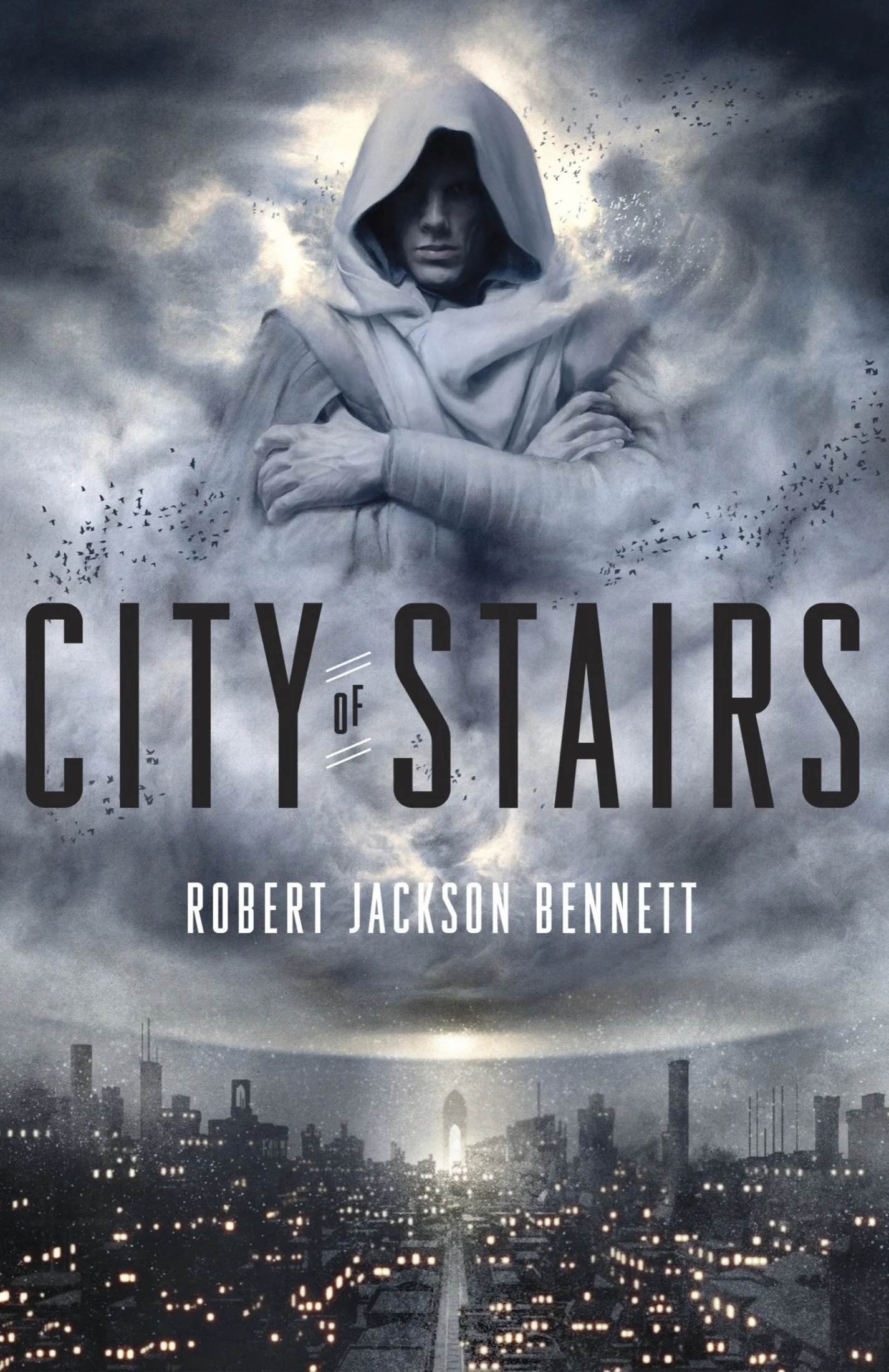
Someone Even Worse
Governor Turyin Mulaghesh presides over a trial in Bulikov, the former capital of the Continent, where Saypuri authorities enforce the Worldly Regulations prohibiting public acknowledgment of the dead Divinities. Vasily Yaroslav, a hat seller, insists that the symbol on his sign only coincidentally resembles the fertility sigil of Ahanas. Prosecutor Jindash argues that the resemblance and a reported twenty-three percent increase in sales establish intent, seeking a fine of fifteen thousand drekels. Yaroslav protests that the regulations deny Continentals their history and religion while allowing Saypuri scholar Dr. Efrem Pangyui to study texts that local citizens cannot legally read. Mulaghesh recognizes the injustice and the city's resentment, although she is responsible for administering the law. Before she rules, embassy assistant Pitry Suturashni delivers news that Pangyui has been found murdered in his university office. Mulaghesh abruptly dismisses Yaroslav's case. The crowd responds with both celebration and fear that Saypur will punish Bulikov or send a more severe official.
Later, Pitry waits at Morov Station for a special train bearing Cultural Ambassador Thivani. The surviving city walls appear partly transparent from a distance, an unsettling reminder that some ancient miracles continue despite the gods' reported deaths. Pitry reflects on Bulikov's deliberately erased religious imagery, the failures of the Worldly Regulations to make citizens forget, and the embassy's alarm at the murder. The coded telegram identifying Thivani as a cultural ambassador seems inconsistent with the urgency of the appointment, leading Pitry to imagine an intimidating secret agent.
A huge, scarred, one-eyed Dreyling named Sigrud exits the train first, and Pitry assumes he is the ambassador. The actual ambassador is the small Saypuri woman Ashara Thivani, who identifies Sigrud as her secretary. Sigrud silently takes a paper from the station porter's clipboard and burns it. Shara asks whether Chief Diplomat Troonyi knows of her arrival and whether the embassy has Pangyui's body, then directs Pitry to take them to the embassy. Pitry cannot reconcile her unassuming appearance with the expectation of a powerful response to the murder.
Key Events
- Yaroslav is tried for displaying a sign resembling Ahanas's sigil despite claiming the resemblance was accidental.
- Pangyui's murder interrupts the trial, and Mulaghesh dismisses Yaroslav's case amid political unrest.
- Pitry waits at Morov Station for the urgently dispatched Cultural Ambassador Thivani.
- Sigrud arrives with Shara, whose appearance and nominal rank contradict the embassy's expectations.
- Shara immediately inquires about Pangyui's body and embassy notification.
Characters Appearing
- Turyin Mulaghesh
- Vasily Yaroslav
- Prosecutor Jindash
- Chief Diplomat Troonyi
- Dr. Efrem Pangyui
- Pitry Suturashni
- Ashara Thivani
- Sigrud
- Nidayin
Themes
- Colonial administration and censorship
- Religious memory and political resistance
- Diplomatic secrecy and public unrest
We Must Civilize Them
On the drive through Bulikov, Shara studies the stairs, incomplete buildings, and surviving miracles left by the Blink, the catastrophic transformation after the Divinities' defeat. She also reflects on her personal admiration for the murdered historian Efrem Pangyui. At the embassy, Chief Diplomat Troonyi treats her nominal cultural-ambassador rank as inconsequential and displays The Night of the Red Sands, a patriotic painting celebrating the Saypuri defeat of a Divinity. Shara challenges the insult this image presents to Continental visitors. She reveals Ministry of Foreign Affairs authority above Troonyi's and orders Sigrud to destroy the painting while arranging Troonyi's removal.
Afterward, Shara tells Sigrud that Thivani is an identity borrowed from a deceased cultural ambassador. Her real family identity would be dangerous to reveal. Sigrud points out the resemblance between Shara and the Kaj, the Saypuri general associated with the gods' defeat. In the embassy vault, Shara examines Pangyui's badly beaten body. Sigrud identifies marks consistent with a toothed implement, possibly a wrench, and thinks the earliest blow struck his face. Pangyui's clothing has been systematically slit open as though searched for concealed papers. Shara notices that he wears an unusually fine necktie rather than his customary scarf; carefully opening its stitching, she discovers a strip of cloth carrying a charcoal-coded message. She had trained Pangyui in basic security measures before his Continental mission, but this concealment suggests activity she had not known about.
Using a surviving Divine communication miracle on an office window, Shara contacts her aunt and superior, Foreign Minister Vinya Komayd. Vinya recognizes her unauthorized assumption of the Thivani identity and objects to assigning someone so personally attached to Pangyui, even though Shara has submitted the necessary notification. Shara withholds the coded message and suspects Vinya either does not know of Pangyui's concealed activities or is refusing to acknowledge them. Vinya grants one week to establish a significant threat to Saypur before replacing her. When Shara asks again for a transfer home after sixteen years abroad, Vinya explains that Shara's knowledge of surviving Divine artifacts and creatures makes her return politically dangerous. She also alludes to Shara's direct descent from the Kaj.
Key Events
- Shara removes Troonyi from the embassy's leadership and orders his triumphalist painting destroyed.
- Sigrud's remarks establish that Shara is traveling under an assumed name and resembles her ancestor, the Kaj.
- Shara finds a coded cloth concealed in Pangyui's tie after noting evidence that his body was searched.
- A Divine window miracle allows Shara to communicate privately with Foreign Minister Vinya Komayd.
- Vinya gives Shara one week to justify the investigation and refuses to promise her a transfer home.
Characters Appearing
- Ashara Thivani
- Sigrud
- Chief Diplomat Troonyi
- Vinya Komayd
- Pitry Suturashni
Themes
- Imperial propaganda and historical interpretation
- Covert investigation and divided loyalties
- Surviving miracles and the cost of official secrecy
Unmentionables
Shara visits Bulikov University with embassy employees Pitry and Nidayin and her bodyguard Sigrud. The university was reconstructed only twenty years earlier to resemble a prewar institution organized around the six Divinities, yet laws governing Divine history prevent much of that history from being taught. Shara uses a forged telegram purportedly from Governor Mulaghesh to authorize a preliminary investigation. She sends the two embassy employees to identify university witnesses while she and Sigrud examine Pangyui's devastated office. The paper has been ripped apart, the bloodstain suggests where the professor fell, and a sophisticated safe stands open without signs of forced entry. Shara finds a coded Ministry access request needing Mulaghesh's signature and nineteen expired visitor permits. Sigrud detects two unskilled people watching them from outside the building.
Shara visits Mulaghesh's fortified quarters and reveals that her actual identity is Shara Komayd, not merely a junior diplomat. The governor, a disillusioned veteran, agrees to assist the inquiry in return for Shara's help obtaining a transfer to the remote island of Javrat rather than a promotion. Mulaghesh describes a conflict between the New Bulikov modernization movement and the Restorationists, conservative activists who used Pangyui's study of forbidden history as a political grievance. She has no reliable evidence identifying his killer. When Shara shows the visitor permits, Mulaghesh admits that Pangyui had access to the supposedly mythical Unmentionable Warehouses, a secret complex outside Bulikov holding thousands of preserved Divine objects and historical texts. The ministerial rules required such artifacts to remain on the Continent but restricted their use. Mulaghesh believes the professor primarily studied books and seemingly inactive objects, some of which he took from storage. She denies Shara access because she lacks clearance and considers the Restorationists the more plausible immediate lead.
Mulaghesh identifies Vohannes Votrov, a wealthy City Father supporting New Bulikov, as a possible political contact at an upcoming reception. Shara reacts with distress because she knew Vohannes intimately in her student years. Meanwhile Sigrud follows the two watchers from the university. He records the woman's residence, then pursues the man across Bulikov's damaged stairways. The man jumps from a high rooftop but vanishes rather than striking the street. Sigrud briefly glimpses a transformed version of the neighborhood with intact white-and-gold towers, suggesting a continuing Divine disturbance rather than an ordinary escape.
Key Events
- Shara finds Pangyui's office extensively searched, an opened safe, nineteen restricted-access visitor passes, and a coded Ministry request.
- Mulaghesh confirms the existence of the Unmentionable Warehouses and Pangyui's authorized visits, but denies Shara permission to enter.
- Shara and Mulaghesh discuss the Restorationists, New Bulikov, and a potential meeting with City Father Vohannes Votrov.
- Shara recognizes Vohannes's name from a painful personal history.
- Sigrud follows the watchers, establishes the woman's address, and witnesses the man's apparently impossible disappearance.
Characters Appearing
- Ashara Thivani
- Sigrud
- Turyin Mulaghesh
- Pitry Suturashni
- Nidayin
- Vohannes Votrov
Themes
- Suppressed history and controlled knowledge
- Political factions and colonial governance
- Surviving Divine phenomena and investigative uncertainty
Dead Languages
Shara spends the night deciphering the coded strip hidden in Efrem Pangyui's tie. It combines letters drawn from old Gheshati and Chotokan writing systems, with additional difficulties in its vowels and numbers. She eventually identifies an address and banking instructions: 3411 High Street, Saint Mornvieva Bank, safety deposit box 0813, under the name Ghiveny Taorskan and a six-digit identifier. Retrieving the contents without exposing the secret investigation is a separate problem. Sigrud reports that one of the people surveilling Pangyui's office is Irina Torskeny, a university maid assigned to clean Pangyui's rooms. He recounts the other man's impossible rooftop escape and briefly seeing buildings from a version of Bulikov that no longer exists. Shara considers known invisibility miracles, including Parnesi's Cupboard, but none adequately explains a man surviving the fall. She asks Sigrud to recruit discreet help, investigates a finance contact at the Ministry, and plans to attend Vohannes Votrov's reception.
Shara's concentration is repeatedly interrupted by memories of meeting Vohannes at Fadhuri Academy in Saypur, where both were unusually talented students. At sixteen, she defeated all her opponents in the traditional Batlan tournament and met Vohannes, a wealthy Continental student expert in the related game Tovos Va, in the final. Their four-hour contest mixed both games. Shara won after he became distracted by her rather than the board. His provocative remarks continued when they encountered each other in the library. As their daily arguments developed into a sexual and romantic relationship, they found rare intellectual companionship, despite fundamentally different attitudes toward national power and individual freedom.
A later memory complicates Shara's feelings about their relationship. When Vohannes casually called her his and suggested she belonged to him, she explained how the language of possession resonated differently in Saypur, where ancestors had lived under Continental slavery. He responded that Saypuri authorities now denied Continentals access to their own history. Both realized that their personal intimacy did not eliminate the injuries and political assumptions separating their nations. Shara remains unsettled by the prospect of facing him again.
Key Events
- Shara translates Pangyui's coded cloth into a bank address, a safety deposit box number, and an account identity.
- Sigrud identifies Irina Torskeny as a surveilling university maid and describes the unexplained disappearance of the other watcher.
- Shara reviews possible hiding miracles but finds no adequate account of the rooftop escape.
- Flashbacks establish Shara and Vohannes's school rivalry, long intellectual intimacy, and romantic relationship.
- A remembered argument about being owned exposes how the histories of slavery and cultural repression divided the pair.
Characters Appearing
- Ashara Thivani
- Sigrud
- Vohannes Votrov
- Irina Torskeny
Themes
- Translation and recovered historical knowledge
- Intimacy across unequal national histories
- Covert surveillance and surviving miracles
To Do What He Does Best
Shara attends an art auction and political fundraiser at the Votrov estate, hoping to question Vohannes about the Restorationists. Governor Mulaghesh introduces her to the controversial modern art, and Ivanya Restroyka, a young assistant curator, enthusiastically brings her among the guests. Vohannes, visibly troubled by a hip injury and carrying a cane, recognizes Shara immediately. In a private meeting they confront the discomfort of their reunion and their different lives. Vohannes recognizes her false diplomatic identity and knows she works for Saypuri intelligence. He explains that Ernst Wiclov, a rival City Father and prominent Restorationist, was among Pangyui's most vocal opponents. Vohannes also discloses a plan to develop the Continent's saltpeter resources into weapons manufacturing for Saypur. Shara warns that such collaboration would expose him to political assassination. She is hurt when he says Ivanya is his fiancée, though he urges her to use his influence to improve conditions in Bulikov.
Armed intruders wearing gray ceremonial clothing and masks attack the mansion. An assailant later identified in the narrative as Cheyschek believes he is executing a holy mission against sinners and foreign collaborators; the group has orders not to harm Mulaghesh and searches specifically for Vohannes, who is upstairs with Shara. Guards and guests are killed or held hostage. Sigrud detects the assault almost immediately, moves through the manor, and kills several attackers with startling brutality, including one whose bolt he catches before throwing him through a window. Shara tries to persuade the two attackers who find her and Vohannes to surrender rather than wait for Sigrud's arrival, but they refuse. In the ballroom, Sigrud kills most of those remaining; Shara persuades him to leave a single wounded intruder alive for interrogation. Downstairs Mulaghesh has already subdued an attacker while protecting the hostages.
Sigrud pursues two assailants fleeing by automobile. He clings to their vehicle, but the driver deliberately scrapes past a building, forcing him to jump clear and killing the other fugitive who had been dragged partly through a window. Sigrud follows the car into a blind alley, only to find the vehicle abandoned with no possible conventional exit. The driver's disappearance resembles the unexplained vanishing of the university watcher. During the party Sigrud also privately remembers a whaling ship, an old locket, and an indistinct personal loss whose details he cannot recover.
Key Events
- Shara reunites with Vohannes, who identifies Wiclov as a Restorationist opponent and reveals his proposed saltpeter-based arms business.
- Vohannes's fiancée Ivanya and his political ambitions complicate Shara's response to their reunion.
- Masked assailants raid the mansion in search of Vohannes, killing guards and taking guests hostage.
- Sigrud and Mulaghesh defeat the intruders, with Shara insisting that at least one survivor be retained for questioning.
- The escaping driver disappears from an enclosed alley, repeating an apparent impossibility from Sigrud's earlier surveillance.
Characters Appearing
- Ashara Thivani
- Sigrud
- Turyin Mulaghesh
- Vohannes Votrov
- Ivanya Restroyka
- Ernst Wiclov
- Cheyschek
Themes
- Political modernization and religious militancy
- Personal loyalties under diplomatic pressure
- Violence, accountability, and unexplained escape routes
A Memory Engraved
After the Votrov attack, Shara and Mulaghesh wait in the Bulikov Police Department while officers struggle to handle the rescued guests, attackers, and Sigrud's lethal intervention. Shara tries to distinguish the murder of Pangyui from the assault on Vohannes: the attackers may have targeted the industrialist, and their tactics differ from those used against the professor. Captain Nesrhev reluctantly allows Shara limited access to a surviving young captive. The boy says his group is the Silenced, people supposedly denied their past, identity, and country. Shara tests his beliefs, suggests that the Restorationist leader Ernst Wiclov may have financed the weapons, and lies that another captured attacker has disclosed how the group's members disappear into impossible passages. The boy is visibly disturbed but refuses to identify his accomplices.
Running out of time, Shara has Pitry obtain a philosopher's stone, a powerful hallucinogenic historically used in Divine rituals, and secretly doses the prisoner's drinking water. Mulaghesh condemns the deception as torture; Shara argues that it may prevent further deaths. Under the drug's influence, the prisoner says his group came to the Votrov house to acquire metal, that they despise Vohannes but need him, and that they did not expect Shara to be present. He describes an older version of Bulikov still reachable through incomplete portions of the present city. When Shara presses him about Pangyui, he becomes terrified, claiming someone is trapped inside his head and pleading for light.
Shara opens the cell's viewing slot. In her perception the room becomes a passage into strange landscapes containing a stone beneath a tree, an alien mountain, a night scene with starlings, and immense hollow statues. An unseen powerful being demands to know how she entered and repeatedly insists on being released. Shara then perceives the prisoner burning; to the observers outside, the boy and Shara have been standing motionless until he suddenly bursts into flame. Mulaghesh rescues Shara, but the prisoner dies. When they leave the police station under guard, Shara privately explains that the event resembles Divine possession. Lesser beings could possess people, whereas the immense power of a principal Divinity would destroy the mortal host. She concludes that at least one major god survived the Kaj's purge, though its identity and means of confinement remain unknown.
Key Events
- Shara questions a surviving masked attacker who identifies his group as the Silenced and refuses ordinary interrogation.
- After secretly administering a hallucinogen, Shara learns that the assailants sought metal from Vohannes and did not expect her.
- The captive describes an older, partly accessible Bulikov and appears to become the channel for a powerful imprisoned presence.
- A terrifying shared encounter ends when the captive spontaneously combusts while Shara survives.
- Shara tells Mulaghesh that the combustion is consistent with possession by a surviving principal Divinity.
Characters Appearing
- Ashara Thivani
- Sigrud
- Turyin Mulaghesh
- Pitry Suturashni
- Captain Nesrhev
Themes
- Fanaticism and political violence
- Ethical limits of intelligence gathering
- Survival of Divine power and uncertainty about its source
Dangerously Honest
After the police-station fire, Shara studies the previous night's massacre and fears the imprisoned being she encountered may have connections to artifacts in the Unmentionable Warehouse. Newspapers print competing political statements: Vohannes Votrov points to inflammatory anti-modernization rhetoric, while Restorationist City Father Ernst Wiclov condemns the use of deaths for political advantage. Vohannes visits the embassy, and Shara tells him that the armed faction intended to seize him and needed metal from his businesses. He mentions his fledgling steelworks, one of the few places on the Continent able to manufacture steel, but cannot explain the captive's reference to vessels that fly. Shara warns him to withdraw temporarily from public campaigning, assigns him Saypuri protection, and asks him to obtain a safety deposit box that belonged to Pangyui. She has confirmed that Vohannes owns Saint Mornvieva Bank through a complex business structure, a fact he does not immediately recognize. He reluctantly takes the information, then asks Shara to support greater Saypuri economic investment in Bulikov. She refuses to intervene in local politics or endorse his industrial program. Vohannes accuses her of protecting the existing order while his city remains impoverished.
Shara contacts Foreign Minister Vinya Komayd using a Divine window miracle. Vinya confirms that she authorized Pangyui's visits to the Unmentionable Warehouse and concealed their purpose beneath an official cultural mission. Pangyui had developed a theory that the worlds established by the six Divinities depended not only on the gods' power but possibly on the participation of their mortal followers. Historical accounts suggest that each god made the nature and history of the world within its own territory conform to its mythology; after the gods died, contradictory realities broke apart and left transient anomalies. Vinya says she wanted to learn how Divinities originated and how the Kaj killed them, in order to prevent anyone else acquiring comparable power. She denies wishing to create such a being herself, though her strategic interest in the research alarms Shara.
Shara suspects Vinya is withholding information about Pangyui and decides not to disclose her contact with a surviving Divinity. Vinya reveals that she has noticed Shara's selective financial background check and knows that the bank is close to Bulikov University. She infers that Pangyui used a safety deposit box as a dead drop, likely following techniques Shara taught him. Vinya firmly insists that Pangyui's research belongs to her operation and must reach her unread. She threatens to remove Shara if the subordinate intelligence officer exceeds her authority. Shara formally promises to pass on anything she discovers, without confirming that she already knows the box's location. Vinya suggests she will send agents to retrieve Pangyui's work, leaving Shara with even less time and little trust in her aunt.
Key Events
- Shara learns Vohannes operates an expensive experimental steelworks and warns that the attackers wanted his metal, not primarily the visiting agent.
- Shara asks Vohannes to obtain Pangyui's deposit box from a bank he owns, offering security and a quicker end to his public restrictions.
- Vohannes presses for political and economic assistance for New Bulikov; Shara refuses to give official Saypuri support.
- Vinya confirms she commissioned Pangyui's Warehouse research to understand Divine realities and prevent a new threat of godlike power.
- Vinya deduces Shara located a possible Pangyui dead drop and demands that any findings be delivered to her before Shara reads them.
Characters Appearing
- Ashara Thivani
- Sigrud
- Vohannes Votrov
- Vinya Komayd
- Turyin Mulaghesh
Themes
- Control of historical knowledge and reality
- National security and imperial economic policy
- Professional duty and compromised family trust
Chapter 8
Shara waits for Sigrud to bring in Irina Torskeny, the university maid who had watched Pangyui's office. During a walk near the embassy, Shara encounters a barefoot, orange-robed worker at a warming shelter. He appears to belong to the Dispersed, a humanitarian movement preserving aspects of the tradition of Olvos, a Divinity who abandoned the Continent centuries before the Great War. The worker denies having a religious identity and explains that people can choose to relieve suffering without any Divine command. Shara gives a small donation and reflects on the contrast between these surviving benevolent customs and the violent religious faction she is investigating.
Sigrud brings Irina to the embassy. The terrified maid expects to be killed, but Shara arranges coffee and draws out her story without overt threats. Irina says three unknown men, including a tall, thin, conspicuously pale man, recruited her after she attended anti-Saypuri meetings. They ordered her to spy on Pangyui and copy whatever records appeared important. Irina cannot read and was ashamed to tell her handlers, but she could reproduce written pages by copying their shapes. Over weeks she copied dozens and perhaps more than a hundred pages from a large tabular list used by Pangyui. The men were disappointed until the tall one recognized something on a page in the month of Tuva; afterward they ordered her to stop. Irina recalls a distinctive bird crest on the document. Shara recognizes the insignia of Mulaghesh's office and realizes the maid copied parts of the Unmentionable Warehouse inventory. The Restorationists have had information about the Warehouse's contents for months, though their objective remains unknown. Irina regrets what she did and believes her spying contributed to Pangyui's death, but Shara distinguishes that fear from proof that she directly caused his murder.
A commotion arises outside the embassy. Ernst Wiclov arrives with lawyers and publicly demands Irina's release, accusing the Saypuri officials of illegally abducting a Continental woman. Although the embassy is considered Saypuri territory and Shara has been interviewing Irina, the confrontation threatens to turn into a political incident. Shara advises Irina to stay, warning that those who recruited her are dangerous and that her residence may be watched. Irina, reassured by Wiclov's official standing and inflamed by his claims of racial solidarity, chooses to leave with him. Mulaghesh reluctantly opens the gates. Shara loses a valuable witness and suspects that the opposing faction has become aware of her investigation.
Key Events
- Shara meets a worker associated with the Dispersed, who maintains a charitable tradition attributed to Olvos while rejecting religious labels.
- Irina Torskeny admits that three men recruited her to copy portions of Pangyui's papers despite her inability to read.
- Irina identifies a bird crest indicating she copied pages from the restricted Warehouse inventory; the men ceased requesting pages after finding an entry of interest.
- Ernst Wiclov and lawyers demand Irina's release, accusing the embassy of unlawful detention.
- Despite Shara's warning, Irina leaves the embassy with Wiclov, and the investigators lose immediate access to her.
Characters Appearing
- Ashara Thivani
- Sigrud
- Irina Torskeny
- Ernst Wiclov
- Turyin Mulaghesh
- Pitry Suturashni
Themes
- Compassion and independent moral judgment
- Exploitation of marginalized informants
- Politics, historical repression, and custody of evidence
What History Tells Us
Following Irina's departure with Wiclov, Shara orders Sigrud's hired observers to follow both of them. Furious and unable to resolve the investigation immediately, she prepares a large meal in the embassy kitchen, a habit Sigrud recognizes as her reaction to anger. As she cooks, she explains the competing histories of the six original Divinities to Mulaghesh, Pitry, and Sigrud. The gods once maintained separate territories and conflicting systems of reality before uniting and expanding to subjugate much of the world, including Saypur. Shara notes that historical records explicitly describe the Kaj killing Voortya, Taalhavras, Ahanas, and finally Jukov. Olvos withdrew from the Continent in 775 and has no confirmed recorded death. Kolkan, the Divinity of judgment, disappeared in 1442, long before the Kaj's invasion.
Shara recounts Kolkan's rise from a tireless divine judge to the author of twelve hundred increasingly intrusive laws and brutal punishments. His followers accepted restrictions on pleasure, sexuality, and especially women's bodies. When Kolkan's severity spread to the other Divinities' territories, those gods reportedly intervened, after which Kolkan disappeared. Unlike the death of a Divinity, his vanishing did not destroy his creations. Instead, the mutilated were healed and the victims' memories and much local historical documentation concerning the punishments were erased. Shara infers that another Divine power rewrote reality and records to conceal what had happened. Many of Kolkan's followers continued to observe his laws even in his absence. Nevertheless, Shara does not assume that the being she encountered through the jailed attacker's possession was Kolkan: its fragmented perceptions and multitude of apparent voices did not match accounts of his personality.
After the meal Shara asks Mulaghesh to examine the Warehouse inventory. The governor confirms that the facility has external guards but no internal patrols and that a second copy of the list exists. Shara proposes identifying the pages Pangyui removed during the month of Tuva, when Irina says the faction found something useful, to reduce thousands of possible artifacts to a few hundred entries. Sigrud reports that his contractors have Irina under observation. Shara privately watches the coffin of Efrem Pangyui prepared for transport to Saypur. She recalls the professor speaking admiringly of her deceased parents' humanitarian efforts during the Plague Years, but cautioning that a historian's duty is to truth rather than patriotic purpose. She cannot fully claim to follow that ideal while working as an intelligence operative.
Key Events
- Shara sets surveillance on Irina and Wiclov, then tells her team the history of six Divine domains and the Kaj's four documented killings.
- Shara explains Kolkan's twelve hundred laws, corporal punishments, disappearance in 1442, and apparent erasure of memories and records.
- She refuses to identify the possessing being as Kolkan merely because the attackers observed Kolkashtani practices.
- The team proposes checking the Warehouse inventory pages examined during Tuva to isolate the Restorationists' possible target.
- Shara sees Pangyui's remains prepared for shipment and remembers his distinction between historical truth and political agendas.
Characters Appearing
- Ashara Thivani
- Sigrud
- Turyin Mulaghesh
- Pitry Suturashni
- Dr. Efrem Pangyui
Themes
- Historical erasure and religious authoritarianism
- Evidence, uncertainty, and investigative inference
- Truth telling versus intelligence obligations
Chapter 10
Vohannes summons Shara to the exclusive Ghoshtok-Solda Dinner Club, where a hostile, male-dominated gathering of Bulikov's business and political figures conducts much of its commerce. He has obtained Pangyui's safety deposit box material and brought it in one suitcase. A second suitcase contains financial papers obtained from a source close to Restorationist City Father Ernst Wiclov. Vohannes proposes that Shara use them against Wiclov, whom he suspects of involvement in the recent attacks. She examines his account of three recently purchased loomworks, an unusual investment that may have occurred after the month when Irina Torskeny copied the Warehouse inventory. Shara warns Vohannes that accepting the evidence may eventually expose him publicly as a collaborator with Saypuri intelligence. Knowing the risks, he insists that she use it.
Their conversation turns personal. Vohannes proposes that Shara leave the Ministry and work for him, perhaps even live with him. She refuses and reminds him that he is engaged. He explains that his family was deeply Kolkashtani and that his violent father enforced painful punishments; his older brother Volka left as a teenager on a religious pilgrimage and was later reported dead. Vohannes's hatred of Wiclov is not solely political. Shara again asks whether he wants to improve Bulikov or to punish its conservative population. Though tempted to inspect Pangyui's materials, she recalls her promise to Vinya to deliver the contents unread. She takes both suitcases without opening the one holding the dead drop.
Outside the club, Ivanya Restroyka confronts Shara and recognizes that her meeting with Vohannes was more intimate than a simple business arrangement. Ivanya explains that Vohannes's persistent hip injury resulted from a brutal police raid on a club where men met other men. Wiclov ordered the raid; Vohannes nearly died. His subsequent political involvement seeks to change a city whose laws persecute people like him. Ivanya says she loves him and asks Shara not to harm him. Shara remembers discovering Vohannes in bed with another male student at Fadhuri Academy after already suspecting he was involved with men. Feeling betrayed, she refused his pleas for a confrontation and withdrew from the relationship. When he asked her to return with him after graduation, she deliberately said something cruel about his forbidden desires. This memory explains the unresolved hostility of their reunion and the personal consequences of Bulikov's sexual restrictions.
Key Events
- Vohannes delivers Pangyui's deposit-box contents and a separate collection of Ernst Wiclov's financial records.
- Shara learns that Wiclov bought three loomworks and warns Vohannes that handing over evidence may expose him as an intelligence source.
- Vohannes asks Shara to leave government service and live with him; she declines and accepts Pangyui's materials unopened.
- Ivanya reveals that Vohannes's hip injury came from a police raid on a club for men seeking men, ordered by Wiclov.
- Shara recalls discovering Vohannes's infidelity at Fadhuri, ending their romance, and rejecting his later offer to return with him to Bulikov.
Characters Appearing
- Ashara Thivani
- Vohannes Votrov
- Ivanya Restroyka
- Ernst Wiclov
- Volka Votrov
Themes
- Political informants and personal risk
- Sexual repression and consequences of betrayal
- Conflicting obligations of love and intelligence work
Survivors
Nearly a week after Shara's arrival, Governor Mulaghesh struggles with the possibility that a Divinity survived the War. Her staff finally retrieves the twenty pages of the Unmentionable Warehouse inventory Pangyui consulted during the month when Irina's handlers found something important. These pages list nearly two hundred ancient objects, including still-active miracles. Meanwhile Shara has spent several nights testing the alleys where Sigrud's pursued suspects disappeared. Her detection rituals reveal ordinary surviving miracles on Bulikov's walls but nothing Divine at the apparent escape sites. During one trial she rolls a silver coin along an alley; after leaving it and collecting it later, she discovers the coin has transmuted into lead, an effect associated with distortions from the Blink rather than a detectable active miracle.
Shara recalls an early encounter with her aunt after passing six days of psychological endurance testing before joining the Ministry. Vinya congratulated her determination, which Shara attributed to remembering her parents' deaths and Saypur's enslavement. Vinya then confronted her with the fallout from exposing corruption in the National Party leadership, explaining that a powerful government's intelligence service must exploit corruption when doing so benefits the nation, not seek general justice. She promised that Shara's overseas assignment would last only a few months. Sixteen years later, Shara questions whether political fear, knowledge of forbidden history, or bureaucratic self-interest accounts for her continued absence from home.
Pitry brings news that Wiclov and another man have removed Irina from her home. Embassy researchers have uncovered that Wiclov acquired three loomworks and purchased steel from Vidashi Incorporated in recurring lots of roughly 1,500 to 1,900 pounds. The purchases fall below the Ministry's automatic review threshold of 2,000 pounds. Shara suspects the Restorationists need more steel than they can procure discreetly, explaining their desperate attempt to seize Vohannes. Sigrud follows the men to a municipal building beside the ruined bell tower of the Seat of the World, an ancient meeting place of the gods. Wiclov and his companion later vanish by another anomalous route, while Irina remains unaccounted for.
Inside the otherwise empty building, Shara and Sigrud find an intensely lit chamber surrounded by a circle of salt. A small girl in a white dress appears to be hurt within it, and nearby lies a pile of women's clothes resembling Irina's. Shara suspects a trap and insists that the apparent girl show her feet; she refuses. Her form collapses to reveal a mhovost, a predatory, many-jointed Divine creature created by Jukov and capable of disguising itself as an appealing victim. Shara concludes that the creature consumed Irina, although its gestures do not establish exactly how she died. It appears to have been contained in a salt ring as a living obstacle guarding a concealed door. The mhovost responds evasively about Jukov's fate, hints that someone other than Wiclov imprisoned it, and performs gestures imitating a vain or feminine accomplice. Seeing that the candelabras contain candles bearing Olvos's symbol and that the creature's dry body is vulnerable to flame, Shara throws a candle at it. It burns away, allowing them to approach the concealed passage.
Key Events
- Mulaghesh obtains the twenty inventory pages reviewed by Pangyui in the relevant month.
- A silver coin left near a suspect's disappearance site changes into lead, supporting the possibility of residual Blink damage.
- Financial records show Wiclov purchased steel in lots beneath the Ministry's 2,000-pound reporting threshold.
- Shara and Sigrud trace Wiclov's movements to a municipal building near the ancient bell tower and find Irina's clothing beside a sealed salt ring.
- Shara identifies and burns a mhovost imitating a distressed child, revealing that a hidden passage was guarded by a surviving Divine creature.
Characters Appearing
- Ashara Thivani
- Sigrud
- Turyin Mulaghesh
- Pitry Suturashni
- Irina Torskeny
- Ernst Wiclov
- Rajandra Adesh
Themes
- Historical trauma and intelligence ethics
- Residual Divine distortions versus active miracles
- Religious deception and predatory violence
Re-creations
After destroying the mhovost, Shara discovers that the wall behind its salt ring conceals a plaster door. Sigrud kicks it through, exposing a long earthen staircase leading under Bulikov's old bell tower. Its walls show evidence of being burned out rather than excavated conventionally. The passage opens into an enormous subterranean temple divided into six decorated atria. Shara identifies it as the actual Seat of the World, the historic meeting place of the Divinities, which did not shrink as later histories claimed but sank beneath the earth during the Blink. Its central stairway formerly had six supporting columns; one has vanished. The atrium devoted to Kolkan has been stripped of its original imagery, consistent with the apparent erasure of that god from history, but someone has recently begun restoring depictions of his judgments with newly carved dark stones. A peculiar wheeled stone door frame stands inside the reconstructed area.
Shara calls Mulaghesh, who arrives with soldiers. Despite Shara's excitement over evidence that could revise Continental history, Mulaghesh argues that a public archaeological operation would reignite the political unrest surrounding Saypur's control of forbidden history. She plans to collapse the clandestine tunnel and conceal the discovery. Shara reluctantly agrees. While leaving, however, Mulaghesh hands Shara copies of the twenty relevant Warehouse inventory pages. Shara notices an entry for the Ear of Jukov, a wheeled stone door frame that supposedly once connected to an identical frame elsewhere. She recognizes its description as the apparatus in the temple. Testing a risky Jukov-associated rite, she cuts her palm, drinks strong liquor, and spits blood and alcohol toward the frame. The dark opening changes to display shelves in the Unmentionable Warehouse. A tossed clod of earth passes through, confirming that the two door frames still function as a portal.
Shara, Mulaghesh, and Sigrud enter the Warehouse through the portal, finding hundreds of shelves with mysterious and sometimes active objects. Many artifacts appear to influence observers' perceptions. A small black orb induces Sigrud to speak about his past and deny being a king until Shara interrupts. The investigators find repeated footprints and search the lower shelves, particularly sections associated with the inventory pages. Shara notices an empty shelf space and a concealed trip wire just as she activates an incendiary mine. Sigrud carries her out through the portal while the fire spreads through the dry collections, destroying centuries of records and Divine artifacts. Shara concludes that intruders stole something and left the trap to destroy evidence or pursuers, but the specific missing artifact remains unidentified. The group escapes back to the temple and orders the tunnel collapsed.
The chapter's final scene stays inside the burning Warehouse. Heat destroys the seals on a clay jug containing a captive being. The jug falls and shatters, releasing an enormous entity with one yellow eye, which celebrates its freedom. Neither the identity of the being nor its relationship to the stolen artifact is yet established.
Key Events
- Shara and Sigrud discover the intact, buried Seat of the World, including recent reconstruction of the erased Kolkan atrium.
- Mulaghesh decides to close the clandestine access tunnel to prevent a public crisis, despite Shara's wish to study the temple.
- The investigators identify the stone door frame as a functional Ear of Jukov, which opens directly into the Unmentionable Warehouse.
- Sigrud experiences an unsettling influence from a black orb inside the Warehouse, while Shara identifies a missing shelf item and triggers a planted incendiary mine.
- The team escapes as the Warehouse burns, and the fire releases an unidentified imprisoned entity from a clay vessel.
Characters Appearing
- Ashara Thivani
- Sigrud
- Turyin Mulaghesh
Themes
- Historical discovery and state secrecy
- Surviving magical technologies and their risks
- Evidence destruction and unintended release of imprisoned beings
You Will Know Pain
An enormous being released by the Warehouse fire escapes into the Solda River. It breaks through heavy ice, kills fishermen, and tears the riverside Vohskoveney Tea Shop apart, swallowing people who fall into the water. At the embassy, Shara and Sigrud recognize that a large creature attacking civilians almost certainly emerged from the destroyed Warehouse. They join Governor Mulaghesh and police Captain Nesrhev on the Solda Bridge, where the authorities report twenty-seven people missing or dead. Shara identifies the many-armed creature, distinguished by a single glowing yellow eye, as Urav, a punishing familiar of Kolkan. Historical sources suggest Jukov trapped Urav in a sealed jug after Kolkan's disappearance, and Shara realizes that the warehouse fire must have released it. Sigrud volunteers to kill Urav, drawing on his expertise as a former Dreyling whaler.
Sigrud prepares heavy towing and sailing ropes, fishing spears, a halberd, and animal fat. Shara adds various substances traditionally believed to repel Divine creatures, though she does not know whether any will work on Urav. Before entering the frozen river, Sigrud leaves his gold bracelet with Shara and asks her to inform his family about him if he dies, provided it is safe. His thoughts reveal that he was once a member of a royal Dreyling family and lost his home during the coup that destroyed the Harkvald dynasty. He believed his wife and children died in the conflagration and buried burned remains; later, after years of violence and confinement in Slondheim, Shara found him and revealed that his family was actually alive. He has remained apart from them while serving as her companion and operative.
Sigrud uses the ropes and spears to entangle Urav, deliberately breaking the river ice to surprise it beneath the surface. The animal fat and Shara's mixture burn the creature when its tentacles touch him, but the fight becomes difficult when Nesrhev's men attack from the bridge and Urav turns on them. Urav destroys much of the Solda Bridge, injuring officers and throwing Sigrud into the water. After the fat washes off, the monster catches and swallows him. Inside its body he enters an apparently supernatural realm of darkness, a yellow eye, and living victims who are imprisoned in suffering. Urav's voice declares that it will teach him pain and shame. Instead of submitting, Sigrud recalls the brand hidden under his glove: a scar from the Finger of Kolkan, which he survived during his earlier imprisonment. He recognizes that Urav cannot impose the suffering it promises because he has already endured the punishment of its creator. As the entity struggles to affect him, Sigrud stabs its eye.
Outside, Mulaghesh and Shara rescue the injured Nesrhev and witness Urav erupt from the river, convulsing and dragging itself onto the river walk. A knife cuts through the creature's abdomen from within, and Sigrud emerges alive. The public gathers, celebrates, and photographs the encounter. Shara spots Vohannes watching with an unexpectedly hostile expression and without his customary cane; he disappears before she can question him. The chapter closes with Urav dead, Sigrud alive, and the incident witnessed by many citizens, complicating the government's attempts to conceal Divine phenomena.
Key Events
- The Warehouse fire releases Urav, Kolkan's former punishing familiar, which attacks people and buildings along the Solda River.
- Shara identifies Urav and Sigrud proposes a dangerous whaling-based attack with ropes, spears, and a protective fat mixture.
- Sigrud recalls the Dreyling royal massacre, his imprisonment, Shara's discovery that his family survived, and his hidden scar from Kolkan's Finger.
- Urav swallows Sigrud after collapsing part of the Solda Bridge, but cannot inflict its supernatural punishment on him.
- Sigrud stabs Urav from within and emerges alive; the widely witnessed encounter draws public celebration while Vohannes observes coldly.
Characters Appearing
- Ashara Thivani
- Sigrud
- Turyin Mulaghesh
- Captain Nesrhev
- Urav
- Vod Drinsky
- Magya Vohskoveney
- Vohannes Votrov
Themes
- Survival of historical violence and trauma
- The ethics and visibility of destroying Divine creatures
- Violence, personal sacrifice, and the limits of punishment
Salvation
In the aftermath of Urav's death, Sigrud rests in the embassy. He shows Shara the scar of Kolkan's Finger on his palm and explains that jailers in Slondheim once offered starving prisoners food if someone could hold the small, impossibly heavy stone for a minute. Sigrud held it for three minutes because he hoped its pain would kill him. When told he had won, he chose to eat an entire chicken rather than share it; most of his former cellmates soon died. Shara recalls rescuing him from imprisonment years earlier and proving that his wife Hild and two daughters had survived the destruction of the Dreyling royal family. The woven gold bracelet his wife sent persuaded him she was alive. Shara promised to help him return home, and he agreed to serve her despite his despair.
Vohannes comes to the embassy proposing a major Saypuri reconstruction effort after the Solda Bridge collapse. He notes that the city's council refused to seek international assistance, even though Wiclov was absent from the vote. Shara and Mulaghesh initially resist his attempt to make use of a tragedy, but he explains that Bulikov endures repeated disasters and cannot afford adequate recovery. He also says the city's people now celebrate Shara and Sigrud as saviors despite the creature's former religious status. He cautions Shara that her descent from the Kaj must remain secret. Later, after drinking with Vohannes and Mulaghesh, Shara allows Vohannes into her bedroom. They attempt to resume their former intimacy, but he finds the encounter difficult, and they fall asleep together. Shara notices a possible discrepancy in his clothing from when she saw him near the river, although intoxication prevents her from pursuing it.
The next morning the Continental Herald publishes a photograph of Shara beside Urav's corpse and names her as Ashara Komayd, great-granddaughter of the Kaj. Her diplomatic cover and lineage are exposed throughout the Continent. She suspects Vohannes disclosed her identity to force Saypur's leadership to consider reconstruction and closer ties with Bulikov. Vinya contacts her and confirms that a shift in Saypuri politics is underway: ministers are reviewing Vohannes's many appeals for economic engagement. Furious about the Warehouse fire and Shara's role in the public scandal, Vinya refuses to accept her account of stolen Divine material and a possible surviving god. She formally strips Shara of intelligence access and promotes her to the highly visible position of chief diplomat, obliging her to manage Saypur's public relationship with Bulikov while forbidding continued covert work.
With her operational authority gone, Shara finally opens Pangyui's previously unread dead drop. His journal records extensive comparisons between mortal Continental attitudes and subsequent Divine decrees. He argues that ordinary people's collective preferences preceded the gods' decisions, including the union of the six Divinities and the violent expansion that enslaved Saypur. Their apparent divine will may have enacted the people's own desires rather than imposed those desires from above. Pangyui also found correspondence indicating that the Kaj's god-killing weapon used an exceptional hard metal called black lead, whose reality Divine beings could not alter. Contrary to patriotic legend, the Kaj developed the material by experimenting on and torturing his family's enslaved djinnifrit servant, whom he eventually killed. Pangyui grew concerned about surveillance, missing papers, intercepted communications, and the possibility that the Blessed or other hidden Divine lineages mattered to his findings. He ended his journal expecting to die in Bulikov. Shara is shaken because this account undermines both the Continental religious narrative and Saypur's heroic story of the Kaj.
Key Events
- Sigrud reveals how Slondheim jailers tortured him with Kolkan's Finger and why the scar allowed him to resist Urav.
- Shara remembers freeing Sigrud, proving his family survived the Dreyling coup, and promising eventually to help him return home.
- Vohannes urges Saypuri intervention in rebuilding Bulikov after the bridge collapse and spends the night with Shara.
- A Continental newspaper exposes Shara as a descendant of the Kaj, and Vinya removes her intelligence powers while making her chief diplomat.
- Pangyui's journal argues that mortal attitudes shaped Divine decisions and reveals that the Kaj created god-killing black lead through torture of a djinnifrit servant.
Characters Appearing
- Ashara Thivani
- Sigrud
- Turyin Mulaghesh
- Vohannes Votrov
- Vinya Komayd
- Dr. Efrem Pangyui
- Hild
Themes
- Political mythology and culpability
- Exposure of state secrets and institutional discipline
- Personal trauma, loyalty, and the cost of historical truth
The Divine City
Several weeks pass after Shara's formal appointment as chief diplomat. Saypuri engineers begin rebuilding the Solda Bridge, while Shara is confined to public meetings that provide her with no access to covert intelligence. She is still troubled by Pangyui's murder and the contradictions surrounding Vohannes. She secretly continues working with Sigrud, who has been watching the three loomworks owned by Wiclov. By testing old Continental coins in an alley where earlier suspects disappeared, Shara discovers that objects bearing symbols associated with Jukov, Kolkan, and Olvos are changed to lead while others remain silver. She infers that the anomaly admits people or objects recognized as belonging to certain Divine traditions. Sigrud then obtains the gray wraps worn by the attackers, finding small amulets bearing Kolkan's scale sewn into the garments. A thrown wrap vanishes across the invisible threshold. Sigrud also reports that a sickly, solemn figure resembling Vohannes has been secretly visiting Wiclov's factories, contradicting the industrialist's political position and deepening Shara's suspicions.
Wearing the wraps, Shara and Sigrud enter a disconnected remnant of prewar Bulikov in which white-and-gold towers, fountains, and original Divine architecture survive under a different sky. Miracles that do not work in modern Bulikov operate here, confirming that the area retains its own conditions of reality. Shara calls it Old Bulikov. Tracks lead from the former Votrov family estate, whose original mansion disappeared during the Blink, through empty streets to an ancient temple. Shara recognizes the temple from an eyewitness account of the Kaj's encounter with Jukov. She finds a small dark projectile lodged in one of its wooden columns and concludes that it is a surviving piece of black lead, the metal used to kill the Divinities. Although Pangyui's journal established the metal's existence, she has now recovered physical evidence.
Following the tracks, the pair use a second boundary between disconnected and modern reality, emerging in hills Shara believes lie near Jukoshtan. Hidden in a valley are six enormous steel vessels being fitted with cannons and structural elements resembling wings. Restorationist workers in Kolkashtani wraps are preparing the vessels despite being far from navigable water. Shara leaves Sigrud to observe and potentially infiltrate the site while she returns to alert Mulaghesh. She takes the black lead to a metalworker to have it fashioned into a versatile bolt tip or small blade, then uses telegrams to demand immediate mobilization of hundreds of troops. Mulaghesh protests the unauthorized order but agrees when Shara warns that the Restorationists have more than thirty heavy naval cannons. She recalls an entry from the Warehouse inventory describing a flying carpet whose individual threads could lift immense weight; three loomworks could have unraveled and incorporated those threads into sails. Shara thus realizes the vessels are intended to fly and bombard their targets from above.
While Shara is heading to meet Vohannes at the reconstruction site, a note appears from him using a Tovos Va reference that he supposedly learned in school. At the bridge she finds a man who looks almost like her former lover but whose eyes are noticeably different and who wears somber clothing without his usual cane. He acknowledges having worked on the operation. Shara attempts to escape, but an accomplice trips her, casts a concealment miracle equivalent to Parnesi's Cupboard over her, and other men drug and carry her away without bystanders realizing what is happening. The chapter ends with Shara abducted as the armed flying vessels near launch.
Key Events
- Shara uses old coins and amulets sewn into Kolkashtani robes to gain access to a surviving portion of Old Bulikov.
- Inside Old Bulikov, she finds the former Votrov estate and recovers a piece of the Kaj's black lead from the temple where Jukov was killed.
- Shara and Sigrud track Restorationists through another reality boundary to a rural worksite containing six steel warships with heavy cannons.
- Shara has the black lead adapted into a weapon and persuades Mulaghesh to mobilize troops; she infers stolen flying-carpet threads will lift the metal vessels.
- A man impersonating Vohannes lures Shara to the Solda Bridge construction site, where accomplices make her invisible and abduct her.
Characters Appearing
- Ashara Thivani
- Sigrud
- Turyin Mulaghesh
- Vohannes Votrov
- Ernst Wiclov
Themes
- Material proof against national myths
- Misuse of miracles and military escalation
- Identity deception and the persistence of historical violence
Family Ties
Shara wakes from the abduction in the same abandoned municipal building where she and Sigrud previously destroyed the mhovost. Her captor is Volka Votrov, the supposedly dead elder brother of Vohannes, whom he has brutally beaten and imprisoned beside her. Volka condemns Shara's Saypuri ancestry and rejects Vohannes for his sexuality and opposition to Kolkashtani doctrine. He explains that, as a teenager, he joined a pilgrimage to the remote monastery of Kovashta. All the other pilgrims died, but he survived and spent almost thirty years studying Kolkan's writings and rituals. When he neared starvation during an attempt to reach the lost Divinity, he heard Kolkan's voice and learned that part of old Bulikov had survived the Blink. He returned to liberate his god, restore Kolkan's authority, and remake the political order.
Shara recognizes Volka as the real organizer of the Restorationist operation. He has used miracles such as the Butterfly's Bell, an invisible barrier that can suffocate prisoners, and Ovski's Candlelight, which helps explain the strangely burned passage to the underground temple. Volka confirms he controlled Wiclov, used the mhovost as a guard, and imprisoned Wiclov as a test subject after his actions exposed the hidden Warehouse route. He also admits that he leaked Shara's Kaj ancestry to the newspapers; she had wrongly suspected Vohannes. Volka says his real military objective is not Bulikov but Saypur. Six steel aerial vessels, fitted with cannons and lifted using threads from Kolkan's flying carpet, are to destroy Saypuri shipyards and naval infrastructure before the country can defend itself. One section follows Captain Mivsk Ashkovsky aboard the airborne Mornvieva as his ship races toward Saypur. Sigrud has infiltrated the vessel, kills Mivsk, and begins turning its own cannon against the other ships.
Shara identifies the actual location of Kolkan's confinement: the sole intact, blank window in the buried Seat of the World, where the other Divinities apparently sealed him centuries earlier. Volka intends to raise the whole temple and release the god. He and his followers take Shara and Vohannes down a reconstructed tunnel into the Seat of the World, where approximately two dozen Restorationists await the ritual. Volka traps the prisoners behind another Butterfly's Bell and climbs the central bell tower. Shara tells Vohannes about her mistaken suspicion that he exposed her identity; he says he would never have done so. She considers invoking Jukov's concealment miracle, Parnesi's Cupboard, but her hands remain bound, and Vohannes struggles to undo the knots.
Volka rings the six Divine bells. Each is accompanied by impossible sensory impressions, and the world begins to shift: the sun moves rapidly across the sky while the buried Seat of the World rises from under Bulikov to become a massive white cathedral with an enormous bell tower. Mulaghesh sees the transformation from the embassy and urgently orders her soldiers to fortify the exposed building. The chapter ends with the ancient temple restored aboveground, Kolkan's release imminent, and the flying warships already in flight.
Key Events
- The captor is revealed as Volka Votrov, Vohannes's surviving older brother and organizer of the Kolkashtani faction.
- Volka reveals that he imprisoned and experimented on Wiclov, exposed Shara's Kaj lineage, and plans to release Kolkan from a window in the buried temple.
- Six flying steel ships bearing naval artillery travel toward Saypur to attack its military infrastructure; Sigrud infiltrates the Mornvieva and kills its captain.
- Shara and Vohannes are bound inside a Butterfly's Bell while Volka initiates the ritual to restore the Seat of the World.
- The Divine bells sound, the sun's motion changes, and the enormous original temple rises into modern Bulikov.
Characters Appearing
- Ashara Thivani
- Vohannes Votrov
- Volka Votrov
- Sigrud
- Turyin Mulaghesh
- Captain Mivsk Ashkovsky
Themes
- Family estrangement and religious extremism
- Restoration of suppressed Divine institutions
- National security, mass violence, and personal responsibility
What is Reaped
In the restored Seat of the World, Volka shatters the transparent window in Kolkan's atrium using a silver hammer and releases a towering figure in gray robes. The being initially appears to be Kolkan. Volka kneels with his followers and implores his god to restore the Continental empire, but Kolkan demands obscure rituals that no one performs and finds countless violations of his prohibitions among the worshippers. He turns the followers to stone and gruesomely punishes Volka by filling his abdomen with stones. Shara urges the bound Vohannes to kneel and imitate penitence while he loosens the ropes on her wrists. Kolkan then commands Vohannes to justify himself. Vohannes refuses to be ashamed for his sexual relationships or for loving Shara, denounces the religious doctrine that taught him self-hatred, and draws the god's fury. Kolkan tortures Vohannes, allowing Shara to finish freeing her hands and conceal herself using Parnesi's Cupboard. The god senses her hiding place but leaves to judge the entire city. Vohannes lies motionless after the punishment; Shara flees, unable to save him.
Kolkan announces that Bulikov's inhabitants are unworthy and begins remaking the city. Enormous structures from Old Bulikov reappear, while ordinary citizens are transformed into armored Divine soldiers who attack their neighbors. Shara reaches Mulaghesh's fortified embassy with a tiny blade fashioned from the Kaj's god-killing black lead. Their forces lack the heavy cannons necessary to fight the magical army, and Kolkan's influence disables electrical communication. Shara elects to swallow a dangerous quantity of philosopher's stones, hoping to amplify the Divine miracles she knows. After an overwhelming psychedelic reaction, she perceives the hidden mechanisms underlying Bulikov's altered reality and uses Ovski's Candlelight to dissolve the armor. The transformed people are released as starlings rather than killed. She also improvises changes to matter, including turning armor into spoons, and creates a freezing barrier that enables the soldiers' guns to destroy approaching attackers.
While Shara exerts this new power, the god repeatedly addresses her as Olvos, his supposedly absent sister-wife, and visions reveal that Kolkan was imprisoned and Jukov later hid in the same cell. Shara realizes there is more than one consciousness within the surviving figure. The god recognizes that she is not Olvos and overwhelms her improvised barriers. Before the embassy falls, a single steel aerial ship appears flying King Harkvald's Dreyling flag. Sigrud has seized the Mornvieva, fired its cannons at the other five Restorationist warships, killed or cast off the hostile crew, and turned back toward Bulikov. He bombards the Divine soldiers with heavy naval ammunition while Shara shields the Saypuri defenders from shrapnel. Sigrud then deliberately jumps from the ship before steering it into the god, creating a tremendous explosion and suffering a severe fall himself.
When the smoke clears, the wounded Divinity still stands, but Shara confronts it with black lead. She accuses the figure of being Jukov as well as Kolkan. It removes its robes, revealing that the two gods have become physically and psychologically fused after Jukov tried to evade the Kaj by sharing Kolkan's prison. Their contradictory identities have left them unable to understand or fulfill the demands of their followers. In grief and exhaustion, the merged Divinity asks Shara to kill it. She hesitates, then cuts its throat with the black-lead blade. The being vanishes instantly, and its recreated buildings collapse while vast flocks of starlings scatter. The novel's final fate of those people and the cost of the destruction are addressed in the following chapter.
Key Events
- Volka releases an apparent Kolkan, who petrifies his own faithful and brutally punishes Volka for failing unfamiliar edicts.
- Vohannes directly rejects Kolkan's doctrine of shame and is fatally tortured, enabling Shara to escape under Parnesi's Cupboard.
- The god restores portions of Old Bulikov, transforms citizens into armored soldiers, and attacks the Saypuri embassy.
- Shara risks a massive dose of philosopher's stones to manipulate surviving miracles; she protects the embassy but cannot defeat the Divinity alone.
- Sigrud seizes the flying Mornvieva, disables the other airships, bombards the Divine army, and rams the god.
- Shara identifies the being as fused Kolkan and Jukov; at its request, she kills it with a black-lead blade, causing restored Divine buildings to collapse.
Characters Appearing
- Ashara Thivani
- Vohannes Votrov
- Volka Votrov
- Sigrud
- Turyin Mulaghesh
- Pitry Suturashni
Themes
- Divine authority and internal contradiction
- Punishment, self-acceptance, and sacrifice
- Costs of war and preservation of civilian life
What is Sown
Shara recuperates in a darkened bath at Mulaghesh's quarters after taking the philosopher's stones and performing extraordinary miracles. She suffers severe migraines, visual disturbances, and light sensitivity that may be permanent. Pitry reports that the destruction in Bulikov has caused more than two thousand casualties and numerous injuries. Many of the people turned into starlings reverted to human form hours after the merged Divinity died. Mulaghesh survives but loses an arm, while Sigrud survives his jump from the airship despite extensive injuries and old wounds. Asked by General Noor for an explanation, Shara presents her reconstruction: Jukov faked his death, allowed a substitute to be executed by the Kaj, and hid in the pane of glass where Kolkan was already imprisoned. Over centuries, Jukov's identity and Kolkan's merged into the contradictory being Shara killed. She considers Olvos the only known surviving original Divinity, though no one knows where she has gone. She rejects public celebration that ignores the city's dead and the state's failure to respond to the suffering that preceded the catastrophe.
Three days later Shara visits Bulikov's ruined neighborhoods and hospitals. She learns that orange-robed Olvoshtani helpers have independently organized relief. A female monk gives her a message offering contact with a friend of Pangyui. Shara meets the monk at night and follows her through impossible terrain to a snowy wooded camp. There the woman reveals herself as Olvos. Far from seeking revenge, Olvos explains why she left the Divinities during the Great Expansion: the gods gained power from their worshippers, but were also shaped and constrained by their followers' collective beliefs and expectations. Olvos cultivated independent moral judgment among her people until they no longer needed her direction. She knew Pangyui and helped guide his inquiries, including bringing an important account of the Kaj's early life to his attention.
Olvos reveals the hidden ancestry that Pangyui had uncovered and that Shara has not yet fully understood. The Saypuri household djinnifrit tortured by the Kaj was Lisha, his own mother, whose parentage he did not know. Lisha was a daughter of Jukov and Olvos and had been sent as a servant to a wealthy Saypuri household, where she fell in love with the man who became the Kaj's father. The Kaj was therefore one of the Blessed, a descendant of gods whose extraordinary nature helped him discover a material capable of killing Divinities. In seeking to liberate Saypur, he tortured and killed his own mother without knowing who she was. Jukov eventually learned this and disclosed the truth to the Kaj through a familiar, helping explain the Kaj's later despair. Shara realizes that her own family carries Divine ancestry. Olvos says those powers diminish rapidly across generations and that Shara herself is not Blessed in the sense of receiving miraculous advantages; Vinya and others nearer or more powerfully affected by the lineage may be different. Olvos does not provide any single stable origin story for the gods because their own histories were overwritten by changing beliefs.
Shara resolves to alter Saypur's relationship with the Continent rather than preserve the secrecy and inequality she has served for sixteen years. She approaches the wounded Mulaghesh, explaining that she will return to Ghaladesh and try to transform the Ministry, with no certainty of surviving the attempt. She asks Mulaghesh to become a general and help oversee a more constructive relationship with Bulikov, and offers Sigrud a possible mission supporting reforms in the Dreyling Republics as the surviving prince, while giving him the location of his wife Hild and daughters if her political plan fails. Both conversations establish possible alliances rather than completed appointments or regime changes.
Traveling home by ship, Shara confronts Vinya through a window miracle. She reasons that Pangyui discovered the Kaj's Divine parentage and sent his research to the Ministry; Vinya ordered an operative to murder him and destroy his records because she feared the revelation would undermine her own legitimacy and Saypur's founding history. Vinya's shocked responses and admissions establish that Shara's accusation is correct. Shara threatens to reveal their Divine ancestry publicly unless Vinya resigns and gives her control of the Ministry. She proposes massive investment in the Continent, abolition of the Worldly Regulations, access to suppressed history, and a more equal international order. Vinya has not yet accepted the ultimatum when Shara ends the conversation, so the proposed changes remain intentions rather than accomplished reforms.
In the final scene Shara carries Vohannes's ashes aboard her ship. She refused a burial in the family tomb that symbolized the repression he endured. Near the midpoint between Saypur and the Continent, she scatters his ashes into the sea, remembers his life, and turns toward Ghaladesh. The murder inquiry has reached its answer, the Divine catastrophe has ended, but Shara's political effort, the future of the Continent, and the fate of her allies remain unresolved.
Key Events
- Shara survives the philosopher's stones; Pitry reports over 2,000 casualties, the restoration of starlings to people, Mulaghesh's amputation, and Sigrud's survival.
- An Olvoshtani relief worker brings Shara to Olvos, who confirms that collective mortal beliefs constrained the Divinities.
- Olvos reveals the Kaj's mother was her own daughter Lisha, also Jukov's daughter, whom the Kaj unknowingly tortured and killed while developing black lead.
- Shara recruits Mulaghesh for possible political reform and offers Sigrud a route toward rebuilding the Dreyling lands and rejoining his family.
- Shara confronts Vinya and establishes that her aunt ordered Pangyui's murder after learning the Kaj's secret parentage.
- Shara threatens to reveal her family's Divine ancestry unless Vinya yields control of the Ministry, then scatters Vohannes's ashes at sea on the way home.
Characters Appearing
- Ashara Thivani
- Pitry Suturashni
- Turyin Mulaghesh
- Sigrud
- Olvos
- Vinya Komayd
- General Noor
- Lisha
- Vohannes Votrov
Themes
- Shared culpability and historical truth
- Collective belief and political legitimacy
- Reform, loss, and unresolved personal obligations