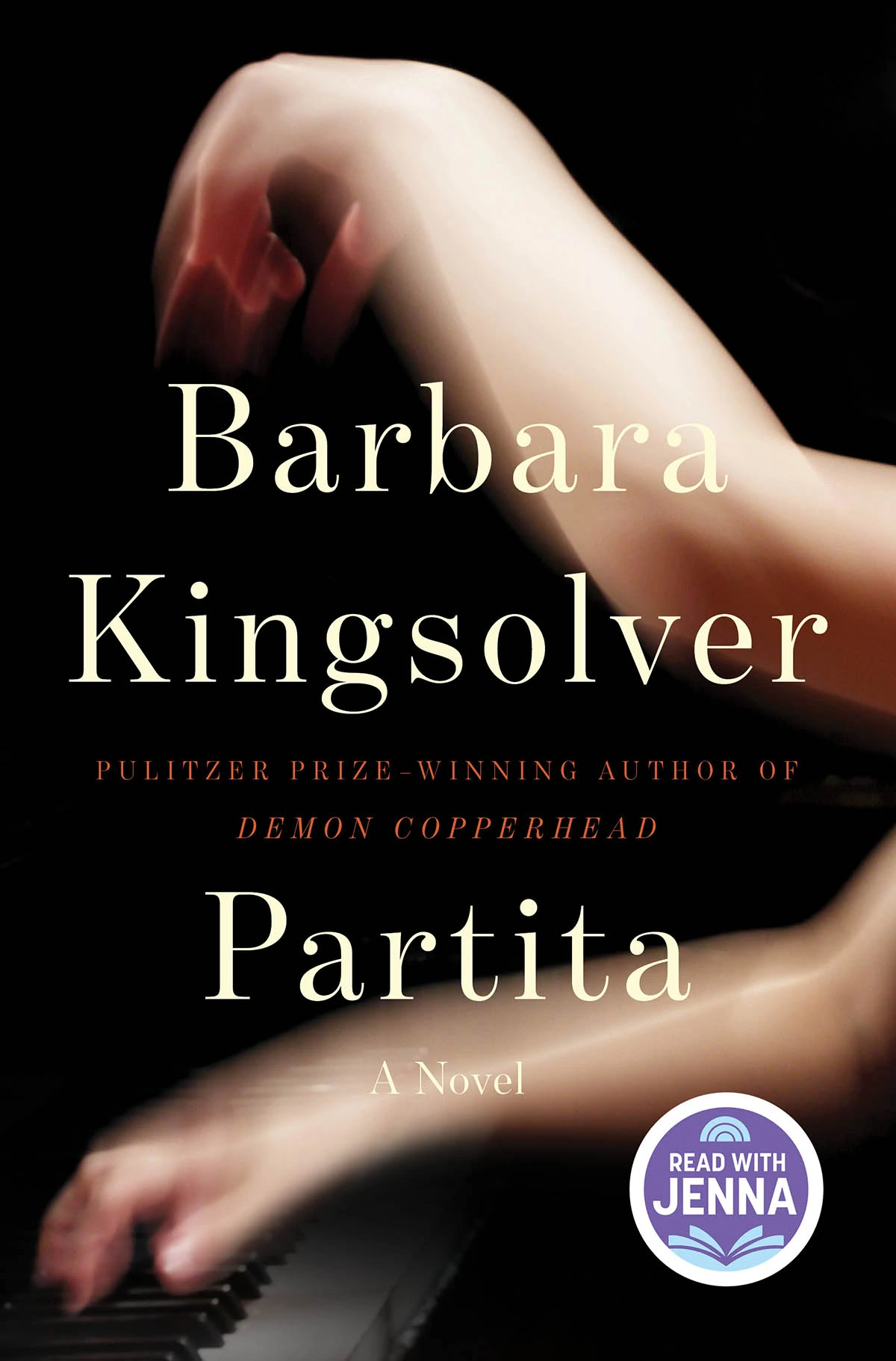
Partita
After a former lover reappears decades after an affair that preceded her devastating injuries, a Tennessee piano teacher reexamines her brother's suicide, her mother's thwarted ambitions, and the marriage and musical life she built from her losses.
Overview
Barbara Kingsolver's Partita follows Livia Bohusz Cable, a gifted pianist whose adult life in rural East Tennessee bears little resemblance to the concert career she expected as a student. In the novel's present, Livia has been married to the farmer Charlie Cable for decades and earns her living by teaching piano to children and adults. Her mother has recently died, leaving an almost impassable house full of saved objects for Livia to clear. Then Sigurd, the politically committed man Livia loved during her university years, calls after more than twenty years of silence. He is visiting Nashville for medical care and wants to see her. His approach summons memories Livia has kept apart from her marriage, including the destruction of her career, a pregnancy she never told Charlie about, and a medical crisis that nearly killed her.
The story is organized as a musical sequence rather than told chronologically. An Overture introduces the suicide of Livia's older brother, Cyrus, when he was seventeen and she was eleven. The novel then alternates contemporary sections called Preludes with longer movements that reconstruct Livia's life as a student, lover, injured worker, and eventually Charlie's wife. Music gives these divisions their names: Allemande, Toccata, Sarabande, Fugue, Pathétique, Da Capo and Al Fine. The back-and-forth structure matters because the younger Livia acts without knowing the information her older self will eventually discover. Neither reader nor narrator can yet explain the brother's death, the mother's resentment, or what Sigurd understood when he left. Later revelations do not simply complete forgotten details. They challenge interpretations that have governed Livia's life.
Livia grows up on a struggling dairy farm, with little prospect of a future that resembles the one her talent makes possible. Her parents expect her brother Cyrus to become the useful son who will inherit the work. Cy, whom Livia adores, instead finds comfort in their close companionship and secretly wants to learn piano. Livia helps him. Her mother treats the children harshly and punishes them physically, while their father Willard, a decent but reticent man, does not protect them. When Cyrus walks in front of a train, Livia is left to wonder whether she missed a warning or said something cruel at the wrong moment. The guilt persists long into adulthood. Playing at his funeral becomes both an act of devotion and evidence of her own unusual ability to survive through music.
A scholarship takes Livia to Indiana University, where she learns that technical mastery does not erase class differences. The other students often have familial support, cultural confidence, and money she does not. Livia performs brilliantly, supports herself in part by accompanying other musicians, and suppresses her mountain accent to appear at home in an elite conservatory. She lives with another student, Jon Link, who imagines a married future for them. Their connection offers security but does not make Livia feel fully understood. She is already beginning to doubt whether professional recognition can justify the sacrifices music demands when she meets Sigurd.
Sigurd works as a typesetter and organizes for a revolutionary socialist party. He is charismatic, attentive, physically attractive, and certain that collective political struggle should be a person's central purpose. His critique of student privilege speaks to Livia's memories of being invisible to university customers when she waited tables. He insists that ordinary laborers are ignored by the very institutions that claim to advance human understanding. Yet Livia knows that piano performance requires years of grueling labor. She struggles with the suggestion that the work she has chosen is less important than the labor or political organizing he champions.
Their attraction becomes an affair while Livia is preparing Ravel's Gaspard de la nuit for a major jury. Its demanding movement Ondine carries the thrill of artistic mastery and the new physical intensity she experiences with Sigurd. Livia receives the approval of her teachers and performs difficult programs, including music whose imagery returns her to Cyrus. At the same time, she becomes emotionally detached from Jon and increasingly absent from the career she was training to pursue. Sigurd's politics give her a new language for her estrangement from class privilege, but he is unable to honor the musician's work as completely as he values his own calling. His failure to attend her performance shows the distance between their lives.
The relationship founders when Sigurd accepts a party directive to leave Bloomington for industrial organizing and railroad work in the Southwest. He believes changing society through unions matters more than working on a college campus. Livia briefly offers to follow, even to become an industrial worker herself, but cannot imagine living without sustained piano practice. Sigurd will not ask her to surrender the vocation he thinks is hers, yet he also will not abandon his political plan for her. Each later explains the separation partly as a sacrifice made for the other's ambition. At the time, it feels to Livia like rejection. She collapses into grief, performs disastrously in a choral rehearsal and loses her work as an accompanist.
The manager of a campus pizzeria, Amadeo, offers Livia food, kindness and a kitchen job. The labor has an exact tempo and a practical purpose, and she discovers a form of satisfaction in preparing meals during rushes. Amadeo urges her to return to the piano rather than mistake a temporary refuge for the abandonment of her abilities. But an unsafe industrial dough roller catches her right hand when she volunteers to clean it during a chaotic evening shift. The machine crushes its bones, tendons and nerves. A skilled surgeon preserves the hand, with Amadeo's intervention helping to secure exceptional care, but several joints are permanently fused and her little finger is shortened. The resulting loss of flexibility and range ends Livia's prospects as the virtuoso she had been.
While she is being treated, a physician's assistant named Ladawna discovers that Livia is pregnant. Because her menstruation is irregular, she has been seriously ill, and her body is underweight, she has not recognized the pregnancy for nearly five months. She does not want to bear the child and has neither stable financial support nor a partner in whom she can trust. Her effort to obtain an abortion is obstructed by a protestor posing as a clinic employee who falsely tells her she needs parental permission. A bomb threat closes the clinic, further delay pushes the pregnancy beyond the services available there, and specialized hospital care becomes unaffordable. Livia writes to Sigurd for help. His party associates intercept and forward the letter, and the delayed telephone conversation makes their separation even uglier. He offers bus fare to Phoenix, where comrades might help her obtain care or arrange an adoption, but cannot leave his new railroad job. She does not tell him what happened to her hand.
Before she can travel, Livia suffers a catastrophic placental abruption and hemorrhage. She reaches a hospital half-conscious, bleeding badly and initially unable to give her name. Surgeons save her life after delivering a nonviable fetus and performing an emergency hysterectomy. She is resuscitated after three cardiac arrests. Survival leaves her unable ever to bear children, a final loss different from the end of a pregnancy she had not wanted. The distinction is crucial: Livia feels both relief that the immediate pregnancy has ended and grief for the possibility of any future children. She sends Sigurd's unopened travel money back and, dangerously weak and alone, finally asks her family for help.
The neighbor Faye Cable answers the telephone. Livia learns that her father has had terminal cancer since spring, a condition her mother concealed even when pleading with her to visit at Easter. Faye's son Charlie drives to Bloomington, gathers Livia's few belongings, carries her to his car and takes her home. Livia explains her crushed hand but calls her abdominal crisis the removal of a growth. She hides the pregnancy and everything that led to it. At home she convalesces alongside Willard, who has chosen not to exhaust the family's limited assets on treatment unlikely to save him. Faye offers care without the judgment Livia expects from her mother. Charlie, once a boy who needed crutches after losing a foot, has learned to walk with a prosthesis and runs the dairy with extraordinary competence. He and Willard have developed a quiet understanding.
Willard dies just before Christmas while the family is searching for the old dog Dolly, who has vanished into the barn. Livia cannot perform the music for his funeral. After the service she tries simple notes on the church piano and finds how little her injured hand will do. She is angry when Charlie praises the attempt, unable to bear the distance between this halting performance and her former mastery. Later she returns secretly, trying simple Chopin and Bach pieces, gradually recognizing that she still has an experienced musician's memory and judgment even where physical technique is lost.
Willard's will assigns the family home and a small parcel to Livia's mother, but leaves the dairy business and remaining land to Livia. Its name, CyLee Dairy, memorializes both of his children. Livia, who never wanted to run a farm, learns the business from Charlie, discovers her father's practical intelligence, hires workers and raises Charlie's pay. When her mother's hoarded house becomes unbearable, Faye offers the little apartment over the Cable garage. There Livia and Charlie grow close. Faye reveals that he admired Livia even as a boy, particularly after watching her play at Cyrus's funeral. Their private piano sessions become a form of trust; intimacy follows. They are careful with the physical signs of each other's injuries and discover pleasure without the devastating demands of Livia's earlier romance.
Eventually they learn that Willard hoped the two would marry and keep the farm together. They marry at the courthouse with little ceremony, refusing to let another family wedding become an occasion for humiliation. Their household expands gradually into the main Cable house. Faye gives Livia an extraordinary gift: a Steinway piano donated by an elderly client. Livia begins teaching children and adults and builds a profession around musical knowledge rather than virtuoso display. As the economics of tobacco and dairy worsen, Charlie and Teddy reorganize their farms, ultimately moving toward raising calves and producing hay. Charlie's work and the combined families' support make their lives possible.
There is no simple erasure of loss. Livia loves Charlie but remains disturbed by the life she did not lead, the children she could not have and the attraction to Sigurd that once overwhelmed her. A late discovery gives her a different name for something she can keep: Dolly, missing since Willard's death, reappears alive in the barn with a single puppy. Charlie and Mickie call the puppy Ondine, because Livia has so often said she will never have Ravel's Ondine again. The name changes from an unattainable measure of artistic accomplishment into a living relationship. Later generations of dogs connect the farm's past with Livia's present companion, Gaspard.
When Sigurd's call revives her memories decades afterward, Livia is also sorting her mother's accumulated boxes. She finds cruel letters from her grandmother condemning her mother for going to Nashville before marriage to pursue a singing career. Performance programs and carefully sewn stage dresses show that the woman who discouraged Livia's ambitions had once cherished musical success herself. Livia cannot recover every detail of that failed attempt, but she can no longer see the woman's bitterness solely as a reaction to her daughter. The family's injuries have been transmitted between generations.
More consequentially, she discovers newspaper clippings about a police encounter involving Marshall Stilwell and other boys and finds letters Cyrus wrote before his suicide. One letter to their mother rejects parental control; another, sealed and addressed to Livia, reveals that Cyrus and Marshall were in love and that Marshall's family forced him to enter the Marines to separate them. Cyrus could not imagine a tolerable future without him. He tells Livia that she will survive, that music is her enduring love and that she should never let the family prevent her from pursuing it. These letters make Livia reconsider a lifetime of self-blame. Cyrus's death arose in a specific relationship and family conflict she never understood, not because she failed to recognize a musical or conversational clue. She still condemns the hopelessness of his choice and mourns the years they could have shared.
Talking with Sigurd again, Livia learns that he never became a successful revolutionary. After decades of industrial work he has turned to a housing nonprofit and is deeply disappointed by growing economic inequality and the political alienation of workers. His medical diagnosis is manageable, an outcome that oddly depresses him because it leaves him years to live without the triumph he expected. He claims he left partly to avoid destroying Livia's musical future. She finally tells him the truth about her ruined hand and lost concert career. He is horrified. His apology cannot change what happened, but the conversation makes it possible for both to acknowledge that their younger selves were limited, not all-knowing agents who controlled one another's destinies.
Livia then burns much of her mother's hoard, keeping the stage dresses but disposing of papers and possessions that have become burdens. With Charlie beside her, she reads aloud from Cyrus's letter and finally burns it too. She chooses to retain the remembered brother who lived and loved her, not only the hour in which he died. The bonfire briefly sets the farmhouse roof alight, and family members use irrigation equipment to contain the damage. At home that night, she tells Charlie more openly that she loves him and that she has lived with persistent sadness. Their renewed physical intimacy helps her recognize how much her silence has kept him outside her inner life. She understands she must tell him more about Sigurd.
The final movement, Al Fine, brings Sigurd to a recital Livia has organized at Cross Creek Methodist. It is a modest event filled with people whose lives she knows closely: farm families, adult beginners, precocious children, the unconventional teenage singers she calls the Furies and their relatives. Charlie sits beside Sigurd, and Livia holds her husband's hand. An unexpected bird flies around the church until a parent places a tray of water at an open window; the bird follows the reflected sky into freedom. The students play classical works, country music, comic performances, personal compositions and pieces important to their families. Livia recognizes that she was wrong to prohibit a memorial song from an earlier formal recital. Her work has not been the consolation prize for the destruction of a professional career. It has allowed others to make music their own.
Elizabeth, an adult pupil, plays movements from a Bach partita, and Livia hears the musical questions and replies that have long helped her think about love and memory. Deronne, her gifted young student, improvises on Bach and surprises her with Le Gibet, the slow movement of Ravel's Gaspard de la nuit. He has chosen it for her dog Gaspard, not because he knows any of her history with Sigurd. Sigurd does not seem to recognize the piece. Livia is moved by its return in new hands and circumstances; she expects Deronne one day to play the complete work she can no longer perform. The novel ends with the recital and Livia's recollection of the church as the place where she has always made musical ceremonies for grief and celebration. It does not depict a romantic reunion or a final explicit confession. Its resolution is more precise: Livia no longer has to measure her life only against the concert pianist she might have been, the brother she lost, or the lover who left. Her music, marriage, students and continued willingness to learn constitute the life she has made.
Main Characters
- Livia Bohusz Cable: The narrator, a former conservatory pianist whose crushed right hand ended her concert ambitions; she becomes a piano teacher and farmer's wife and gradually confronts the grief and secrets she has retained.
- Sigurd: Livia's charismatic former lover, a typesetter and revolutionary socialist organizer whose commitment to industrial work separates them; decades later he is a retired railroad worker employed by a housing nonprofit.
- Charlie Cable: Livia's patient and practical husband, a Tennessee farmer who lost a foot in childhood and runs the inherited dairy; he provides care without judgment while knowing only part of her past.
- Cyrus (Cy) Bohusz: Livia's older brother, who died by suicide at seventeen after his beloved Marshall was sent to the Marines; his withheld letters change Livia's understanding of his death.
- Livia's mother: A harsh and emotionally distant parent who compulsively saved possessions and concealed family information; she had once wanted to become a singer but was shamed into abandoning the ambition.
- Willard Bohusz: Livia's quiet father, a skilled dairyman who leaves the family business to his daughter and relies on Charlie during his terminal illness.
- Faye Cable: Charlie's mother and Livia's supportive neighbor, an experienced home care worker who shelters Livia and ultimately helps her establish a musical household.
- Mickie Barnes: Charlie's sister and Livia's close friend, an English teacher who encourages her to read Cyrus's letters and recognize the importance of art outside elite careers.
- Amadeo: The Gorgo's manager who shelters Livia after Sigurd leaves and mobilizes expert help when her hand is crushed.
- Ladawna: A compassionate physician's assistant who supports Livia's hand recovery, identifies her pregnancy and challenges disinformation about abortion access.
- Jon Link: Livia's conservatory boyfriend, whose assumptions about a shared marriage and professional life are overtaken by her relationship with Sigurd.
- Deronne: A highly talented young piano student whose inventive recital performance shows Livia that her music can flourish beyond her own injured hands.
- Marshall Stilwell: Cyrus's first love, forced by his family into military service; his absence contributes to Cyrus's despair.
Central Themes
- Artistic vocation as demanding work and as something valuable beyond professional recognition
- Class, access to higher education and unequal respect for manual labor
- Private love and collective political commitments, including the costs of pursuing incompatible ambitions
- Family violence, thwarted aspirations and the intergenerational transmission of shame
- Queer love, social enforcement of gender norms and the devastation of forced separation
Mood & Atmosphere
Intimate, retrospective literary fiction that moves between young artistic ambition, political argument, intense romance, medical catastrophe and the ordinary warmth of a rural community; grief and anger persist alongside wit, patient care and qualified hope.
Source Edition
Partita (2026), HarperCollins. How sources are recorded.