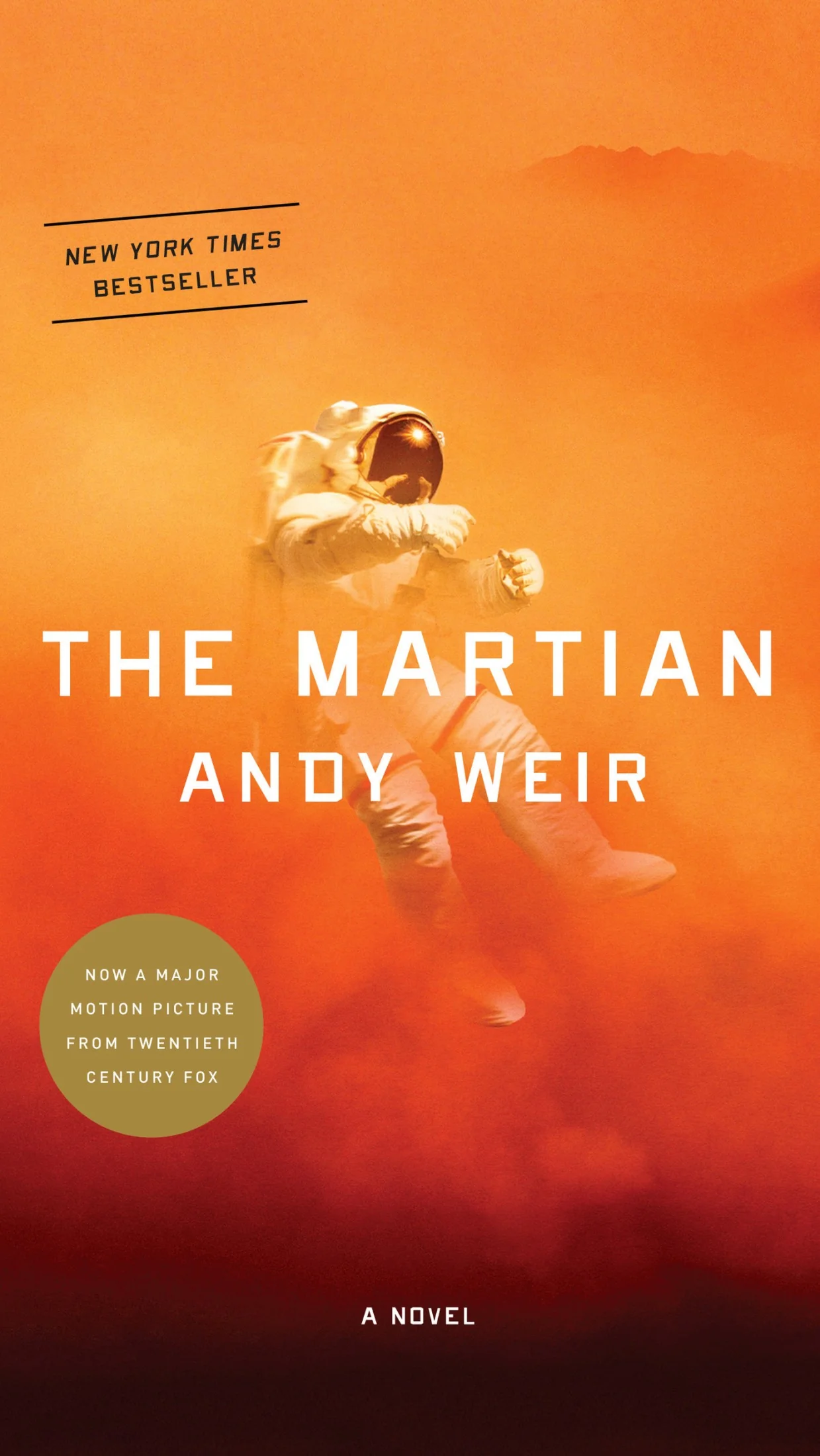
The Martian
After the Ares 3 crew mistakenly leaves him on Mars, botanist and engineer Mark Watney survives through improvised farming and equipment repairs until NASA, China's space agency and his returning crewmates coordinate a rescue that brings him aboard Hermes, still 211 days from Earth.
Overview
Six sols into the Ares 3 mission, a severe sandstorm threatens the Mars ascent vehicle (MAV) and forces an emergency evacuation. An antenna torn from the main communications array impales astronaut Mark Watney and damages his suit and biomonitor. His crewmates see signs of catastrophic decompression and, believing him dead, leave for the orbiting Hermes spacecraft. Watney survives because the antenna and dried blood temporarily seal his suit's breach. He patches it, reaches the intact habitat (Hab), and treats his wound. The MAV and the main radio dish are gone, leaving him unable to contact Earth. Although the remaining food could last roughly 400 sols at reduced rations, the next planned crewed landing is more than a thousand sols away. Watney, the mission's botanist and mechanical engineer, must develop other ways to survive.
Watney begins cultivating potatoes from the crew's Thanksgiving food supply. He combines Martian dirt with Earth soil, microbes and human waste to create a growing medium, then expands the cultivated area around the Hab. Water is insufficient, so he extracts hydrogen from the abandoned Mars descent vehicle's hydrazine and burns it to produce more water. Unburned hydrogen accumulates in the Hab and later causes an explosion while he tries to remove it. He survives, confirms the soil bacteria are still alive and continues farming. His crops eventually extend his estimated food supply to around Sol 900, although they cannot sustain him indefinitely.
On Earth, satellite technician Mindy Park notices the Hab's clean solar cells and rover pop-tents that were not deployed before the evacuation. NASA Mars operations director Venkat Kapoor finds further evidence of activity after the crew's departure, including moved equipment and a dismantled descent vehicle. NASA publicly announces Watney's survival, but administrator Teddy Sanders and Venkat initially withhold the discovery from the returning Ares 3 crew, fearing that the knowledge will impair their concentration. NASA begins developing ways to communicate with Watney and send supplies; its early rescue concepts involve a modified Ares 4 descent vehicle that could transport him across the Martian surface.
Unaware that Earth is monitoring him, Watney modifies a rover with a second battery, portable solar panels and heat from a recovered radioisotope thermoelectric generator. He travels to the dormant Pathfinder lander, recovers it along with the Sojourner rover and brings both back to the Hab. After Watney repairs Pathfinder's power supply, its autonomous systems acquire a signal. JPL restores its old control equipment, and Watney exchanges messages using cards positioned before the lander's camera and a hexadecimal alphabet that NASA can indicate by rotating the camera. JPL software engineers then help him modify the rover's software, allowing typed messages through Pathfinder despite the considerable Earth-Mars communication delay. Watney reports his crops and insists the crew was not responsible for leaving him. Once NASA has a rescue concept, flight director Mitch Henderson secures permission to inform Hermes. The crew reacts with relief, but Commander Lewis says she personally bears responsibility for leaving him.
The farming solution collapses on Sol 119. A concealed weakness in Hab canvas sheet AL102, aggravated by an earlier storm and repeated Airlock 1 pressure cycles, causes the airlock to detach explosively and the habitat to depressurize. Watney survives in the detached airlock by sealing its leak and improvising a pressure suit from damaged equipment. He reaches his rover, later repairs the Hab, and restores NASA communications, but the vacuum and cold have destroyed the potatoes and living soil. Watney recovers 1,841 edible potatoes; combined with stored rations, they will last only until about Sol 584. NASA's existing plan for a Sol 856 food delivery is now too late.
JPL urgently builds Iris, a simpler food-and-radio supply probe intended to reach Mars before Watney starves. Its projected flight takes 414 days, leaving very little manufacturing time. To meet the deadline, Teddy authorizes omission of normal launch inspections despite the additional risk. Iris launches, but its concentrated food payload shifts under acceleration and vibration. The resulting off-center force and a defective restraint bolt cause the probe to break loose inside its aeroshell, and the launch vehicle is lost. NASA's immediate means of delivering food to Watney has failed.
Guo Ming and Zhu Tao of the China National Space Administration offer an alternative: the powerful booster intended for their Taiyang Shen solar probe could launch a smaller payload. An agreement that includes a future Ares 5 seat for a Chinese astronaut makes the booster available to NASA. NASA initially considers another hastily built probe that would crash-land food on Mars, but astrodynamicist Rich Purnell proposes a different use for the same rocket. Hermes could accelerate toward Earth, use an Earth gravity assist, collect a resupply package near Earth, and return for a Mars flyby on Sol 549. Watney would travel about 3,200 kilometers to the prepositioned Ares 4 MAV and launch into Hermes's path without the larger ship entering Mars orbit. The diversion would extend the Ares 3 crew's mission by 533 days and require another 211 days to reach Earth after the rescue.
Teddy rejects the maneuver because it would risk the entire Hermes crew rather than Watney alone. A copy of Rich's calculations nevertheless reaches the spacecraft through a disguised attachment. After Vogel checks the trajectory, Lewis gives every crew member a chance to object, and they unanimously choose to attempt the rescue. Johanssen disables Houston's ability to override the spacecraft remotely, and Hermes changes course. NASA must then support the mission the crew has committed to. The Chinese booster successfully launches a JPL resupply package, which Martinez guides to Hermes during its near-Earth passage. The added food and supplies make the extended voyage possible.
Watney learns that Hermes will return on Sol 549 and begins converting the two rovers into a mobile habitat with greater battery storage, solar panels, oxygen production, a temperature-control system and a trailer for equipment and supplies. While modifying the trailer, he accidentally destroys Pathfinder's electronics with an electrical short. Direct two-way communication ends, leaving him to signal NASA by arranging messages made from rocks for orbiting cameras. On Sol 449, Watney shuts down the Hab and departs for the distant Ares 4 MAV. NASA can monitor some of his progress but cannot warn him of a persistent dust storm in Arabia Terra. As solar output falls, Watney measures differences in sunlight across a north-south route, deduces how to escape the storm, and makes a substantial detour. Near the destination, unstable ground overturns his rover and trailer. He rights both vehicles, repairs the equipment and reaches the MAV.
To intercept the fast-moving Hermes, the Ares 4 MAV needs more fuel and far less mass than a normal ascent. Under NASA's procedures, Watney extracts hydrogen from water to make additional fuel and removes most of the ship's normal safety equipment, life-support hardware, controls, redundancies, part of its hull and one first-stage engine. He covers the missing forward structure with Hab canvas and prepares to launch in an EVA suit. Martinez will fly the MAV remotely from Hermes while Beck prepares an external retrieval using a maneuvering unit and a tether. At liftoff, intense acceleration and a tear in the canvas cover create excess atmospheric drag. Watney briefly loses consciousness; the MAV reaches orbit but its calculated intercept is sixty-eight kilometers short of Hermes.
Lewis orders Hermes to use its attitude-control thrusters to close the distance. The maneuver corrects the separation but leaves a relative approach speed of forty-two meters per second, too high for Beck to safely retrieve Watney. After rejecting Watney's suggestion of propelling himself with escaping air from his suit, Lewis proposes using Hermes's own atmosphere for thrust. Vogel prepares a charge to open the forward vehicular airlock, Johanssen sets up remote detonation, and the crew seals off the bridge and reactor compartment. The controlled vent lowers the closing speed. Beck reaches the torn MAV, clips himself to Watney and pushes away with him. His maneuvering unit runs out of fuel while they still have five meters per second of relative motion. Vogel applies gradual friction to their tether until their speed matches Hermes, then reels them safely into Airlock 2. Lewis reports that all six crew members are aboard, and people around the world celebrate.
In his final log, Watney identifies the date as Mission Day 687 aboard Hermes, corresponding to Mars Sol 549. He has two broken ribs and receives medical care after the crew restores the ship's atmosphere. He reflects on the combined work of his crewmates, NASA, JPL, the Chinese space program and people around the world, and sees their response as evidence that people generally help others in danger. The novel ends with Watney safe aboard Hermes and 211 days remaining before Earth, not with the spacecraft's arrival home.
Main Characters
- Mark Watney - Ares 3 astronaut, botanist and mechanical engineer stranded on Mars, who farms potatoes, repairs equipment and reaches the rescue MAV
- Commander Lewis - Ares 3 commander who initially orders the storm evacuation, later accepts responsibility and leads the Hermes crew's independent rescue decision
- Venkat Kapoor - NASA director of Mars operations who organizes observation, communications and rescue planning
- Teddy Sanders - NASA administrator who authorizes emergency resupply efforts but refuses the original Hermes diversion because of danger to its crew
- Mindy Park - satellite technician who identifies post-evacuation evidence of Watney's survival and monitors his movements
- Bruce Ng - JPL director responsible for emergency probe construction and technical planning for MAV modifications
- Mitch Henderson - Ares 3 flight director who objects to concealing Watney's survival from the crew and advocates giving them rescue information
- Rich Purnell - NASA astrodynamicist who calculates the Earth-gravity-assist trajectory that allows Hermes to return to Mars
- Major Rick Martinez - Ares 3 pilot who remotely guides the Chinese-launched resupply probe and Watney's stripped-down MAV
- Beth Johanssen - Ares 3 systems operator and programmer who helps execute the crew's unauthorized trajectory change and manages launch telemetry
- Dr. Chris Beck - Ares 3 doctor and EVA specialist who leaves Hermes to attach himself to Watney during retrieval
- Vogel - Ares 3 chemist who verifies the flyby calculations, helps execute the emergency airlock vent and brakes the rescue tether
- Guo Ming - director of China's space administration who arranges an international booster agreement
- Zhu Tao - Chinese space administration under director who recognizes the Taiyang Shen booster's ability to support a Mars rescue payload
Central Themes
- Survival through botany, engineering and resource accounting
- Isolation, communication and psychological endurance
- Risk assessment and the failure of complex technical systems
- Crew loyalty, independent judgment and command responsibility
- International scientific cooperation and mutual assistance
Mood & Atmosphere
The narrative combines Watney's technical logs and irreverent humor with tense scenes of equipment failure, institutional decision-making and orbital rescue.
Source Edition
The Martian (2014), Random House Publishing Group. How sources are recorded.