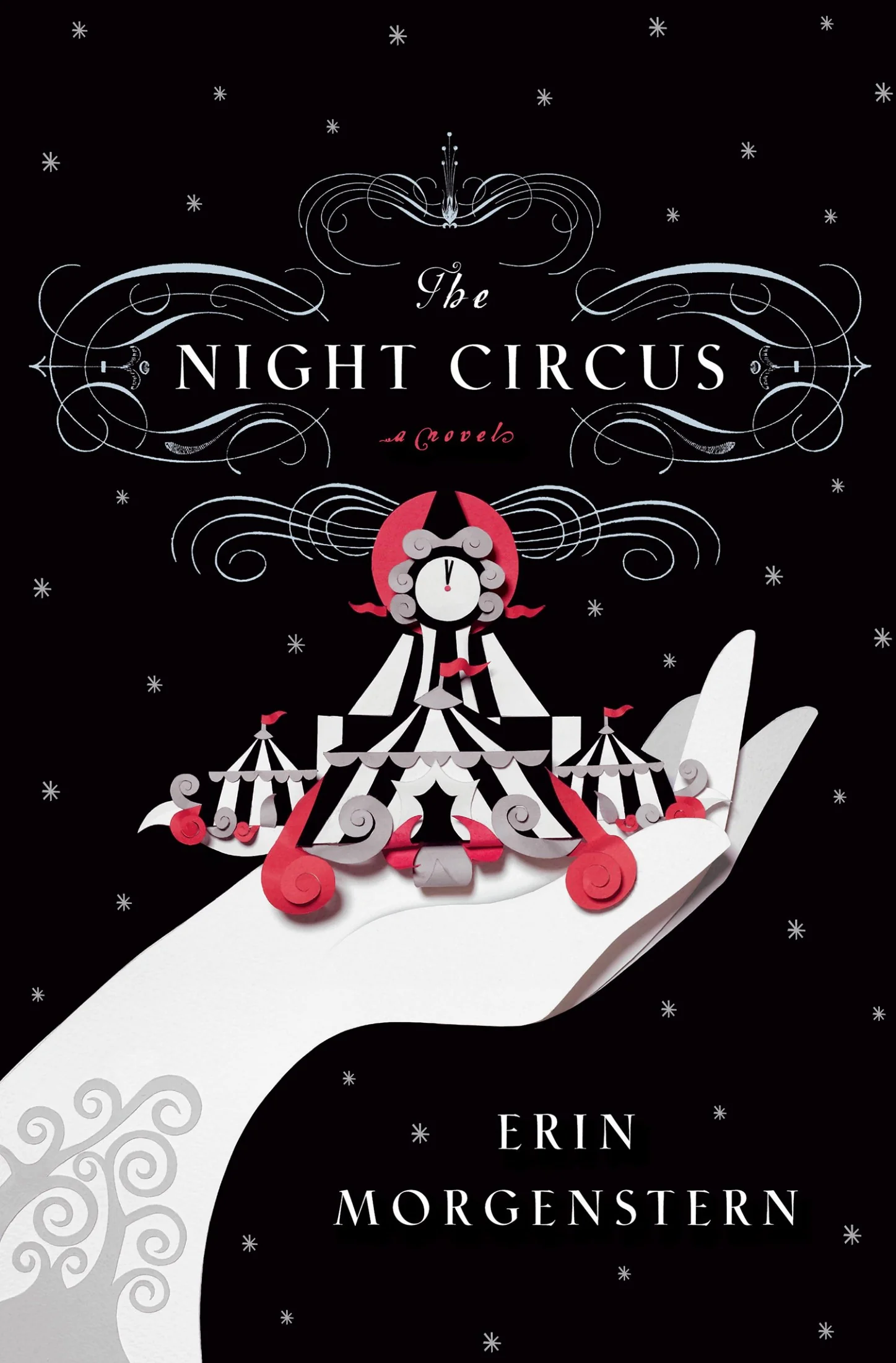
Chapter 1 Anticipation
A mysterious circus arrives in the town without warning, its presence marked by a monochromatic color scheme of black and white. Striped tents and an ornate wrought-iron fence add to its enigmatic allure. The sign at the entrance, reading 'Opens at Nightfall Closes at Dawn,' draws the curious townspeople, who gather in anticipation as dusk approaches.
As the sky darkens, the crowd grows restless, their excitement building. Suddenly, a magical display of lights illuminates the tents, casting a spell over the onlookers. The iron gates shudder and unlock, revealing the name of the circus in glowing letters: 'Le Cirque des Rêves' or 'The Circus of Dreams.' The gates swing open, inviting the eager crowd to enter and explore the enigmatic circus.
Key Events
- A mysterious circus arrives in the town without warning.
- The crowd gathers and waits for the circus to open at nightfall.
- A magical display of lights illuminates the circus tents.
- The gates of the circus open, revealing the name 'Le Cirque des Rêves'.
Themes
- Mystery and Intrigue
- Anticipation and Curiosity
- Illusion and Reality
Chapter 2 Unexpected Post: New York, February 1873
In New York, February 1873, a peculiar delivery arrives at the theater: a young girl, Celia, accompanied by a suicide note pinned to her coat. The lawyer who brings her refuses to explain, leaving the theater manager to handle the situation. Recognizing the girl as the magician’s daughter due to her resemblance, the manager takes her to his office, where she remains silent and still, refusing to remove her coat or drink the tea offered to her.
When Hector arrives, he is initially taken aback and utters a crude exclamation. Upon reading the suicide note, he learns the girl's name is Celia and that she is his daughter. He demonstrates his magical abilities by repairing a teacup that Celia had inadvertently shattered, startling her. Hector examines Celia closely, noting her potential, and decides to take her in. Over the following weeks, he tries to rename her, but she insists on being called Celia. Several months later, Hector writes a letter, sending it without an address, confident it will reach its intended recipient.
Key Events
- Prospero the Enchanter receives his daughter, Celia, accompanied by a suicide note.
- Celia inadvertently shatters a teacup, showcasing her latent magical abilities.
- Hector decides to keep Celia and attempts to rename her, but she refuses to respond to any name other than Celia.
- Hector writes a letter without an address, confident it will reach its destination.
Characters Introduced
- Celia
Themes
- Parental responsibility
- Magical inheritance
- Identity and naming
Chapter 3 A Gentlemen’s Wager: London, October 1873
In London, October 1873, Prospero the Enchanter mesmerizes the audience with his illusions, transforming fans into birds. However, a man in a grey suit, who remains unimpressed, watches the performance with a critical eye. After the show, he meets Hector Bowen backstage, where Hector introduces his daughter, Celia, showcasing her nascent magical abilities. Hector, sensing the man's interest, proposes a game—a competition between Celia and a student chosen by the man. Despite his reservations about the risks, the man agrees, marking Celia's finger with a magical ring as a binding symbol. Hector suggests Chandresh Christophe Lefèvre, a theatrical producer, as a potential host for the competition. As the man in the grey suit departs, Hector discusses the nature of names and identities with Celia, acknowledging her perceptiveness.
Key Events
- Prospero performs a magic show in London.
- A man in a grey suit observes the show without clapping.
- Hector introduces Celia to the man in the grey suit and showcases her magical abilities.
- Hector and the man in the grey suit agree to a magical competition involving Celia.
- The man in the grey suit marks Celia's finger with a magical ring.
- Hector suggests Chandresh Christophe Lefèvre as a potential host for the competition.
Themes
- Magical competition
- Binding agreements and their consequences
- The nature of identity and names
Chapter 4 Shades of Grey: London, January 1874
In January 1874, the man in the grey suit visits a nondescript grey building in London to interview children for an unspecified purpose. The headmistress, dressed in deep charcoal, is perplexed by his unusual criteria and presents him with three candidates: two boys and a girl. After brief interviews, he dismisses the first two, deeming them unsuitable. His attention turns to the third child, a boy who appears younger than his age but claims he will be nine in May. The boy is well-spoken and has a keen interest in reading, having exhausted the limited selection of books at the institution. To test the boy’s reflexes, the man tosses his cane, which the boy catches effortlessly. Impressed, the man decides to take the boy under his tutelage, promising him access to a vast library. He informs the boy that they will leave shortly and that names are unimportant; the boy can choose one for himself if needed. The boy packs his few belongings, and the man completes the necessary paperwork, leading the boy away from the grey stone building, never to return.
Key Events
- The man in the grey suit interviews three children at a grey building.
- The man selects a nine-year-old boy based on his reading skills and reflexes.
- The man in the grey suit emphasizes the unimportance of names and takes the boy away to study with him.
Characters Introduced
- The boy (later known as Marco)
Themes
- The selection of a protege for a mysterious competition
- The value of knowledge and education
- The fluidity of identity and naming
Chapter 5 Magic Lessons: 1875–1880
Celia's growth under her father Hector Bowen's erratic tutelage continues, marked by frequent moves between various cities and theaters. Her lessons become more spontaneous and challenging, with Hector testing her abilities constantly and pushing her to perform magic in increasingly difficult situations, such as healing a broken-winged dove and repairing a shattered doll. Celia's relationship with her father is strained, as he alternates between neglect and harsh criticism, often leaving her to fend for herself in dressing rooms or hotels.
Meanwhile, Marco lives a secluded life in a London townhouse under the care of Alexander. His days are filled with rigorous studies and rare outings to museums and libraries. Alexander introduces him to the concepts of binding and illusion, taking him to see two different magicians perform—one using mechanical tricks and the other employing true magic. Marco is fascinated by the differences and becomes increasingly curious about his own role in the upcoming game, especially after Alexander binds him with a gold ring, leaving a permanent scar as a reminder of his obligations.
The chapter highlights the stark contrasts in the training methods and living conditions of Celia and Marco, both of whom are being prepared for a mysterious competition. Celia's emotional turmoil and Marco's intellectual curiosity set the stage for their future confrontation, while the enigmatic nature of their bindings and the competition itself adds layers of intrigue to their parallel narratives.
Key Events
- Celia is tested with increasingly difficult magical tasks by Hector.
- Marco is taken on rare outings to museums and libraries by Alexander.
- Marco witnesses two different types of magic performances, one mechanical and one genuine.
- Alexander binds Marco with a gold ring, leaving a permanent scar.
Themes
- The unpredictable and demanding nature of magical training
- The contrast between Celia and Marco's lives and mentors
- The mystery of the impending competition and its rules
- The emotional and psychological impact of isolation and obligation
Chapter 6 Le Bateleur: London, May–june 1884
As Marco approaches his nineteenth birthday, Alexander relocates him to a modest flat overlooking the British Museum, signaling the end of his formal lessons. Marco continues his independent studies, filling notebooks with symbols and glyphs, and begins to explore the city on his own. During one of his walks, he returns to his former townhouse, only to find it abandoned. Realizing his notebook is missing, he retraces his steps and encounters Isobel, a young woman who has his notebook. They strike up a conversation, and Marco invites her to a nearby café, where they share a meal and a bottle of wine. Isobel reveals her interest in the occult and her possession of a tarot card deck, which intrigues Marco. To demonstrate his skills, Marco performs a magical illusion, transporting them from the rainy London street to a sunny winter forest, where he kisses her. To passersby, they appear as just another young couple sharing a moment in the rain.
Key Events
- Alexander moves Marco to a modest flat in London.
- Marco loses his notebook and retrieves it from Isobel.
- Marco and Isobel have a conversation and meal at a café.
- Marco performs a magical illusion, transporting Isobel to a winter forest and kissing her.
Characters Introduced
- Isobel Martin
Themes
- Magic and Illusion
- Romance and Connection
- Transition to Adulthood
Chapter 7 False Pretenses: July–november 1884
Hector Bowen, now retired from the stage, continues to tour with his sixteen-year-old daughter, Celia, who acts as a spiritual medium to earn money. Celia detests the job, finding the clients’ desperate attempts to communicate with the dead unsettling and demeaning. Despite her protests, Hector insists it is good practice for her, pushing her to perform increasingly elaborate tricks and changing her name frequently, often to Miranda, which irritates her. After fainting during a session, Celia is granted a brief respite in New York, but Hector quickly resumes her grueling schedule, emphasizing the importance of practice for her upcoming challenge, the details of which remain vague.
Meanwhile, Marco and Isobel continue their experiments with magic in Marco’s flat. Isobel struggles with a charm involving silk ribbons, while Marco demonstrates his ability to read her thoughts, learning about her past and her flight from an arranged marriage. The man in the grey suit, Alexander, interrupts their session, instructing Marco to apply for a position with Chandresh Christophe Lefèvre, emphasizing the importance of securing the job without distraction. Marco is left to ponder the implications of this move, wondering if it signifies the beginning of the challenge.
Back in New York, Hector’s behavior becomes increasingly erratic. He isolates himself in the upstairs parlor, ignoring Celia and rarely eating. One day, Celia discovers him experimenting with a mysterious form of magic, causing parts of his body to fade in and out of existence. When questioned, Hector dismisses her concerns, further isolating himself and leaving Celia to wonder about the nature of his experiments and the true purpose behind their current circumstances.
Key Events
- Celia continues to act as a spiritual medium despite her dislike of the job.
- Marco and Isobel experiment with magic, and Marco learns about Isobel's past.
- Alexander instructs Marco to apply for a position with Chandresh Christophe Lefèvre.
- Hector isolates himself in the parlor and experiments with a mysterious form of magic.
Themes
- The ethical and emotional toll of performing deceptive acts
- The tension between duty and personal desires in magical training
- The psychological impact of isolation and experimental magic
Chapter 8 Target Practice: London, December 1884
In his study, Chandresh Christophe Lefèvre repeatedly throws a silver-handled knife at a dartboard adorned with a glowing review from the London Times. Fixated on the word 'almost,' which suggests his productions are not quite transcendent, Chandresh shreds the paper with each throw, obscuring key words. Despite the positive review, he is deeply frustrated by the implication that his work falls short of true transcendence. Chandresh reflects on his lifelong fascination with audience reactions, believing that the power of performance lies in the audience's response. Raised in the theater, he has always been more interested in how the audience feels rather than the performances themselves. His reliance on reviews to gauge these reactions has intensified his focus on the word 'almost.' After several throws, Chandresh decides to involve Marco in his next project, bellowing for him and hinting at a significant shift in Marco's role and the potential start of the competition.
Key Events
- Chandresh repeatedly throws a knife at a glowing review, focusing on the word 'almost'.
- Chandresh reflects on his fascination with audience reactions.
- Chandresh calls for Marco, hinting at a new phase in their relationship.
Themes
- Perfectionism
- Audience Reaction
- Artistic Frustration
Chapter 9 Darkness and Stars
Holding a ticket, a patron joins a line of people, passing through a heavy striped curtain that separates the outside world from the circus. Once inside, the patron is immediately enveloped in darkness, a stark contrast to the bright, bustling exterior. As the eyes adjust, tiny lights resembling stars appear along the dark walls, guiding the patron through a twisting, mazelike tunnel. The isolation and disorientation within the tunnel heighten the sense of mystery and anticipation, creating a solitary journey through the unknown.
The tunnel's design, with its winding path and minimal lighting, ensures that the patron is completely separated from others, enhancing the individual experience of the circus. The tunnel's twists and turns make it impossible to determine direction or distance traveled, adding to the surreal and dreamlike atmosphere. Eventually, the patron reaches another curtain, which parts easily to reveal a blinding light on the other side, signaling the transition to the next part of the circus. This initial experience sets the tone for the enchanting and unpredictable nature of Le Cirque des Rêves, drawing the reader deeper into its magical world.
Key Events
- Patrons enter the circus through a heavy striped curtain.
- The patron is engulfed in darkness and guided by tiny star-like lights.
- The tunnel isolates the patron from others, enhancing the individual experience.
- The patron reaches another curtain, transitioning to a brightly lit area.
Themes
- Solitary Journey Through Mystery
- Mystery and Enchantment
- Individual Experience
Chapter 10 Truth or Dare: Concord, Massachusetts, September 1897
Bailey, the younger brother of Caroline, is dared by his sister to break into the Night Circus and bring back something as proof. Despite the daunting task, Bailey accepts the dare, driven by the need to prove himself to his siblings and friends. As he approaches the towering, silent tents, his resolve wavers, but the allure of the circus and the desire to return victorious draw him forward.
Once inside the deserted circus grounds, Bailey navigates the eerie, empty pathways, feeling a stark contrast to the vibrant night atmosphere. He encounters a red-haired girl, dressed in a fantastical white costume, who warns him to leave before he is caught. She guides him to a less visible exit and, upon learning of his dare, gives him one of her white gloves as proof of his intrusion. The encounter leaves Bailey intrigued, and he returns to his friends, who have dispersed, with the glove as evidence of his success.
Key Events
- Bailey accepts Caroline's dare to break into the Night Circus.
- Bailey navigates the deserted circus grounds and encounters a red-haired girl.
- The red-haired girl helps Bailey escape and gives him a white glove as proof of his intrusion.
Characters Introduced
- red-haired girl
Themes
- Curiosity and risk-taking
- The allure of the unknown
- Proof and validation
Chapter 11 Associates and Conspirators: London, February 1885
In London, Chandresh Christophe Lefèvre hosts a Midnight Dinner, a tradition of elaborate, multicourse meals served precisely at midnight. The dinners are exclusive and highly sought after, known for their mysterious and luxurious atmosphere, with no menus provided and exquisite, enigmatic dishes served. Guests, including Mme. Ana Padva, Mr. Ethan W. Barris, and the Burgess sisters, are treated to a night of fine dining and entertainment, setting the stage for Chandresh's announcement.
After dessert, Chandresh reveals his plan to create a unique circus, unlike any other, emphasizing the need for style, ingenuity, and a touch of mystery. He presents rough sketches and notes, outlining his vision for a multifaceted, immersive experience. The guests, intrigued and inspired, begin to contribute ideas, with Mr. Barris drawing detailed designs. The meeting extends into the early morning, with the group generating numerous plans and notes, laying the groundwork for the circus's development.
Key Events
- Chandresh hosts a Midnight Dinner with exclusive guests.
- Chandresh reveals his plan to create a unique and mysterious circus.
- The guests contribute ideas and designs for the circus, extending the meeting until dawn.
Characters Introduced
- Mme. Ana Padva
- Mr. Ethan W. Barris
- Tara Burgess
- Lainie Burgess
Themes
- Creativity and Innovation
- Mystery and Intrigue
- Collaboration and Vision
Chapter 12 Condolences: New York, March 1885
The announcement of Hector Bowen's death, known as Prospero the Enchanter, sends ripples through the magical community. Heart failure claimed his life, leaving behind a seventeen-year-old daughter, Celia. Condolence cards and letters flood the townhouse, transforming the entryway into a sea of floral arrangements and messages of sympathy. Overwhelmed by the scent of lilies, Celia uses her magic to transform them into roses, then begins sorting through the condolences, which range from heartfelt to insincere, and even include disturbing marriage proposals.
Among the letters, Celia discovers a plain grey envelope addressed to her father, postmarked after his death. Inside, a card bears the cryptic message: 'Your move.' The absence of a return address and any other identifying marks leaves Celia feeling a mix of excitement and dread. Determined to confront the matter, she ascends to the upstairs parlor, where she finds her father, now a ghostly figure, partially visible in the sunlight. Hector reads the note and laughs delightedly, confirming that the game he has been preparing for is about to begin.
Key Events
- Hector Bowen's death is announced in the newspaper.
- Condolence cards and letters flood the townhouse.
- Celia finds a cryptic message addressed to her father.
- Celia confronts her father's ghost in the parlor.
Themes
- Death and Legacy
- Mystery and Intrigue
- The Beginnings of a Magical Game
Chapter 13 The Contortionist’s Tattoo: London, September 1885
In the aftermath of Hector Bowen's death and the mysterious card, the scene shifts to London, where Chandresh's Midnight Dinner is held without Mr. Barris, who is traveling in Germany. The dinner proceeds without planned entertainment until an unexpected guest, Tsukiko, arrives. Introducing herself as a contortionist, Tsukiko is small, with long, black hair and an elegant presence. She removes her dark coat to reveal a thin, red silk gown adorned with an intricate tattoo of alchemical and astrological symbols.
Tsukiko performs a mesmerizing contortionist act, displaying exceptional flexibility and grace that captivates the dinner guests. Chandresh, particularly impressed, sees her performance as the embodiment of what he envisions for the circus—unusual, beautiful, provocative, and elegant. He persuades Tsukiko to join the circus, which she agrees to after some discussion and persuasion. Tsukiko's presence and performance become a regular feature at subsequent Circus Dinners, solidifying her role as a key element in Chandresh's vision for the circus.
The chapter highlights the growing momentum and creativity surrounding the planning of the circus, with Tsukiko's unique talents serving as a catalyst for Chandresh's inspiration. Her tattoo, a blend of ancient symbols, adds a layer of mystique and personal history, hinting at deeper themes of identity and transformation.
Key Events
- Tsukiko arrives unexpectedly at Chandresh's Midnight Dinner.
- Tsukiko performs a mesmerizing contortionist act.
- Chandresh persuades Tsukiko to join the circus.
- Tsukiko becomes a regular fixture at the Circus Dinners.
Characters Introduced
- Tsukiko
Themes
- Identity and transformation
- Creativity and inspiration
- The transformative power of performance
Chapter 14 Horology: Munich, 1885
Intrigued by the craftsmanship of Herr Friedrick Thiessen's cuckoo clocks, Mr. Ethan Barris travels to Munich to commission a special piece. Despite Herr Thiessen's busy schedule, Mr. Barris convinces him with the promise of unlimited funds and the challenge of creating something truly outstanding, describing it as 'dreamlike.' Herr Thiessen agrees, and the project begins with a generous advance and a specified deadline.
The clock, which Herr Thiessen refers to as the Wunschtraum clock, takes months to complete. He meticulously designs and constructs it, incorporating intricate details and mechanical wonders that transform the clock into a dreamlike spectacle when wound. The clock features shifting colors, floating clouds, expanding and contracting parts, and a series of miniature scenes including a juggler juggling silver balls, a princess in a tower, and a game of chess. By noon, the clock resets, becoming a simple timepiece once more.
After the clock is shipped to London, Mr. Barris sends a letter expressing his admiration and gratitude, along with another substantial payment. Herr Thiessen, though flattered, does not hear from Mr. Barris again and continues his work, occasionally wondering about the fate of the Wunschtraum clock.
Key Events
- Mr. Barris commissions Herr Thiessen to create a dreamlike clock.
- Herr Thiessen spends months designing and constructing the Wunschtraum clock.
- The Wunschtraum clock features intricate, transforming scenes when wound.
- Mr. Barris sends a letter and additional payment, expressing satisfaction with the clock.
Characters Introduced
- Herr Friedrick Thiessen
Themes
- Creativity and craftsmanship
- The power of imagination
- The value of artistry
Chapter 15 Auditory: London, April 1886
An unprecedented gathering of illusionists awaits their turn to audition for Chandresh Christophe Lefèvre in the theater's opulent lobby. Among them is Celia, standing out in a deep-green gown, holding her numbered slip (23). The other illusionists are wary of her, and she maintains a composed demeanor, ignoring their curious glances.
Marco, acting as the usher, calls number twenty-three, and Celia steps forward, radiating a striking beauty that momentarily distracts Marco. In the theater, Chandresh and Mme. Ana Padva await, and Celia confidently asserts her status as an illusionist. Despite Chandresh's initial skepticism, Celia proves her abilities by transforming her jacket into a raven and Marco's notebook into a dove. She also changes her green gown to a black-and-white ensemble, demonstrating her mastery over illusion and transformation.
Impressed, Chandresh offers Celia a unique employment opportunity, which she accepts. The chapter concludes with the remaining illusionists in the lobby being dismissed, grumbling about their unsuccessful auditions. The raven, a recurring motif, adds a mystical element to Celia's performance, highlighting her connection to the supernatural and her father's legacy.
Key Events
- Celia Bowen auditions for Chandresh and Mme. Padva, showcasing her magical abilities.
- Celia transforms her jacket into a raven and Marco's notebook into a dove.
- Celia changes her green gown to a black-and-white ensemble, impressing Chandresh.
- Chandresh offers Celia a unique employment opportunity, which she accepts.
Themes
- Illusion and Transformation
- Legacy and Inheritance
- Mastery and Confidence in Magic
Chapter 16 Stratagem: London, April 1886
Chandresh Christophe Lefèvre, brimming with excitement over Celia Bowen's exceptional talent, insists that she must have her own tent in the circus. Marco, visibly distressed, fidgets with his notebook, trying to conceal his discomfort. Chandresh notices and dismisses him, urging Marco to rest and handle the paperwork later. Marco, hands trembling and knuckles white from gripping a pen that eventually snaps, politely dismisses the remaining illusionists in the lobby.
Later, in his flat, Marco confides in Isobel, revealing that he has identified his opponent in the competition: Celia, Prospero’s daughter. Overwhelmed by the realization, Marco feels unprepared and uncertain about how to proceed. Isobel suggests she could join the circus as a fortune-teller, offering to help Marco by writing letters and providing updates. Marco is hesitant, torn between the potential benefits and his instructor’s warnings about distractions.
Marco and Isobel delve into the logistics of her joining the circus, with Isobel arguing that it would be a perfect solution. Marco considers the idea, seeing it as a possible strategy to deal with his newly revealed opponent. The chapter ends with Marco contemplating Celia’s name, Celia Bowen, and unconsciously stroking the empty space where his binding ring once was.
Key Events
- Chandresh insists on giving Celia her own tent in the circus.
- Marco is visibly distressed and dismissed by Chandresh.
- Marco identifies Celia as his opponent in the competition.
- Isobel suggests joining the circus as a fortune-teller to help Marco.
- Marco considers Isobel’s proposal, despite his hesitation.
Themes
- Competition and Strategy
- Uncertainty and Preparation
- Isolation and Connection
Chapter 17 Fire and Light
As patrons step into the central courtyard of Le Cirque des Rêves, they are immediately enveloped by a vibrant scene of activity and enchantment. The courtyard is surrounded by striped tents, with curving pathways leading off into the unknown, dotted with twinkling lights. Vendors traverse the crowd, selling exotic refreshments flavored with vanilla, honey, chocolate, and cinnamon, adding to the sensory overload. Nearby, a contortionist in a sparkling black costume performs impossible feats of flexibility on a platform, while a juggler tosses globes of black, white, and silver high into the air, captivating the audience with their skill and grace.
At the heart of the courtyard, a large bonfire burns in a unique black iron cauldron. The cauldron, balanced on clawed feet, has a rim that breaks into long, curling strips of iron, creating a cage-like structure. The flames, visible through the gaps and rising above, are not the usual yellow or orange but a pristine white, dancing and flickering with an otherworldly glow. The source of the fire remains a mystery, hidden at the bottom of the cauldron, adding to the aura of magic and intrigue that permeates the circus. This central feature serves as a focal point, drawing visitors deeper into the enchanting world of Le Cirque des Rêves.
Key Events
- Patrons enter the central courtyard of the circus.
- A contortionist performs on a platform, and a juggler entertains the crowd.
- A unique bonfire with white flames burns in a black iron cauldron.
- The cauldron's design creates a cage-like structure, adding to the circus's mysterious atmosphere.
Themes
- Mystery and Enchantment
- Circus Atmosphere and Sensory Delight
- Magical Elements
Chapter 18 Hidden Things: Concord, Massachusetts, October 1902
Bailey's family is embroiled in frequent arguments over his future, primarily fueled by his grandmother's insistence that he attend Harvard. Despite his father's strong opposition and his mother's conflicted support, Bailey remains determined to pursue higher education, driven by his desire for adventure and the unknown. His grandmother, a steadfast advocate of his imaginative pursuits, reinforces her belief in his potential, urging him to follow his dreams and not be swayed by his father's wishes.
To escape the tension at home, Bailey increasingly retreats to a tall oak tree, where he reads and contemplates his future. In the tree, he keeps a small wooden box containing cherished items, including a white glove from his encounter with a red-haired girl at the Night Circus. He writes down his memories of the circus to preserve them, but the circus has not returned since, leaving him with only the glove as proof of his experience.
One grey Saturday morning, Bailey climbs his tree and is stunned to see the black-and-white striped tents of the Night Circus reappear in the field below, a sight that nearly causes him to fall out of the tree. This unexpected return of the circus reignites his hopes and dreams, suggesting a new chapter in his life may be about to unfold.
Key Events
- Bailey's family argues over his future, with his grandmother insisting he attend Harvard.
- Bailey retreats to a tall oak tree to read and think about his future.
- Bailey keeps a box of cherished items, including a glove from the Night Circus.
- The Night Circus reappears in the field, shocking Bailey.
Themes
- Pursuing Dreams Amidst Family Pressure
- Escape and Adventure
Chapter 19 Opening Night I: Inception: London, October 13 and 14, 1886
The grand opening of Le Cirque des Rêves draws a massive crowd long before sundown. Acts from around the world perform in adjacent tents, each detail meticulously planned, creating a seamless and enchanting experience. The air is filled with scents and sounds that draw patrons deeper into the magic.
At midnight, the bonfire is ceremoniously lit, a spectacle that captivates the audience. Twelve fire performers, positioned around the courtyard, shoot flaming arrows into the iron cauldron, changing the fire's color with each chime of the clock. The flames transform from yellow to a blinding white, creating a mesmerizing display. The crowd's reaction is overwhelmingly positive, with patrons roaming the tents and sharing recommendations, reluctant to leave as dawn approaches.
Amid the festivities, a minor mishap occurs: the wife of the wild-cat tamer goes into labor and gives birth to fraternal twins, Winston Aidan Murray and Penelope Aislin Murray. The babies are born just before and after midnight, respectively, and are welcomed by the circus community. Tsukiko, the contortionist, blesses the twins with paper cranes, and they are given the nicknames Poppet and Widget, which quickly stick. The twins are placed in a black wrought-iron cradle, a mysterious gift whose origin remains unknown.
Key Events
- The circus opens to a massive, enchanted crowd.
- The bonfire is ceremoniously lit with colored flames.
- A wild-cat tamer's wife gives birth to fraternal twins, Poppet and Widget.
- The twins are welcomed by the circus community and given the nicknames Poppet and Widget.
Themes
- Enchantment and wonder
- Community and belonging
- Mystery and the origins of gifts
Chapter 20 Opening Night Ii: Sparks: London, October 13 and 14, 1886
Nervously awaiting midnight, Marco paces through the early hours of the circus's opening night, his mind preoccupied with the unexpected birth of the Murray twins. As the organizer, he understands the significance of the bonfire lighting, a pivotal moment in his strategy to deepen his connection to the venue. Just before the clock strikes twelve, Marco slips away to the iron cauldron and tosses a leather-bound notebook into the empty vessel, a symbolic act meant to bind him to the circus.
As the archers release their flaming arrows, the flames transform through a spectrum of colors, culminating in a brilliant white. Marco closes his eyes, the heat of the red flames searing through his eyelids. Meanwhile, Celia, who had been assisting with the birth of the Murray twins, feels a sudden, powerful shift in the circus's energy, nearly knocking her off her feet. Tsukiko, noticing Celia's distress, reassures her, suggesting that sensitive individuals are often affected by such events. Celia, still uncertain about her opponent, senses the circus as if it is ensnared within a net, and wonders how to counter this move.
The chapter juxtaposes Marco's meticulous planning and the symbolic act of tossing the notebook into the bonfire with Celia's unexpected reaction to the bonfire lighting. Her growing awareness of the circus's magical nature adds layers of tension and anticipation to the unfolding game.
Key Events
- Marco tosses a leather-bound notebook into the bonfire cauldron just before midnight.
- The bonfire is lit with flaming arrows, transforming the flames through a spectrum of colors.
- Celia feels a powerful shift in the circus's energy during the bonfire lighting.
- Tsukiko reassures Celia, noting her sensitivity to the event.
Themes
- Strategic Binding and Control
- Sensitivity to Magical Energies
- Competitive Tensions and Uncertainty
Chapter 21 Opening Night Iii: Smoke and Mirrors: London, October 13 and 14, 1886
Chandresh Christophe Lefèvre, the circus's creator, avoids entering the tents on opening night and instead wanders the pathways, observing the crowd and making notes on improvements. As the bonfire lighting approaches, Marco, his assistant, disappears just before the ceremony, leaving Chandresh alone. Tara Burgess approaches, correcting him about mistaking her for her sister, Lainie. They chat about the circus and the Murray twins, but their conversation is interrupted by the archers preparing to light the bonfire.
As the archers shoot their flaming arrows, the bonfire transforms through a spectrum of colors, culminating in a brilliant white flame. The crowd erupts in applause, but Chandresh stumbles, feeling dizzy. Tara steadies him, but he remains unsteady. Marco reappears and takes Chandresh to a quieter area, reassuring Tara that he will handle the situation. Tara, still concerned, confides in Lainie about Marco's mysterious background, but they decide to explore the circus further.
The bonfire's magical impact is evident, but the chapter also introduces a subtle tension with Chandresh's sudden illness and the mysterious disappearance and reappearance of Marco.
Key Events
- Chandresh observes the crowd and makes notes on improvements.
- Marco disappears before the bonfire lighting.
- Chandresh stumbles and feels dizzy during the bonfire lighting.
- Marco reappears and takes Chandresh to a quieter area.
- Tara and Lainie discuss Marco's mysterious background.
Themes
- The magical impact of the circus on its patrons.
- Subtle tensions and mysteries surrounding key characters.
- The personal and physical effects of the circus's magic.
Chapter 22 The Hanged Man
High above the ground, acrobats, trapeze artists, and aerialists perform without safety nets, illuminated by glowing lamps that resemble stars or planets. Girls in feathered costumes spin on ribbons, marionettes control their own strings, and aerialists move within and outside of descending spheres. At the center of the tent, a man in a tuxedo is suspended by one leg tied with a silver cord, his hands clasped behind his back. He begins a slow, deliberate movement, extending his arms and starting to spin faster and faster until he becomes a blur. Suddenly, he stops and falls, causing the audience to dive out of the way, clearing a space below. Just as the crowd cannot bear to watch, he stops at eye level, suspended by the seemingly endless silver rope. He removes his hat and takes a dramatic, inverted bow, leaving the audience in awe.
Key Events
- Acrobats and aerialists perform without safety nets.
- A man in a tuxedo performs a daring acrobatic routine, suspending himself by a silver rope.
- The man performs a dramatic, inverted bow after his fall.
Themes
- Daring and risk-taking
- Spectacle and performance
- Illusion and defying gravity
Chapter 23 Oneiromancy: Concord, Massachusetts, October 1902
Eagerly awaiting the sunset, Bailey spends the day counting down the hours until the circus opens. His family's dinner is tense, with his mother and Caroline discussing his past dare to sneak into the circus, which he did not complete. Despite his mother's mild disapproval, Bailey leaves for the circus, determined to explore it properly this time.
Upon arriving, Bailey finds a large crowd and is relieved to see many adults and only a few children. The circus lights come on, and the sign above the gates illuminates, revealing 'Le Cirque des Rêves.' Bailey buys a ticket and enters, following the winding, star-speckled path to the courtyard. He notices the familiar scents of smoke, caramel, and an indescribable aroma, and decides to wander the circus to potentially find the red-haired girl he met years ago.
Bailey watches a contortionist perform a mesmerizing act, disappearing into a glass box and vanishing in a cloud of smoke. He then enters an illusionist's tent, where a dark-haired woman performs a series of intricate illusions, including making a chair burst into flames and transforming it into doves. The performance is seamless, with no apparent tricks or mirrors, and the woman vanishes at the end. Outside, Bailey discovers a statue-like figure in a white gown, slowly releasing snowflakes, with a plaque reading 'in memoriam.'
Key Events
- Bailey waits for the circus to open and leaves his family to attend.
- Bailey watches a contortionist disappear into a glass box and vanish in smoke.
- Bailey enters an illusionist's tent and witnesses a series of intricate illusions.
- Bailey discovers a statue-like figure in a white gown releasing snowflakes outside the tent.
Themes
- Anticipation and excitement
- Intricate performances and illusions
- Memorial and remembrance
Chapter 24 Rules of the Game: 1887–1889
Frustrated by the lack of communication from his instructor, Marco carves symbols into the frost on his window to summon Alexander. When Alexander appears, he confirms that Marco's work has been sufficient but sternly warns him not to repeat the summoning. Marco expresses his confusion about the rules of the competition, but Alexander insists that understanding the rules is less important than following them, emphasizing the importance of not interfering with his opponent's work.
Meanwhile, Celia stands before the Carousel, a recent addition to the circus, and converses with her father's ghost, Hector. Hector disapproves of the Carousel and warns Celia against collaboration, insisting that she must work independently to outshine her opponent. Celia challenges Hector's advice, questioning the nature of the competition and the fairness of the rules, but Hector remains evasive and vanishes without providing clear answers.
Later, Celia discovers a new tent, the Ice Garden, which is entirely constructed of ice. Intrigued by the magical and intricate details, she spends the entire morning exploring it, marveling at the skill required to create and maintain such a spectacle. The Ice Garden deepens her curiosity about her opponent's abilities and the true nature of the competition.
Isobel surprises Marco by visiting his flat in London. Despite his initial reluctance to let her in, they go out for tea. Marco notices a bracelet on Isobel's wrist, but she dismisses it. The bracelet mysteriously disappears when Isobel returns to the circus that evening, adding another layer of mystery to their relationship and the ongoing competition.
Key Events
- Marco summons Alexander using symbols carved into frost.
- Alexander confirms Marco's work is sufficient but warns against repeating the summoning.
- Celia discusses the Carousel with Hector's ghost, who warns against collaboration.
- Celia discovers and explores the Ice Garden, marveling at its magical construction.
- Isobel surprises Marco with a visit and the bracelet on her wrist mysteriously disappears.
Themes
- Ambiguity of Competition Rules
- Collaboration vs. Independence
- Mystery and Revelation
- Magical Creation and Maintenance
Chapter 25 Tasting: Lyon, September 1889
In Lyon, France, Herr Friedrick Thiessen, a horologist from Munich, spends his holiday visiting vineyards and collecting wines. One day, a winemaker suggests he visit the unusual circus, Le Cirque des Rêves, which is only open at night and features a clock similar to Thiessen's work. Intrigued, Thiessen heads to the circus, where the glowing tents and the crowd's excitement immediately captivate him.
Upon reaching the circus, Thiessen is particularly drawn to the elaborate black-and-white clock just inside the gates. He watches it chime, noting its perfect condition despite being outdoors. Curious, he inquires about contacting the person responsible for the clock and is given a business card for Chandresh Christophe Lefèvre, the circus proprietor. Thiessen enters the circus, wandering through the tents and enjoying various performances and a fine eiswein, feeling a deep connection to the circus's monochromatic and circular design.
Thiessen attends the circus multiple times before returning to Munich, where he writes a heartfelt letter to M. Lefèvre, praising the circus and his clock's placement. He receives a polite response from M. Lefèvre’s assistant, expressing gratitude and assuring him that he will be contacted if there are any issues with the clock. Despite the lack of information about the circus's future locations, Thiessen remains enamored with the circus, and it begins to influence his work, inspiring new clocks with circus-themed designs.
Key Events
- A winemaker recommends Herr Thiessen visit Le Cirque des Rêves.
- Herr Thiessen is captivated by the circus and its clock.
- Herr Thiessen receives a business card for Chandresh Christophe Lefèvre.
- Herr Thiessen writes a letter to M. Lefèvre praising the circus and his clock.
- Herr Thiessen receives a response from M. Lefèvre’s assistant.
Themes
- The influence of art and creation on personal work
- Appreciation of intricate craftsmanship
- The allure and mystery of the circus
Chapter 26 Chaperoned: Cairo, November 1890
In Cairo, the Murray twins, Poppet and Widget, are allowed to explore the backstage areas of Le Cirque des Rêves but must be chaperoned during performances. Tonight, Celia, the illusionist, takes on the role of their chaperone. She blends seamlessly into the crowd, unrecognized without her performance attire, and leads the twins through the Ice Garden. They grow impatient and beg to ride the Carousel instead. After a couple of rides, Widget requests caramel-drenched popcorn, which Celia fetches for him. Poppet, however, seems distracted and mentions seeing a 'nice lady' in the stars, who will soon be put in the ground. Intrigued by the twins' apparent psychic abilities, Celia probes further and discovers that Widget can visualize places and events connected to people. Recognizing the significance of their gifts, Celia decides to teach them magic when they are older, despite the risks. She stresses the importance of keeping their lessons a secret. The chapter ends with the twins excitedly agreeing to the lessons and following Celia back to the courtyard.
Key Events
- Celia chaperones the Murray twins during a performance night.
- Poppet reveals her ability to see things in the stars.
- Widget discloses his ability to see places and events related to people.
- Celia decides to teach the twins magic in the future, emphasizing secrecy.
Themes
- Psychic Abilities
- Secrecy and Trust
- Mentorship and Responsibility
Chapter 27 Wishes and Desires: Paris, May 1891
Marco visits Isobel in her fortune-teller’s chamber, where she is surprised to see him. He shows her a sketch of a new Wishing Tree, a creation he believes is Celia’s, covered in dripping white candles. Isobel describes how the tree works, with new wishes ignited by old ones, but Marco is certain it belongs to Celia, explaining that he can feel its presence and its connection to her. Isobel questions whether Celia can feel Marco's presence in the same way, and Marco uses a set of scales to illustrate the nature of the competition.
Key Events
- Marco shows Isobel a sketch of the Wishing Tree.
- Marco explains that he can feel the presence of Celia's creations.
- Isobel questions whether Celia can feel Marco's presence in the same way.
- Marco uses a set of scales to illustrate the nature of the competition.
Themes
- Competition and Strategy
- Mystery and Perception
- Psychic Connection and Rivalry
Chapter 28 Atmosphere: London, September 1891
The circus materializes near London after nightfall, its tents and structures appearing without any visible crew. While most performers venture into the city, Celia Bowen remains in her backstage suite, surrounded by books and doves. Tsukiko, the contortionist, visits and insists on taking Celia to a social engagement at la maison Lefèvre, surprising her with the unexpected invitation.
At la maison Lefèvre, Celia is greeted warmly by Chandresh and the other guests, including the Burgess sisters, Mr. Barris, and Mme. Padva. The atmosphere is lively, with conversations ranging from the circus's design to personal anecdotes. Celia keenly observes the dynamics between the guests, noting Chandresh’s evident interest in Marco and Mr. Barris’s preference for Lainie. She also detects a haunting quality in Tara’s demeanor, reminiscent of her mother.
During dinner, Celia savors the gourmet courses and engages in witty banter with the guests. Marco, who has been quietly attentive, briefly reveals a more charming side. After dinner, the conversation continues over coffee and brandy. Celia thanks Tsukiko for the evening, feeling a deeper sense of belonging among the group than she anticipated.
Marco watches the guests depart, ensuring everything is in order before checking on Chandresh. Chandresh compliments the dinner and asks Marco to cancel a meeting and order more brandy. He also comments on Celia, suggesting they invite her to future dinners. Marco, feeling uneasy, agrees and later returns to the library, standing in the spot where he found Celia, unaware of the eyes watching him from the shadows.
Key Events
- The circus sets up in London without a crew, and Celia stays behind in her suite.
- Tsukiko takes Celia to a social engagement at la maison Lefèvre.
- Celia observes and interacts with the guests, noting their dynamics and Chandresh’s interest in Marco.
- Marco watches the guests depart and checks on Chandresh, who suggests inviting Celia to future dinners.
Themes
- Isolation vs. Social Connection
- Observation and Perception
- Manipulation and Control
Chapter 29 Rêveurs: 1891–1892
Herr Friedrick Thiessen receives a card in the mail, notifying him of the arrival of Le Cirque des Rêves in Dresden. Thrilled, he makes arrangements to visit the circus, which appears overnight, drawing a large crowd. Thiessen feels a deep connection to the circus and spends almost every night there, documenting his experiences in a journal. His writings are eventually published in the local newspaper, gaining popularity and leading to the formation of a society of circus enthusiasts known as the rêveurs.
The rêveurs, identifiable by their black coats and red accessories, become a dedicated group of followers who discuss the circus endlessly and share their experiences. They create a network to inform each other of the circus's movements, using black-and-white cards to notify one another. Thiessen receives letters from other rêveurs, including a particularly intriguing one from Celia Bowen, which he responds to with great interest. The chapter highlights the growing community of circus devotees and their profound emotional connection to Le Cirque des Rêves.
Key Events
- Herr Thiessen receives a card notifying him of the circus's arrival in Dresden.
- Thiessen documents his experiences and shares them in a local newspaper, forming the basis of the rêveurs.
- The rêveurs develop a tradition of wearing black coats with red accessories to identify each other.
- Thiessen receives and responds to an intriguing letter from Celia Bowen.
Themes
- Formation of a Dedicated Community
- Emotional and Mystical Connection to the Circus
- Communication and Networking Among Enthusiasts
Chapter 30 Collaborations: September–december 1893
Marco visits Mr. Barris’s chaotic London office, where the engineer is packing up his belongings. Marco seeks to confirm Mr. Barris’s knowledge of the competition and his neutrality. Mr. Barris reveals that Celia approached him years ago, asking about designing without constraints, leading to the creation of the Carousel. He assures Marco that he will remain neutral and not reveal Marco’s identity to Celia.
Later, Celia explores a magical hallway filled with snow, eventually finding a room with suspended books and a sandy desert. Her father’s ghostly voice criticizes her for collaborating with her opponent, but Celia defends her approach, questioning how her skills can be compared fairly. She feels the competition is tiring and exhausting, expressing frustration with her father’s constant demands.
Alone in his flat, Marco constructs tiny paper rooms, connecting them to the chambers Celia has created. He leaves spaces open for her to respond, continuing their intricate game of magical one-upmanship.
Key Events
- Marco confirms Mr. Barris’s neutrality and his involvement in the Carousel’s creation.
- Celia explores a magical hallway and defends her approach to the competition to her father’s ghost.
- Marco constructs paper rooms, connecting them to Celia’s creations.
Themes
- Neutral Alliances and Secrecy
- Magical Exploration and Self-Defense
- Creative Fatigue and Resilience
Chapter 31 The Ticking of the Clock: Vienna, January 1894
Tara Burgess navigates the cluttered office of Mr. Barris in Vienna, her frustration mounting over the circus's mysterious events and the lack of transparency. She feels increasingly trapped, sensing that something is amiss. Tara questions Mr. Barris about the circus plans and his recent move from London. Mr. Barris, understanding her concerns, explains that he left London for similar reasons as the Burgess sisters—too many prying eyes and insincere praise. He offers Tara a business card for Alexander, suggesting he might have the answers she seeks. Despite the offer, Tara declines Mr. Barris’s invitation to dinner and leaves the office alone, her mind racing with unanswered questions.
Key Events
- Tara Burgess visits Mr. Barris in Vienna.
- Tara expresses her frustration and sense of being trapped.
- Mr. Barris provides Tara with a business card for Alexander, suggesting he might offer answers.
- Tara declines Mr. Barris’s invitation to dinner and leaves alone.
Themes
- Secrecy and Deception
- Mystery and Uncertainty
- Personal Struggles and Frustration
Chapter 32 The Magician’s Umbrella: Prague, March 1894
Despite the clear sky, a sign on the gates of Le Cirque des Rêves announces it is closed due to inclement weather. An hour later, heavy rain and wind begin, and Celia Bowen steps out of the circus, carrying a large umbrella. She walks through the rain to a cozy café, where Isobel Martin is reading a book by the fireplace. They chat about the weather and their lives, carefully avoiding any mention of the circus. Celia asks for a tarot reading, and Isobel reluctantly agrees. The cards reveal Celia’s heavy burdens, a conflict with something unseen, and an impending revelation. Celia is intrigued but remains guarded, thanking Isobel for the insight. As Celia prepares to leave, she realizes her umbrella is not hers. Marco appears, drenched, claiming it is his. Celia recognizes Marco as her opponent in the competition, and they share a moment of mutual realization before Celia vanishes, leaving Marco alone in the rain.
Key Events
- Celia ventures out into the rain to visit a café.
- Celia and Isobel have a tarot reading that reveals Celia's burdens and an impending revelation.
- Celia realizes the umbrella she has is Marco's, leading to a confrontation where she identifies him as her opponent.
- Celia and Marco acknowledge each other as opponents, but Celia vanishes before accepting Marco's invitation to talk further.
Themes
- Mystery and Revelation
- Magical Competition
- Fate and Destiny
- Unseen Conflicts
Chapter 33 Reflections and Distortions
The Hall of Mirrors at Le Cirque des Rêves defies ordinary expectations, greeting visitors with a labyrinth of mirrors of various sizes and shapes, each framed uniquely. As patrons navigate through the hall, their reflections appear and disappear unpredictably, creating a disorienting and surreal experience. Some mirrors reflect objects or people that are not present in the actual space, adding to the mystery and enchantment of the environment.
The hall culminates in a round room bathed in bright light emanating from a tall lamppost in the center. The lamppost, crafted from black iron with a frosted-glass lamp, casts a glow that transforms the room into an endless field of streetlamps, with the striped ceiling and floor patterns repeating in fractal-like sequences. This optical illusion creates a sense of infinite space, drawing visitors deeper into the magical and distorted world of the circus.
Key Events
- Patrons navigate the Hall of Mirrors, experiencing disorienting reflections.
- The hall culminates in a round room with a central lamppost casting bright light.
- The round room creates an illusion of endless streetlamps and repeating patterns.
Themes
- Illusion and reality
- Surrealism and enchantment
- Reflection and distortion
- Optical illusions and infinite space
Chapter 34 Cartomancy: Concord, Massachusetts, October 1902
After the disorienting experience in the Hall of Mirrors, Bailey wanders further into Le Cirque des Rêves, pausing to watch the sparkling bonfire and buying a bag of chocolate mice. His curiosity piqued, he stumbles upon a smaller tent adorned with a sign that reads 'Fates Foretold and Darkest Desires Disclosed.' The atmosphere inside is both solitary and eerie, reminiscent of his grandmother’s parlor but filled with candles and a beaded curtain.
Behind the curtain, a veiled fortune-teller named Isobel greets Bailey. She inquires about his future, particularly his indecision between attending Harvard and taking over the family farm. Isobel reads Bailey’s tarot cards, which predict a journey and significant responsibilities ahead. She also reveals that Bailey is searching for Poppet, the red-haired girl he met earlier, confirming that she is indeed at the circus. The reading eases Bailey’s mind, and he offers Isobel a chocolate mouse before departing.
Isobel directs Bailey to turn right upon exiting, and he complies, feeling a renewed sense of purpose as he continues his exploration of the circus.
Key Events
- Bailey enters the fortune-teller's tent and meets Isobel.
- Isobel reads Bailey’s tarot cards, predicting a journey and significant responsibilities.
- Isobel reveals that Bailey is looking for Poppet, the red-haired girl.
- Bailey feels more at ease about his future after the reading and offers Isobel a chocolate mouse.
Themes
- Destiny and Choice
- Tarot and Prophecy
- Personal Growth
Chapter 35 The Wizard in the Tree: Barcelona, November 1894
In the striped tent beneath a large, bare tree, the Murray twins, Poppet and Widget, spend a quiet evening after their performances. Poppet shares a recent vision filled with confusing and distressing images: red paint, a man without a shadow, and a sense of unraveling. She also foresees the arrival of company, though she cannot determine who it is or when they will arrive.
Widget tells Poppet a story about a powerful wizard who shares his secrets with a young, clever, and beautiful girl. The girl uses the wizard's secrets against him, trapping him inside an oak tree. The wizard, now part of the tree, gains a form of immortality as the tree thrives and spreads its seeds. The story reflects on the power and dangers of secrets and magic, resonating with the twins' own experiences and visions.
After the story, Widget uses his magic to warm Poppet's cider, and they discuss the nature of being trapped, considering how it can be both good and bad depending on the circumstances and companions. The chapter ends with the twins sitting in the tent, sipping their warm cider and gazing at the candle-lit branches.
Key Events
- Poppet and Widget discuss Poppet's recent vision, which includes confusing and distressing images.
- Widget tells Poppet a story about a wizard trapped in a tree, reflecting on the power and dangers of secrets and magic.
- Widget uses his magic to warm Poppet's cider, and they discuss the nature of being trapped.
- The chapter ends with the twins sitting in the tent, sipping their warm cider and gazing at the candle-lit branches.
Themes
- The power and dangers of secrets and magic
- The duality of entrapment and freedom
- The interplay between loss and gain
Chapter 36 Temporary Places: London, April 1895
Tara Burgess returns to London after her visit to Vienna, carrying a card from Mr. Barris with an address leading to the Midland Grand Hotel. Despite months of hesitation, she finally decides to follow the lead. At the hotel, she inquires about the man on the card, but the desk clerk insists no such person is registered. Confused and uncertain, Tara eventually encounters the man in the grey suit, recognizing him from the card. She confides her concerns about the circus's inexplicable elements and her struggle to discern reality. The man in the grey suit calmly dismisses her worries, assuring her that the circus is merely an impressive exhibition. Feeling swayed by his composed demeanor, Tara agrees and is escorted to the train station. On the platform, she notices a flash of grey and observes the man in the grey suit arguing with a distorted, darker-suited figure. The figure appears and disappears in the shifting light, capturing and losing form. Fixated on the apparition, Tara steps forward, unaware of the approaching train. The chapter ends with her gaze locked on the mysterious figure, hinting at deeper secrets and the complex nature of the circus's magic.
Key Events
- Tara receives a card from Mr. Barris leading her to the Midland Grand Hotel.
- Tara encounters the man in the grey suit and discusses her concerns about the circus.
- The man in the grey suit dismisses Tara's concerns, suggesting she focus on other matters.
- Tara sees the man in the grey suit arguing with a distorted, darker-suited figure on the train platform.
Themes
- The Elusiveness of Truth
- Shadows and Distortions
- Magical Elements and Their Impact
Chapter 37 Movement: Munich, April 1895
Herr Thiessen is elated as Le Cirque des Rêves sets up near Munich, particularly because of a promised visit from Miss Celia Bowen, with whom he has maintained a long correspondence. When Celia arrives at his workshop, she is dressed in a manner quite different from her usual circus attire, and Friedrick is both surprised and delighted to meet her in person. Celia apologizes for not revealing her identity sooner, explaining her fear that it might alter his perception of her. However, Friedrick reassures her, expressing his honor at finally meeting the woman he has known through letters. Celia spends the evening repairing a broken clock in his workshop, and they engage in a lively discussion about the circus, books, and art. Later, they walk to the circus together, and Celia subtly acknowledges him during her performance, a gesture that warms his heart.
Key Events
- Celia visits Herr Thiessen's workshop in Munich.
- Celia repairs a broken clock in Herr Thiessen's workshop.
- Celia and Herr Thiessen spend the evening discussing various topics, including the circus, books, and art.
- Celia and Herr Thiessen walk to the circus together, and Celia subtly acknowledges him during her performance.
Themes
- Connection and Friendship
- Artistic Collaboration and Mutual Respect
- Subtle Revelations and Trust
Chapter 38 In Loving Memory of Tara Burgess: Glasgow, April 1895
Rain pours over the Glasgow cemetery as the funeral of Tara Burgess unfolds. Lainie Burgess, Tara’s sister, delivers a heartfelt speech, her voice trembling with emotion as she speaks of the void left by her sister’s absence. Despite the dreary weather, the mood remains one of thoughtful melancholy, with a sense that Tara is not entirely gone, as evidenced by the living statue of the Snow Queen standing guard over the grave.
Isobel and Tsukiko stand apart from the crowd, their faces somber. Tsukiko speculates that the circumstances surrounding Tara’s death may not be as straightforward as an accident, hinting at the possibility of deeper, more sinister forces at play. She also notes the peculiar absence of injuries and illnesses among the circus members, suggesting a level of monitoring and control. Isobel, troubled by these revelations, contemplates the implications of Tsukiko’s words and the broader mysteries surrounding the circus.
The chapter ends with the Snow Queen statue remaining at the grave, holding a single black rose, while the rain continues to fall, pulling feathers from her wings and pinning them to the muddy ground.
Key Events
- Tara Burgess's funeral is held in Glasgow.
- Lainie Burgess delivers a touching speech about her sister.
- Isobel and Tsukiko speculate about the true nature of Tara’s death.
- Tsukiko hints at the controlled and monitored environment of the circus.
Themes
- Mystery and Suspicion
- Control and Monitoring
- Loss and Grief
- Mystical Guardianship
Chapter 39 Labyrinth
The reader steps into a surreal and disorienting journey through a labyrinthine section of Le Cirque des Rêves. Hallways lined with playing cards stretch endlessly, lanterns made of cards hanging overhead, swaying gently as the reader passes. At the end of the hall, a spiraling iron staircase leads upwards, and the reader ascends to a room filled with feathers that flutter down, obscuring the door below.
From the room of feathers, the reader encounters six identical doors and chooses one at random. Stepping through, the scent of pine overwhelms the senses, and the reader finds themselves in a forest of luminous white evergreen trees. The forest is dense and shadowy, making navigation difficult. The sound of a woman laughing echoes nearby, or it might be the rustling of the trees. The reader feels a warm breath on their neck, but turning reveals no one there, adding to the eerie and unsettling atmosphere of the labyrinth.
Key Events
- The reader navigates a hallway lined with playing cards.
- The reader ascends a spiraling iron staircase to a room filled with feathers.
- The reader enters a forest of luminous white evergreen trees.
- The reader experiences unsettling sensations and sounds in the forest.
Themes
- Mystery and Enchantment
- Disorientation and Uncertainty
- Surrealism and Dreamlike Atmosphere
- Isolation and Solitude
Chapter 40 Ailuromancy: Concord, Massachusetts, October 1902
After leaving the fortune-teller’s tent, Bailey stumbles upon a captivating performance featuring Poppet and Widget, the same siblings he had met earlier. The act involves kittens performing astonishing tricks, and Poppet greets Bailey with a warm smile. Despite the crowd dispersing, Poppet and Widget reappear and invite Bailey to join them for a walk through the circus.
As they stroll, Poppet and Widget guide Bailey through various attractions, including the Stargazer, where Poppet reads the stars and shares glimpses of the future, which sometimes causes her distress. Widget, who can read the past from people, reveals insights about Bailey’s life, including his connection to an old oak tree and his strained relationship with his sister.
Their journey continues to the Cloud Maze, a unique attraction with floating platforms and white spheres. Bailey and Poppet explore the maze, and Poppet encourages him to jump from a high platform into a sea of spheres, which he does with hesitation but enjoyment. As midnight approaches, Poppet and Widget walk Bailey to the gates, and Poppet gives him a special pass for unlimited admission to the circus, ensuring they will know when he returns.
Bailey leaves the circus feeling transformed, with a sense of belonging and excitement about his new friendships. He reflects on the night, feeling more like the person he is meant to be, and dreams of being a knight on horseback with a silver sword.
Key Events
- Bailey encounters Poppet and Widget performing with kittens.
- Poppet and Widget invite Bailey to explore the circus with them.
- Poppet explains her ability to see the future and experiences distress during a star-gazing session.
- Widget shares insights about Bailey’s past, including his connection to an old oak tree and his strained relationship with his sister.
- Bailey and Poppet explore the Cloud Maze, and Poppet gives Bailey a special pass for unlimited admission to the circus.
Themes
- Transformation and Growth
- Divination and Premonition
- Friendship and Connection
Chapter 41 Tête-à-tête: London, August 1896
In the hushed atmosphere of the Midnight Dinner, Celia Bowen and Mme. Padva engage in quiet conversation, while Marco watches Celia with an intensity that makes her increasingly uncomfortable. Despite her discomfort, Celia maintains her composure. During the meal, she subtly demonstrates her magical prowess by righting a spilled wineglass and refilling it without touching it, an act that only Chandresh notices. After dinner, Celia misplaces her shawl, and Marco retrieves it, only for it to disintegrate in his hands. Celia quickly restores the shawl with a wave of her hand, and Marco seizes the opportunity to invite her for a drink, which she accepts.
As they sit together, Marco and Celia share personal stories and delve into the intricacies of their magical abilities. Marco reveals his life of manipulation and enchantment, while Celia opens up about her traumatic childhood and the abusive training methods of her father. They find solace in their shared experiences and the unique challenges of their talents. Marco shows Celia an illusion of the future garden project, and they explore its intricate details, marveling at the vividness of the vision. The illusion deepens their bond, and they feel a powerful connection.
Their conversation turns to the circus and the ongoing competition. Marco explains his use of the bonfire to maintain a link to the circus, and Celia hints at the extraordinary abilities of the Murray twins, though she remains guarded. They discuss their favorite tents, with Marco favoring Celia's illusionist tent and Celia preferring the Ice Garden. The evening takes an intimate turn when they touch, and a surge of energy courses between them. Marco helps Celia control her energy, and they share a moment of mutual attraction before Celia discreetly departs.
Later, Marco finds Celia's shawl left behind in the game room, a tangible reminder of the evening's events and the growing connection between them.
Key Events
- Celia and Marco share personal stories and discuss their magical abilities, deepening their bond.
- Marco reveals an illusion of the future garden project, which amazes Celia and strengthens their connection.
- They experience a powerful mutual attraction when they touch, and Marco helps Celia control her energy.
- Celia leaves discreetly, leaving her shawl behind in the game room.
Themes
- Deepening Magical Connection
- Personal Revelation
- Intimate Connection
- Competition and Collaboration
Chapter 42 The Lovers
In the midst of the crowd, two figures stand on a platform, motionless and statue-like. The woman, dressed in a bridal-like ballerina gown adorned with black ribbons, striped stockings, and tall black boots, has dark hair styled in waves and decorated with white feathers. Her companion, a handsome man in a black pinstriped suit, crisp white shirt, and black bowler hat, stands entwined but not touching, their heads tilted toward each other, lips frozen in the moment before or after a kiss. Though many patrons only glance at them before moving on, those who stay longer begin to notice the subtlest of movements. The slight change in the curve of a hand hovering near an arm, the shifting angle of a perfectly balanced leg. Despite these minute adjustments, the figures continue to gravitate toward each other without ever making contact. A nearby patron remarks, ‘They cannot be real,’ adding to the air of mystery and enchantment surrounding the display.
Key Events
- Two statue-like figures, a woman and a man, stand on a platform, seemingly frozen in a moment of intimacy.
- Patrons notice subtle movements in the figures, adding to the mystery and enchantment of the display.
- A patron comments on the impossibility of the figures being real.
Themes
- Frozen Intimacy and Subtle Motion
- Perception and Illusion
- Crowd Interaction and Individual Observation
Chapter 43 Thirteen: London, Friday, October 13, 1899
The grand anniversary celebration for Le Cirque des Rêves marks the thirteenth year of the circus's existence, held on Friday, October 13, 1899, at Chandresh Christophe Lefèvre’s town house. This exclusive gathering contrasts sharply with the circus's usual black-and-white aesthetic, with guests adorned in a spectrum of colors and the house decorated with elaborate floral arrangements, vibrant tapestries, and stained-glass sconces casting dancing light. Each course of the dinner is styled in black or white but bursts with color and flavor once pierced, culminating in a dessert featuring a tiered cake shaped like circus tents and miniature chocolate leopards. Chandresh delivers a lengthy speech, thanking everyone for their contributions, though his comment about the guests not aging is met with an awkward silence. As the evening progresses, the atmosphere becomes more festive with dancing. Celia performs a magical act, making Tsukiko disappear and reappear in the library. Marco and Celia share a moment of intense connection in a shadowed alcove, but their reunion is interrupted by Alexander, who advises Marco to keep his distance from Celia and focus on his own work. Frustrated and in love with Celia, Marco declares he wants to quit the game, but Alexander reminds him that he is bound to it and cannot quit. Marco then publicly kisses Celia in the ballroom, causing a momentary confusion among the guests. Widget, noticing the man in the grey suit's lack of a shadow, shares this observation with Poppet, and they run off, leaving Chandresh to ponder the strange occurrence.
Key Events
- The grand anniversary celebration for Le Cirque des Rêves is held on the thirteenth year.
- Celia performs a magical act, making Tsukiko disappear and reappear.
- Marco and Celia share a moment of intense connection, but it is interrupted by Alexander.
- Marco declares his love for Celia and his desire to quit the game, but Alexander reminds him he is bound to it.
- Marco publicly kisses Celia in the ballroom, causing a momentary confusion among the guests.
- Widget notices the man in the grey suit has no shadow and shares this with Poppet.
Themes
- The tension between tradition and innovation in the circus's anniversary celebration.
- The intensity and complications of forbidden love.
- The constraints and obligations of the magical competition.
- The mysterious and supernatural elements of the circus.
Chapter 44 Bedtime Stories: Concord, Massachusetts, October 1902
Bailey spends the evening exploring the Labyrinth with Poppet and Widget, navigating through a series of bizarre and enchanting rooms. Widget tells the story of the Minotaur, adding to the eerie atmosphere as they explore. They become trapped in a metal birdcage-like room but manage to escape when Bailey finds a hidden key. After the twins leave for their performance, Bailey discovers a hidden tent marked with a postcard labeled 'Bedtime Stories.'
Inside the tent, Bailey finds a long room filled with jars and bottles, each containing a unique scent and memory. He opens several, experiencing vivid and often unsettling sensations, including the warmth of a bonfire, the scent of a rose garden, and a disturbing autumn scene. The final bottle he opens releases a luxurious and sensual experience, but it is interrupted when Poppet finds him. She explains that the tent belongs to Widget, who uses it to store his stories.
Poppet and Bailey continue exploring the circus, encountering a statue known as the Paramour, who accepts a rose from a young woman. Poppet explains that the Paramour is a favorite among the circus patrons. They then visit the Ice Garden, a tent filled with white flora and fauna, where Poppet suggests they play hide-and-seek. Bailey agrees, and the chapter ends with Poppet blending into the white surroundings, making it difficult for Bailey to find her.
Key Events
- Bailey and the twins explore the Labyrinth and become trapped in a metal birdcage.
- Bailey discovers and enters the 'Bedtime Stories' tent, experiencing various scents and memories.
- Poppet explains that the tent belongs to Widget and that it is used to store his stories.
- Bailey and Poppet visit the Paramour statue and the Ice Garden, where they play hide-and-seek.
Themes
- Sensory exploration and memory
- Magical realism
- Friendship and trust
- Mystery and discovery
Chapter 45 Bookkeeping: London, March 1900
Chandresh Christophe Lefèvre, fueled by insomnia and brandy, wanders through his house, his steps leading him to Marco’s office. Despite the office’s orderly appearance, the documents are not clearly organized. Chandresh finds blueprints and sketches, some bearing Mr. Barris’s stamps and others inscribed in unfamiliar languages. He discovers a locked drawer containing a large, leather-bound book filled with signatures and locks of hair, including his own and those of the circus members. Marco confronts Chandresh, revealing the extent of his control and the futility of Chandresh’s attempt to dismiss him. Marco systematically removes all his belongings from the office and leaves, placing a full bottle of brandy next to Chandresh.
Key Events
- Chandresh searches Marco's office for circus documents.
- Chandresh discovers a locked drawer with a large, leather-bound book containing signatures and locks of hair.
- Marco confronts Chandresh, revealing the extent of his control and the futility of Chandresh's attempt to dismiss him.
- Marco systematically removes all his belongings from the office and leaves, placing a full bottle of brandy next to Chandresh.
Themes
- Chandresh's Illusion of Control
- Secrecy and Deception
- The Price of Power
Chapter 46 Three Cups of Tea With Lainie Burgess: London, Basel, and Constantinople, 1900
Lainie Burgess visits Mme. Ana Padva’s studio, where they discuss the declining state of Chandresh and the potential future of Mme. Padva’s business. Mme. Padva voices her concerns about Chandresh’s mental health and her plans to leave her business to Lainie. Later, Lainie travels to Basel to visit Mr. Barris in his office, pressing him for information about the mysterious events surrounding the circus and her sister’s death. Despite his knowledge, Mr. Barris refuses to break his trust, suggesting that Lainie seek answers from Alexander.
In Constantinople, Lainie invites Celia to meet her at the Pera Palace Hotel. Over tea, Lainie reveals her sister’s death and questions Celia about the underlying truths of the circus and the competition. Celia, cautious but honest, explains the basic concept of the challenge and the circus’s role, though she avoids revealing specific names or details. Frustrated by the secrecy, Lainie demonstrates her magical abilities by repairing a shattered teacup, emphasizing the need for transparency and the dangers of keeping secrets.
Key Events
- Mme. Padva discusses Chandresh’s decline and her plans to leave her business to Lainie.
- Lainie presses Mr. Barris for information about the circus and her sister’s death, but he refuses to break his trust.
- Lainie invites Celia to meet her in Constantinople and questions her about the circus and the competition.
- Celia explains the basics of the challenge and the circus’s role to Lainie, but avoids revealing specific details.
- Lainie demonstrates her magical abilities by repairing a shattered teacup, emphasizing the need for transparency.
Themes
- The erosion of trust due to secrecy
- The personal cost of keeping secrets
- The search for truth and its consequences
Chapter 47 Stormy Seas: Dublin, June 1901
After her performance, Celia Bowen lingers in the illusionist's tent, where Marco, disguised in a bowler hat, has been waiting to see her. Marco reveals he has been in the audience all evening, and Celia, pleased to see him, engages in a playful conversation about their respective creations, such as the Cloud Maze and the Carousel. The two share a moment of intense connection, with Marco demonstrating his magical abilities by transforming the tent into a forest of poem-covered trees and then into a ship made of books floating on an ink-black sea.
During their conversation, Celia shares the story of her father's attempt to remove himself from the physical world, which left him in a fragmented, ghostly state. She explains that he now haunts various places and can only partially manifest himself. Marco and Celia also discuss the scars on their ring fingers, which are remnants of the rings used to bind them to the competition. They confess their feelings for each other, but Celia expresses fear of complicating the game and losing control of her powers.
Marco suggests they run away together, but when he genuinely considers it, he experiences excruciating pain, realizing they are bound to the game and cannot leave. Celia reveals she had a similar experience on the night of the anniversary party when she thought about running away with Marco. They agree to continue their relationship within the confines of the circus, and Marco gives Celia a card with his address, inviting her to visit anytime.
Key Events
- Marco reveals he has been in the audience all evening and waits to see Celia.
- Celia and Marco share a moment of intense connection and magical demonstrations.
- Celia explains her father's attempt to remove himself from the physical world and his current ghostly state.
- Marco and Celia discuss the scars on their ring fingers and their inability to leave the game.
- Marco suggests they run away together, but both experience excruciating pain, confirming their binding to the game.
Themes
- Love and sacrifice
- The emotional toll of magical bindings
- The struggle for control and independence
Chapter 48 An Entreaty: Concord, Massachusetts, October 30, 1902
Poppet appears unexpectedly at Bailey's farm, looking out of place in the mundane setting. She tells Bailey that the circus will leave that night and urgently asks him to join them, emphasizing that his presence is crucial for the future of the circus. Bailey is shocked and skeptical, questioning why he is needed and how he could fit into the circus lifestyle. To persuade him, Poppet gives Bailey a tiny glass bottle containing the essence of his favorite oak tree.
Key Events
- Poppet appears at the farm and asks Bailey to join the circus.
- Poppet explains that the circus needs Bailey to ensure its survival.
- Poppet gives Bailey a tiny glass bottle containing the essence of his favorite oak tree.
Characters Introduced
- Poppet
Themes
- Urgency and necessity
- Sacrifice and responsibility
- Belonging and identity
Chapter 49 Invitation: London, October 30, 1901
Celia Bowen is tempted to visit Marco's flat immediately upon the circus's arrival in London, but she decides to go to the Midland Grand Hotel instead. She stands silently in the lobby for over an hour, unnoticed by the staff and guests who pass by, lost in their own affairs. After standing still for a considerable amount of time, the man in the grey suit, Alexander, approaches her. Celia speaks to him, and he listens without reacting, nodding only when she finishes. She then performs a perfect curtsey and leaves the hotel. Alexander remains in the lobby, standing unnoticed for some time after Celia's departure.
Key Events
- Celia Bowen stands silently in the Midland Grand Hotel lobby for over an hour.
- The man in the grey suit, Alexander, approaches Celia and listens to her without reaction.
- Celia performs a perfect curtsey and leaves the hotel.
- Alexander remains in the lobby, unnoticed, after Celia's departure.
Themes
- Secrecy and Communication
- Silent Understanding
- Mystery and Anticipation
Chapter 50 Intersections I: the Drop of a Hat: London, October 31–november 1, 1901
On All Hallows' Eve, the circus buzzes with a festive energy, patrons and performers mingling freely in the masked atmosphere. As the night deepens and the crowd thins, the fortune-teller's tent, where Isobel Martin resides, becomes deserted. Marco visits Isobel, confirming what her tarot cards have long hinted at, though she remains shaken by the confirmation.
After Marco departs, Isobel removes her fortune-telling sign and sits alone, shuffling her tarot deck compulsively. Disturbed by the repeated appearance of swords, symbols of conflict and strife, she seeks solace in a hatbox hidden under her table. Inside, she finds an old black bowler hat, a lace handkerchief, and a tarot card depicting an angel, labeled Tempérance, a charm she created to balance the circus's energies.
Reflecting on her role in maintaining the delicate equilibrium between Marco and Celia, Isobel feels a growing sense of futility. In a surge of frustration, she tears the ribbons binding the hat, half-expecting a dramatic reaction. When nothing occurs, she feels foolish and doubts the significance of her actions. Suddenly, the calm is shattered by Poppet Murray's piercing scream from outside the tent.
Key Events
- The circus is particularly festive on All Hallows' Eve.
- Marco confirms to Isobel what her tarot cards have hinted at for years.
- Isobel retrieves a hatbox containing a charm she created to balance the circus's energies.
- Isobel tears the ribbons binding the hat, expecting a reaction but receives none.
- Isobel hears Poppet Murray screaming outside the tent.
Themes
- The futility of controlling mystical forces
- The tension between fate and free will
- The symbolic significance of tarot and charms
Chapter 51 Darkest Before the Dawn: Concord, Massachusetts, October 31, 1902
Late on All Hallows' Eve, Poppet and Widget stand by the circus gates, the air crisp and the crowd thinning. Widget, munching on chocolate-covered popcorn, teases Poppet about her kiss with Bailey, which she admits was to emphasize the importance of his decision. Poppet is worried that Bailey might not grasp the gravity of the situation, especially her request for him to either come with them or not attend the circus tonight. Widget suggests a more drastic measure, proposing they kidnap Bailey to ensure his presence. Poppet dismisses the idea, believing they have done all they can and now must wait. She shares a vision she had on the Stargazer, where she saw the circus courtyard bright and burning, with Bailey present. Widget agrees that the event is imminent but remains skeptical about their passive approach. Poppet, her heart heavy with uncertainty, continues to wait by the gates, occasionally checking the time on the Wunschtraum clock.
Key Events
- Poppet and Widget discuss their interaction with Bailey.
- Poppet admits to kissing Bailey to emphasize the importance of his decision.
- Widget suggests kidnapping Bailey, but Poppet dismisses the idea.
- Poppet shares a vision of the circus courtyard and Bailey's presence, indicating the event is imminent.
Themes
- The weight of decisions and their consequences
- The tension between fate and free will
- The role of visions and premonitions
Chapter 52 Intersections Ii: Scarlet Furies and Red Destinies: London, October 31–november 1, 1901
A cold, crisp night envelops the circus on All Hallows' Eve, the air thick with magic and the crowd masked and boisterous. Chandresh Christophe Lefèvre, adorned with a silver mask, enters the circus and trails the man in the grey suit, Alexander, who meanders leisurely through the tents. Marco, maintaining a discreet distance, watches Chandresh's growing anxiety with each stop Alexander makes. Alexander, unrecognized by the patrons, visits the fortune-teller and the Ice Garden, his presence stirring unease. As Chandresh's tension reaches its peak, he hurls a silver knife at Alexander, but it strikes Herr Friedrick Thiessen, leading to a tragic and unexpected death.
Key Events
- Chandresh follows Alexander through the circus, becoming increasingly anxious.
- Marco observes Chandresh and Alexander from a distance.
- Alexander interacts with various attractions and performers, including the fortune-teller and the Ice Garden.
- Chandresh throws a silver knife at Alexander, but it hits Herr Friedrick Thiessen, killing him.
Themes
- Mystery and Magic
- Obsession and Paranoia
- Tragic Consequences of Impulse
Chapter 53 The Pool of Tears
Inside the Pool of Tears tent at Le Cirque des Rêves, patrons are instructed to take a smooth black stone upon entry. The tent is dark, with a ceiling adorned with open black umbrellas, their handles hanging like icicles. At the center, a pool enclosed by a black stone wall and surrounded by white gravel emits a shimmering, shifting light that filters through the spaces between the stones at the bottom.
As the patron sits on the wall, turning the black stone over in their fingers, the stillness of the tent evokes a quiet melancholy. Memories of past disappointments, lost chances, heartbreaks, and loneliness begin to surface, mingling with fresh wounds. The stone in hand feels heavier, embodying the weight of these sorrows. Dropping the stone into the pool, the patron feels a sense of release, as if a burden has been lifted, and the tent's ambiance shifts to a lighter, more peaceful state.
Key Events
- Patrons are instructed to take a black stone upon entering the Pool of Tears tent.
- The tent's interior is dark and adorned with open black umbrellas.
- A glowing pool in the center of the tent contains hundreds of identical black stones.
- The patron experiences a resurgence of forgotten and fresh sorrows.
- Dropping the stone into the pool provides a sense of release and relief.
Themes
- Memory and Remembrance
- Emotional Catharsis
- Transformation through Sorrow
Chapter 54 Farewell: Concord, Massachusetts, October 30 and 31, 1902
Bailey climbs his oak tree to retrieve his hidden box before sunset, but decides to take only Poppet’s white glove, placing it in his coat pocket. He returns the box to the tree and heads home to prepare for his departure. Counting his savings, he packs a change of clothes and an extra sweater, considering a spare pair of shoes but deciding against it, thinking he can borrow from Widget. After carefully packing and repacking his bag, Bailey waits until everyone is asleep before attempting to sneak out. Caroline confronts him about his plans to leave, but Bailey remains determined to join the circus.
Key Events
- Bailey retrieves Poppet’s white glove from his hidden box in the oak tree.
- Bailey packs his essentials and writes a farewell note to his parents.
- Caroline confronts Bailey about his plans to leave.
- Bailey leaves home, determined to join the circus.
Themes
- Preparation for a new journey
- Family dynamics and conflict
- Personal growth and self-discovery
Chapter 55 Retrospect: London, November 1, 1901
Alexander, moving through the crowded circus, parts the patrons effortlessly. He encounters Hector Bowen, now a ghostly apparition, who comments on the interesting evening. Alexander subtly manipulates the crowd's attention to avoid drawing suspicion. Concerned that the competition has become too exposed, Alexander argues that the venue's constant movement is part of his strategy to maintain secrecy. Hector, however, enjoys the exposure, accusing Alexander of growing too attached to his player, Marco. Alexander counters that Hector's own students often choose to end the game, questioning if Celia will be the next to do so. Hector defends his daughter's strength, but Alexander points out her distress over the death of Herr Friedrick Thiessen, a man she was fond of. Hector scowls, and the two argue about the unpredictability of the game and the consequences of their actions. Hector vanishes, and Alexander lingers by the gates before departing.
Key Events
- Alexander and Hector argue about the exposure and secrecy of the competition.
- Hector accuses Alexander of growing too attached to Marco.
- Alexander highlights Celia's distress over Herr Thiessen's death.
- Hector and Alexander debate the strength and predictability of their players.
- Hector vanishes, and Alexander departs the circus.
Themes
- The tension between maintaining secrecy and enjoying public exposure in the competition
- The emotional toll of the competition on the players
- The complex dynamics between the creators and their players
Chapter 56 Beautiful Pain: London, November 1, 1901
Marco’s flat, once plain and spare, is now cluttered with mismatched furniture and books. As he works frantically on his magical projects, the door opens on its own, and Celia enters, her gown covered in blood. Marco is immediately alarmed and asks what happened. Celia, visibly distraught, explains that she tried to save Herr Thiessen but failed. Her eyes well with tears as she recounts the futile attempt to heal him, a reminder of the high stakes of their competition.
Celia reveals that she invited Alexander to the circus to determine a winner, hoping to end the competition and be with Marco. She blames Isobel’s charm for disrupting the balance. Marco admits he told Isobel about his love for Celia, which likely triggered Isobel’s actions. They discuss the impossibility of protecting everyone and the guilt they feel over Herr Thiessen’s death.
Marco shows Celia a room filled with intricate models of the circus, bound together with strings and magic. Celia recognizes the ancient and powerful nature of the magic, and they share a moment of connection. Despite the constraints of the game and their silence, they express their love and passion for each other, culminating in a tender and intimate moment.
The next morning, Marco wakes up alone, the fire reduced to embers. He finds a silver band engraved in Latin on the two of hearts card. He puts the ring on, alongside the scar on his ring finger, and later realizes the leather-bound safeguard from his desk is missing.
Key Events
- Celia arrives at Marco's flat, distraught over failing to save Herr Thiessen.
- Celia and Marco discuss the disruption caused by Isobel’s charm and the guilt over Herr Thiessen’s death.
- Marco shows Celia a room filled with magical models of the circus, and they share a moment of intimacy.
- The next morning, Marco finds a silver band on the two of hearts card and realizes the safeguard is missing.
Themes
- The weight of responsibility in a magical competition
- The emotional toll of magical interference
- Intimacy and connection amidst constraints
Chapter 57 Technicalities: London, November 1, 1901
Celia wishes she could freeze time as she listens to Marco’s heartbeat and the ticking of the clock, but she can only slow his heart enough for him to fall asleep. Reluctantly, she dresses and leaves the flat, placing her ring on the mantel between the two hearts on a playing card. She takes a volume filled with names, hoping to understand Marco’s systems to make the circus more independent and reduce her burden.
As she steps into the shadows, her father, Hector, emerges to confront her. He accuses her of deceit and warns her against interfering with Marco’s work. Celia asserts that she intends to learn his systems, not interfere, but Hector dismisses her abilities, calling her weak. In a moment of clarity, Celia grasps the残酷的真相:胜者是最后一个能够承受的人,而另一个则无法继续。她质问赫克托关于游戏结束后马戏团和其他人的命运。赫克托解释说,马戏团只是一个场地,他们的命运只是后果。Celia被他话语中的冷漠震惊,意识到游戏只能以一个玩家的胜利结束。赫克托透露,前一位获胜者,亚历山大的学生,仍然参与马戏团,被其需求所扭曲。
Key Events
- Celia slows Marco’s heartbeat to let him sleep and leaves her ring on the mantel.
- Celia takes a volume filled with names to understand Marco’s systems.
- Hector confronts Celia in the shadows, warning her against interfering with Marco’s work.
- Celia grasps the残酷的真相:胜者是最后一个能够承受的人,而另一个则无法继续。
- Hector confirms that the game is played out, not stopped, and that it can only end with one player left.
Themes
- The harsh reality of the game's rules
- The personal cost of magical competition
- The fate of those entangled in the circus
Chapter 58 Playing With Fire
Radiant, flickering white flames illuminate the tent, casting an ethereal glow over the performers. On various platforms, acrobats and artists showcase their skills with fire, creating a mesmerizing display of agility and control. A fire-eater keeps small bits of flame dancing atop long sticks, preparing to swallow them, while a woman swings chains with balls of flame, leaving glowing trails of white light.
Key Events
- Patrons witness a fire-eater and a woman with flaming chains performing intricate displays.
- Performers juggle and toss flaming torches, creating a shower of sparks.
- An artist forms flames into various shapes, including snakes, flowers, and a heart of fire.
Themes
- Spectacle and performance
- Mastery of elements
- Artistic transformation
Chapter 59 Tsukiko: En Route From London to Munich, November 1, 1901
Celia boards a train traveling from London to Munich, her mind heavy with the recent events at the circus. She places a leather-bound book safely among her volumes and changes into a moonlight grey gown. Seeking solace, she visits Tsukiko’s private car, where she finds Isobel sobbing in Tsukiko’s lap. Tsukiko invites Celia in and serves her tea, creating a calming atmosphere despite the recent turmoil.
Celia and Tsukiko discuss the challenge, with Celia expressing frustration over Tsukiko’s secrecy. Tsukiko reveals that she was bound by an agreement not to reveal herself unless approached directly. She explains that the game is more complex than Celia initially thought, encompassing every aspect of their lives and not just the circus. Tsukiko also shares that she once participated in a similar challenge, which ended with her opponent becoming a pillar of ash in Kyoto.
Tsukiko advises Celia that love is unreliable in the context of the game and suggests that Celia must take responsibility for the circus’s survival. She warns that if Celia fails, Tsukiko will intervene. Celia reflects on the fragility of her relationship with Marco and the gravity of the challenge, realizing that the circus’s future depends on her ability to manage it independently.
Key Events
- Celia visits Tsukiko’s private car on the train.
- Tsukiko reveals her past participation in a similar challenge and the fate of her opponent.
- Tsukiko advises Celia about the complexity of the game and the unreliability of love.
- Tsukiko warns Celia that she must take responsibility for the circus’s survival or face intervention.
Themes
- The complexity of the magical challenge
- The personal stakes of the game beyond the circus
- Responsibility and independence in the face of magical forces
Chapter 60 Escapement: Concord and Boston, October 31, 1902
Feeling lost after the circus disappears from the field, Bailey decides to run to the train depot in hopes of catching up with it. Upon arriving, he finds the depot deserted except for two figures in black coats and red scarves, who introduce themselves as Victor and Lorena, dedicated followers of Le Cirque des Rêves known as rêveurs. Bailey explains his friendship with Poppet and Widget, and the couple invites him to join them in their pursuit of the circus, promising to help him find it.
While waiting for the train, they are joined by another rêveur, Elizabeth, who welcomes Bailey into their circle and confirms his status as a rêveur based on his devotion to the circus. They share stories of the circus and the society of rêveurs, explaining how they track the circus’s movements and support each other. The train arrives, and they travel to Boston, where Victor and Lorena offer Bailey a room at their hotel, the Parker House. Overwhelmed by the opulence, Bailey is fitted with a new suit and shoes, further integrating him into the rêveur community.
At dinner, the group discusses the changes in the circus since the death of Herr Thiessen, a clockmaker and the first rêveur. They share memories of Thiessen and the impact of his absence, noting that the circus seems 'off-kilter' without him. Victor receives a telegram during the meal, informing them that the circus is heading to New York, and they plan to depart the next morning.
Key Events
- Bailey runs to the train depot to catch up with the circus.
- Bailey meets Victor, Lorena, and Elizabeth, who are devoted rêveurs.
- Victor and Lorena offer Bailey a room at their hotel, the Parker House.
- Bailey is fitted with a new suit and shoes, integrating him into the rêveur community.
- The group discusses the changes in the circus since Herr Thiessen's death.
- Victor receives a telegram informing them that the circus is heading to New York.
Characters Introduced
- Victor
- Lorena
- Elizabeth
Themes
- Devotion and community
- Change and loss
- Integration and acceptance
Chapter 61 Impasse: Montréal, August 1902
Celia Bowen, still reeling from her confrontation with her father, performs her illusionist act in Montréal. The audience is left in awe as she disappears, but Marco, sitting in the front row, remains in his seat, his gaze fixed on the empty space where Celia stood. Moments later, Celia reappears across from him, still in her performance attire, and the two engage in a tense conversation.
Marco accuses Celia of avoiding him, and Celia admits to needing time to think. She thanks Marco for the Pool of Tears, a place where she can feel safe enough to cry. Marco reveals that Celia stole his book, and she apologizes, explaining that she needed to learn his system to make the circus independent. Despite Marco’s offer to help, Celia insists she can manage with the assistance of Ethan Barris and Lainie Burgess, as well as the Murray twins.
The conversation turns emotional as Marco expresses his love for Celia and his desire to be with her. Celia, however, reveals the harsh truth: the game’s end is a life-or-death struggle, where the winner lives and the loser dies. She explains that to end the game, she must let Marco win, as continuing the competition has become increasingly difficult. She requests Marco not to return, to prevent further harm. In his desperate plea, Celia disappears, leaving behind only the scent of her perfume.
Marco stands alone in the empty tent, placing a playing card on Celia's chair before he leaves.
Key Events
- Marco and Celia have a tense conversation about Celia's avoidance and her efforts to make the circus independent.
- Celia reveals the true nature of the game: the winner lives, the loser dies, and she intends to let Marco win.
- Celia requests Marco not to return, and she disappears before he can protest.
- Marco places a playing card on Celia's chair before leaving the tent.
Themes
- Love and Sacrifice
- Independence and Control
- The Price of Survival
Chapter 62 Visitations: September 1902
Still reeling from her confrontation with Marco, Celia Bowen retreats to her library, surrounded by piles of books and magical artifacts. She attempts to decipher Marco’s system from a stolen book, a task that frustrates her. Her father, Hector, appears as a ghostly form, criticizing her for using tools and constructs instead of relying on her natural talents. Celia, already on edge, accuses Hector of interfering and causing the death of Herr Thiessen, a clockmaker she was fond of. The confrontation escalates, and Celia throws a volume of Shakespeare at Hector, causing the room to react magically. Hector vanishes, leaving Celia to control her emotions and the chaotic environment. Meanwhile, Marco inscribes symbols on the windows of his flat, waiting anxiously for the man in the grey suit, Alexander. When Alexander arrives, Marco confirms his fears that one of them must die for the game to end, a reality that deeply disturbs him. Alexander does not admonish Marco for summoning him but stands silently, allowing Marco to express his desperation and frustration. Marco accuses Alexander of setting him up for a challenge that is more than he can bear, to which Alexander responds that he believed it was preferable to the life Marco might have had otherwise, despite the consequences. Marco locks the door, and Alexander leaves without further comment.
Key Events
- Celia attempts to decipher Marco’s system from a stolen book.
- Celia confronts Hector about his interference and the death of Herr Thiessen.
- Hector vanishes after a heated argument with Celia.
- Marco confirms with Alexander that one of them must die for the game to end.
- Alexander explains his reasons for training Marco despite the consequences.
Themes
- Interference and Consequences
- Magical Knowledge and Power
- Desperation and Fate
Chapter 63 Charming but Deadly
The hypnotic melody of a flute draws you into a hidden corner of the circus, where two women sit on striped silk pillows. One plays the flute, while the other, removing the lid of a large black-lidded basket, begins to play a countermelody. Two white cobras emerge, coiling and rising in perfect time with the music. For a moment, the snakes appear as one, then separate and glide onto the ground, moving in a formal, elegant dance. As the music intensifies, their movements become more aggressive, and the waltz transforms into a battle. They circle each other, hissing and striking, their bodies now a perfect ebony black. The music and the incense rise into the starry sky, creating a mesmerizing and deadly performance.
Key Events
- Two women perform a mesmerizing snake charmer act.
- The snakes transform from white to black during the performance.
- The music and incense create a hypnotic and dangerous atmosphere.
Themes
- Duality and Transformation
- Danger and Beauty
- Hypnotic Performance and Control
Chapter 64 Precognition: En Route From Boston to New York, October 31, 1902
Poppet and Widget visit Celia in her train compartment, their faces grave. Poppet shares a troubling vision she has had: a fire consuming the circus courtyard, with Celia and a man in a suit present, followed by Bailey appearing after the fire. Recognizing the man as Marco, Celia reassures the twins that Marco is currently in London, suggesting the vision may not be immediate. Poppet and Widget express their concerns about the future and the nature of the circus, leading to a deeper conversation about the game Celia is involved in, though the details remain shrouded in mystery.
Key Events
- Poppet and Widget visit Celia to discuss Poppet's troubling vision.
- Poppet describes a vision of a fire consuming the circus courtyard, with Celia and a man in a suit present.
- Celia reassures the twins that Marco is in London, suggesting the vision may not be immediate.
- Widget and Poppet learn that the circus is part of a game Celia is involved in, but the details are kept vague.
Themes
- The uncertainty and foreboding of visions
- The complexity and secrecy of the game
- The burden of knowledge and trust
Chapter 65 Pursuit: En Route From Boston to New York, November 1, 1902
Bailey, dressed in a mismatched outfit of a faded grey coat and a new charcoal suit, boards a train from Boston to New York alongside Victor, Lorena, and Elizabeth. The journey is slow, and Bailey spends most of his time engrossed in a red leather-bound scrapbook given to him by Victor. The scrapbook contains articles and letters about the circus, piquing Bailey’s curiosity. Lorena notices Victor’s keen interest in Bailey and comments on his unusual generosity in sharing his books, suggesting that Bailey reminds him of Friedrick Thiessen. Elizabeth, meanwhile, presents Bailey with a red wool scarf she has been knitting, adding a personal touch to the journey.
Key Events
- Bailey boards a train to New York with other rêveurs.
- Victor gives Bailey a red leather-bound scrapbook about the circus.
- Lorena comments on Victor’s unusual interest in Bailey.
- Elizabeth gives Bailey a red wool scarf she has been knitting.
Themes
- Mentorship and guidance
- Personal connections and gifts
Chapter 66 Old Ghosts: London, October 31, 1902
Isobel stands outside Marco's London flat, waiting for him to return. Despite the late hour, she remains, wrapped in a pale blue shawl. When Marco finally appears, he is surprised and asks why she is there. She explains that she has left the circus and Celia gave her permission to do so. Marco is initially resistant to letting her in, but Isobel insists on speaking with him.
Isobel apologizes to Marco for not telling him about her tempering and for her role in the events that led to Herr Thiessen's death. She explains that she initially wanted to help but became entangled in the complexities of the game. Marco acknowledges the many factors that contributed to the current situation, reassuring her that it was not solely her fault. Isobel reveals that she began tempering after Marco's visit to Paris and continued after reading Celia's tarot cards, which she struggled to interpret accurately.
Isobel asks Marco if he ever loved her, and he admits that he did not, though he thought perhaps he could. She reflects on her time with Marco and her feelings of belonging at the circus, acknowledging that she was wrong to believe she could change the outcome of the game. She shares a recent tarot reading for a young man, whose cards suggested a possibility of saving Marco and resolving the game favorably. However, she concludes that the timing is not right, and she blows a pile of black ash at Marco, causing his briefcase to fall to the ground.
Key Events
- Isobel waits outside Marco's flat and apologizes for her role in the game.
- Isobel reveals that she began tempering after Marco's visit to Paris and continued after reading Celia's tarot cards.
- Isobel asks Marco if he ever loved her, and he admits he did not.
- Isobel shares a recent tarot reading for a young man, suggesting a possibility of saving Marco, but concludes the timing is not right.
- Isobel blows black ash at Marco, causing his briefcase to fall to the ground.
Themes
- Regret and Apology
- Timing and Fate
- Unrequited Love and Guilt
Chapter 67 Aftermath: New York, November 1, 1902
Bailey arrives at the circus in New York, finding it eerily still and permeated by a sickly sweet, burned odor. The circus is closed due to inclement weather, and the usual vibrant scents are replaced by a pungent, unsettling smell that makes him nauseous. Unable to slip through the fence, Bailey climbs a tree and jumps into the circus grounds, landing in a path between the tents, bruising his shoulder and scraping his hands.
Wandering the empty paths, Bailey searches for Poppet but finds no one. He eventually reaches the bonfire courtyard, where he is surprised to find the fire extinguished and the ground black and muddy. Tsukiko, the contortionist, greets him, explaining that the fire has never gone out before and that the circus has suffered an explosion. Acting as an emissary, Tsukiko leads Bailey to a tent marked 'Fearsome Beasts and Strange Creatures Wonders in Paper and Mist,' instructing him to wait for further explanation.
Key Events
- Bailey arrives at the circus in New York and finds it closed and smelling of something burned.
- Bailey climbs a tree to enter the circus grounds, injuring himself in the process.
- Bailey discovers the bonfire is extinguished and the ground is black and muddy.
- Tsukiko, the contortionist, explains that the circus has suffered an explosion and leads Bailey to a specific tent.
Themes
- Mystery and Uncertainty
- The Consequences of Catastrophe
- The Role of Emissaries and Messengers
Chapter 68 Incendiary: New York, October 31, 1902
Disoriented and covered in black ash, Marco finds himself abruptly transported to the Wunschtraum clock near the circus in New York. Tsukiko, the contortionist, greets him, explaining that Isobel used a trick she learned from Tsukiko to send him there. As Marco processes the events, Tsukiko leads him through the circus, revealing that the circus is hosting an ‘inclement-weather party’ in the acrobats’ tent.
Tsukiko, once a student of Alexander like Marco, shares her story of a past game that ended with her opponent, Hinata, setting herself on fire. She empathizes with Marco’s love for Celia, comparing it to her own love for Hinata. Tsukiko explains that Celia plans to let Marco win by sacrificing herself, but Tsukiko cannot bear to see the circus fade and decides to intervene.
Celia appears, drenched and wind-tangled, and pleads for more time to find a way to keep the circus going without her. Tsukiko, however, insists that the game must end. Marco, determined to stay with Celia, shouts at Tsukiko to proceed. In a desperate move, Celia leaps into Marco’s arms just as Tsukiko flicks her cigarette toward the bonfire. The ensuing explosion engulfs them, and they vanish, leaving the circus in flames.
Key Events
- Marco is transported to the Wunschtraum clock by Isobel's trick.
- Tsukiko reveals her past as a student of Alexander and her opponent's tragic end.
- Celia and Marco embrace just before Tsukiko attempts to end the game, resulting in their disappearance.
- The circus catches fire, and Tsukiko watches as the flames die down, leaving the bonfire empty.
Themes
- Sacrifice and Love
- The Consequences of Magical Games
- The Unpredictability of Fate
Chapter 69 Transmutation: New York, November 1, 1902
Celia and Marco are caught in the chaotic aftermath of the explosion at the circus. Struggling to maintain control over the circus and her own existence, Celia breaks herself apart and then painstakingly reconstructs herself, pulling Marco with her. She finds herself in her tent, surrounded by transparent objects, and realizes she must find Marco to keep the circus from collapsing.
Disoriented and cold, Marco finds himself in the Ice Garden, where everything is transparent. He sees Celia and, overcome with relief, embraces her. Celia explains that she used the circus as a touchstone to bring them both back, but she is struggling to hold the circus together without the bonfire. The garden around them is melting, and Celia is trembling with the effort of maintaining the circus.
Marco urges Celia to let go of the circus, but she fears it will collapse if she does. They realize that the circus needs a caretaker to sustain it, and Celia is the only one capable of doing so. The weight of the responsibility and the fragility of the circus's existence are evident as they stand entwined, trying to find a way to keep everything from falling apart.
Key Events
- Celia and Marco are transported away from the explosion and reassemble themselves.
- Celia struggles to hold the circus together, causing elements to melt and slip away.
- Marco and Celia reunite in the Ice Garden, realizing the circus needs a caretaker to prevent its collapse.
Themes
- Love and Sacrifice
- Control and Responsibility
- The Fragility of the Circus
Chapter 70 Suspended: New York, November 1, 1902
Bailey steps into a tent filled with suspended paper animals, where Marco, appearing ghostlike, explains that the circus has been suspended to give them more time. Together, they navigate the tent, and Marco demonstrates his ability to interact with the paper animals, noting that elements he created are more tangible to him. As they move through the tent, the acrobat tent comes into view, frozen in time, with Poppet and Widget suspended in place. Marco reveals that the circus desperately needs a new caretaker and suggests Bailey for the role. Touched by the trust placed in him, Bailey agrees to take on the responsibility, and Marco binds him with a magical ring.
Key Events
- Bailey encounters Marco, who appears ghostlike, in the tent of suspended paper animals.
- Marco and Bailey navigate the frozen acrobat tent, where they find Poppet and Widget suspended in place.
- Marco and Celia ask Bailey to become the new caretaker of the circus.
- Bailey agrees to take on the responsibility of the circus, and Marco binds him with a magical ring.
Themes
- Responsibility and Commitment
- Sacrifice and Love
- The Role of the Caretaker in Maintaining the Circus
Chapter 71 The Second Lighting of the Bonfire: New York, November 1, 1902
Bailey finds the book-filled room and locates the page with Poppet’s and Widget’s signatures. He carefully tears the page, writes his name, and gathers the necessary items: a ball of yarn, two cards, a pocket watch, and a candle. The pocket watch, engraved with H.B., no longer ticks. Bailey places the items in the book and secures it with yarn, then adds the book to the cauldron along with Marco’s hat and other personal items, including Poppet’s white glove and a glass bottle with a miniature tree inside.
Outside, Tsukiko waits for Bailey and lends him her silver lighter. Despite her claim of indifference, Bailey senses her attachment to the circus. He attempts to light the bonfire with the candle, initially without success. Bailey focuses intensely, wishing for the circus to survive and for the well-being of everyone involved. The bonfire ignites with a bright crimson flame that turns blinding white, showering sparks like stars. The heat pushes Bailey back, and the ground beneath him transforms from muddy to dry and patterned in black and white. Lights pop to life along the tents, signaling the rebirth of the circus.
Marco and Celia, standing beneath the Wishing Tree, watch as the candles come alight. Celia confirms the success by kissing Marco passionately, mirroring the moment he kissed her in the ballroom. The chapter ends with the circus revitalized and the bond between Marco and Celia reaffirmed.
Key Events
- Bailey gathers the necessary items and prepares the book for the bonfire.
- Bailey successfully lights the bonfire with the help of Tsukiko's lighter and his intense wish.
- The bonfire ignites, transforming the courtyard and reviving the circus.
- Celia confirms the success by kissing Marco, reaffirming their bond.
Themes
- Sacrifice and dedication
- Rebirth and renewal
- The transformative power of intention
- Love and commitment
Chapter 72 Fates Foretold
The air in the fortune-teller's tent is warm and scented with incense, roses, and beeswax. A patron enters, passing through a beaded curtain that sounds like rain as the beads collide. The room is lined with candles, and the patron finds a surprisingly comfortable chair at the center table. The fortune-teller's face is hidden behind a fine black veil, but her eyes catch the light as she smiles. She has no crystal ball or deck of cards, only a handful of sparkling silver stars that she scatters across the velvet-covered table, reading them like runes. The fortune-teller speaks with uncanny specificity, revealing facts and possibilities that the patron might have guessed, as well as those that are hard to fathom. The stars on the table seem to shift and change in the undulating candlelight, adding to the mystical atmosphere. Before the patron leaves, the fortune-teller reminds them that the future is never set in stone, a sentiment that lingers as the patron exits the tent, feeling both enlightened and unsettled by the experience.
Key Events
- A patron enters the fortune-teller's tent and experiences a warm, scented environment.
- The fortune-teller reads the patron's future using sparkling silver stars scattered on a velvet-covered table.
- The fortune-teller reveals specific and uncanny information about the patron's life and future possibilities.
- The fortune-teller reminds the patron that the future is never set in stone.
Themes
- The ambiguity of divination and its impact on personal choices
- The interplay between fate and free will in shaping destiny
- The psychological effects of mystical experiences
Chapter 73 Blueprints: London, December 1902
Poppet Murray rings the doorbell and knocks loudly at la maison Lefèvre, where Chandresh, disheveled and clutching a crumpled paper, finally answers. He remarks on Poppet's growth and the absence of her brother, Widget, who is in France. As she steps inside, Poppet observes the house's disarray and the lack of staff, which Chandresh attributes to their inefficiency.
In Chandresh's cluttered study, Poppet presents a contract for Chandresh to sign over ownership of the circus. Initially hesitant, Chandresh reviews the document briefly before signing. Poppet explains that the circus will be entrusted to Mr. Clarke, a dear friend. Chandresh, feeling a sense of relief, reveals a collection of blueprints and sketches for a new museum. They begin arranging the blueprints together, and Chandresh mentions Marco's sudden departure. Poppet reveals that Marco left to be with Celia Bowen, and Chandresh, amused, suggests dedicating a room to them in the museum.
Poppet offers to help Chandresh find a new assistant and presents him with a black-and-white kitten named Ara for company. She also mentions that she won't restore Chandresh's lost memories, believing it's better for him to move forward. Chandresh feels a renewed clarity and energy as they continue working on the blueprints.
Key Events
- Poppet arrives at la maison Lefèvre and meets Chandresh.
- Poppet presents a contract for Chandresh to sign over ownership of the circus to Mr. Clarke.
- Poppet and Chandresh work together to arrange blueprints for a new museum.
- Poppet reveals Marco left to be with Celia Bowen and presents Chandresh with a kitten named Ara.
Themes
- Transition and Change
- New Beginnings
- Friendship and Support
Chapter 74 Stories: Paris, January 1903
In the quiet of a Parisian morning, January 1903, Alexander and Widget sit in a dimly lit room, surrounded by stacks of books and papers. They delve into a discussion about the nature of stories, reflecting on how modern narratives have evolved from the simpler, more straightforward tales of the past. Alexander muses that clear-cut heroes and villains are a thing of the past, and the lines between good and evil have become increasingly blurred. Widget, whose unique ability allows him to read people’s pasts, shares his linguistic skills and how Celia taught him to find patterns in sounds, contrasting this with the more forceful methods of his father. As they debate the complexity of the challenge and the fates of Marco and Celia, Widget cleverly negotiates with Alexander, offering to tell the story of their meeting in exchange for the circus’s ownership.
Key Events
- Alexander and Widget discuss the complexity of modern stories.
- Widget reveals his ability to read people’s pasts and his linguistic skills.
- Widget and Alexander debate the nature of the challenge and the fate of Marco and Celia.
- Widget negotiates with Alexander for the circus, offering to tell the story of their meeting in exchange for the circus’s ownership.
Themes
- The evolution of storytelling in modern times
- The blurring of moral boundaries
- The power of personal narratives
- Strategic negotiation and compromise
Chapter 75 Bons Rêves
The protagonist wanders the nearly deserted circus in the predawn hours, contemplating how to spend the final moments before it closes. Vibrant red scarves drape the few remaining patrons, adding a splash of color to the dimly lit tents. The protagonist ponders revisiting a favorite tent, exploring an uncharted one, or indulging in one last caramel apple. The night, once endless, now slips away, pushing the protagonist toward the inevitable dawn.
Lingering near the entrance, the protagonist notices the intricate clock, now unobscured by the crowd. Beneath the clock, a silver plaque commemorates the lives of Friedrick Stefan Thiessen and Chandresh Christophe Lefèvre. Reading the plaque, the protagonist feels a deep connection to the circus's history. The woman in the ticket booth watches and waves, beckoning the protagonist over. She hands them a business card for Mr. Bailey Alden Clarke, the new proprietor of Le Cirque des Rêves, and smiles reassuringly.
The protagonist thanks the woman and tucks the card into their pocket. Stepping through the gates, the transition from the painted ground to the bare grass feels heavy. Walking away from the circus into the creeping dawn, the protagonist reflects on the heightened sense of wakefulness they felt within the circus, now uncertain which side of the fence is the dream.
Key Events
- The protagonist contemplates how to spend the remaining minutes before the circus closes.
- The protagonist reads a memorial plaque for Friedrick Stefan Thiessen and Chandresh Christophe Lefèvre.
- The woman in the ticket booth hands the protagonist a business card for Mr. Bailey Alden Clarke, the new proprietor.
- The protagonist reflects on the sense of wakefulness felt within the circus as they leave.
Themes
- The passage of time
- Reflection and nostalgia
- The blurring of reality and illusion