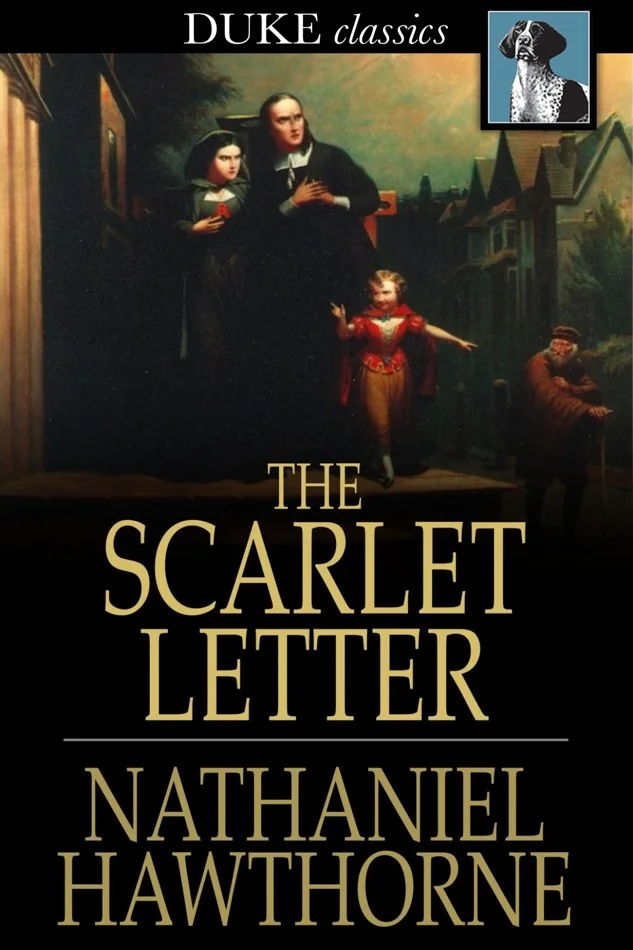
Chapter 1 I. The Prison Door
A crowd of Puritan settlers gathers outside Boston's first prison, a stark wooden building with an oak door reinforced with iron spikes. The assembled throng consists of men in steeple-crowned hats and women in hoods, all waiting in their characteristic dark clothing before this grim edifice that represents one of the earliest establishments of the colony.
The narrator reflects on how the founders of new colonies invariably establish two essential institutions first: a cemetery and a prison. Boston's prison, built near Cornhill, arose almost simultaneously with the first burial ground around Isaac Johnson's grave, which later became part of King's Chapel's churchyard. Despite being only fifteen to twenty years old, the wooden jail already bears the weathered appearance of age, its iron-studded door rusted as though it had existed since time immemorial.
Between the prison and the street lies an unkempt patch of ground overtaken by weeds and unsightly vegetation, symbolically described as 'the black flower of civilized society.' However, amid this desolation grows a wild rose bush beside the prison door. The narrator suggests this rose bush might have either survived from the ancient wilderness or sprouted beneath the footsteps of Ann Hutchinson as she entered the prison. The chapter concludes with the narrator metaphorically plucking a rose to offer readers, suggesting it might symbolize moral beauty amidst the tale of human frailty and sorrow about to unfold.
Key Events
- Description of Boston's first prison and assembled crowd
- Establishment of prison and cemetery as first colonial institutions
- Introduction of the symbolic rose bush at the prison door
Characters Introduced
- Ann Hutchinson
Themes
- Civilization versus wilderness
- Beauty amidst darkness
- Justice and punishment
- The weight of history
- Natural world versus man-made institutions
Chapter 2 II. The Market-place
The crowd that gathered outside Boston's prison now witnesses the emergence of the condemned woman herself. Hester Prynne steps into the summer morning light, carrying her three-month-old infant and wearing an elaborately embroidered scarlet letter 'A' on her breast. The assembled townspeople, particularly the women, discuss various forms of punishment common in their society - from the correction of disobedient servants to the execution of witches - demonstrating the close interweaving of religion and law in Puritan society.
Despite her shame, Hester carries herself with dignity and grace, her beauty enhanced rather than diminished by her circumstances. Her appearance startles many who knew her before, as she has transformed the intended mark of shame into an artistic statement, having carefully embroidered the letter with gold thread and adorned herself in fine clothing that exceeds the colony's sumptuary laws.
Hester is led to the scaffold in the market-place, which stands near Boston's earliest church. Though spared the physical constraint of the pillory device, she must stand on the platform for public viewing, enduring the weight of a thousand condemning eyes. As she stands there, her mind wanders through memories of her past - her childhood in England, her father's grey stone house, and significant moments leading to her present circumstance. Among these recollections appears the image of a pale, scholarly man with a slightly deformed shoulder, suggesting a connection to her untold story.
The crowd's solemn reaction to her punishment is overseen by the colony's dignitaries - the governor, counselors, a judge, a general, and ministers including the young Reverend Master Dimmesdale - who watch from a balcony of the meeting-house. Among the crowd, the witch Mistress Hibbins observes with particular interest. Rather than finding relief in mockery or scorn, Hester finds the grave silence of the assembled crowd almost unbearable, though she maintains her composure through the ordeal. The chapter ends with Hester clutching her crying infant, touching the scarlet letter to confirm the reality of her situation amid the flood of memories.
Key Events
- Hester Prynne emerges from prison with her infant
- First public display of the scarlet letter
- Hester stands on the scaffold for public shame
- Revelation of Hester's memories and past life
- Introduction of the mysterious scholarly man in Hester's memories
Characters Introduced
- Mistress Hibbins
- Reverend Master Dimmesdale
Themes
- The transformation of shame into art and defiance
- Memory as escape from present suffering
- The performative nature of Puritan justice
- Social hierarchy and religious authority in colonial governance
- The psychological weight of public condemnation
Chapter 3 III. The Recognition
While enduring her public shame on the scaffold, Hester's attention is suddenly drawn to a peculiar figure at the crowd's edge - a small man in a mixture of civilized and savage clothing, accompanied by a Native American. The stranger has a slightly deformed shoulder that he attempts to conceal, and upon seeing him, Hester clutches her baby with such force that it cries out in pain. The man's initial casual glance transforms into an intense stare, and though his face briefly contorts with horror, he quickly masters his expression.
The stranger inquires about Hester from a townsman, who explains her situation and reveals that she is the wife of a learned man who sent her ahead to the colonies while he remained in Amsterdam. The townsman shares that no word has been heard from her husband in two years, and that she refuses to name her baby's father. The stranger, displaying bitter interest in these details, learns that the magistrates have shown mercy by sentencing her to three hours on the scaffold and a lifetime of wearing the scarlet letter instead of death.
The public interrogation begins as Reverend Wilson calls upon Reverend Dimmesdale to appeal to Hester's conscience. Dimmesdale makes an impassioned plea for Hester to name her fellow sinner. Despite his tremulous and moving appeal, which stirs the hearts of all present and even affects Hester's baby, she firmly refuses to reveal her secret. The stranger observes this exchange intently, while Dimmesdale, with his hand upon his heart, commends the strength of Hester's heart.
The chapter concludes with Reverend Wilson delivering a lengthy sermon about sin, focusing particularly on the symbolism of the scarlet letter. Throughout this final ordeal, Hester maintains a stoic demeanor, having reached the limits of her emotional endurance. She is eventually led back to prison, with witnesses noting an eerie red glow cast by the letter as she disappears into the dark passageway.
Key Events
- Appearance of the mysterious stranger with the deformed shoulder
- Revelation of Hester's marriage to a learned man from Amsterdam
- Reverend Dimmesdale's public appeal to Hester
- Hester's steadfast refusal to name her fellow sinner
- Wilson's sermon and Hester's return to prison
Characters Introduced
- Governor Bellingham
- Reverend John Wilson
- The Stranger (Hester's husband)
- The Native American companion
Themes
- Public shame versus private guilt
- The power of secrets and silence
- Religious authority and moral judgment
- Personal integrity versus social pressure
- The complexity of sin and punishment
Chapter 4 IV. The Interview
Back in her prison cell, Hester becomes dangerously agitated, causing concern for both herself and her infant who seems to have absorbed her mother's anguish through nursing. The jailer, Master Brackett, calls for medical assistance from a physician who turns out to be the stranger from the crowd - now identifying himself as Roger Chillingworth. Upon entering the cell, Chillingworth first tends to the suffering infant with medicine from his leather case, drawing upon knowledge gained from both alchemy and his time with Native Americans.
Once alone with Hester, Chillingworth reveals himself as her long-lost husband and confronts her about her infidelity. He acknowledges his own folly in marrying a young, beautiful woman despite his age and deformity, admitting that their marriage was unnatural from the start. While he claims to forgive Hester, stating that they have wronged each other equally, his true intentions become clear as he fixates on discovering the identity of her lover, whom he views as the one who has wronged them both.
Chillingworth extracts a solemn oath from Hester, demanding she keep his true identity secret from everyone, including her former lover. He announces his intention to remain in the settlement under his new name, determined to discover the identity of Hester's paramour through careful observation and his scholarly abilities. Though he promises not to harm the man physically or damage his reputation, his words and demeanor suggest a deeper, more sinister form of vengeance. The interview concludes with Chillingworth's chilling declaration that while he won't destroy Hester's soul, he has other plans in mind, leaving Hester troubled by his ominous smile and dark intentions.
Key Events
- Roger Chillingworth reveals his true identity to Hester
- Chillingworth treats the sick infant with medicine
- Chillingworth forgives Hester but vows to find her lover
- Hester swears an oath to keep Chillingworth's identity secret
- Chillingworth announces his intention to settle in the community under his new name
Characters Introduced
- Master Brackett
Themes
- Revenge vs. forgiveness
- Secret identities and deception
- The consequences of past actions
- Marriage and its obligations
- The relationship between physical and moral suffering
Chapter 5 V. Hester at Her Needle
Released from prison, Hester Prynne faces the daunting challenge of reintegrating into Puritan society while bearing the scarlet letter. Unlike the dramatic public spectacle of her punishment, she must now endure the daily torment of isolation and shame without the protective numbness of that initial shock. Though free to leave New England and start anew elsewhere, Hester chooses to remain, settling in an isolated cottage on the peninsula's outskirts, driven by a complex mixture of penance, fate, and an unspoken connection to the father of her child.
Hester establishes herself as a skilled needleworker, her artistic talents providing a means of sustenance despite her social isolation. Her elaborate embroidery becomes sought after for official ceremonies, military decorations, and even the Governor's attire, though she is notably never asked to work on bridal veils. She lives ascetically, wearing plain clothes save for the scarlet letter, while channeling her earnings into charity and dressing her daughter in fantastically decorated garments, perhaps hiding deeper meaning in the child's attire.
This new existence brings an endless series of subtle torments as Hester navigates her position as a living symbol of sin. Children flee from her, religious leaders use her as a sermon subject, and women of all classes find ways to wound her with their words and actions. Most disturbing to Hester is a newfound sensitivity she develops - a seeming ability to recognize hidden sin in others, manifesting as sympathetic throbs from the scarlet letter when passing supposedly virtuous community members. This perception torments her, suggesting either diabolic influence or an uncomfortable truth about human nature.
The community develops its own dark mythology around Hester and the scarlet letter, with some claiming the emblem glows with hellfire at night. Though such tales are dismissed as superstition, they reflect the deep psychological impact of both the punishment and Hester's dignified endurance of it. Despite her isolation and suffering, Hester maintains her integrity, refusing to believe that others share her guilt, even as her mysterious new sense suggests otherwise.
Key Events
- Hester's release from prison and establishment in isolated cottage
- Development of her needlework business and reputation
- Emergence of her supernatural sensitivity to others' sins
- Community's development of myths about the glowing scarlet letter
- Hester's choice to remain in New England despite opportunity to leave
Themes
- Social isolation and ostracism
- Public shame versus private suffering
- The duality of sin and virtue in Puritan society
- Art as both sustenance and expression
- The supernatural versus the psychological
Chapter 6 VI. Pearl
Pearl, Hester's child born of sin, has grown into a beautiful but peculiar young girl whose otherworldly quality both enchants and disturbs those around her. Despite her physical perfection and natural grace, she displays an ungovernable nature that Hester believes stems from the passionate circumstances of her conception. Hester dresses her daughter in elaborate, richly decorated clothing, creating a stark contrast between Pearl's magnificent appearance and their humble circumstances, perhaps as a way of expressing her own repressed artistic nature.
Pearl proves resistant to all forms of discipline, displaying a wild, capricious temperament that manifests in unsettling ways. The child shows an uncanny awareness of her mother's scarlet letter, having noticed it before anything else in her infancy, and often fixates on it with disturbing intelligence. Pearl's interaction with the letter becomes a source of torment for Hester, as the child frequently draws attention to it through games and gestures, seeming to understand its significance despite her young age.
In her isolation, Pearl develops into a social outcast among the settlement's children, responding to their rejection with fierce hostility and witch-like anathemas. She creates her own rich fantasy world in solitude, but notably populates it with adversaries rather than friends, suggesting a deep-seated antagonism toward the world that mirrors her mother's situation. The chapter culminates in a revealing exchange between mother and child, where Pearl's response to questions about her divine parentage demonstrates both her precocious insight and her troubling connection to her mother's sin, leading some townspeople to whisper that she might be a demon offspring.
Key Events
- Pearl's first awareness of the scarlet letter is revealed
- Pearl's rejection by and hostility toward other children
- Pearl's disturbing games targeting the scarlet letter
- Pearl's denial of having a Heavenly Father
- Development of Pearl's isolated fantasy world
Themes
- The inheritance of sin
- Social isolation and its effects on childhood
- The relationship between mother and child
- The supernatural versus the natural
- The manifestation of guilt through subsequent generations
Chapter 7 VII. The Governor's Hall
Hester visits Governor Bellingham's mansion, ostensibly to deliver embroidered gloves, but her true purpose is far more urgent - she has learned of a plan by leading colonists to take Pearl away from her. These prominent citizens, including Bellingham himself, argue that if Pearl is of demonic origin, she poses a threat to Hester's salvation, and if the child is capable of Christian growth, she would be better served under different guardianship. The gravity of this custody dispute reflects the era's tendency to elevate personal matters to affairs of state.
As Hester and Pearl make their way to the Governor's mansion, Pearl's appearance and behavior continue to draw attention. Dressed in an elaborate crimson velvet tunic embroidered with gold, Pearl's outfit eerily mirrors her mother's scarlet letter, seeming to be another manifestation of the symbol itself. When Puritan children attempt to taunt them, Pearl fiercely charges at them like an 'infant pestilence,' sending them fleeing in terror before calmly returning to her mother's side.
Arriving at Bellingham's impressive wooden mansion, adorned with glass-studded stucco that glitters like diamonds in the sunlight, Hester and Pearl encounter a bond-servant who initially tries to turn them away, citing the Governor's meeting with ministers and a physician. Inside the grand entrance hall, they find themselves surrounded by the trappings of English aristocracy - carved furniture, family portraits, and a prominent suit of armor. Pearl becomes fascinated with the armor's breastplate, where the reflection shows an exaggerated version of Hester's scarlet letter, seeming to consume her mother's entire image. The chapter ends as voices approach from the garden, where the Governor and his companions are returning to the house.
Key Events
- Hester learns of the plan to take Pearl away
- Mother and daughter travel to Governor Bellingham's mansion
- Pearl's confrontation with Puritan children
- Entry into the Governor's impressive hall
- Pearl's discovery of the distorted reflection in the armor
Characters Introduced
- The bond-servant
Themes
- Public authority versus maternal rights
- The relationship between personal matters and state affairs
- Symbolic connections between Pearl and the scarlet letter
- Class and social hierarchy in Puritan society
- The contrast between English refinement and New World simplicity
Chapter 8 VIII. The Elf-child and the Minister
The custody battle for Pearl comes to a head as Governor Bellingham, Reverend Wilson, Reverend Dimmesdale, and Roger Chillingworth encounter Hester and her daughter at the Governor's mansion. Pearl's unusual nature is immediately apparent as she responds to questioning with wild, fanciful answers, claiming she was plucked from the rose bush by the prison door rather than acknowledging God as her creator. This behavior alarms the officials, who view it as evidence that the child lacks proper Christian guidance.
When Bellingham announces his intention to remove Pearl from Hester's care, Hester responds with fierce determination, declaring that Pearl is both her happiness and her torture - a living embodiment of the scarlet letter itself. In desperation, she turns to Reverend Dimmesdale, appealing to him as her former pastor to speak on her behalf. Dimmesdale, though visibly unwell and agitated, delivers an impassioned defense of the mother-child bond, arguing that God intended Pearl to serve as both blessing and retribution for Hester, helping to prevent her from falling into deeper sin.
Following Dimmesdale's compelling argument, the officials agree to let Hester keep Pearl, provided the child receives proper religious instruction. A telling moment occurs when Pearl, usually wild and defiant, approaches Dimmesdale with an uncharacteristic display of tenderness, laying her cheek against his hand. The chapter concludes with a disturbing encounter with Mistress Hibbins, who invites Hester to a witch's gathering in the forest. Hester's response - that she would have accepted had Pearl been taken from her - demonstrates how crucial Pearl is in keeping her mother anchored to virtue.
Key Events
- Pearl fails her religious examination
- Dimmesdale's defense of Hester's right to keep Pearl
- Officials decide to let Hester keep Pearl
- Pearl's tender moment with Dimmesdale
- Mistress Hibbins' invitation to the forest gathering
Characters Introduced
- No new characters introduced
Themes
- The complex nature of punishment and redemption
- The sacred bond between mother and child
- The tension between religious authority and personal morality
- The role of children in divine providence
- The thin line between salvation and damnation
Chapter 9 IX. The Leech
Following the resolution of Pearl's custody battle, Roger Chillingworth continues his calculated integration into Boston society through his medical practice. His expertise, combining European learning with Native American remedies acquired during his captivity, makes him invaluable to the settlement. The community views his arrival as providential, especially given Reverend Dimmesdale's declining health - the minister has grown increasingly pale and weak, often clutching his heart in apparent pain.
Chillingworth strategically positions himself as Dimmesdale's personal physician, overcoming the minister's initial reluctance to accept medical help. Their relationship deepens through long walks along the seashore and intellectual discussions that both attract and disturb Dimmesdale's orthodox sensibilities. Through careful manipulation, Chillingworth arranges to lodge in the same house as his patient, ostensibly to provide better care.
As months pass, the community observes disturbing changes in Chillingworth's appearance and demeanor. His scholarly countenance transforms into something increasingly ugly and malevolent, particularly in Dimmesdale's presence. Drawing on their collective intuition, the townspeople begin to suspect that Chillingworth might be Satan's agent, permitted by Providence to torment their beloved minister. Dimmesdale's visible deterioration - marked by growing gloom and terror in his eyes - seems to confirm their fears about this spiritual battle, though they maintain hope for their minister's eventual triumph.
Key Events
- Chillingworth establishes himself as a respected physician in Boston
- Chillingworth becomes Dimmesdale's personal physician and confidant
- Chillingworth arranges to live in the same house as Dimmesdale
- The community begins to suspect Chillingworth's evil nature
- Dimmesdale's health continues to deteriorate under Chillingworth's care
Themes
- The predatory nature of revenge disguised as healing
- Medical authority as a tool for psychological manipulation
- Community intuition versus individual blindness
- The physical manifestation of spiritual corruption
Chapter 10 X. The Leech and His Patient
Chillingworth's transformation from scholarly physician to obsessed tormentor becomes increasingly apparent as he delves deeper into Dimmesdale's psyche. Building on his successful positioning as the minister's personal doctor, what began as supposedly impartial medical investigation has evolved into a consuming obsession, with Chillingworth metaphorically mining the minister's heart like a prospector searching for gold or a sexton digging in a grave. His eyes now occasionally gleam with an ominous blue fire, betraying the darkness that has overtaken his soul in his quest for revenge.
The relationship between physician and patient grows more complex as they engage in loaded conversations about guilt, confession, and redemption. During one such discussion in Dimmesdale's study, they debate whether it is better to reveal one's sins or keep them hidden. Their theoretical discourse is interrupted by Pearl's laughter from the adjacent graveyard, where she dances irreverently on tombstones and decorates Hester's scarlet letter with burrs. The child's perceptive nature shows through when she warns her mother about the 'old black man' who has already 'caught' the minister, demonstrating an uncanny understanding of Chillingworth's true nature.
The chapter culminates in a pivotal confrontation between Chillingworth and Dimmesdale when the physician suggests that the minister's physical ailments stem from unconfessed spiritual wounds. Dimmesdale reacts with uncharacteristic violence to this probing, declaring that he will only confide in the 'one Physician of the soul.' Though they later reconcile, with Dimmesdale apologizing for his outburst, the chapter ends with a chilling scene: Chillingworth discovers something on the sleeping minister's chest that causes him to react with 'ghastly rapture,' suggesting he has finally found concrete evidence of Dimmesdale's guilt. His triumphant reaction is described as being so demonic that it reveals how Satan himself might appear when claiming a soul.
Key Events
- Chillingworth's investigation becomes an obsession
- Theological debate between Dimmesdale and Chillingworth about confession
- Pearl's prophetic warning about Chillingworth in the graveyard
- Dimmesdale's emotional outburst against Chillingworth's probing
- Chillingworth's discovery of something on Dimmesdale's chest while the minister sleeps
Themes
- Chillingworth's moral degradation through revenge
- The psychological warfare between physician and patient
- Pearl's supernatural insight into adult corruption
- The tension between confession and concealment of sin
- The discovery of physical evidence of spiritual guilt
Chapter 11 XI. The Interior of a Heart
With Dimmesdale's secret now fully exposed to his probing eyes, Chillingworth abandons any pretense of healing and dedicates himself entirely to psychological torment. Though he cannot follow his original plan of becoming Dimmesdale's confidant, he finds a deeper satisfaction in his role as intimate tormentor, using his position as physician to observe and manipulate the minister's suffering. With an almost supernatural perception, Chillingworth can now read and exploit every movement of Dimmesdale's soul, playing upon his guilt like a musician on an instrument.
Paradoxically, as Dimmesdale's private torment intensifies, his public reputation soars to new heights. His suffering transforms his sermons into powerful, emotionally resonant messages that connect deeply with his congregation. While older and more learned ministers may surpass him in theological knowledge, Dimmesdale's anguished eloquence speaks directly to the human heart, making him extraordinarily popular. The community's adoration, however, only increases his internal agony, as their reverence feels like a mockery of his hidden sin.
Dimmesdale's private life becomes a study in self-torture, as he adopts increasingly extreme practices of penance. He frequently scourges himself with a bloody whip, fasts until weak, and maintains long vigils where he stares at himself in mirrors by lamplight. During these vigils, he experiences haunting visions, including diabolic shapes, angels, dead relatives, and most significantly, Hester and Pearl pointing to his breast. Though he recognizes these as hallucinations, they feel more real to him than the physical world, which has become insubstantial in his state of living falsehood. The chapter concludes with Dimmesdale, driven by a sudden impulse, dressing himself and venturing out into the night.
Key Events
- Chillingworth's transformation into a deliberate tormentor
- Dimmesdale's rise to unprecedented popularity as a preacher
- Revelation of Dimmesdale's private acts of penance
- Dimmesdale's nighttime vigils and visions
- Dimmesdale's sudden decision to venture out at night
Themes
- The duality of public virtue and private guilt
- Self-torture and penance
- The psychology of guilt and confession
- The relationship between suffering and spiritual insight
- The destructive nature of revenge
- The contrast between appearance and reality
Chapter 12 XII. The Minister's Vigil
In the dark of night, Dimmesdale finds himself drawn to the scaffold where Hester endured her public shame seven years earlier. Standing on the platform, he experiences a mix of penitence and cowardice, eventually letting out an anguished shriek that echoes through the empty town. Though he fears discovery, only Governor Bellingham and Mistress Hibbins briefly notice the disturbance from their windows, with the latter mistaking it for the sounds of witches.
The night grows stranger as Reverend Wilson passes by with a lantern, having just left Governor Winthrop's deathbed. Dimmesdale, in a state between madness and dark humor, nearly calls out to him but remains silent. His solitude is soon broken by the arrival of Hester and Pearl, who have also been at Winthrop's deathbed where Hester took measurements for his burial robe. In a moment of connection, the three hold hands on the scaffold, forming what the narrator describes as an 'electric chain.' Pearl, with her characteristic perception, asks if Dimmesdale will stand with them at noon the next day, but he can only promise to join them on Judgment Day.
The scene reaches its climax when a meteor illuminates the night sky, appearing to form a giant letter 'A'. During this supernatural display, Pearl spots Chillingworth watching them from nearby, causing Dimmesdale to shiver with inexplicable horror. When questioned about Chillingworth's identity, Pearl responds with gibberish, maintaining the secret of his true identity. The chapter concludes with Chillingworth leading the weakened minister home, followed by a powerful sermon the next day. The discovery of Dimmesdale's glove on the scaffold and rumors of the meteor's meaning circulate through the town, adding to the growing layers of symbolism and secrecy.
Key Events
- Dimmesdale's midnight vigil on the scaffold
- The meeting of Dimmesdale, Hester, and Pearl on the scaffold
- The appearance of the meteor in the shape of an 'A'
- Pearl's refusal to reveal Chillingworth's identity
- Discovery of Dimmesdale's glove on the scaffold the next day
- Death of Governor Winthrop
Characters Introduced
- The grey-bearded sexton
Themes
- Public vs. private guilt
- The supernatural as divine revelation
- The power of shared secrets
- The relationship between sin and confession
- The interpretation of natural phenomena as spiritual signs
Chapter 13 XIII. Another View of Hester
Following the profound midnight encounter at the scaffold, Hester carries with her a disturbing new understanding of Dimmesdale's condition. His moral strength appears completely broken, though his intellect remains sharp, and she realizes that Chillingworth's influence has taken a devastating toll. Feeling a unique responsibility due to their shared sin and her knowledge of Chillingworth's true identity, Hester resolves to help the minister against his tormentor.
Over the years, the community's perception of Hester has gradually shifted from hostility to acceptance. Her quiet dignity, charitable works, and selfless aid during times of sickness and trouble have earned her a measure of respect. Some even begin to interpret the scarlet letter as standing for 'Abel,' meaning strength, rather than adultery. However, this transformation comes at a personal cost - Hester's beauty and vitality have been replaced by a stark austerity, her luxuriant hair hidden and her manner devoid of passion.
In her isolation, Hester's mind has turned from emotion to intellectual contemplation, leading her to question societal conventions and women's place within them. These radical thoughts, which might have made her a religious reformer like Ann Hutchinson had circumstances been different, are tempered only by her devotion to Pearl's upbringing. Hester's philosophical wanderings often lead her to dark conclusions about the futility of women's existence, yet she channels these energies into raising her daughter amid countless difficulties.
Having witnessed Dimmesdale's deterioration and recognized Chillingworth's poisonous influence, Hester acknowledges her own culpability in allowing this situation to develop through her promise of secrecy. Now stronger after years of hardship, she determines to confront Chillingworth and attempt to save Dimmesdale from his tormentor's grip. The chapter concludes with Hester spotting Chillingworth gathering herbs, presenting an opportunity for this confrontation.
Key Events
- Hester's realization of Dimmesdale's deteriorating condition
- Community's gradual acceptance of Hester over seven years
- Transformation of the scarlet letter's meaning in public perception
- Hester's development of radical philosophical thoughts
- Hester's decision to confront Chillingworth
- Discovery of Chillingworth gathering herbs
Themes
- Hester's evolution from social pariah to community pillar
- The intellectual awakening born from social isolation
- The personal cost of public redemption
- Puritan women's constrained agency and hidden rebellion
- Complicity in another's moral destruction
- The tension between maternal duty and philosophical freedom
Chapter 14 XIV. Hester and the Physician
Hester sends Pearl to play by the seashore while she approaches Chillingworth for their inevitable confrontation. As Pearl amuses herself by looking at her reflection in tide pools, Hester and Chillingworth engage in a tense conversation that reveals how deeply he has transformed over the seven years. While he speaks of possible mercy from the magistrates regarding her scarlet letter, Hester observes the dramatic changes in his appearance - his once-scholarly demeanor replaced by an eager, searching, almost fierce look that occasionally reveals glimpses of inner fire.
The confrontation intensifies as Hester expresses her guilt and regret over binding herself to secrecy about Chillingworth's identity, acknowledging that this silence enabled him to torture Dimmesdale. Chillingworth defends his actions with disturbing pride, claiming credit for keeping Dimmesdale alive while simultaneously describing his systematic psychological torment of the minister. He reveals that he has derived a perverse pleasure from analyzing and intensifying Dimmesdale's suffering, admitting that he has transformed himself into a fiend through his obsessive pursuit of revenge.
The conversation reaches its climax when Hester declares her intention to reveal Chillingworth's true identity to Dimmesdale, regardless of the consequences. Though Chillingworth expresses a moment of pity for Hester, recognizing the waste of her noble nature, he refuses her plea for forgiveness and mercy. He insists that their fate was sealed by their first missteps, and that everything since has been a dark necessity. The chapter ends with Chillingworth dismissing Hester to return to his herb gathering, having fully embraced his role as tormentor and rejected any possibility of redemption.
Key Events
- Hester's confrontation with Chillingworth about his treatment of Dimmesdale
- Chillingworth's admission of his transformation into a fiend
- Hester's declaration that she will reveal Chillingworth's identity to Dimmesdale
- Chillingworth's rejection of mercy and forgiveness
- Pearl's symbolic interaction with her reflection in the tide pools
Themes
- The corrupting nature of revenge
- The consequences of secrecy and guilt
- The possibility of redemption versus fate
- Personal transformation and moral decay
- The power of confession versus concealment
Chapter 15 XV. Hester and Pearl
Hester watches Chillingworth's hunched figure depart, gathering herbs along the ground as he goes. Her contemplation turns dark as she wonders whether the earth itself might produce poisonous plants beneath his touch, and whether his shadow carries an ominous presence. Despite attempting to suppress her feelings, Hester admits to herself that she hates her former husband, reflecting bitterly on their past marriage and how he had deceived her into believing she could be happy with him.
Meanwhile, Pearl continues amusing herself by the seashore in increasingly elaborate ways. She plays with her reflection in tide pools, builds boats from birch-bark, chases sea foam, and attempts to pelt seabirds with pebbles. When she accidentally injures a bird, she shows unexpected compassion by ceasing her game. In a telling moment, Pearl creates a costume for herself as a mermaid, complete with a green letter 'A' made from eel-grass on her chest, mimicking her mother's scarlet letter.
The chapter culminates in a series of probing questions from Pearl about the meaning of the scarlet letter, particularly its connection to Dimmesdale's habit of keeping his hand over his heart. Her persistent questioning reveals both her precocious understanding and her role as a living conscience. Hester, seeing a new depth in her daughter, considers for the first time that Pearl might be old enough to become a confidante rather than just a burden. However, when pressed about the letter's meaning, Hester breaks her seven-year streak of honesty about the symbol, dismissively claiming she wears it for its gold thread. The chapter ends with Pearl's relentless pursuit of the truth, even into the following morning, forcing Hester to threaten her with punishment to end the questioning.
Key Events
- Hester's admission of hatred toward Chillingworth
- Pearl's creation of a green letter 'A' from seaweed
- Pearl's persistent questioning about the scarlet letter's meaning
- Hester's first lie about the scarlet letter's significance
- Hester's realization that Pearl might be mature enough to be a confidante
Themes
- Truth versus deception
- The burden of guilt and secrets
- Mother-daughter relationships
- Natural innocence versus learned shame
- The symbolic power of the scarlet letter
Chapter 16 XVI. A Forest Walk
Following her confrontation with Chillingworth, Hester resolves to reveal his true identity to Dimmesdale, but struggles to find an appropriate opportunity. Rather than meeting in his study, where many penitents have confessed their sins, she decides to seek him out in the open forest, away from Chillingworth's interference. Learning that Dimmesdale has gone to visit the Apostle Eliot among his Indian converts, Hester sets out with Pearl to intercept him on his return journey through the forest.
During their forest walk, Pearl and Hester engage in a revealing game with sunlight, as Pearl notices how the sunshine seems to flee from her mother's scarlet letter. The child demonstrates her characteristic vivacity by successfully catching the light, while Hester remains in shadow. Their interaction leads to a discussion about the 'Black Man' of the forest, a common superstition of the period, with Pearl connecting this figure to both her mother's scarlet letter and Mistress Hibbins. Hester plays along with Pearl's questioning, admitting to meeting the Black Man and suggesting the scarlet letter is his mark.
As they venture deeper into the forest, mother and daughter find a secluded dell beside a melancholy brook. The setting reflects the somber mood of their situation, with the brook's sad murmuring contrasting sharply with Pearl's lively spirit. When Hester hears Dimmesdale approaching, she sends Pearl away to play. The minister appears notably changed from his public persona, looking haggard and despondent, barely able to continue walking. His deteriorated condition, marked by his hand clutched over his heart, presents a stark picture of his inner torment, setting the stage for the crucial conversation to come.
Key Events
- Hester's decision to meet Dimmesdale in the forest
- The symbolic game with sunlight between Pearl and Hester
- Pearl's questioning about the Black Man and the scarlet letter
- Discovery of the secluded dell by the brook
- Dimmesdale's arrival in a state of deep despair
Themes
- Nature as reflection of inner states
- The contrast between innocence and guilt
- The weight of hidden sin
- The relationship between public and private personas
- Superstition and moral judgment
Chapter 17 XVII. The Pastor and His Parishioner
Their long-awaited forest encounter finally allows Hester to reveal the truth she has carried for seven years: Roger Chillingworth is her husband. The revelation sends Dimmesdale into despair and momentary anger, though he ultimately forgives Hester while acknowledging that Chillingworth's revenge has been darker than their original sin. Their shared moment of truth creates an intimate connection as they discuss their past and present circumstances, with Dimmesdale expressing how his public veneration has only intensified his private torment.
As they grapple with the implications of this revelation, Hester recognizes the full extent of the damage done to Dimmesdale by allowing Chillingworth to remain close to him. She understands now that Chillingworth's presence has been poisoning the minister's spirit, keeping his conscience in a perpetual state of agitation and leading him toward potential madness. Their discussion reveals the deep emotional and spiritual toll that their shared secret and Chillingworth's manipulation have taken on them both.
Faced with Dimmesdale's desperation, Hester proposes a bold solution: escape. She suggests they could flee into the wilderness or across the sea to Europe, where they might start anew beyond Chillingworth's reach. Though initially resistant, claiming he lacks the strength to venture into the world alone, Dimmesdale's resolve begins to waver when Hester declares that he won't have to go alone. This simple yet powerful statement marks a turning point in their relationship and sets the stage for potential dramatic changes in their circumstances.
Key Events
- Hester reveals Chillingworth's true identity to Dimmesdale
- Dimmesdale initially reacts with anger but ultimately forgives Hester
- Hester proposes escape to Europe or the wilderness
- Hester promises to accompany Dimmesdale in his escape
- Dimmesdale confesses the torment of his public veneration
Themes
- The revelation of long-held secrets
- Redemption through escape
- Chillingworth's psychological manipulation
- The destructive nature of prolonged revenge
- The possibility of starting anew beyond societal judgment
Chapter 18 XVIII. A Flood of Sunshine
The profound transformation begins as Dimmesdale, despite his initial fear at the boldness of their escape plan, finds himself drawn to Hester's broader perspective. Her years of social isolation have freed her from conventional constraints, allowing her to envision possibilities beyond societal boundaries. Their contrasting experiences - Hester's public shame versus Dimmesdale's internal torment - converge at this pivotal moment where the minister finally chooses to embrace a new life with her.
In a symbolic gesture of liberation, Hester removes the scarlet letter from her breast and throws it among the withered leaves near the brook. This act of defiance triggers an immediate transformation - her hair falls free, her beauty returns, and her youth seems restored. Nature itself appears to respond to their newfound hope, as sunshine suddenly floods the forest, turning the gloomy setting into a radiant scene that mirrors their emotional state. Their decision to flee together creates a magical moment where love transforms not only their spirits but seemingly the physical world around them.
The chapter concludes with Pearl's introduction to this transformed reality, as Hester calls her to meet Dimmesdale in his new role. While the adults share their moment of joy, Pearl has been experiencing her own communion with the forest, which welcomes her as a kindred spirit. The wildlife - from partridges to squirrels, and even a fox - accepts her presence, suggesting her natural affinity with this untamed environment. Pearl adorns herself with forest flowers, becoming like a nymph child, though her approach slows when she spots Dimmesdale, hinting at the challenges that lie ahead in uniting their unconventional family.
Key Events
- Dimmesdale's decision to flee with Hester
- Hester's removal of the scarlet letter
- The transformation of the forest from gloom to sunshine
- Pearl's communion with the forest creatures
- Pearl's hesitation upon seeing Dimmesdale
Themes
- Liberation from social constraints
- Nature's sympathy with human emotion
- Transformation and renewal
- The contrast between civilized and natural law
- The relationship between sin and redemption
Chapter 19 XIX. The Child at the Brookside
Hester and Dimmesdale watch Pearl playing in the forest, adorned with wildflowers, as they discuss their newfound plans for escape. Their conversation reveals both hope and anxiety as they openly acknowledge Pearl as the living symbol of their connection - the physical manifestation of their shared secret that has been visible to the world for seven years. Dimmesdale expresses fear that his features might be recognizable in the child's face, marking the first time they have spoken so directly about their relationship.
Their attempt to unite as a family meets an unexpected obstacle when Pearl, reaching the brook's edge, refuses to cross over to them. Standing in a ray of sunshine, with her reflection shimmering in the water below, Pearl fixes them with a penetrating stare and points insistently at her mother's breast, where the scarlet letter is now missing. The child's strange behavior escalates into a violent tantrum, complete with screams and wild gestures, all while maintaining her demanding gesture toward Hester's chest.
Understanding Pearl's distress, Hester retrieves the discarded scarlet letter and pins it back on her chest, immediately losing the radiant transformation she had briefly enjoyed. Only then does Pearl cross the brook to embrace her mother, kissing both her face and, in a characteristic display of her complex nature, the scarlet letter itself. The chapter concludes with Pearl's continued resistance to Dimmesdale, refusing his kiss and washing her forehead in the brook to remove it, suggesting that despite their plans for a future together, the path to becoming a true family will not be simple.
Key Events
- Hester and Dimmesdale openly discuss Pearl as their child
- Pearl refuses to cross the brook without the scarlet letter
- Hester is forced to retrieve and replace the scarlet letter
- Pearl finally crosses the brook and embraces her mother
- Pearl rejects Dimmesdale's attempt at affection
- Pearl washes away Dimmesdale's kiss in the brook
Themes
- The unbreakable bond between sin and identity
- The complexity of family reconciliation
- The power of symbolic gestures
- Children's intuitive understanding of truth
- The persistence of past sins despite attempts at escape
Chapter 20 XX. The Minister in a Maze
After leaving Hester and Pearl in the forest, Dimmesdale experiences a profound psychological transformation that manifests immediately in his journey back to town. Everything appears simultaneously familiar and strange to him, as if years rather than mere hours have passed. His newfound plans for escape with Hester have created a dramatic shift in his perspective, leaving him feeling like a different man entirely - one who left his old self behind in the forest.
This transformation manifests in disturbing ways as Dimmesdale encounters various townspeople. He feels unprecedented urges to commit blasphemous acts: to whisper heretical thoughts to a pious deacon, to argue against the immortality of the soul with an elderly widow, and to corrupt a young female parishioner's innocence. These impulses, though resisted, reveal the profound moral crisis within him, as his decision to flee with Hester has seemingly awakened a darker side of his nature.
The minister's internal struggle reaches its peak when he encounters Mistress Hibbins, who cryptically alludes to his forest meeting and suggests a connection to dark powers. Upon reaching his study, Dimmesdale finds himself viewing his surroundings - his books, his unfinished sermon, his entire life - with a strange detachment. The chapter culminates in a tense meeting with Chillingworth, where both men engage in careful verbal sparring while maintaining their facade. In a final burst of energy, Dimmesdale burns his original Election Sermon and writes a new one through the night, feeling simultaneously inspired and corrupted.
Key Events
- Dimmesdale's journey back to town with altered perceptions
- Series of encounters with townspeople where he resists evil impulses
- Confrontation with Mistress Hibbins about his forest visit
- Tense meeting with Chillingworth in his study
- Burning of original Election Sermon and writing of new version
Characters Introduced
- The eldest female church member
- The youngest sister of the church
- The drunken seaman
- Anne Turner
Themes
- The minister's psychological fracturing after his forest decision
- Temptation toward blasphemy and moral corruption
- The transformative power of choosing sin over duty
- Creative inspiration born from spiritual crisis
- The burden of maintaining false appearances
Chapter 21 XXI. The New England Holiday
Election Day transforms colonial Boston's marketplace into an unusually festive scene, filled with craftsmen, settlers, and visitors from the forest settlements. Despite the general celebratory atmosphere surrounding the inauguration of a new Governor, Hester maintains her characteristic gray attire and marble-like composure. However, there's an unseen change in her demeanor, as she faces the crowd voluntarily for what she believes will be the last time before her planned escape, converting her years of agony into a final triumph.
The normally somber Puritan settlement shows rare signs of celebration, though still restrained compared to the festive traditions of Elizabethan England. The marketplace comes alive with wrestling matches and attempts at swordplay demonstrations, though the latter is quickly stopped by the town beadle. The scene is further enlivened by the presence of Native Americans in their traditional dress and Spanish sailors who brazenly flout local customs by drinking and smoking in public, highlighting the contrast between strict Puritan society and the lawless maritime world.
The chapter takes a dark turn when Chillingworth is seen in close conversation with the commander of the ship that Hester has arranged for their escape. Shortly after, the ship's captain approaches Hester and reveals that Chillingworth has booked passage on the same vessel, claiming to be a close friend of the gentleman in their party. The chapter concludes with Chillingworth sending a knowing smile across the marketplace to Hester, conveying a secret and fearful meaning that threatens to destroy their carefully laid escape plans.
Key Events
- Election Day celebration in Boston
- Public gathering at the marketplace with diverse crowds
- Revelation that Chillingworth has booked passage on Hester's escape ship
- Ship captain's unwitting disclosure of Chillingworth's plans to Hester
- Chillingworth's ominous smile across the marketplace
Characters Introduced
- The Spanish sailors
Themes
- Contrast between Puritan restraint and natural human festivity
- The collision of different cultural worlds - Puritan, maritime, and native
- The fragility of carefully constructed escape plans
- Chillingworth's omnipresent surveillance and control
- The irony of public celebration masking private desperation
Chapter 22 XXII. The Procession
The Election Day procession begins with military music and marching soldiers, creating a grand spectacle in the marketplace. As the parade passes, Dimmesdale appears transformed, walking with unprecedented vigor and energy that seems more spiritual than physical. Unlike his usual frail demeanor, he moves with strength and purpose, though his mind appears distant from his surroundings, absorbed in preparation for his upcoming sermon.
Hester watches from the crowd, devastated by Dimmesdale's apparent remoteness from her. Despite their intimate connection in the forest, he now seems utterly beyond her reach, wrapped in his public role and separated from their shared world. Pearl, noticing this distance, questions whether this could be the same minister who kissed her in the forest, while Mistress Hibbins approaches Hester with knowing insinuations about the minister's forest visit and his hidden mark.
Unable to enter the crowded church, Hester positions herself near the pillory scaffold to listen to Dimmesdale's sermon. Though the words are indistinct, his voice carries profound emotion and pain that touches every listener. Meanwhile, Pearl dances through the marketplace, interacting with Indians and sailors, including the ship's captain who reveals that Chillingworth has arranged to join their planned escape voyage. The chapter concludes with Hester enduring renewed public scrutiny as curious onlookers from surrounding towns gather to stare at the scarlet letter, making it burn more painfully than it has since its first day.
Key Events
- Election Day procession featuring Dimmesdale's transformed appearance
- Mistress Hibbins' cryptic confrontation with Hester about the forest meeting
- Ship captain's revelation about Chillingworth joining their escape voyage
- Hester listening to Dimmesdale's sermon from outside the church
- Renewed public fascination with the scarlet letter
Themes
- The paradox of spiritual transformation amid public performance
- The isolation of shared secrets in public spaces
- The magnetic power of notorious symbols
- The collision between private revelation and public duty
- The manipulation of trust through deception
Chapter 23 XXIII. The Revelation of the Scarlet Letter
Dimmesdale emerges from the church at the height of his public acclaim, having delivered what many consider the most inspiring Election Day sermon ever heard in New England. The crowd's rapturous response creates an atmosphere of almost divine celebration, yet beneath this triumph lies a current of melancholy as many sense this might be their beloved minister's final address. Dimmesdale, having reached the pinnacle of his earthly success, appears simultaneously strengthened by spiritual fervor and physically weakened to the point of collapse.
As the procession moves through the marketplace, Dimmesdale suddenly halts near the scaffold where Hester stands with Pearl. Despite Chillingworth's desperate attempt to stop him, Dimmesdale calls Hester and Pearl to join him on the platform. In a dramatic reversal of their forest plans for escape, Dimmesdale chooses public confession over private redemption, acknowledging his role in the sin that Hester has borne alone for seven years. The moment marks both his triumph over Chillingworth's manipulation and his acceptance of divine judgment over earthly salvation.
In his final moments, Dimmesdale reveals to the shocked crowd a mark upon his breast, though its exact nature remains undescribed. The revelation completes his public confession and brings Pearl's transformation, as she finally kisses her father and shows signs of developing normal human sympathies. Dimmesdale's death comes with both victory and uncertainty - while he has escaped Chillingworth's vengeance and unburdened his soul, his final words to Hester suggest doubt about their eternal reunion, emphasizing that their sin against divine law may have eternal consequences despite their earthly repentance.
Key Events
- Dimmesdale's triumphant Election Day sermon
- Dimmesdale's public confession on the scaffold
- Pearl's acceptance of Dimmesdale as her father
- Revelation of the mark on Dimmesdale's chest
- Dimmesdale's death and final words to Hester
- Chillingworth's defeat in losing his victim to public confession
Themes
- Public confession versus private guilt
- The transformative power of truth
- Divine judgment versus earthly redemption
- The consequences of sin and the possibility of salvation
- The relationship between punishment and mercy
Chapter 24 XXIV. Conclusion
In the aftermath of Dimmesdale's death, multiple accounts emerge regarding what transpired on the scaffold. While most witnesses claim to have seen a scarlet letter imprinted on the minister's chest, various theories arise about its origin - some attribute it to self-inflicted torture, others to Chillingworth's dark magic, and still others to the physical manifestation of remorse. A minority of observers, particularly those close to the church, steadfastly deny seeing any mark at all, interpreting Dimmesdale's final moments as a parable about universal sin rather than a personal confession.
Chillingworth's fate takes a dramatic turn following Dimmesdale's death, as he withers away without his target for revenge, dying within the year. In his final act, he bequeaths his considerable fortune to Pearl, making her the richest heiress in the New World. Shortly after his death, Hester and Pearl disappear from the colony, though occasional rumors of their fate drift back across the sea. The story of the scarlet letter becomes a legend in the community, maintaining its power over the imaginations of subsequent generations.
Years later, Hester returns alone to her old cottage, still wearing the scarlet letter by choice. Pearl's fate remains somewhat mysterious, though evidence suggests she married and found happiness abroad, as indicated by letters bearing foreign seals and luxury items sent to her mother. Hester spends her remaining years as a respected counselor to women in distress, particularly those suffering from matters of the heart. She develops a philosophical perspective on women's place in society, believing that a future revelation will establish a more equitable relationship between men and women, though she no longer sees herself as its potential prophet. The narrative concludes with Hester's death and burial near Dimmesdale's grave, their shared tombstone bearing the simple heraldic device of a scarlet letter A on a black field.
Key Events
- Various interpretations emerge about Dimmesdale's final revelation
- Chillingworth's death and bequest of fortune to Pearl
- Hester and Pearl's departure from the colony
- Hester's eventual return alone to New England
- Hester's death and burial near Dimmesdale
- Pearl's implied successful life abroad
Characters Introduced
- No new characters introduced
Themes
- The subjective nature of truth and interpretation
- Redemption through public service
- The transformative power of time on social judgment
- The relationship between love and hate
- Women's role in society and social progress
- The lasting impact of sin and redemption