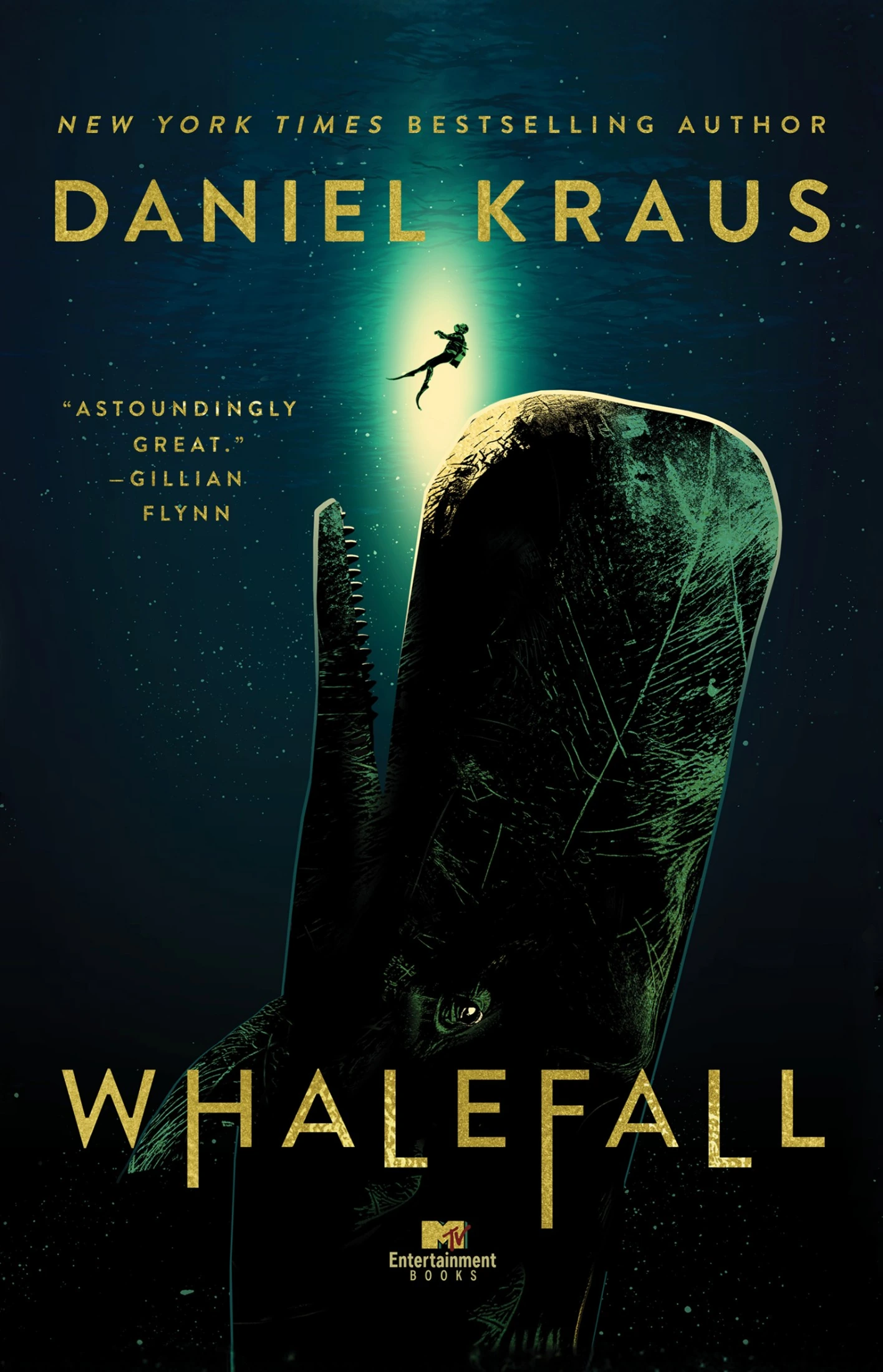
Whalefall
Searching for his estranged father's remains, seventeen-year-old Jay Gardiner is accidentally swallowed by a sperm whale and must combine hard-won diving skills with his family's remembered knowledge to survive, confront their troubled relationship, and reach rescuers.
Overview
Daniel Kraus's Whalefall follows Jay Gardiner, a seventeen-year-old diver who returns to the Pacific Ocean off Monterey, California, a year after his father died by suicide. Jay wants to recover some of Mitt Gardiner's remains from the water near Monastery Beach. His mother Zara and his older sisters Nan and Eva have struggled with the absence of a body, and Jay hopes that locating bones will allow them to mourn and accept him again. The mission also serves a less generous purpose. Jay wants to disprove the public judgment that he abandoned a respected diver when he was dying. He knows another version of Mitt, an alcoholic and volatile father who repeatedly humiliated him and made the ocean a place of forced instruction rather than freedom. What begins as a risky solo dive becomes a struggle for survival after a sperm whale swallows Jay while hunting a giant squid.
The novel's structure makes the relationship between external and internal danger explicit without collapsing them into one. Many short chapters in the present are titled with decreasing readings from Jay's scuba tank, starting at 3000 PSI. Chapters labeled with years from childhood through 2022 interrupt the descent and the confinement inside the whale. These are not events occurring simultaneously with the dive. They recover experiences that explain Jay's equipment choices, his knowledge of marine life, the breakdown of his family relationships, and his changing understanding of what Mitt taught him. The first part is labeled Truth and the second Mercy. The readings create a measurable survival constraint, while the dated sections trace decisions whose consequences cannot be measured by the gauge. A final sequence of chapters labeled 0 follows the apparent exhaustion of Jay's breathing supply and carries the narrative through the explosion and rescue.
Jay approaches Monastery Beach inadequately prepared. He has not dived for two years, uses worn equipment and a single tank, substitutes batteries for missing dive weights, forgets his gloves, and attaches his bag for collecting bones with an unsafe clip. NOAA and Coast Guard vehicles near the beach make him afraid he will be stopped, so he takes a less suitable entry through dangerous rocks and surf. He escapes a rip current and dense kelp, then descends near Carmel Canyon, where the water becomes colder and visibility poorer. He searches cracks and ledges at coordinates supplied by Mitt's friend Hewey. He finds no bones. As he follows a line of starfish toward the canyon edge, Jay persuades himself that going a little deeper is worth the risk of returning empty-handed. His desire to repair his reputation makes him dismiss warnings he would have recognized in another diver.
The early recollections explain why Mitt's approval still matters so much. Mitt was experienced at sea and capable of protecting wildlife, assisting other divers, and being generous to strangers. He was also unable to sustain employment or tolerate the constraints of family life. His expertise became a way of controlling his son. He mocked Jay's tears, disparaged formal safety training when it suited him, and treated a child's questions as examinations that could be failed. Jay's sisters experienced a more affectionate father and therefore did not fully understand why their brother fled. Jay's mother loved and protected him but repeatedly hoped that the family could be reunited. Jay eventually left at fifteen after a frightening confrontation on Mitt's failing whale-watching vessel Sleep. Drunk, enraged by the collapse of his business, and preoccupied with the destruction of marine habitats, Mitt demanded that Jay cut his face as part of a ritual he associated with whale hunters. He approached Jay with an open knife. Jay fought him off, jumped into the sea, and swam toward shore. The last words he heard from Mitt questioned whether sons also have duties toward their fathers.
Mitt subsequently developed mesothelioma. Jay learned about treatments and worsening symptoms through calls and messages from Zara, Nan, and Eva, but refused to visit the father he had escaped. He does not regret protecting himself from abuse so much as he struggles with the possibility that he denied a dying man and his grieving family a last encounter. Hewey brought Jay the news of Mitt's suicide, explaining that Mitt jumped from a small boat at Monastery Beach while wearing dive weights. At the funeral, Hewey offered a view of Mitt's misery without endorsing his treatment of Jay. Much later, Hewey disclosed the location of the death, having previously protected it because Mitt wanted to remain unfound. He warned Jay that truth does not always outweigh mercy. That warning is tested by the dive: even if Jay finds a bone, the family conflict will not be made simple, and the dangers of trying to retrieve it are real.
Below the canyon edge, Jay encounters a living giant squid. Its bioluminescence at first resembles stars in the darkness. A much larger sperm whale rises from the deep and attacks the squid, using echolocation clicks and feeding suction. Jay is caught in the current rather than selected as prey. The whale draws both animals into its mouth. Jay inflates his buoyancy vest and discards his weights, nearly escaping between the teeth. But the squid's tentacle becomes tangled in the mesh bone bag, and the bag's unsafe clip will not release. The squid pulls Jay back into the mouth while the whale's teeth damage his buoyancy vest and wetsuit. He is swallowed into the first stomach chamber with his cylinder and regulator still attached. The object he carried to recover his father is therefore directly implicated in the accident that nearly kills him.
Inside, the physical problems change repeatedly. Powerful stomach contractions press Jay against his equipment. The surviving squid attacks him, tears open his neck, and then dies and passes into a second digestive chamber. Jay hyperventilates, vomits into his regulator, and struggles to restore its airflow. Acid burns his skin when he crawls into the next chamber, where a squid beak becomes embedded in his palm. His attempt to continue through the digestive tract fails when the next opening proves too narrow. For a time he gives up and removes the regulator to breathe the stomach's contaminated atmosphere. A memory of Mitt becoming disoriented in a methane-filled landfill helps him recognize that the gas is impairing him. He returns to tank air, turns himself around, and forces his way back into the first chamber. The danger is not a single act of swallowing but a series of injuries, mechanical restrictions, gas hazards, and increasingly limited resources.
A voice appears to address Jay from within the whale, at times using words and mannerisms associated with Mitt. The text does not require a literal explanation of this experience. Jay repeatedly considers narcosis, head injury, oxygen deprivation, fear, and an impossible connection between the whale and his father. The voice sometimes supplies helpful prompts and sometimes seems to resume Mitt's criticism. It allows a conversation Jay never had with the living man, but it cannot serve as independent evidence that Mitt has been reincarnated or that the whale knows his personal history. The uncertainty matters because Jay must still test every practical idea against the animal's anatomy and his actual circumstances. The novel distinguishes the psychological significance of the dialogue from the observable actions Jay takes to stay alive.
Those actions repeatedly draw on instruction Jay once resented. He wedges a discarded fin against the stomach walls to reduce the force of their contractions. Remembering how Mitt once calmed his childhood panic with slow breathing, he regulates his inhalations in time with the whale's heartbeat and circulation. He pulls the embedded squid beak from his hand, separates it into a cutting tool, and uses it to remove a patch of his neoprene hood to compress the bleeding wound on his neck. He names the beak Beaky and begins treating it as a source of reassurance as well as an instrument. Each solution depends on both knowledge and adaptation. Mitt may have introduced some of the facts, but Jay must decide how to use them and bear the consequences. The passing pressure readings make clear that competence cannot eliminate the oxygen deadline.
Jay's first aggressive attempt at escape nearly proves fatal. Recalling how whales may regurgitate under distress, he stabs the stomach wall with Beaky in the hope of being expelled. Instead the injured whale dives rapidly into the canyon, exposing Jay to severe pressure changes. His eardrums rupture, his judgment deteriorates, and he imagines himself approaching death as fragmented memories of rare happy moments with Mitt return. The whale then stops its descent, but not because Jay's plan succeeded. Orcas are attacking. As the whale absorbs repeated injuries, Jay begins to see it as another vulnerable creature rather than only the body imprisoning him. He urges the animal to summon other sperm whales. The narrative presents a group responding to calls and forming a defensive arrangement around the injured male. They repel the attackers and escort him upward, easing the pressure on Jay. Cooperation that Jay had dismissed as weakness becomes essential to the survival of both.
The reprieve changes the terms of Jay's imagined conversation with Mitt. He recognizes that some people genuinely benefited from his father's knowledge and protection, including a diver who recounts how Mitt saved her life. He also insists that the existence of those good acts cannot erase the unequal responsibilities of parent and child. When the voice suggests their relationship failed in both directions, Jay argues that he was a child and Mitt was the adult responsible for caring for him. The later apparent apologies do not undo the drinking, threats, or humiliation. Jay is instead learning to accept that his father could have harmed him and helped others, and could sometimes have loved him without knowing how to make that love reliable. His family's requests for reconciliation are neither dismissed as meaningless nor adopted as proof that leaving was wrong.
With the whale near the surface, Jay tries to climb back toward its mouth. He cuts the sphincter at the base of the throat, secures protruding hoses, and abandons the bone bag. A discarded gym sock lets him carry a helmet jellyfish without direct contact with its stinging tentacles. By provoking brief flashes from the animal, he illuminates folds in the esophagus and pulls himself upward. The whale breaches, and Jay holds on to an unusual firm structure at the upper throat. Daylight and human voices reach him from a nearby boat, but his cries for help go unanswered. The voice prompts him to notice the structure supporting him. He recognizes the whale's larynx and recalls two different sources of instruction: Hewey once described a theory that sperm-whale calves use vocal folds, while Nan demonstrated how human vocal cords move. Jay manipulates the cartilage as the whale exhales, producing a loud, unfamiliar cry. Boaters react with concern, but Jay has no confirmation that they have called for rescue. When the whale feeds again, he loses his hold and is swallowed back down, badly injuring his legs.
Jay's final plan brings the family's knowledge together more explicitly. With little breathing gas left and unable to climb again, he remembers his sister Eva's demonstrations about ignition and his mother helping him study the requirements for fire. Among the swallowed debris is a box of steel-wool pads. A single nine-volt battery remains in Jay's equipment from his improvised ballast. He uses Beaky to cut through the stomach wall into the whale's body cavity, losing the beak during the attempt. He removes his tank gear and releases the last of his compressed air into the cavity, reasoning that oxygen might permit methane from the digestive tract to ignite. The plan is desperate and likely fatal, not a safe rescue procedure. He touches the steel wool to the battery inside the opening, producing an explosion that ruptures the whale's body.
The explosion does not immediately save him. In the final chapters labeled 0, Jay regains sensation among torn organs and tries to reach sunlight while unable to breathe. He hears people nearby and eventually reaches the whale's massive heart, which obstructs the passage. A final inner instruction tells him to break it, reversing the repeated family appeal not to break Mitt's heart. Jay tears through the heart and reaches an opening where rescuers take his wrist and cut away tissue to extract him. The literal rescue is clear: a scientist named Joy and other personnel carry the severely injured Jay toward shore, discuss his broken bones, blood loss, burns, ear damage, and need for oxygen and specialized treatment, and ask his name. He answers. The team was already present at Monastery Beach to investigate a different sperm whale that had stranded and died, explaining the vehicles, equipment, and crowd Jay noticed before he entered the water. The novel therefore closes the causal sequence from his initial attempt to evade observers to his unexpected proximity to help.
Jay has not recovered Mitt's bones. He understands instead that the skills his father passed on, the harm he endured, his sisters' professional knowledge, his mother's care, and the help of strangers are all part of the life he must now continue. His surviving body will need extensive medical attention, and the narrative does not pretend the losses or injuries have vanished. The apparent dialogue with Mitt offers moments of regret and recognition, but it remains filtered through Jay's experience rather than resolved as a supernatural fact. The recurring question about where he is finally receives an affirmation of presence rather than an expression of isolation. The concluding return to Mitt's familiar morning command follows Jay's physical extraction and changes its emphasis from a father's demands to the son's opportunity to live.
Main Characters
- Jay Gardiner: A seventeen-year-old diver who left his abusive father and undertakes a dangerous solo search for his remains; his survival demands physical ingenuity and a reassessment of family relationships.
- Mitt Gardiner: Jay's deceased father, a highly knowledgeable but volatile professional diver and whale-watching operator whose harsh treatment of Jay coexisted with genuine maritime expertise and acts of compassion toward others.
- Zara Gardiner: Jay's mother, who remains attentive and supportive after he leaves home while hoping he will find a way to visit Mitt during his terminal illness.
- Nan Gardiner: Jay's older sister, a speech-language pathologist whose understanding of vocal folds contributes to his attempt to make the whale cry for help.
- Eva Gardiner: Jay's older sister, trained in chemical engineering, whose demonstrations help him reason through the final ignition plan.
- Hewey: Mitt's longtime friend and a retired dentist who treats Jay kindly, recounts Mitt's suicide, supplies the coordinates of his death, and introduces ideas about marine life, religion, and mercy.
- Chloe Tarshish and her family: Friends who give Jay a stable home after he leaves his father's household; Jay borrows equipment from the home before his dive.
- Joy: A scientist who helps receive Jay after rescuers extract him from the whale and reassures him while organizing medical care.
- The sperm whale: A large, injured male that accidentally swallows Jay while hunting a squid, is attacked by orcas, and becomes the setting for Jay's physical struggle and subjective conversations with a voice resembling his father.
Central Themes
- Abusive parenting and the difference between a father's useful knowledge and his responsibility to treat a child with care
- Estrangement, grief, and the impossibility of repairing past harm through one dramatic act
- Survival through remembered instruction, individual adaptation, and help from family and strangers
- The distinction between literal physiological events and perceptions shaped by fear, injury, memory, and oxygen deprivation
- Aging and vulnerability in both human and nonhuman lives
Mood & Atmosphere
Physically intense and claustrophobic, alternating a tightly constrained underwater survival narrative with recollections of family conflict, moments of maritime wonder, and an urgent rescue.
Source Edition
Whalefall: A Novel (2023), MTV Books. How sources are recorded.