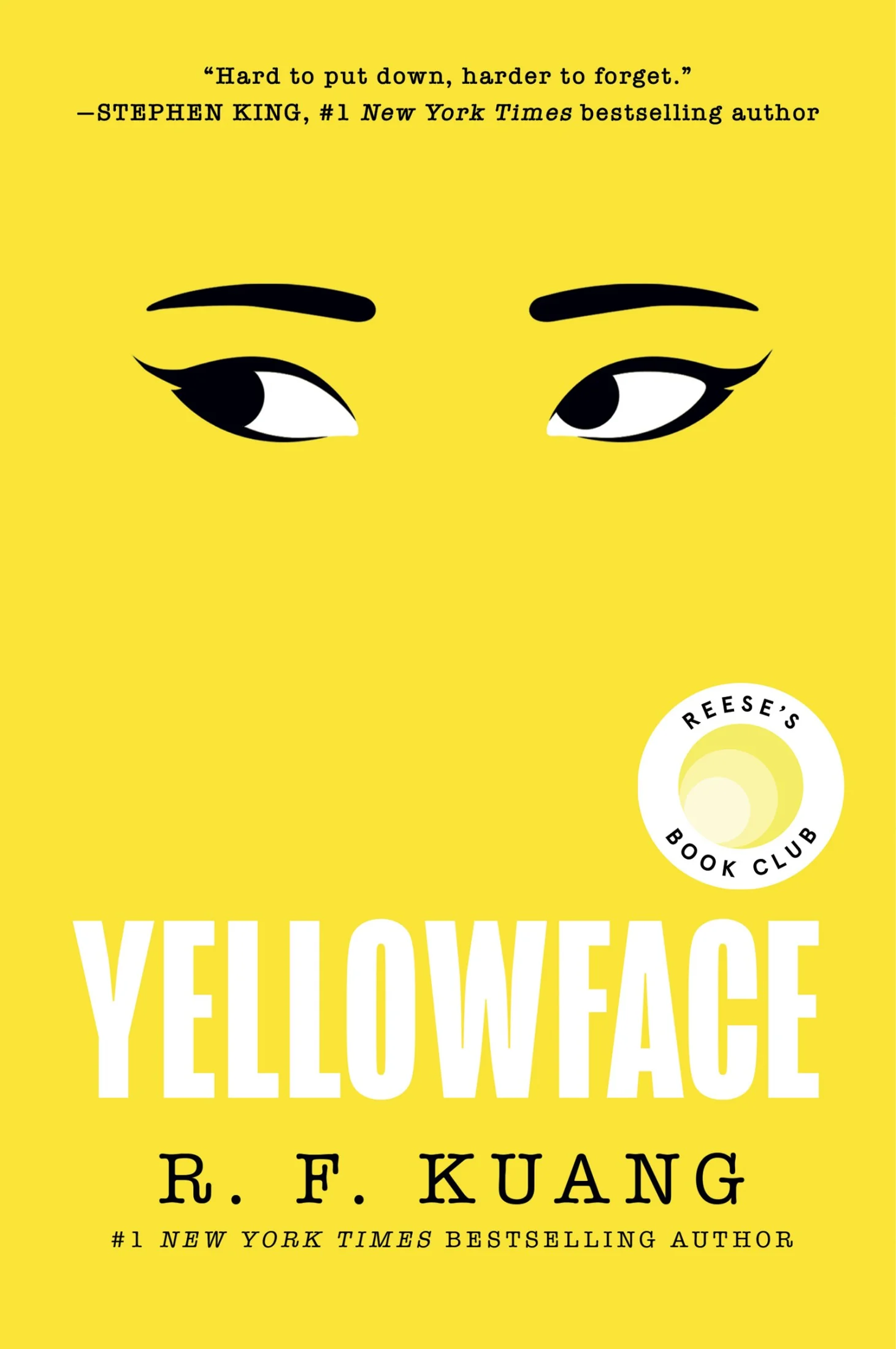
Yellowface
After secretly publishing her deceased rival Athena Liu's manuscript as her own, struggling novelist June Hayward manipulates her public identity and survives successive plagiarism scandals, until a former editor obtains a recorded confession and June plans yet another version of the truth.
Overview
Yellowface follows June Hayward, a white American novelist who has struggled to gain recognition after the disappointing reception of her debut, Over the Sycamore. Her former Yale classmate Athena Liu has become precisely the writer June hoped to be: critically acclaimed, commercially successful and courted for screen adaptations. Their relationship contains genuine intimacy but is dominated in June's telling by resentment, professional comparison and the conviction that Athena enjoys advantages denied to June. During a night out in Washington, DC, Athena shows June a typewritten manuscript of The Last Front, an unfinished novel about the Chinese Labour Corps in the First World War. Later, at Athena's apartment, the two compete to eat pandan pancakes. Athena chokes. June tries to help, calls emergency services and witnesses Athena's death. The novel does not establish that June murdered her. It does establish that June takes The Last Front from the apartment after Athena dies.
June presents herself publicly as a close friend grieving Athena while privately reading the stolen draft. She discovers vivid writing and extensive historical research, but also missing transitions and unresolved narrative problems. Rather than return the pages to Athena's family, June reorganizes scenes, expands characters and fills gaps. She submits the manuscript to literary agent Brett Adams as her own, never disclosing that Athena conceived and drafted the work. June's previous publisher declines its contractual first look, but an auction brings a lucrative offer from Eden Press. Editor Daniella Woodhouse then pushes for changes that make the book more commercially accessible: historical racism is softened or displaced, white missionaries gain sympathetic prominence, and the Chinese laborers' perspectives are partially subordinated to an emotionally simpler account. June makes many of these changes knowingly. Her editorial contribution is real, but so are Athena's original manuscript, research and authorship. June's insistence that the work was therefore hers alone is self-justification, not an independently established attribution.
The publisher also helps construct a marketable identity. Marketing staff worry about questions raised by a white author telling Chinese history, while editorial assistant Candice Lee advocates involving a Chinese sensitivity reader. June rejects the additional scrutiny, resents Candice and pressures the publisher to remove her from the project. A conflict over a Goodreads review contributes to Candice losing her position. At the suggestion of the publicity process, June begins publishing as Juniper Song. Song is her actual middle name, chosen by her mother, not a fabricated Chinese name or proof of Chinese ancestry. June repeatedly admits to herself that the byline and promotional presentation can lead others to assume she is Asian, yet she allows the ambiguity because it benefits her career. She also exploits her publicly asserted closeness to Athena. When Athena's mother, Patricia Liu, considers donating her daughter's notes to a Yale literary archive, June discourages the donation because the papers might reveal Athena's original work.
The Last Front becomes a major bestseller, reaching number three on the New York Times list, earning awards attention and winning a Goodreads Choice Award. June pays debts, begins living comfortably and relishes the professional standing previously enjoyed by Athena. She volunteers as a mentor to Emmy Cho, a young Korean American writer, but diminishes the obstacles Emmy faces by suggesting that diversity makes publication easier. She is challenged by critics including Adele Sparks-Sato, Kimberly Deng and Xiao Chen, who object to her white-centered treatment of Chinese workers and particularly to a scene featuring missionary daughter Annie Waters. June had altered Athena's colder, more critical depiction of that character into a sentimental encounter with a Chinese laborer. Instead of considering her own editorial choices, she largely describes critics as envious, self-promoting or ignorant. At a Cambridge event, student Lily Wu challenges June's right to profit from this history. June offers a rehearsed argument for a writer's freedom to represent experiences outside her own. The issue of what writers may depict is distinct from the concealed fact that she published someone else's manuscript.
June's discomfort occasionally breaks through. A Chinese American social club in Rockville invites her to speak, initially assuming from her byline that she has Asian ancestry. June tells organizer Susan Lee that she is white, and the meeting itself remains hospitable. Elderly member James Lee says his uncle served in the Chinese Labour Corps and gratefully thanks June for ensuring the laborers will not be forgotten. His trust produces genuine shame: June recognizes that Athena should be receiving his thanks. June nevertheless leaves without admitting the truth. At the same time, she meets Hollywood producers Justin and Harvey, who consider a film option but casually discuss foregrounding a white British officer and treating Chinese casting as an overseas-market opportunity. June accepts these proposals in the hope of obtaining a lucrative adaptation. Greenhouse later offers to option the novel; the original meeting was not a firm deal.
An anonymous Twitter account named for Athena's ghost publicly accuses June of stealing The Last Front and of misrepresenting her ethnic identity. Its central charge of appropriation is correct, but it invents details about June deliberately cultivating Athena and searching her notebooks. June takes the inaccuracies as evidence that the poster cannot prove the theft. She falsely denies the allegation to Brett and Eden, and a wave of social media attention brings death threats, sleeplessness and obsessive monitoring of reviews. Earlier in her career June had dismissed a similar campaign of racist and misogynistic abuse directed at Athena; only now does she begin to appreciate its effects. At a Virginia panel, artist Diana Qiu confronts June about uncredited Asian labor, forcing a humiliating public dispute. June attempts to identify the original anonymous accuser by drawing the account to a website she controls. The resulting IP address provides only a broad location in Fairfax, Virginia, which June takes as proof that Athena's former boyfriend Geoffrey Carlino is responsible. Neither the geolocation nor the account itself independently identifies him.
June confronts Geoff and covertly records their conversation. He knows Athena had researched a First World War novel about Chinese laborers, but does not show June documentary evidence of the stolen draft. When June feigns a tentative admission, Geoff proposes keeping quiet in exchange for a share of the profits. June threatens to publish the recording of his attempted blackmail, then releases a false written denial claiming her manuscript is wholly original and that her publishing team investigated her innocence. The anonymous account disappears, public sympathy shifts, and film-option negotiations resume. June initially believes she has defeated Athena's ghost. The novel does not independently demonstrate that Geoff controlled the account, although his behavior at the meeting gives June leverage to silence him.
As attention fades, June finds herself incapable of starting another book. She then reveals that on the night Athena died she took more than The Last Front: loose pages of notes also came home with her. A handwritten passage about a woman disappearing down a hallway stimulates June's imagination, and she develops a novella called Mother Witch around a daughter chasing an immortal mother. Its larger story develops from June's ideas and feelings about her own family, but Athena's paragraph supplies its opening. June also revisits a formative incident at Yale. After June told Athena about a distressing and incompletely remembered sexual encounter, Athena helped her seek counseling, then published fiction unmistakably resembling the intimate details June had disclosed. June experienced this as a breach of trust and has long used it to defend her resentment. Athena never explains the similarity, and this incident does not erase June's later unauthorized publication of The Last Front. Mother Witch receives favorable reviews, but only modest sales.
Adele Sparks-Sato subsequently produces a much stronger case of textual borrowing. Athena had workshopped a story called Her, and dated documents and witnesses show that Mother Witch reproduces its opening. June's career and friendships deteriorate. Marnie Kimball and Jen Walker, who previously supported her, withdraw; Emmy Cho ends the mentorship. In a conference with Daniella, Brett, publicists and Eden's lawyer, June acknowledges using Athena's paragraph while continuing to deny the more extensive theft of The Last Front. Daniella even discusses a possible shared-authorship arrangement with Athena's estate if June discloses the true history. June refuses, and Eden instead seeks a manageable public response, including a rewrite of Mother Witch's opening. Patricia Liu, who does not intend to sue at this stage, calls after Adele requests access to Athena's drafting notebooks. June nearly confesses but gives a carefully evasive answer, permitting Patricia to avoid reopening her daughter's papers. June's survival within publishing is partly commercial: the controversy increases sales as conservative commentators adopt her as an example of unfair cancellation.
Despite that financial protection, June feels artistically empty. She ventures into DC's Chinatown looking for stories, intrudes on the lives of restaurant workers and is asked to leave when a waitress recognizes her. Brett offers her work-for-hire fiction from Snowglobe, a packaging company proposing a sensational Chinese one-child-policy dystopia; June rejects the concept while remaining anxious that she can no longer write without Athena. At a young Asian American writers' workshop in Massachusetts, her initial enthusiasm for teaching is undermined when she hears students discussing the plagiarism evidence. She vindictively humiliates a student, Skylar Zhao, during critique. When organizer Peggy Chan receives complaints, June invents a family emergency to escape accountability. She does visit her mother afterward, finding childhood notebooks that remind her of writing before fame and professional rivalry. A confrontation with her mother about stable work exposes June's overriding fear of being forgotten.
Back home, June reads a perceptive anonymous review suggesting The Last Front bears signs of two authors and wondering what a novel about the Athena-June relationship might reveal. She develops a fictionalized autobiography incorporating the theft, their friendship and her public downfall. The project initially restores her ability to write, and memories of genuine closeness with Athena complicate her preferred depiction of constant rivalry. Then Athena's inactive Instagram account starts posting digitally distorted images of her apparently alive, sometimes displaying books published after her death. The posts appear directed specifically at June, who alternates between recognizing the probable work of a troll and imagining Athena has returned. Geoff examines one image and identifies it as manipulated, but June keeps seeing Athena in places where nobody else can confirm her presence. The novel's apparent supernatural events are filtered through June's increasingly unstable, frightened first-person account.
As the images multiply, June researches Chinese ghosts and tries improvised offerings and rituals. She accepts privately that the only morally credible way to lay Athena's ghost to rest would be to acknowledge her authorship, yet refuses to do it. June's new manuscript becomes a chaotic ghost story rather than the artful account she planned. Outside a cafe she chases and grabs a woman she thinks is Athena, only to discover critic Diana Qiu, whose appearance she has misread. The confrontation exposes how far June's perception has diverged from reality. She contacts her former therapist, Dr. Gaily, but cannot resume interstate telehealth care and is offered referrals. After another taunting post from Athena's account, June demands an explanation and receives instructions to meet at Georgetown's Exorcist steps late at night. She believes the location proves Athena's involvement because the two once raced there, though it later emerges that Athena had discussed the steps publicly.
At the steps, June hears what seems to be Athena's voice posing questions. Desperate for the ordeal to end, she admits taking the manuscript, recognizes the act as wrong and offers to confess to Patricia and her publisher. The person waiting is not Athena but Candice Lee. Candice describes obtaining access to Athena's social media account through a publicist, manipulating photographs and using recorded audio to draw June into a confession. She has recorded June's words on camera and intends to expose them. Candice speaks not only about her personal retaliation for being fired after the Goodreads dispute but also about how publishers market a token Asian writer, limit the range of stories that writer can tell and exclude other Asian creators. Candice announces plans for a tell-all called Yellowface. June begs for silence and then attacks her, trying to recover the recordings. During the struggle June considers whether Candice's death could be passed off as an accidental fall. Candice bites June and kicks herself free; June falls backward from the steps.
June survives with serious injuries and spends four days in hospital. Authorities are told she slipped on ice, and the person who summoned help with her phone vanished before responders arrived. June suspects Candice, but this is her inference. Candice releases the recording in a New York Times interview, and publishers court the memoir she plans to write. A month later Candice sells its proposal to Penguin Random House for a seven-figure advance. June becomes severely withdrawn and briefly considers suicide, but her commitment to being remembered becomes stronger than her despair. She begins constructing a competing story in which she is the victim of an elaborate hoax, cyberbullying and a manipulative publishing system. She plans to approach Brett, write a rapid proposal and redefine the exposed theft as a test of the industry's racial and commercial hypocrisies. The novel ends at the point of intention. It does not show June's new book being sold or accepted, prove her accusations against Candice, settle responsibility in court or establish that her public reputation has recovered.
June's narration is therefore both the means by which readers learn of the theft and the instrument by which she attempts to justify and eventually rewrite it. The book distinguishes genuine questions about who owns stories, the exploitation of personal experience, discriminatory expectations placed on minority authors and the economic behavior of publishing institutions from June's unsupported claim that those structures excuse taking Athena's manuscript. Athena was neither an uncomplicated saint nor the authorial impostor June wants her to be; June's memories contain credible grievances and real affection as well as jealousy. Candice is not a disinterested guardian of Athena's legacy, either: her planned exposé pursues her own professional rehabilitation and profit. The decisive outcome remains June's refusal to allow even a filmed confession to be the last word. By ending with her intention to manufacture another persuasive account, the novel locates its final uncertainty in what readers and institutions may choose to believe.
Main Characters
- June Hayward / Juniper Song: white novelist, first-person narrator and unreliable claimant to sole authorship of Athena's work
- Athena Liu: acclaimed Chinese American novelist whose unfinished manuscript June steals after her death
- Candice Lee: former Eden editorial assistant who documents the Mother Witch dispute and engineers the recorded confession
- Brett Adams: June's literary agent who repeatedly protects her career and manages publishing opportunities
- Daniella Woodhouse: Eden Press editor whose commercial decisions reshape The Last Front and response to the scandal
- Patricia Liu: Athena's mother, whose private notebooks could document her daughter's authorship
- Geoffrey Carlino: Athena's former boyfriend who confronts June and later urges her to move beyond the controversy
- Adele Sparks-Sato: critic who publicly questions June's work and corroborates the Mother Witch textual overlap
- Diana Qiu: artist and critic who confronts June in public and is later mistaken for Athena
- Emmy Cho: novice writer June mentors before the documented plagiarism controversy drives them apart
Central Themes
- Literary ownership, revision and plagiarism
- Unreliable narration and motivated self-justification
- Cultural appropriation, racial representation and tokenism
- Commercial publishing incentives and manufactured author identities
- The commodification of trauma and private experience
Mood & Atmosphere
Darkly satirical, anxious and increasingly claustrophobic. June's self-interested narration moves from professional envy to public scandal and perceived haunting, with the ending returning to the danger of persuasive but unreliable self-exoneration.
Source Edition
Yellowface (2024), HarperCollins. How sources are recorded.