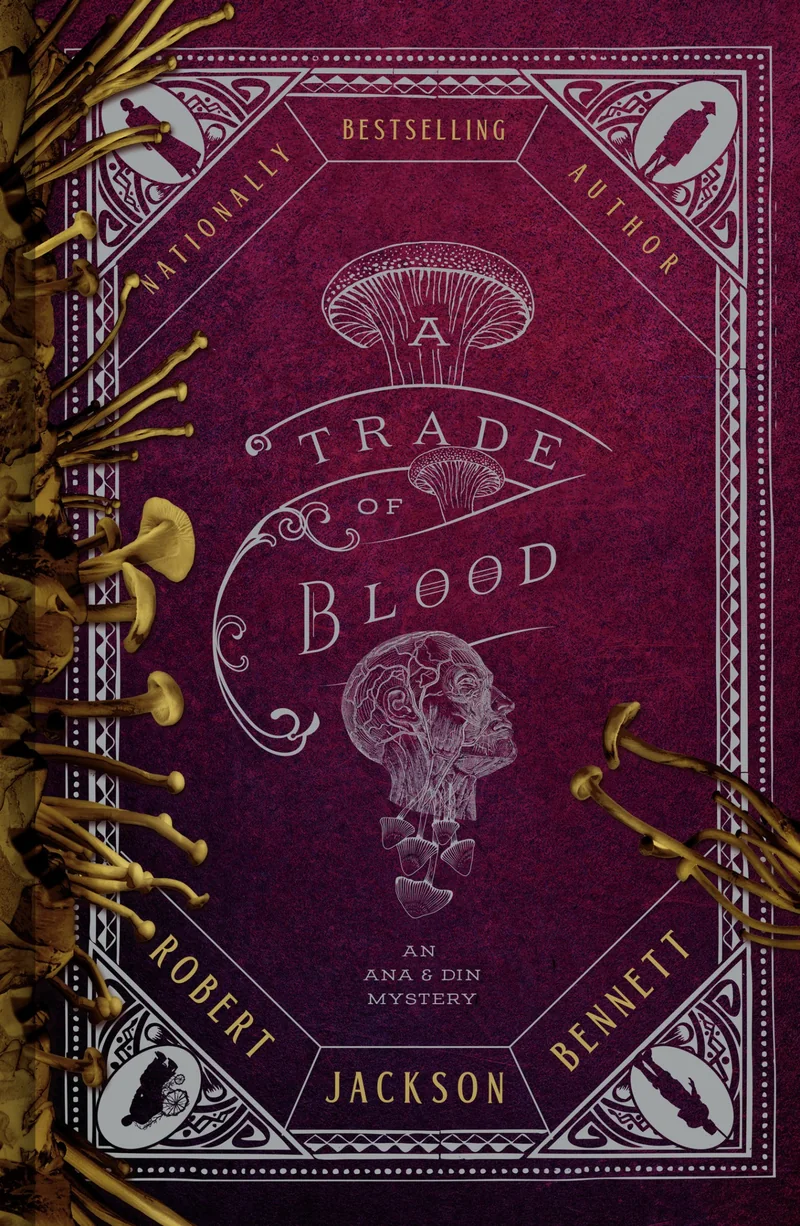
A Trade of Blood
Investigating a cattle-heir murder in Sapirdad, Ana Dolabra and Dinios Kol uncover a conspiracy to redirect an inheritance using human-controlling fungus, then discover that the technique originated in an ancient system of forced labor.
Overview
The Empire of Khanum survives repeated leviathan incursions through biological alteration and increasingly elaborate manipulation of living organisms. Dinios Kol, a young engraver whose altered memory records his experiences with exceptional precision, works for the Iudex under the investigator Ana Dolabra. Ana generally wears a blindfold to control sensory stimulation while Din observes scenes, remembers conversations, and reports evidence she can analyze. They travel to the cattle-producing canton of Sapirdad, where the agricultural center of Lacanthim depends heavily on the rival Armenta and Burav houses. The killing of Zansay Burav, found grievously mutilated at an inn, threatens to bring the feuding families into open violence and disrupt food supplies. Castus Armenta, her secret lover and the surviving direct heir of his house, is arrested with blood on his hands. He remembers an unusual, beautiful melody before the killing but cannot explain his subsequent movements. What initially looks like a personal murder is entangled with the unexplained deaths of Castus's three elder siblings, the family's inherited wealth, and the region's methods of controlling animal labor.
Din encounters custodi leader Atun Seriv and discovers that public anger between Burav drovers and Armenta guards could overwhelm the authorities. As he and Ana question Castus and others, they learn that the late Armenta children Lyimo, Sagma, and Gevma each died under different apparent circumstances: a drowning, a hanging, and a riding accident. Castus and Zansay planned to abandon their families and escape together. The aged Armenta matriarch Velona has become increasingly ill and is considering ways to preserve her line. Her brother and seneschal, Trikao, conducts the family's business, while his only son Ippeas works as a drover with little expectation of inheritance. Din is surprised to discover that his estranged sister Fotia is engaged to Ippeas, compelling the siblings to confront painful memories of their upbringing as well as their different positions in imperial society.
Zansay's examination reveals evidence that a form of guiding web, a fungus normally associated with the training of drokha-cats, infected her body and grew rapidly following death. The Buravs became wealthy after their father Burilis developed methods for making field cats repeat trained behaviors on command, allowing them to work enormous grain operations that sustain cattle. The control system depends on repeated exposure to infected material and distinctive musical notes played on specialized pipes. Ana and Orbiis environmental commander Raudoti Tauri begin to suspect that an altered variant has been used to bind human actions to those notes. That hypothesis would explain why Castus could have performed mechanically precise flensing motions against Zansay while lacking any deliberate wish or recollection of killing her. The novel distinguishes the observed fungal growth and sound-linked behavior from the investigators' evolving theories about who developed the human variant, who administered it, and who played the controlling tune.
The inquiry is complicated when the Burav manor burns during a memorial gathering for Zansay. Most of the family dies in the fire. A badly burned younger son, Jalin Burav, survives because he was living apart from the main household. Ippeas is arrested after entering the burning house, although he rescued a kitchen servant and had come because of an anonymous promise of evidence that could exonerate Castus. Ana recognizes that the fire and letter may be an attempt to frame or kill him. Jalin had suffered years of brutality in the Burav flensing halls, including his father's coercion and Lyimo's bullying. Din also learns that Burilis once worked in the imperial Orbiis and supervised access to an uncanny altered forest surrounding a forbidden Touched Site associated with the ancient Khanum. Orbiis thuribles temporarily open passages through the otherwise impenetrable trees. The site's huge black stone cover is guarded, but the purpose of the sealed space has been forgotten or withheld.
Din and Tauri explore a concealed part of the forest and find a cache of musical instructions, altered water, and evidence of a quarrel between people using the web. An inscription warns that a so-called lysis command is not immediate, complicating the timing of later effects. The cache suggests that one participant may be manipulating another, but it does not prove their identities. At the Lacanthim jail, Castus develops severe cranial fungal growth and becomes violently compelled to repeat flensing movements even while injured. Din is forced to kill him to stop the attack. Ana suspects a delayed musical trigger rather than spontaneous natural illness. She obtains authority to examine the preserved bodies of the dead Armenta children. Sagma and Gevma show extensive signs of fungal infection, while Lyimo, the earliest victim, has much less. Sagma's neck bears a very narrow strangulation injury inconsistent with an ordinary rope. A small wound on Lyimo's back resembles the sharp crest of the distinctive Burav ring Jalin wears. Jalin disappears from medical custody soon afterward.
Ana also studies the rich Burav family's locked inner vault. A strangely simple mark on its four numeral tumblers corresponds to the religious emblem of Master Gaddar, a figure revered in the region's cult of the ancient Daljen, and the combination opens a room full of old manuscripts, research materials, Orbiis devices, and wine rather than ordinary treasure. Inside, the investigators find the surviving housekeeper Madi Istelia, dehydrated and intoxicated after hiding from the fire. She describes Jalin's traumatic childhood, erratic later behavior, and his assertion that another man had come to control him. Among the vault's wine vessels is an expensive Choros Ayak vintage associated with a gift sent to Lyimo before his drowning. Ana tentatively reconstructs Jalin's first attempt at human conditioning, in which the inexperienced operator had to drown Lyimo physically when the pipe command failed. She infers that a more capable second killer subsequently controlled Jalin and planned the deaths that followed. This is a reasoned explanation at this stage rather than an already proved identity.
Burilis's ancient Daljen collection allows Ana to map routes from the Hand of Gaddar and the shrine of the soft spines to Naos-Minra, a smaller temple hidden in the forest. Ana privately tells Din that, despite constraints making it painful for her to discuss ancient history, she believes the Daavir rulers of the first Empire erased the Daljen from history after a violent conflict. She associates a larger historical site called the Cup of Heaven with the sealed Orbiis Touched Site but has not yet established what lies beneath it. Din accompanies Tauri and a small expedition along the forest's reagent-opened seams, passing unnerving statues and a stone figure bearing an inscription about a wayward mind. At Naos-Minra's ruined fountain, the party finds Jalin dead from self-inflicted wrist wounds. He does not test positive for the fungus, and there are no signs that the final act was compelled. A nearby makeshift Apoth laboratory contains guiding-web samples and Burilis's dated experimental journal. The journal details his work with infected drokha-cats, water chemistry, and conditioned behavior but gives no indication that he ever engineered the fungus to act on people. The source of its human-controlling capacity and the identity of Jalin's blackmailer remain unknown.
Din and Tauri become intimate while the investigation continues. After their first night together, Din dreams that he is immobile in his Green Drover bedroom, listening to a melody, although he knows he went to sleep elsewhere. His engraver memories begin distinguishing the compelled past event from his actual circumstances. An infection test turns orange, showing he has ingested the web, and his dream indicates he was conditioned about two days earlier, near the time of Castus's fatal transformation. Ana and Din test the Green Drover's water, which is contaminated. Ana tests positive herself and directs Tauri to examine two other inns frequented by the Armenta gentry, the Crooked Horn and Prancing Calf. Their wells are contaminated too, while neighboring wells are clean. The murderer had been steering selected victims to the same infected lodgings long enough to accumulate the fungus. Fotia, who commonly stayed with the drovers rather than in gentry rooms, was not infected. Ana warns Din that Tauri is still a possible suspect, since he has technical knowledge and access, but does not equate suspicion with proof.
Meanwhile Fotia locates Arthinio, the man who removed Sagma's supposed hanging noose. He tells her that it was a ribbon rather than rope. Ana connects it to Sagma's habit of fastening decorative neck ribbons while dressing in the morning, a routine she could have rehearsed repeatedly without knowing it was being used to prepare her death. She identifies the second killer from the likely origin of those gifts and the family's inheritance arrangements, but keeps the name from Din while arranging a trap. A letter to Velona falsely claims Ana holds evidence of the heir killings in her Green Drover quarters. Custodi officers watch approach routes from neighboring buildings. A conditioned youth carrying a musical pipe initially appears to be the approaching culprit, but Din recognizes him as a decoy. When guards rush toward the youth, the actual operator enters the tavern through another route and plays the command that immobilizes everyone exposed to it. Din's engraver memory personifies itself as his long-dead mother and helps him resist enough to perceive his surroundings and move against the command. He sees Trikao Armenta, armed and disguised as an officer, moving to kill Ana and remove the alleged evidence. Trikao wears wax in his ears to protect himself from his own pipe. Ana, unaffected by the conditioning, stabs him with a lypi lance before he can kill Din.
Ana reconstructs the conspiracy for the distraught Ippeas and Fotia. Trikao, who resented serving sister Velona and seeing his son denied an inheritance, witnessed Jalin unsuccessfully compel Lyimo into a pond and physically drown him. He blackmailed Jalin with this knowledge, obtained the guiding web and its commands, contaminated the inns, and arranged the subsequent deaths of Sagma and Gevma so they looked unrelated. He gave Sagma the ribbons that ultimately supplied her staged noose. When Castus and Zansay planned to leave the canton together, Trikao faced the prospect of one remaining direct Armenta heir escaping his reach. He therefore conditioned Castus's routine flensing motions to murder Zansay, expecting Castus to be executed and the Burav household to be implicated once the fungus grew from her body. When the Iudex interrupted that plan, Trikao used a delayed destructive melody against Castus and then conditioned the investigators, believing it would secure his escape. Jalin, increasingly desperate under Trikao's control, had burned his family home and attempted to draw Ippeas into the fatal blaze to strike back at his blackmailer. Ana distinguishes Jalin's first crime and destructive retaliation from Trikao's calculated series of killings.
Trikao's succession scheme succeeded in one legal respect. Velona changed her inheritance filing after Castus's death and made Ippeas sole heir, despite the crimes that created the vacancy. Ippeas refuses to visit Trikao in custody. Severely injured by the lypi lance, Trikao insists that the murders were for his son's benefit. Din brings the prisoner Ippeas's response: he intends, if he inherits, to sell the enormous Armenta holdings to many independent farmers and families and end the single great estate, instead of accepting the power his father pursued. Trikao is devastated. The investigators and Apoths begin treating those infected and cleansing the wells, but the fate of Lacanthim's cattle economy is not settled. Tauri questions why Ana, whose own test was positive, was not controlled by the music. She offers no credible explanation and instead leads Din and Tauri back to the forest to learn where the human-controlling fungus originated.
Using the abandoned laboratory's digging tools and the position of a dry fountain as clues, Ana directs Tauri and Din toward an old excavation running north-northeast, aligned with the black-capped Touched Site. Ana remains at Master Gaddar's shrine while they descend into a narrow tunnel. It leads to an immense underground lake whose waters test positive for the web. They find desiccated human corpses bearing immense fungal fruiting bodies, still mechanically stirring the contaminated water. Another fungus-animated corpse plays an ancient instrument, whereupon one dead laborer begins carrying a cup of water toward them. Beneath the surface lies a vast heap of human bones. Din and Tauri flee, recognizing that the original Daljen system coerced ordinary humans into agricultural labor and continued using their bodies even after death. Its continued functioning reveals that the web's capacity to command humans is ancient rather than necessarily the invention of Jalin or Burilis. Tauri concludes the first imperials must have been resistant to their own fungus and infers from Ana's resistance that she may be related to them. When Din will not reveal anything about her, Tauri breaks off their relationship and leaves him at the forest edge.
Din rejoins Ana at the shrine. She acknowledges that she expected the discovery and suggests Tauri could use it to challenge an industry dependent on conditioned animals, while recognizing that the imperial Orbiis and Apoths may instead conceal it. Ana also corrects her earlier account of the Daljen's destruction. The Daavir may have erased the evidence, but she describes their rejection of the Daljen's human enslavement as practical recognition that systems founded on domination eventually stagnate and collapse, not a righteous vindication of human freedom. She declines to explain their subsequent path. Ana offers Din two weeks' leave to support Fotia and Ippeas in beginning a new life. Din remains reluctant to return to his family because his engraver memories have started appearing with his dead mother's face and voice. Ana's comment that she has seen stranger beings than Master Gaddar, together with a remark about meeting her own family, causes Din to speculate about her connection to the isolated emperor. The novel ends without confirming the emperor's identity or condition, the exact nature of Ana's connection to him, the future of Tauri's discoveries, or what reform, if any, will follow for the cattle industry.
Main Characters
- Dinios Kol: The Iudex engraver and narrator, whose exact memories help reconstruct the murders, resist fungal conditioning, and confront the limits of his trust in Ana and his family.
- Anagosa Dolabra (Ana): Din's unusually perceptive Iudex superior, who deduces a succession-driven conspiracy and deliberately leads the final investigation toward the concealed Daljen site while withholding the full truth of her own past.
- Raudoti Tauri: An Orbiis environmental commander whose augmentations connect him to the damaged landscape; he investigates the web, becomes intimate with Din, and recoils at the ancient enslavement and Ana's possible identity.
- Fotia Kol: Din's estranged sister and Ippeas's fiancée, who tracks the evidence behind Sagma's staged death and seeks a future independent of the cattle houses.
- Ippeas Armenta: Trikao's son, an Armenta drover who becomes heir through crimes he did not solicit and resolves to divide and sell the great estate rather than preserve it.
- Trikao Armenta: Velona Armenta's brother and seneschal, who blackmails Jalin and orchestrates the later deaths so his son inherits the family lands.
- Jalin Burav: The traumatized Burav son who first tries to kill Lyimo with altered guiding web, is manipulated by Trikao, later burns the Burav estate, and dies in the forest.
- Castus Armenta: Zansay Burav's secret lover, falsely treated as her intentional killer after fungal conditioning forces him to use practiced slaughtering motions.
- Zansay Burav: The Burav daughter who plans to flee with Castus and is murdered through Castus's compelled actions, revealing the threat posed by human-guiding web.
- Velona Armenta: The ailing matriarch whose inheritance decisions and lost direct heirs are exploited by Trikao.
- Atun Seriv: The canton custodi leader who helps investigate the deaths, protect survivors, and coordinate the final trap.
- Burilis Burav: The deceased pioneer of agricultural guiding web whose hidden Daljen research and forest laboratory connect current farming technology with ancient coercive practices.
Central Themes
- The misuse of biological augmentation to eliminate free will
- Inheritance and violence in the cattle-owning gentry
- Human and animal exploitation in imperial food systems
- The suppression of dangerous historical knowledge
- Memory as resistance to coercion
Mood & Atmosphere
Investigative and increasingly disturbing, with biologically driven horror, violent family conflict, oppressive industrial settings, and an unresolved historical revelation.
Source Edition
A Trade of Blood (2026), Random House Worlds. How sources are recorded.