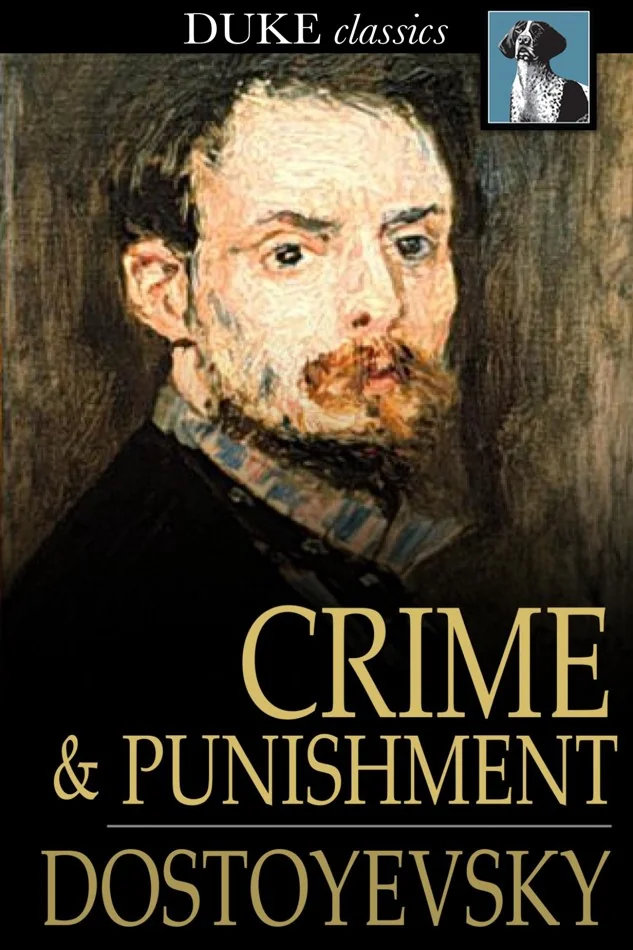
Crime and Punishment
An impoverished former student murders a pawnbroker and her sister while testing his theory of exceptional individuals, resists psychological investigation, and eventually confesses, with his moral renewal beginning only later during imprisonment in Siberia.
Overview
Rodion Raskolnikov, an impoverished former student in St. Petersburg, isolates himself while considering an act he cannot reconcile with his own revulsion at violence. His sister Dounia is preparing to marry the prosperous Pyotr Luzhin, whose expectation of a grateful, dependent wife Raskolnikov finds intolerable. A tavern conversation with the disgraced, alcoholic clerk Marmeladov introduces him to another impoverished household: Marmeladov's daughter Sonia supports his sick wife Katerina Ivanovna and her children by selling sex. Raskolnikov alternates between acts of compassion and resentment over his powerlessness.
Raskolnikov visits the pawnbroker Alyona Ivanovna under the pretext of pledging his father's watch, observing her rooms and keys. He has overheard a student argue that killing her to redistribute her wealth could benefit many people, although the student says he would not do it himself. Horrified by a dream in which a crowd beats a horse to death, Raskolnikov briefly rejects his contemplated murder. When he unexpectedly learns that Alyona's sister Lizaveta will be away the next evening, however, he interprets the opportunity as a settled decision. He kills Alyona with an axe; Lizaveta returns unexpectedly, and he kills her too. Raskolnikov escapes with a purse and pledged objects, but never examines their value and later hides them beneath a courtyard stone. The second killing was not part of his plan, and he does not use or even examine the stolen valuables.
Illness, confusion and fear of discovery follow. A police summons initially concerns only a debt to Raskolnikov's landlady, but he faints when he hears officers discussing the murders. He provokes police clerk Zametov with near admissions, revisits the crime scene and continually misreads or tests other people's suspicions. His friend Razumihin offers care and work, while Raskolnikov resists assistance even as he depends on it. Investigator Porfiry Petrovitch questions him about the ring and watch he pawned and about an article distinguishing ordinary people from extraordinary individuals who may consider violating laws in pursuit of consequential aims. Raskolnikov's philosophical account does not establish that he acted for an altruistic purpose: he later admits to Sonia that he wanted to test whether he had the daring to overstep a moral boundary. Porfiry uses the article, Raskolnikov's unusual behavior and a question about painters working near the crime scene to probe him. The painter Nikolay falsely confesses, but Porfiry doubts his account and ultimately tells Raskolnikov directly that he believes him to be the murderer. At that meeting Raskolnikov denies it, and Porfiry urges him to surrender voluntarily rather than wait for an arrest.
Other crises unfold around him. Marmeladov is fatally struck by a carriage, and Raskolnikov gives his widow money for the family. Dounia herself rejects Luzhin after he demands precedence over her brother and insults Sonia. After the engagement ends, Luzhin accuses Sonia of stealing a hundred-rouble note at Marmeladov's memorial dinner. His acquaintance Lebeziatnikov reveals that he saw Luzhin slip the banknote into Sonia's pocket, and Raskolnikov explains the likely connection with the broken engagement. The accusation fails, but Katerina Ivanovna and her children are evicted. In her final illness she attempts to make the children perform in the streets, collapses from consumption and dies in Sonia's room.
Sonia, who knew Lizaveta and possesses her New Testament, reads Raskolnikov the Gospel account of Lazarus. Raskolnikov privately confesses to Sonia that he killed both sisters. He offers conflicting explanations involving poverty, his mother, Napoleon, power and his wish to discover whether he could dare to kill. Sonia does not excuse the crime; she urges him to acknowledge it publicly and accept the consequences, and promises to accompany him in suffering. Their conversation is overheard through the wall by Arkady Svidrigaïlov, the former employer who pursued Dounia. Svidrigaïlov attempts to exploit this knowledge to obtain Dounia's affection, locking her in his rooms and offering to help her brother escape. She fires a pistol at him, grazing his temple, and rejects him unequivocally. He lets her go. After providing money for Sonia and Katerina's children, Svidrigaïlov dies by suicide with the pistol Dounia left behind.
Raskolnikov says a troubled farewell to his mother and sister. Although he decides to surrender, he continues to defend his actions intellectually and fears humiliation more clearly than he expresses remorse. He finally accepts Sonia's wooden cross and follows her instruction to kneel and kiss the earth in the Hay Market, but cannot announce his guilt to the crowd. At the police office he learns of Svidrigaïlov's death and nearly leaves without confessing. Seeing Sonia waiting outside, he returns and admits to killing Alyona and Lizaveta and robbing them.
The epilogue follows Raskolnikov to an eight-year sentence of penal servitude in Siberia. His mother's health fails and she dies; Dounia marries Razumihin, and they plan eventually to settle near him. Sonia follows Raskolnikov and visits him despite his initial coldness. He remains ashamed of his failure and explicitly does not yet repent of the murder. After illness and a disturbing dream of a world destroyed by people convinced of their own infallibility, he discovers how much Sonia matters to him. When they meet by the river, he weeps at her feet and their mutual love becomes clear. He wonders whether he might come to share her convictions, but does not open the New Testament she has given him. Seven years of imprisonment remain, and the narrator presents moral renewal as a process beginning beyond the novel's final scene, not as a completed conversion.
Main Characters
- Rodion Romanovitch Raskolnikov - impoverished former student who kills Alyona and Lizaveta and later confesses
- Sofya (Sonia) Semyonovna Marmeladov - Marmeladov's daughter who supports her family and urges Raskolnikov toward confession
- Porfiry Petrovitch - investigator who probes Raskolnikov's theory and conduct
- Avdotya (Dounia) Romanovna Raskolnikov - Raskolnikov's sister who rejects Luzhin and resists Svidrigaïlov
- Dmitri Prokofitch Razumihin - Raskolnikov's friend who supports his family and marries Dounia
- Arkady Ivanovitch Svidrigaïlov - Dounia's former employer who overhears Raskolnikov's confession and coerces her
- Pyotr Petrovitch Luzhin - Dounia's rejected fiancé who falsely accuses Sonia of theft
- Pulcheria Alexandrovna Raskolnikov - Raskolnikov's mother whose health declines
- Semyon Marmeladov - impoverished alcoholic clerk whose death deepens his family's precarity
- Katerina Ivanovna Marmeladov - Marmeladov's ill widow, responsible for three children
- Alyona Ivanovna and Lizaveta Ivanovna - the pawnbroker and her sister, both killed by Raskolnikov
Central Themes
- Moral exceptionalism and self-justification
- Crime, punishment and delayed repentance
- Compassion, dependence and personal responsibility
- Poverty, social vulnerability and coercion
- Faith, love and the possibility of renewal
Mood & Atmosphere
St. Petersburg's heat, poverty and overcrowding reinforce the protagonist's anxious isolation. Fever, suspicion, interpersonal conflict and moments of compassion continue through a comparatively restrained, unresolved Siberian epilogue.
Source Edition
Crime and Punishment, Duke Classics. Authoritative EPUB extraction preserves six part dividers and one combined Epilogue section. Its text explicitly marks Epilogue I and II; published summaries logically split section 49 at the II marker into 41 narrative units (39 numbered chapters plus two epilogue chapters), with the source file unchanged. How sources are recorded.