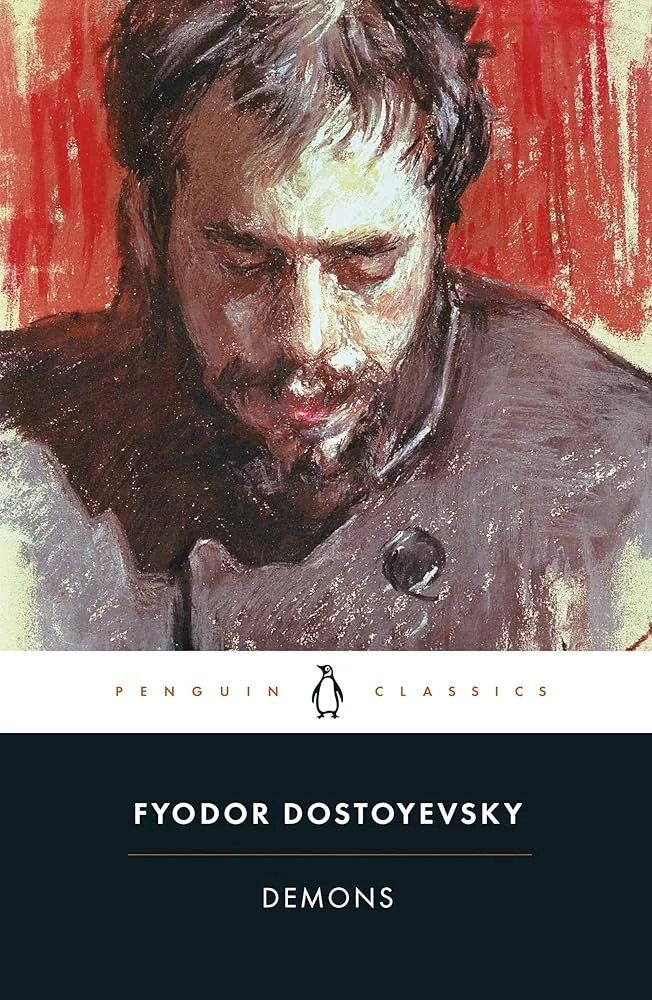
Demons
Pyotr Verkhovensky exploits a provincial town's political and social divisions while Nikolay Stavrogin's concealed marriage and moral crisis culminate in murder, the destruction of a revolutionary cell, and Stavrogin's suicide.
Overview
The narrator begins in a provincial Russian town with Stepan Trofimovich Verkhovensky, a former liberal intellectual dependent for decades on the patronage of Varvara Petrovna Stavrogina. Their intimate but troubled friendship is marked by affection, wounded pride, and financial control. Stepan's small circle disputes politics, religion, and the relationship between educated Russians and the people. His estranged son Pyotr Stepanovich, returning from abroad, belongs to a more ruthless generation of agitators. Varvara's own son Nikolay Stavrogin has already acquired a disturbing reputation through a series of earlier scandals. Her effort to marry Stepan to her ward Darya Pavlovna becomes entangled in rumors surrounding Stavrogin, Liza Drozdova, and Captain Lebyadkin's vulnerable sister Marya Timofeyevna.
Stavrogin returns, refuses to retaliate when the disillusioned Shatov strikes him, and later deliberately misses his opponent in a duel. Beneath these public displays of self-control lies an unresolved private crisis: he has been secretly married to Marya Lebyadkina for years. He confirms the marriage to Shatov, warns him that Pyotr's revolutionary associates may kill him as a suspected informer, and confronts Marya and her exploitative brother. Fedka the Convict hints that the Lebyadkins might be killed for money. Stavrogin rejects him violently but later gives him money, an act whose significance is not conclusively settled. Shatov, once influenced by Stavrogin, now argues for the spiritual importance of the Russian people, while their acquaintance Kirillov believes an act of freely chosen suicide could overcome the fear of death. The novel presents these positions as the characters' convictions rather than settled truths.
Pyotr courts Yuliya Mikhaylovna, the governor's ambitious wife, and manipulates both her fashionable circle and a small clandestine revolutionary group. He exaggerates the existence of a centralized organization and exploits fears of denunciation. At a contentious meeting, Shigalyov outlines an authoritarian system that he calls equality, while Pyotr tests members' willingness to conceal political murder. Pyotr hopes to bind his followers by shared guilt and imagines Stavrogin as a legendary, hidden figurehead; Stavrogin does not accept that role. Meanwhile the desecration of an icon, the grievances of workers at the Shpigulin factory, and Governor von Lembke's erratic treatment of a peaceful petition heighten the town's disorder. Stavrogin publicly acknowledges his marriage after Liza challenges him about Captain Lebyadkin's letters.
The governor's literary gala turns into a scandal through provocative performances and hostile audience reactions. Stepan defends the value of art against a narrowly utilitarian politics, only to be challenged over his own past dealings with Fedka. Liza leaves for Stavrogin's estate; the subsequent ball dissolves as arson breaks out in Zarechye. Fedka and a small number of factory workers are implicated in the fire, not the workforce as a whole. In a separate house fire, Captain Lebyadkin, Marya, and their elderly servant are found murdered. Suspicion turns toward Stavrogin, who rented the house, but the public rumors do not establish that he ordered the deaths. After spending the night with Stavrogin, Liza breaks with him and tries to visit the murder scene with her loyal suitor Mavriky Nikolayevich. Hostile onlookers assault her, and she subsequently dies.
For Shatov, the sudden return of his estranged, pregnant wife Marya Ignatyevna offers the possibility of a different life. He obtains help during her labor and lovingly accepts her newborn son, although he is not the biological father. Almost immediately afterward, Erkel lures him out under the pretext of handing over a hidden printing press. Shigalyov protests the proposed killing and departs. Pyotr shoots Shatov as other conspirators hold him down, and the group conceals the body in a pond. Pyotr then coerces Kirillov into writing a false confession to Shatov's murder before Kirillov kills himself in pursuit of his own philosophical project. Pyotr escapes by train. Shatov's wife, searching desperately for him with her newborn, collapses and dies after the infant's death. Lyamshin's confession brings arrests and exposure of the local conspirators, but the final judicial outcomes and the true scope of the wider organization remain unresolved.
After the gala, Stepan wanders into the countryside and meets the Gospel seller Sofya Matveyevna. Gravely ill, he admits his lifelong vanity and responds to the Gospel account of demons entering swine, interpreting it in relation to the turmoil around him. Varvara comes to care for him, and he receives communion before dying. Finally, Stavrogin writes to Darya offering a secluded life in the Swiss canton of Uri. He acknowledges moral guilt for the death of his wife and for his treatment of Liza, without settling the precise legal responsibility for the murders. Although Darya and Varvara prepare to go to him, he returns unexpectedly to Skvoreshniki. They find him hanged in the attic beside a note declaring that no one else is to blame. The doctors subsequently reject insanity as an explanation. The surviving narrator leaves a record of private cruelty, manipulated idealism, political violence, and the limits of both public judgment and individual repentance.
Main Characters
- Stepan Trofimovich Verkhovensky - a former liberal intellectual financially dependent on Varvara Petrovna, whose final journey prompts a religious reckoning
- Pyotr Stepanovich Verkhovensky - Stepan's estranged son who manipulates a revolutionary circle and personally murders Shatov
- Nikolay Vsevolodovich Stavrogin - Varvara's son, secretly married to Marya Lebyadkina and struggling with guilt and a lack of purpose
- Varvara Petrovna Stavrogina - Stavrogin's mother and Stepan's long-standing patron who manages their difficult household relationships
- Ivan Shatov - a former revolutionary who challenges Stavrogin's ideas, reconciles with his estranged wife, and is murdered by Pyotr
- Aleksey Nilych Kirillov - an engineer who espouses philosophical suicide and is coerced into a false confession
- Lizaveta Nikolayevna Tushina - Liza, divided between Stavrogin and her loyal suitor Mavriky and fatally assaulted at the murder scene
- Marya Timofeyevna Lebyadkina - Stavrogin's concealed wife, exploited by her brother and later murdered
- Darya Pavlovna Shatova - Varvara's ward and Shatov's sister, whose offer of loyalty to Stavrogin becomes central to his final letter
- Yuliya Mikhaylovna von Lembke - the governor's wife, whose political and social ambitions Pyotr manipulates
Central Themes
- Ideological coercion, conspiratorial loyalty, and political violence
- Religious belief, disbelief, conscience, and the possibility of repentance
- Patronage, family relationships, and conflicting obligations
- Guilt, self-knowledge, and the limits of moral self-control
- Rumor, evidence, and the narrator's qualified account of collective events
Mood & Atmosphere
A politically unstable provincial setting marked by public scandal, ideological conflict, psychological distress, and moments of religious reflection.
Source Edition
Demons (2010), Penguin Group USA, Inc.. How sources are recorded.