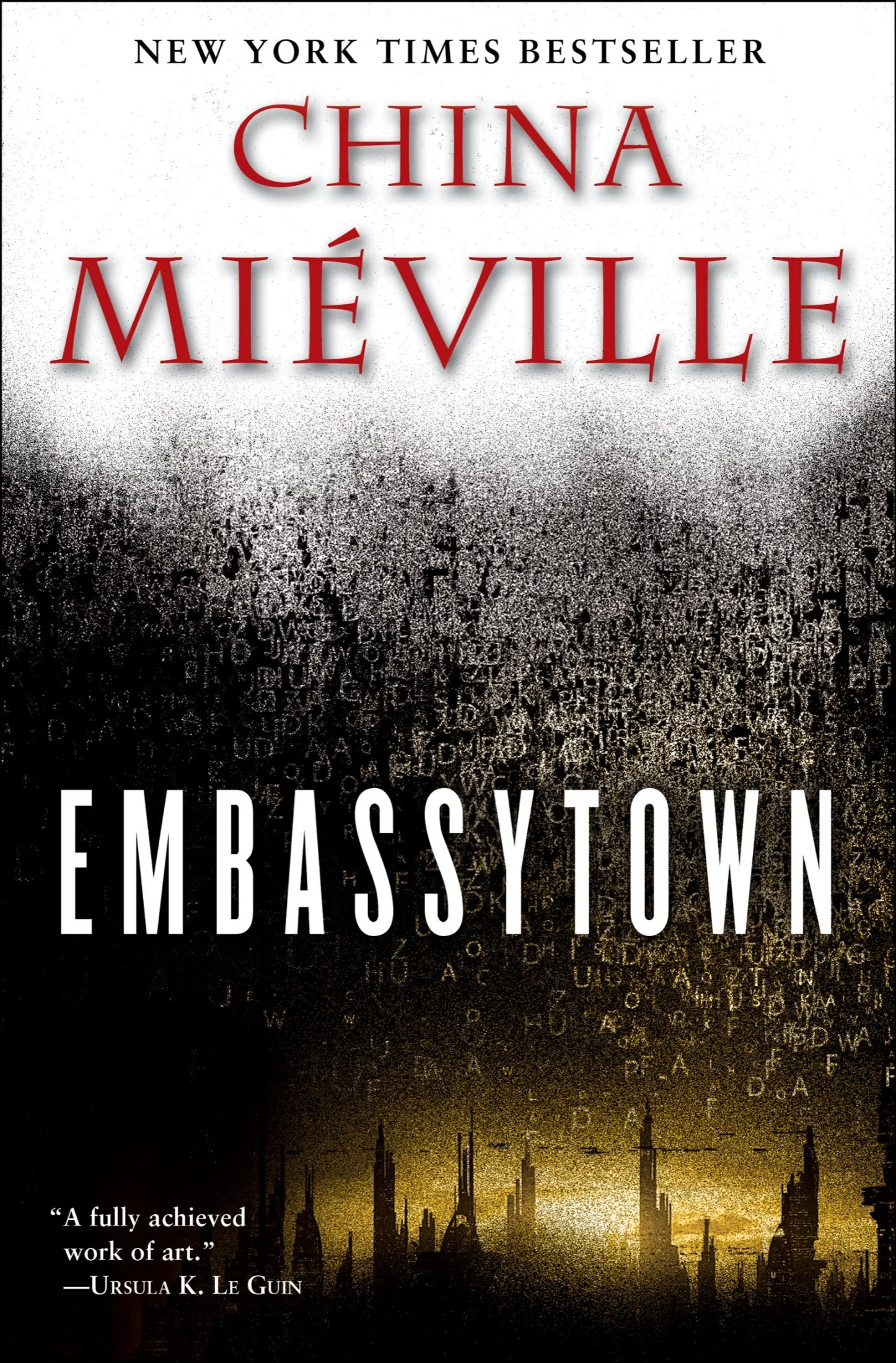
Embassytown: A Novel
When a new Ambassador's addictive speech destroys the delicate linguistic relationship between humans and alien Hosts on the frontier world of Arieka, former immerser Avice Benner Cho must help both species learn that the ability to lie—to separate language from reality—may be the key to consciousness itself.
Overview
On the distant world of Arieka, the human colony of Embassytown exists in an uneasy symbiosis with the indigenous Hosts, alien beings whose language is so fundamentally different from human speech that only specially trained Ambassador pairs can communicate with them. Avice Benner Cho, an immerser who travels between worlds through the dangerous medium of the immer, returns to her childhood home with her linguist husband Scile, drawn back to a place that exists at the very edge of human civilization. What makes Embassytown unique is not just its isolation, but Avice's own peculiar role in Host society—she has been transformed into a living simile, a breathing metaphor that the Hosts incorporate into their utterly literal language, where words and reality are inseparable.
The delicate balance of this frontier world shatters with the arrival of EzRa, a new Ambassador pair whose unconventional nature immediately signals trouble. Unlike traditional Ambassadors who are raised as identical twins or clones to speak in perfect unison, Ez and Ra are merely compatible friends, and their first attempt at communication triggers a catastrophic response in the Hosts. What should have been routine diplomatic contact instead becomes an addiction crisis of unprecedented scale, as the Hosts become helplessly dependent on EzRa's voice, abandoning all normal functions of their society to seek their next linguistic fix. As Embassytown's infrastructure crumbles and the Hosts descend into chaos, Avice finds herself caught between her husband's increasingly erratic behavior and a growing resistance movement led by the remaining functional Ambassadors.
The crisis deepens when some Hosts resort to self-mutilation, cutting away their fanwings—the organs that allow them to speak their dual-voiced language—in a desperate attempt to break free from their addiction. These "Absurd" form an army that threatens to destroy both the Host city and Embassytown itself, while the colonial government struggles to maintain control through rationed broadcasts of EzRa's addictive speech. Scile's obsession with the theological implications of the Hosts' language leads him down a path of dangerous collaboration, believing that the crisis represents a divine judgment on a corrupted species. Meanwhile, Avice discovers that the key to salvation may lie in teaching the Hosts something that should be impossible for beings who speak pure, literal truth: the ability to lie, to think metaphorically, to separate language from reality.
The resolution comes through a profound transformation that challenges everything both species believed about consciousness and communication. Spanish Dancer, one of the Hosts who learns to think beyond the constraints of literal Language, becomes the catalyst for a revolution that spreads throughout Arieka. By teaching metaphorical thinking to thousands of addicted Hosts simultaneously, Spanish Dancer breaks the cycle of dependency and opens the door to a new form of consciousness—one that can encompass both the Hosts' ancient linguistic purity and the human capacity for abstraction. This linguistic evolution comes at great cost, including personal betrayals and the violent end of the Ambassador system, but it ultimately offers both species a path toward genuine understanding rather than mere translation.
Miéville crafts a meditation on the relationship between language and reality that goes far beyond traditional first-contact science fiction. Through Avice's journey from reluctant returnee to active participant in a species-wide transformation, the novel explores how consciousness itself might evolve through linguistic change, and how the very structure of thought can be both prison and liberation. The book's central insight—that learning to lie might be the most honest thing a species can do—resonates as both philosophical paradox and practical wisdom, suggesting that the ability to separate words from their referents is not a corruption of pure communication but rather the foundation of true creativity and growth. In Embassytown, Miéville has created a work that functions simultaneously as thrilling space opera and profound linguistic philosophy, demonstrating how the most alien of encounters can illuminate the deepest questions about what it means to think, speak, and be conscious.
Main Characters
- Avice Benner Cho - former immerser and living simile who becomes central to resolving the crisis
- Scile - Avice's linguist husband whose obsession with Host language leads to dangerous collaboration
- EzRa - the unconventional Ambassador pair whose speech triggers the addiction crisis
- Spanish Dancer - the Host who learns metaphorical thinking and leads the linguistic revolution
Central Themes
- The relationship between language and reality
- Evolution of consciousness through linguistic change
- The necessity of lies and metaphor for true communication
- Cultural collision and transformation
- Addiction and dependency in communication
Mood & Atmosphere
Cerebral and unsettling, blending wonder at alien linguistics with mounting dread as communication becomes addiction, ultimately resolving into cautious hope for transformed understanding.