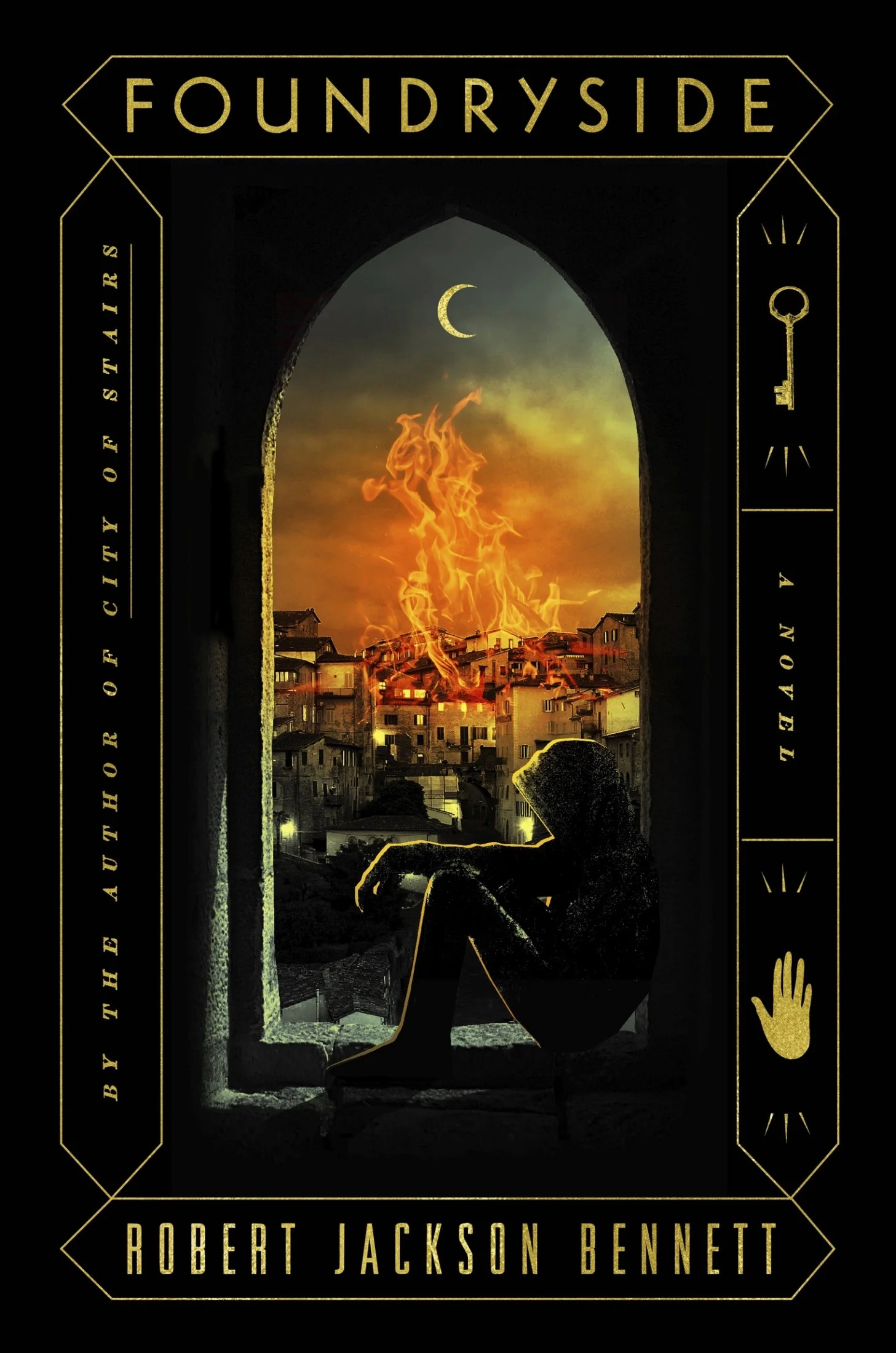
Foundryside
An enslaved woman turned thief discovers an ancient talking key and a conspiracy to transform thousands of lives into a single powerful being; after stopping the ritual, she joins the founding of a new merchant house while a concealed ancient threat remains.
Overview
Sancia Grado lives in Foundryside, the impoverished district outside the private campuses of Tevanne's merchant houses. The city's wealth depends on scriving, a system of inscribed commands that convinces objects to behave as though physical facts were different. Scrived carriage wheels believe they are rolling downhill, weapons are persuaded to strike with greater force, and locks accept carefully defined credentials. Powerful lexicons extend and support the complicated definitions on which this technology depends. The principal merchant houses protect their designs, operate their own police and services, and leave the surrounding Commons with little security or political authority. Sancia survives as an exceptional thief, but her ability to sense the histories and workings of objects through bare-handed contact comes from a metal plate forcibly implanted in her skull during experiments on enslaved people. The constant involuntary sensations make ordinary touch, food, and intimacy painful. She hopes to earn enough money to pay someone to remove the plate.
An intermediary named Sark hires Sancia to steal an unopened box from a safe in the heavily secured waterfront Waterwatch offices. She infiltrates the site by using improvised scriving to travel across the bay and manipulate its defenses. To escape discovery, she ignites a diversion in a nearby cargo yard; the fire spreads disastrously across the waterfront. When she returns home, Sancia discovers that the box conceals a golden key. The key can talk to her through the implanted plate and calls himself Clef. He has incomplete memories of his creation but can perceive and manipulate the logic of scrived devices. Instead of physically picking a lock, he can persuade a scrived door that opening in an unauthorized direction does not violate its instructions. He demonstrates this power by breaking through a supposedly secure Candiano gate, exposing the vulnerability of merchant-house defenses.
Sancia consults Claudia and Giovanni, independent scrivers who work outside the established houses. They cannot identify the sigils that govern Clef. They connect him instead to the long-lost Occidental civilization, whose hierophants were said to command reality more directly than contemporary scrivers can. Clef may be an artifact from newly discovered ruins on Vialto, valuable enough to threaten the merchant houses' control over technology. Sancia decides to keep him and escape the city. Her efforts are interrupted by armed pursuers, the apparent murder of Sark, and a mysterious opponent who uses a golden instrument to disable scriving across an entire neighborhood. The resulting breakdown causes a building to collapse. Captain Gregor Dandolo, a reform-minded officer investigating the waterfront theft, traces the case to Sark and Sancia. His privileged background and faith in justice initially put him at odds with Sancia's experience of the houses as owners and exploiters. Nevertheless, the two are forced to cooperate against assassins using exceptionally advanced gravity-altering equipment. Their alliance begins when Sancia saves Gregor during an attack; he later chooses to work with her rather than immediately enforce her arrest.
The trail leads to Orso Ignacio, Dandolo Chartered's chief scriver, and his fabricator Berenice Grimaldi. Orso arranged the illicit purchase of the ancient key with money his house had not authorized. His superior, Ofelia Dandolo, knows of a broader threat to Tevanne's technological security but does not disclose everything she has learned. Orso and Berenice explain how lexicons maintain the more sophisticated definitions of scriving and how a mass failure of those devices could cripple the city. A hidden listening rig in Orso's workshop reveals that an adversary has been recording private conversations. Sancia and Berenice follow the apparatus through Candiano territory to the supposedly abandoned Cattaneo Foundry. Their infiltration identifies the conspirator as Tomas Ziani, a businessman who runs the declining Candiano Company through his marriage to the incapacitated founder's daughter, Estelle. Tomas is collecting ancient Occidental objects, commissioning attempts to duplicate a device called an imperiat, and using dangerous new gravity rigs to protect his plans. He intends to exploit a type of scriving that can control or suppress other technologies.
Orso's team believes the original imperiat is stored in the Mountain of the Candianos, an immense fortified building constructed by Estelle's father, Tribuno Candiano. They recruit the Scrappers, establish a hidden workshop, and devise an infiltration through the delivery canals using a sealed underwater capsule. Orso also seeks Tribuno's blood, reasoning that the Mountain's protections might still recognize their original creator. Estelle, whom Orso loved years earlier, agrees to provide blood and directions to a private entrance. She presents herself as a woman confined by the inheritance laws and her father's authority, first through a forced marriage and then under the violent control of Tomas. The account is partly true, but her motives for assisting the group are not what Orso believes. Meanwhile Gregor confronts Ofelia about the illegal human-scriving experiments in which Sancia was altered. Ofelia admits the Dandolo company previously funded such work and claims to have ended it. She also shows Gregor a secret light-absorbing suit of assassin's armor and urges him to abandon his civilian ambitions for a role in the coming conflict between houses. He refuses.
Sancia initially rejects the invasion plan because the others have developed a sequence of potentially lethal maneuvers without properly considering her consent. Her refusal matters in a life previously defined by forced labor, bodily violation, and survival under threat of death. Gregor describes the siege of Dantua, where his soldiers starved after the destruction of a lexicon, resorted to eating corpses, and died of disease. He was buried during the epidemic and apparently escaped the mass grave alive. He argues that merely surviving under oppressive institutions cannot by itself change the conditions that produce oppression. Sancia eventually chooses to participate, not out of obligation to Orso, but to prevent further exploitation. She reveals Clef to the team. With Sancia's permission, Clef speaks through her body and helps the scrivers interpret the cryptic Occidental records. They discover that ancient tools were made by extracting a human consciousness from its living body and transferring it into a specially constructed vessel at midnight. Such a vessel could exploit permissions supposedly unavailable to mortal beings. Clef concludes that he was once human and was forcibly turned into a key. Tomas's attempts to reproduce the technique therefore threaten the lives and minds of people used as experimental subjects.
Sancia enters the Mountain using the capsule, Tribuno's blood, and Clef's assistance. Inside she discovers an artificial consciousness extending across the building and its contents. The Mountain tells her that Tribuno designed it to attract ancient hierophants, whom he believed might still exist. It suggests that the legendary wand attributed to Crasedes could instead have been a golden key, making Clef's identity even more consequential, though Clef cannot verify the inference. Tomas has anticipated Sancia's arrival and surrounds his office with guards. She manages to send Clef away in an air-sailing rig's protective cask, but Tomas controls Sancia through the imperiat, which can affect the device implanted in her skull. Gregor catches the escaping cask, only to be stabbed by Estelle, who steals the key and orders Gregor thrown into a canal. Sancia is imprisoned at a foundry, where Tomas and his scriver Enrico examine her unusual implant and threaten to cut it from her head.
Another ancient intelligence, contained in a locked box among Tomas's collected artifacts, speaks to Sancia. Calling itself Valeria, it says the Occidental mind-transfer experiments must be stopped and offers to rewrite the faulty commands in her head. The intervention is agonizing, but afterward Sancia can deliberately turn her sensory connection off, perceive nearby scrivings directly, and argue with their instructions. She discovers that her old implant was designed to make its human subject behave as an object and that its failure to define the intended behavior precisely produced her unusual abilities. The alteration gives her a way to resist physical confinement and experiment with new kinds of control. Before she can escape, Estelle enters Tomas's foundry, kills Enrico and several guards using scrived devices she concealed on them, and crushes her husband with a gravity rig. She reveals that she secretly designed many of the new devices attributed to Tribuno and engineered Tomas's pursuit of the Occidental artifacts. Supplying her father's blood to Orso was part of a plan to have Tomas capture Sancia and lead Estelle to the hidden collection. Her real purpose is to repeat the hierophants' method of creation on a far greater scale: she believes she can accumulate many human souls inside her living body and become a hierophant herself.
Sancia escapes the foundry by determining the verbal command that releases her restraints and changing a sword's understanding of its own weight until it can smash through a wall. She returns to the Scrappers' refuge and explains that the revised identification sachets issued to Candiano personnel may serve as hidden markers for a mass transfer of souls. If Estelle performs the rite at midnight, the marked employees and servants could die as their minds are drawn into her. Sancia persuades the team to stop her rather than flee. Berenice reconstructs a damaged gravity rig from information Sancia receives directly from its scrivings. Orso and the Scrappers devise a twinned chamber that makes a portable container behave as though it holds Orso's fixed test lexicon. Together these innovations briefly support gravity-based flight at a distance. Orso also begins arranging a new merchant house with the Scrappers, anticipating that they will need an independent institution to survive the established houses' retaliation.
The team attacks the Candiano campo. Sancia uses light-absorbing material to approach its outer walls and persuades the secured gates that opening outward does not count as opening. She schedules the gates to smash outward one after another, destroying sections of the walls and drawing guards away from the Mountain. Orso drives the portable lexicon into range, and Sancia uses the uncalibrated gravity rig to launch herself toward the dome. Another attacker reaches the Mountain first: Gregor, recovered from the canal by Ofelia and revived through a secret intervention. He learns that she had him altered long ago, after the childhood accident that killed his father and brother, and that his survival of later apparent deaths was managed through the same hidden technology. Ofelia suppresses his will and sends him in the light-absorbing assassin armor to kill Estelle and retrieve both Clef and the locked box. He kills many guards but is trapped when Estelle disables the armor with the imperiat.
Sancia reaches the Mountain's roof and turns her own gravity rig into a devastating point of attraction, causing a large portion of the dome to implode. Estelle preserves a small area containing herself, Tribuno, Gregor, and the artifacts by using the imperiat. Gregor manages to shoot and wound her. Sancia returns through the surviving interior, sees the scrived device in Gregor's skull, and realizes that he too has been deprived of control over his own body. She appeals to his earlier conviction that people can reject the roles imposed on them. Gregor manages to resist his commands and gives her Clef, but Estelle stabs her father when midnight arrives and the mass soul-transfer ritual begins. Sancia fights the imperiat's attempt to define her as an obedient object and reaches the locked box. Turning Clef in its mechanism threatens to destroy his failing consciousness.
Through their bond, Sancia perceives a representation of the damaged key and meets the mind that powers it. He identifies himself as Claviedes, one of the ancient creators of the technology imprisoned in the box. He explains that Valeria is not merely a clerk but a powerful artificial process whose conflict with its makers helped destroy their civilization. Releasing her may stop Estelle but also renew an older and much larger conflict. Claviedes chooses to restore the key to its original form, sacrificing the independent personality that has become Sancia's friend. The box opens. Valeria appears as an imposing golden figure and interrupts Estelle's ritual by stripping the ancient dagger of its special commands. She warns Sancia that a powerful adversary already hidden in Tevanne will not forgive her for this act, and disappears. Estelle, mortally wounded and deprived of her transformation, dies. The ritual ends, but Tribuno is dead; Clef remains silent, and Gregor has been badly harmed by his mother's control. Sancia takes the imperiat and escapes with Gregor as Dandolo forces enter Candiano territory. Orso is arrested.
The immediate aftermath does not restore Tevanne's old order. At Orso's trial, Ofelia attempts to impose a death sentence by disregarding evidence of Estelle's ritual and concentrating on the destructive attacks. Orso escapes execution through a legal rule requiring representatives of every chartered merchant house to consent: the Scrappers have registered a new company, Foundryside Limited, and it has not been represented on the court. The new house offers its workers ownership and access to technology that the older houses have monopolized. Orso invites Sancia to become a founder rather than treating her as an employee whose service can be commanded. She asks that Gregor be protected, that Clef be restored if possible, and that Berenice be part of the life she may choose there. These conditions leave their recovery and future work unresolved rather than pretending the crisis has repaired every injury.
The novel ends with a separate confrontation still developing beneath the Dandolo mansion. Ofelia visits a moth-filled chamber and reports to a black-wrapped figure she calls her prophet that Gregor has failed and the construct Valeria is free. The figure declares that the older struggle is beginning again and decides to stop hiding. Its exact nature, the full history of its conflict with Valeria, and Clef's prospects are not resolved within this novel. Foundryside's principal conflict therefore ends with Estelle's immediate plan defeated and a new institution founded, while Sancia's personal freedom remains bound to difficult decisions about the power she now possesses. The book repeatedly contrasts technical ingenuity with the exploitation it can enable: commands that free people from physical limitations are also used to make people into property, and the meaningful distinction lies in who controls the commands, who bears their costs, and whether people are allowed to refuse.
Main Characters
- Sancia Grado: A former slave whose implanted scriving lets her perceive objects; a hired theft brings her into an ancient conspiracy, and an intervention by Valeria grants her greater control over her abilities and her own physical autonomy.
- Clef (Claviedes): A talking golden key powered by a trapped human consciousness; his ability to reinterpret scriving protects Sancia, and he sacrifices his self-aware personality to unlock the box containing Valeria.
- Gregor Dandolo: An idealistic Waterwatch captain and veteran whose apparent survival of repeated deaths proves to be the result of secret alteration and control by his mother; he resists being turned into her assassin.
- Berenice Grimaldi: Orso's gifted fabricator, excluded from equal power despite her talent; she helps Sancia investigate the foundries, rebuilds a gravity rig, and forms a romantic bond with her.
- Orso Ignacio: Dandolo's irascible hypatus who secretly acquires the ancient key; he collaborates with independent scrivers, helps stop Estelle, and founds a new employee-owned merchant house.
- Estelle Candiano: Tribuno's daughter and Tomas's abused wife; a formidable scriver who secretly develops advanced devices and engineers the pursuit of artifacts, then attempts to become a hierophant by absorbing the souls of Candiano personnel.
- Tomas Ziani: Estelle's domineering husband and leader of the declining Candiano Company; he pursues the imperiat and other relics for commercial and military power, not knowing how thoroughly Estelle has manipulated him.
- Ofelia Dandolo: Gregor's mother and the head of Dandolo Chartered, who secretly maintains her son's altered body and conditioned military role while cooperating with a concealed figure beneath her mansion.
- Claudia and Giovanni: Independent Scrappers who provide technical expertise and practical assistance, then join Orso in establishing Foundryside Limited.
- Valeria: An ancient intelligence imprisoned in an artifact; she rewrites Sancia's implant, stops the mass-transfer ritual after being released, and warns of an adversary already present in Tevanne.
- Tribuno Candiano: The incapacitated former head of the Candiano Company, architect of the Mountain's artificial intelligence and former patron of illicit experiments; Estelle uses him as the initial victim of her ritual.
- The Mountain: An intelligent scrived environment developed by Tribuno to attract ancient hierophants, whose blood-based instructions help Sancia move within the building.
Central Themes
- The distinction between physical escape from slavery and psychological freedom from habits enforced by coercion
- Scriving as both a tool of innovation and a system of concentrated economic, military, and political power
- Bodily autonomy, consent, and the ethical consequences of treating consciousness as a resource
- Institutions that make exploitation routine and suppress scrutiny of their own operations
- Collective ownership and independent access to technical knowledge as alternatives to established merchant-house control
Mood & Atmosphere
Tevanne combines elaborate engineered devices and tightly defended merchant campos with polluted canals, poor districts, and violent inequity. The story begins as a high-risk theft and develops into a technological mystery, a conspiracy involving ancient artifacts, and an urgent attempt to stop mass killing. Its action is frequently violent and its treatment of slavery and bodily control is disturbing; the aftermath offers a cautiously constructive institutional change while preserving a serious unresolved threat.
Source Edition
Foundryside: A Novel (2018), Random House Worlds. How sources are recorded.