Mr. Shivers
Pursuing the scarred wanderer who killed his daughter across a drought-stricken America, Marcus Connelly increasingly adopts the violence he condemns, kills the being known as Mr. Shivers and accepts his place as a new embodiment of death associated with the coming age's collective destruction.
Overview
Amid drought, unemployment and mass migration across the United States, Marcus Sullivan Connelly leaves Memphis to pursue the scarred wanderer who killed his young daughter, Molly. His marriage has broken down under their shared grief, and his wife has gone to stay with her mother. Connelly imagines that killing the man will make a return to ordinary life possible, although she has promised no such reconciliation. In Rennah, Missouri, he joins three men already pursuing the same figure: former preacher Reverend Pike, young Jakob Hammond and Roosevelt. Hammond found his parents murdered after seeing the stranger outside their home; Pike lost a close friend; Roosevelt blames him for violence around a Chicago factory riot, while admitting that he cannot say exactly what the man did. The wanderer is known among displaced travelers as Mr. Shivers.
The men follow reports of Shivers westward through ruined farming communities and migrant camps. Stories associate him with hunger, killing and strange bargains. A boy describes watching him slaughter a pig and secretly eat its heart. A carnival seer called Sibyl knows Connelly's full name and warns him that reaching his goal will not make his choices harmless. Her cards connect the pursuit with death and rebirth. Connelly also begins dreaming of a bloodied young blond man who speaks of a world undergoing change. Pike insists that the hunters must be prepared to kill anyone who obstructs them, and Connelly accepts the demand even while continuing to think of himself chiefly as a bereaved father.
Another group joins the pursuit: Lottie, Monk, Roonie and the twins Jake and Ernie. Lottie believes Shivers killed her runaway son, although she learned of his death through other people and never found his grave. In a nearly deserted town, Ernie is found brutally killed. Connelly glimpses Shivers, who recognizes him, but a dust storm prevents their confrontation. The survivors spend days sheltering from the storm with Ernie's body. After his burial, Jake kills himself rather than continue without his brother. The group resumes its journey with both deaths behind it, but their causes remain distinct: Ernie is a victim of violence, while Jake dies by suicide.
An old traveler warns that men seeking revenge on the scarred figure have disappeared before. The hunters nevertheless continue by freight train, where armed men ambush them. Lottie shoots one attacker, while Connelly, supported by Hammond, drags another beneath the train. The survivors are injured, and Pike concludes that Shivers arranged the trap. Having killed two men during the fight, the group abandons the railways. Connelly has taken a life in pursuit of the man he condemns. When Lottie later asks whether she killed the other attacker, he falsely tells her that she missed and the man fell while reloading.
A stranded migrant family offers a different course. Connelly repairs Clark and Missy Hopkins's truck, receives food and hospitality, and briefly finds satisfaction in useful work and ordinary company. Lottie recognizes how the hunt is changing them and decides to leave with the Hopkinses. She invites Connelly to join her, warning that pursuing one death is producing more. Clark also offers the travelers a place with the family. Connelly refuses because he still believes Molly's death must be answered. Lottie departs safely with the family, while Connelly, Pike, Hammond, Roosevelt, Monk and Roonie continue north.
Human cruelty also exists beyond the hunters' quarry. After they encounter a lynched Black man near Privet, Pike rejects the idea that Shivers can be blamed for every atrocity. The party then divides in a town where Sheriff Miles captures Connelly, Pike and Roosevelt. Miles tortures them and serves the figure he calls the Mithras-man. Connelly is confined beside an elderly prisoner, Peachy, whose stories suggest that the sheriff has enjoyed an unnaturally long life. When a concealed carved object makes Connelly dangerously ill, Peachy's observations help him find and break it, releasing a black fluid and relieving the illness.
Shivers visits Connelly in the cell and confirms that Miles works for him in exchange for life and peace. He explains that the small protective figures called watchers only slowed the hidden taint, rather than removing its source. He recognizes something of himself in Connelly, points to the lives Connelly has already taken, and tells him to abandon the pursuit. Shivers fears an approaching new age and wants to prevent it. When challenged to kill Connelly directly, he reaches for his throat but cannot complete the act, invoking rules and natures that constrain him. Asked why he killed Molly, he gives no motive beyond bringing about her death. Connelly continues to insist on revenge.
Hammond and Roonie dig into the jail, and Connelly insists on freeing Peachy along with Pike and the badly traumatized Roosevelt. During the escape, Miles shoots Roonie after mistaking him for Connelly. Connelly captures the sheriff and systematically breaks his limbs and jaw, then leaves him alive. Separated from the others, Connelly receives shelter from Nina and Dexy, two strange women who live with an unnamed third sister. Nina and Dexy explain that Shivers is a being with many names, of which Death is only one partial description. His present form can be killed, but death will remain in the world. They warn that he is weakening before an approaching change and speak of rebirth after his defeat. They neither explain Molly's death nor promise to restore her. Connelly says he would continue even if what he lost could never return.
Connelly rejoins the surviving men, with Peachy now accompanying them. Monk has disappeared; Pike says he left, while Hammond suspects Pike killed him after a private confrontation. The narrative supplies no witnessed resolution of Monk's fate. Roosevelt, still deeply altered by his imprisonment, leads them to Gurry, a green and prosperous town preparing for a religious celebration. Its pastor, Leo, offers them shelter. Connelly discovers graves and warnings left by other travelers, then finds churchmen burning the barn where Peachy is sleeping. Pike prevents him from attempting a rescue, and Peachy dies inside.
Under interrogation, Leo admits that Gurry's apparent protection from sickness and death depends on its arrangement with Shivers and the sacrifice of outsiders. The townspeople know about the bargain, and Shivers has ordered the pursuers killed. Leo identifies a farm where Shivers can be found. Connelly kills him. As Connelly, Pike and Hammond prepare to burn Gurry, a young resident discovers them and threatens to raise the alarm. Connelly kills her with a shovel. The men set the town on fire and leave its inhabitants screaming in the blaze. The pursuit has now involved Connelly in the killing of people beyond the original object of his revenge.
At the farm, the hunters watch Shivers kill a bull in a ritual, bend to its wound and lift his blood-covered face. He notices them and escapes, and armed survivors from Gurry attack the pursuers. A townsman shoots Hammond in the back; before dying, Hammond regrets not returning home. Connelly and Pike continue into the mountains. Connelly can no longer reliably remember the color of Molly's eyes and discovers that he has lost the portrait he carried of her. When Roosevelt catches up, Pike and Connelly infer that Shivers altered him to lead them into Gurry's trap. Connelly helps bind Roosevelt and supplies the knife Pike uses to torture him for information. He finally shoots Roosevelt to end his suffering, learns from Pike that Shivers is seeking a mountain cave, and then shoots Pike dead. He proceeds alone.
Connelly follows Shivers into a cave containing human bones and weapons from many different eras. Shivers says he tried to stop what is coming and warns that death will survive his defeat. In their fight, Shivers cuts Connelly repeatedly, while Connelly shoots him in the leg and abdomen. Shivers remains alive and retreats farther into the cave. For a moment Connelly sees the blond man from his dreams beneath Shivers's ruined appearance. Shivers asks whether Connelly imagined that either of them was the first, connecting their struggle to a succession of predecessors.
Beside an underground stream, Shivers directs Connelly to visions in the water. Connelly sees vast wars fought with machines, starving people behind barbed wire, the destruction of a city by an overwhelming blast, and a later world of enormous cities, industrial pollution and technological expansion. These are visions of the coming age, whose scale of suffering calls for a new Death hardened against pleas for mercy. Shivers begs Connelly to die without crossing the stream. Connelly instead beats him to death with a stone, continuing to strike after he is dead. A scarred figure with black hair, a thick beard and Connelly's own face waits on the opposite bank. Connelly accepts its invitation and wades across, taking the place of the predecessor he has killed. The pursuit ends in succession, without restoring Molly or returning Connelly to his wife.
The Epilogue returns to the wandering communities among whom stories of Shivers first circulated. Rumors describe a scarred, black-haired and bearded man moving east from the west. He is said to be less personally savage than his predecessor, but blank, grim and associated with suffering on a far greater scale. A cabbie hears marching armies in his footsteps; other travelers describe industrial sounds and smoke; a preacher attributes a city's nightmares to his passage. The accounts assign him the fates of cities, countries and the world instead of individual victims. Their spread brings a shared dread of the approaching era. The Epilogue presents these incidents as circulating testimony, preserving the folkloric form while showing that Connelly's victory has introduced a new embodiment of death.
Main Characters
- Marcus Sullivan Connelly: Grieving father who leaves Memphis to kill Molly's murderer, repeatedly refuses opportunities to leave the pursuit, becomes responsible for further deaths and finally succeeds Shivers as a new embodiment of death.
- Mr. Shivers: Scarred wanderer associated with death, sacrifice and bargains for prolonged life; he tries to prevent the coming age and his own replacement, then is killed by Connelly.
- Reverend Pike: Former preacher pursuing the man who killed his friend Jonas; he demands ruthless commitment from the hunters, tortures Roosevelt and is killed by Connelly.
- Roosevelt: Hunter who blames Shivers for deaths connected with a Chicago factory riot, survives Miles's imprisonment in an altered state, and leads the party to Gurry before Pike tortures him and Connelly kills him.
- Jakob Hammond: Young man from Winthrop, Massachusetts, whose parents were murdered; he joins the hunt, suspects Pike in Monk's disappearance and dies after a Gurry survivor shoots him.
- Lottie: Mother pursuing reports that Shivers killed her runaway son; she recognizes the damage caused by the hunt and leaves safely with the Hopkins family.
Central Themes
- Revenge that destroys the relationships and memories it claims to honor
- Responsibility for chosen violence despite claims of necessity or fate
- Grief, irreparable loss and the refusal to accept limits on restitution
- Hospitality and shared work as alternatives to isolation and revenge
- Communal security purchased through the sacrifice of outsiders
Mood & Atmosphere
Bleak, mournful and increasingly violent, with the hardship of migrant life developing into supernatural dread. Brief scenes of hospitality offer an alternative that Connelly refuses, and the ending replaces the prospect of personal revenge with fear of collective destruction.
Source Edition
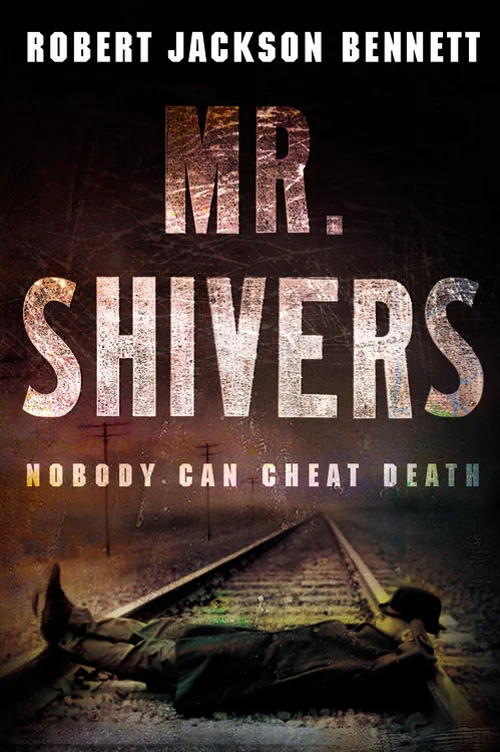
Mr. Shivers (2010), Orbit. First Orbit ebook edition, January 2010. Source ISBN 9780316071376 is distinct from the US print and UK paperback editions. January 15, 2010 is the current publisher-listed source edition date; conflicting 2009 retailer listings do not establish an earlier worldwide first publication here. All 32 extracted entries reconcile to 27 chapters, one narrative Epilogue and four excluded nonnarrative entries. Isolated name and age inconsistencies are recorded in the gold audit without altering the source. No independent publisher-master collation performed. The existing 500 by 752 WebP visually matches title and author; exact cover-edition correspondence and reproduction rights were not independently established. How sources are recorded.