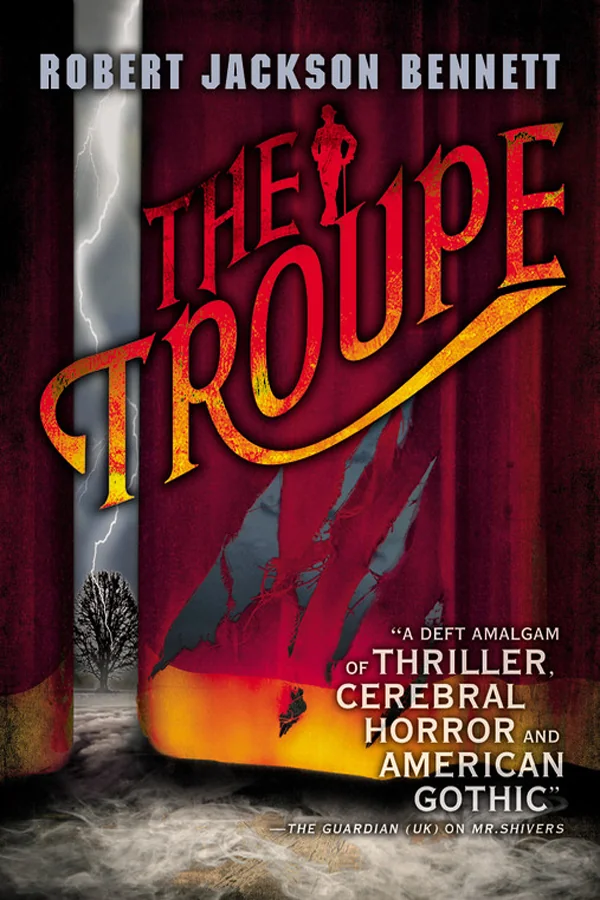
The Troupe
A young pianist seeking the father he has never known joins a vaudeville troupe that preserves Creation through music, discovers the hidden cost of its mission, and uses his real father's final gift to bargain with the darkness for the world's survival.
Overview
Sixteen-year-old George Carole leaves his job as a theater pianist in Freightly, Ohio, to find Heironomo Silenus, the traveling performer he believes is his father. George's mother, Alice, died giving birth to him, and his upbringing with his grandmother in Rinton has left him sensitive to his illegitimacy and eager for recognition. A photograph and his grandmother's reaction to a visiting troupe have led him to Silenus. He hopes the celebrated showman will give him both a family and a career worthy of his remarkable musical ability.
George catches the troupe in Parma. Professor Kingsley Tyburn presents marionettes that seem disturbingly alive, Colette de Verdicere dances under the identity of a Persian princess, and Frances Beatty performs feats of strength despite appearing exhausted and frail. Their final act is a chorale conducted by Silenus, with Colette singing and an apparently mute cellist named Stanley. Beneath the ordinary music George hears another song that transforms his perception of the world. Unlike the rest of the audience, he remains conscious throughout it. He also recognizes the unnatural silence surrounding men in gray suits who have been following the troupe. His warning helps Silenus escape these pursuers, and George joins the company. During their early travels he also gains an unexpected protector when he defends a young woman against the other seasonal winds. She is Zephyrus, the spring wind, and becomes his patron, promising help if he calls her.
Silenus eventually explains that their performances preserve fragments of the First Song, the music with which the world was created. According to his account, the Creator departed and the surrounding darkness awakened, taking the form of wolves that consume Creation. The Song sustains the world's remaining boundaries, while its scattered echoes offer glimpses of the original whole. Silenus believes the Creator abandoned its work, but Stanley disputes that conclusion. The ruined lands beyond ordinary reality confirm the danger without resolving the Creator's intentions. George himself absorbed an unusually large fragment as a child when he discovered a hidden place near Rinton. It accounts for his musical gifts and his sensitivity to the wolves. Removing it could kill him.
After George names his mother, Silenus accepts his claim of paternity and allows him to stay. Their supposed family relationship is disappointing. Silenus remains secretive and often cruel, while George's vanity repeatedly damages his relations with the other performers. When George attempts an unauthorized solo performance, Silenus secretly pays the audience to humiliate him. Stanley instead offers clothes, presents and quiet companionship.
The troupe's members depend on Silenus for reasons George does not initially understand. Franny reveals that she is dead and that the intricate symbols covering her skin animate her body. She cannot truly rest and has lost much of her memory, although she sometimes glimpses the future. Kingsley, whose real surname is Harrison, sought Silenus after a family catastrophe. After his severely malformed infant died, he blamed his wife and had her prosecuted and hanged. Silenus taught him how to animate marionettes with parts of himself. After looking directly at the wolves during the escape from Parma, Kingsley becomes increasingly distressed and feeds the puppets more of his body. The puppets gain independence at the cost of his life, then turn on George.
George escapes through Silenus's magical office into the lands the darkness has consumed. The pursuing marionettes cannot survive there, but George becomes stranded and eventually emerges into the burned remains of his former theater. He finds his old colleague Irina murdered and falls into the wolves' hands. One captor, distinguished by a red coat and an enthusiasm for human behavior, has swallowed a fragment of the Song. It has given him a separate identity and an interest in living. It also enables the wolves near him to resist the troupe's protective music and locate other fragments. The wolves summon their progenitor, the First Darkness, whose presence nearly destroys George's mind. Zephyrus brings Silenus and Franny to rescue him. Stanley and Silenus then heal him by altering the Song, consuming part of it permanently. George learns that changing Creation uses up the very music needed to protect it.
Colette's difficulties reveal another kind of dependence on Silenus. She is a woman of mixed race from New Orleans, not a Persian princess. Silenus devised her royal identity to help her evade the racism that restricts Black entertainers. She wants a larger career, but resents having to maintain a false identity and doubts whether even exceptional talent will secure fair treatment. George declares his love, yet she recognizes that he idealizes the woman he watches onstage without understanding her life. He later discovers that she and Silenus are lovers. When he assumes she must have been coerced, she insists the relationship was her own choice and rejects his efforts to rescue her. The red-coated wolf's mistaken suggestion that Stanley's attention is romantic also leads George to reject his kindness, including the offer of a treasured pocket watch.
Silenus takes George to an old cemetery to obtain a gift for potential allies. There George sees the grave of Anne Marie Sillenes, Silenus's wife, who died of cancer decades earlier. Confronted about the troupe's hurried itinerary, Silenus admits that he has reduced its protective performances to pursue the remaining Song. He wants to assemble it, understand why suffering exists and perhaps summon the Creator to repair the world. He has concealed this purpose from the others, including Stanley, while places behind them disappear into darkness. From another grave he steals a bottle of uisce beatha, an ancient whisky prized by the fairies, to secure help against the wolves.
At the fairy court of Heartache's Founding, the troupe encounters immortal beings whose damaged bodies and elaborate masks conceal neither their cruelty nor their expectation of the world's end. Their ruler, Ofelia, hates Silenus because her mother, Titania, died fulfilling an agreement to help him find the Song. The whisky purchases Ofelia's aid and a promise not to harm Silenus in revenge for Titania. She supplies botkines, likenesses of the performers that will distract the wolves, and a road to another fragment. During the visit she also tempts George with fame, compelled love from Colette and revenge against Silenus. He refuses these offers, unwilling to turn Colette into another puppet.
Returning to the fairy court restores Franny's memories. George overhears her asking Ofelia to make Silenus experience her suffering. Angry about Silenus's deceptions and jealous of his relationship with Colette, George chooses not to warn him. He tells himself that replacing Silenus would allow the troupe to fulfill its neglected duty. After Stanley and Silenus collect the next fragment at Lake Logehrin, Franny identifies herself as Anne Marie Sillenes. Silenus had used Titania's instructions to revive his dead wife, but the attempt left her trapped for decades in an exhausted, confused body. He could neither restore her fully nor let her die. Annie's anger intensifies when she believes he has fathered George and sees his relationship with Colette.
Ofelia exploits the wording of Annie's request, treating her promise that Silenus will know Annie's pain as permission to inflict new injuries on them both. Her servants beat Silenus and cut his throat. Annie suffers the same wounds but survives because of her inscriptions; confined in an abandoned train car, she begins losing her memories again. Silenus appears to die after a prolonged beating, and the fairies take his body to eat. Before his death, however, he secretly drinks wine containing maenad's honey. Its delayed regenerative power eventually reconstructs him from the blood of the fairies who consumed him, leaving the court dying as he returns to seek his companions.
Meanwhile, Ofelia brings the botkines back to the lake with the wolves following them. She has traded the troupe's safety for a final extravagant celebration before the darkness consumes the world. Colette saves George and Stanley by persuading the troupe's enchanted backdrop, a chimera's skin, to show the wolves a blinding light. They flee, but Stanley is separated from the others. The red-coated wolf finds George and Colette hiding and chooses to help them. He has decided that life should continue despite its pain. He gives George his fragment and leads the other wolves away, risking the loss of the individuality the Song gave him.
Stanley plans another diversion. He asks Annie to break the dam and tells George and Colette to climb beyond the flood's reach. Then he openly sings the First Song, drawing the wolves after him. George realizes that Stanley has been carrying the collected music inside himself all along. His constant silence prevents it from escaping, and his years of protection and tenderness were the actions of George's real father. As Colette carries George to safety, Stanley's singing creates an encounter with an echo of Alice and a vision of the young lovers together. Alice reassures George that her death was not his fault and that both his parents love him.
Annie drags the train car up to the dam, destroying her body in the effort while struggling to remember her name. She throws herself and the car against the structure, releasing the lake. Stanley has chained himself to a tree below the dam to draw the wolves into the flood. The water destroys their immediate attack, but also fatally injures him. George finds his father still alive and briefly reaches him as a son before Stanley passes the accumulated Song into him. Through its echoes, George learns why his father concealed their relationship: exposing Stanley's connection to the Silenus family could have revealed him as the bearer. Faced with sending George away, Stanley himself proposed letting him believe Silenus was his father so that he could remain close.
Stanley dies as the First Darkness forces its way into the world. With his childhood fragment joined to the collected echoes, George possesses nearly the whole Song and can alter Creation itself. He stops time, unmakes the world and sings it into existence again before the watching wolves. Rebuilding history gives him the opportunity to prevent his father's death, but he refuses to substitute a life arranged around his wishes for the one Stanley actually lived. Annie's death also remains. He restores the lands the wolves had consumed, including those lost because Silenus neglected the troupe's protective work. Yet the few missing notes leave him unable to establish whether an original Creator had a plan or whether other bearers have remade the world before him.
George's decisive change is to make the wolves human. They now face the mortality they imposed on others, and the First Darkness must confront the prospect of devouring its own children. George uses that shared vulnerability to bargain for time in which the world will be left alone. The duration is not disclosed, and death itself is not abolished. Most of the wolves are allowed to return to their former state, while those who want human lives remain, including the red-coated wolf. George spends all the Song he carries on his reconstruction, but also repairs Stanley's broken pocket watch, a gift he had once rejected.
Silenus and Colette reunite with George, and the three bury Stanley. Silenus confirms that he is an older family relative, not George's father, and that the methods he used to prolong his life made him sterile. He cannot host the Song himself. For years he directed attention toward his own performance while Stanley quietly hummed the music during the chorale. Despite everything the pursuit has cost, Silenus still wants an explanation for suffering. He departs to search for new echoes and another bearer. George refuses to follow him, and Colette declines to remain with either man. With Zephyrus's help, she leaves to seek audiences who may accept her without the false princess identity.
George returns to Rinton and reconciles with his grandmother. He establishes a household, marries and raises a daughter. His unnamed blond wife travels frequently to help distant fields, and their garden receives unusually favorable weather, details that suggest she is Zephyrus without identifying her directly. George is never heard playing the piano again. Teaching his daughter with a blackboard and showing her Stanley's watch continue to bring grief, but he also sings while they garden. Neighbors come to hear the strange, echoing song, and sometimes his daughter joins him. The ending does not explicitly name their hymn or explain its relationship to the Song George spent.
Main Characters
- George Carole: A gifted young pianist whose search for his father leads him into the troupe's struggle against the wolves; his jealousy and desire for recognition give way to a recognition of Stanley's love and a willingness to protect the world without undoing every personal loss.
- Heironomo Silenus: The long-lived troupe leader, also called Harry and formerly known to his wife as Bill; unable to bear the First Song himself, he protects its carriers through deception but sacrifices the troupe's wider duty to his desire to recover his wife and understand Creation.
- Stanley Silenus: The cellist, secret bearer of the collected First Song and George's actual father; keeping the Song contained prevents him from speaking, while concealing his identity lets him remain near his son until his final sacrifice and transfer of the music.
- Colette de Verdicere: A dancer from New Orleans who performs as a Persian princess to evade racist restrictions; she manages the troupe, loves Silenus, resists George's assumptions about her and eventually leaves to pursue a new act and a career of her own choosing.
- Anne Marie Sillenes: Silenus's deceased wife, reanimated and presented as the strongwoman Franny Beatty; recovering her memory prompts a disastrous attempt at revenge, followed by her decision to destroy the dam and save the younger performers at the cost of her own life.
- Professor Kingsley Tyburn: A former lawyer whose real name is Kingsley Harrison, who had his wife executed after their infant's death; his desire for children leads him to animate marionettes with pieces of himself until the effort kills him.
- Zephyrus: The spring wind, appearing as a girl or young woman in green; she becomes George's patron after he defends her, helps rescue him from the First Darkness and later assists Colette in leaving to perform elsewhere.
- The Red-Coated Wolf: A servant of the darkness changed by a swallowed fragment of the Song; his curiosity about human life leads him to surrender the fragment, protect George and Colette and ultimately choose to remain human.
- Ofelia: The fairy ruler of Heartache's Founding, who resents Silenus's part in Titania's death; she manipulates the wording of bargains, turns Annie's demand for redress into an execution and delivers the troupe to the wolves in exchange for a last celebration.
- The First Darkness: The progenitor of the wolves, seeking to consume Creation and become whole again; George forces it to negotiate by making its children vulnerable to the loss it has inflicted on the living.
- Alice Carole: George's mother, who loved Stanley and died during childbirth; an echo of her created through Stanley's singing shows George their history and releases him from the belief that he is to blame for her death.
Central Themes
- Grief, shared vulnerability to death and the harm caused by refusing to accept loss
- Fatherhood expressed through care and sacrifice, and the emotional cost of secrecy
- Performance as deception and creation, and the danger of mistaking an imposed role for a person
- Racial prejudice and the compromises demanded of a performer seeking recognition
- The desire for a complete explanation of suffering and the limits of certainty
Mood & Atmosphere
The vaudeville tour combines shabby hotels, theatrical disputes and comic vanity with an increasingly threatening supernatural world. The wolves, animate puppets and fairy court turn curiosity into physical and emotional horror. The final chapters concentrate on bereavement, sacrifice and acceptance, ending with domestic happiness that preserves the memory of loss and leaves the world's ultimate origins unresolved.
Source Edition
The Troupe (2012), Orbit. How sources are recorded.