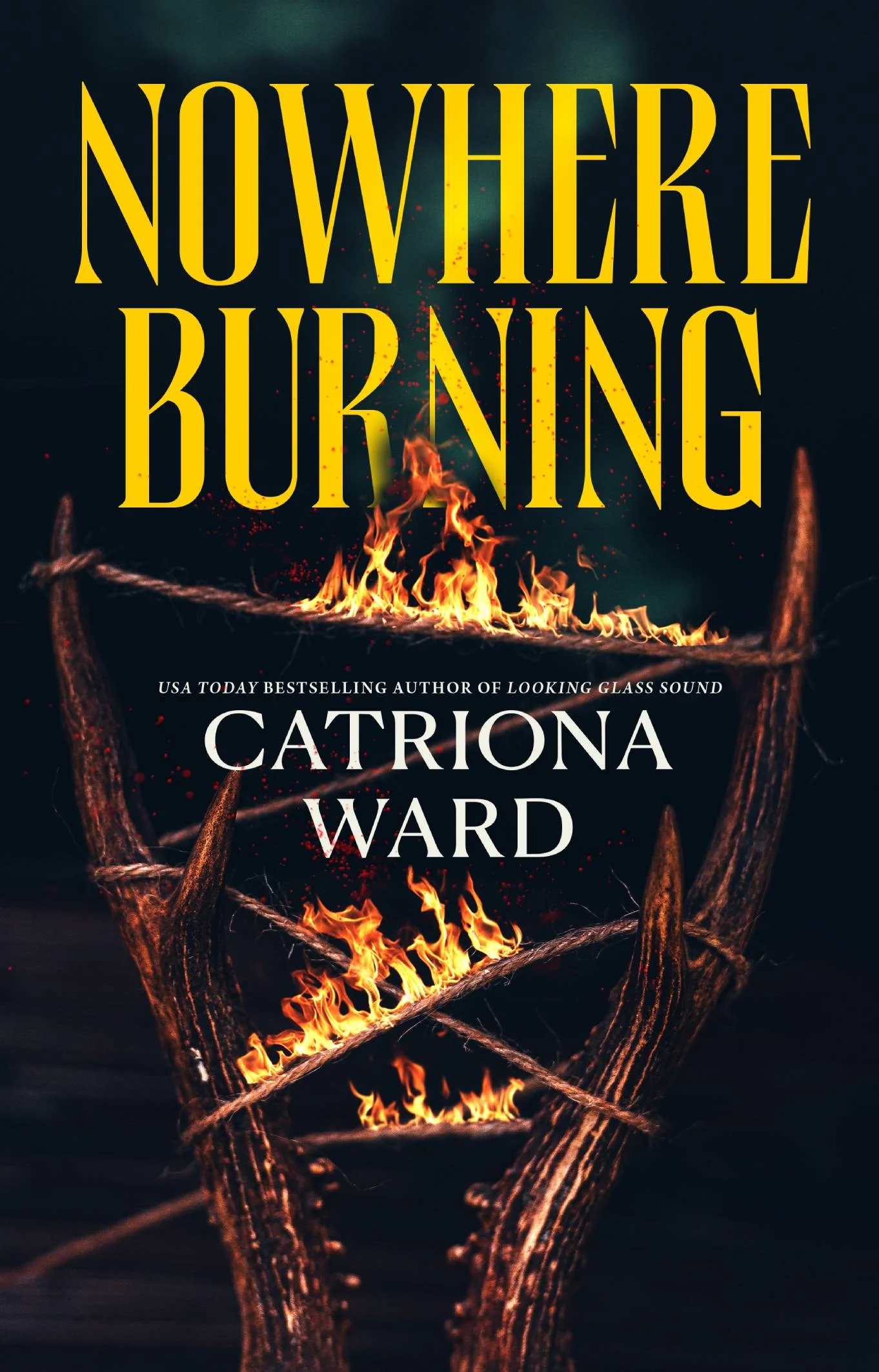
Nowhere Burning
After a teenager flees an abusive guardian with her brother and enters a remote community devoted to protecting children, the novel's overlapping timelines reveal her connection to a serial killer's estate, the brother's later identity, and the unresolved consequences of her choice to stay.
Overview
Catriona Ward's Nowhere Burning tells the history of a secluded mountain estate through intersecting accounts separated by decades. Riley's story concerns a teenage girl trying to protect her younger brother in the years after the estate's notorious fire. Marc's apparent investigation of the children living there takes place much later. Adam Leahy's chapters return to the period when actor Leaf Winham owned Nowhere House, while accounts of an earlier apple farm and a lost boy provide historical evidence that the central narrators cannot initially connect. The novel withholds these relationships to make the difference between a witnessed event, a remembered event and a belief about the supernatural central to its construction.
Riley and her seven-year-old brother Oliver have been living with an abusive guardian they call Cousin. Their mother is dead, and their father is absent from the history Riley knows. Cousin deprives the children of food and teaches Oliver to interpret his own suffering as evidence of evil within him. Riley is both Oliver's protector and an increasingly frightened child herself. A girl called Noon offers the siblings directions to Nowhere, where she says runaway children can live safely. Riley prepares to poison Cousin, then flees with Oliver. Later, Noon says a newspaper confirmed that he died from rat poison. The journey to the isolated mountain valley becomes another disaster when Riley shoots a young man beside a ship-shaped tree. She has believed that he means to attack them, but she subsequently sees that he held a compass rather than a knife. A further shot wounds Oliver. Riley hides the body and conceals her responsibility for his injury.
Cal and Everett find the exhausted siblings and bring them into Nowhere by a zipline that descends into the enclosed valley. They join Noon, Midnight, Dawn and a collection of younger children living around the old stables. The group shares food, cares for Oliver's damaged leg and gives Riley useful work, including preparing food and animal skins. Its members have histories of neglect and abuse. Dawn was abandoned on the mountain by her parents; Noon says she killed a father who harmed her. Riley begins to feel that the valley might be the home she has never had. She is also alarmed by the group's secrecy, its refusal to approach the ruined house, the crocodile Tinkerbell living in the lake and the nightly ritual in which residents offer their breath towards the property. Noon explains that their apparent worship of Leaf Winham is chiefly an expression of gratitude towards Nowhere itself. The earlier settlement, she says, nearly destroyed itself in struggles over food and power.
Cal's missing brother Danny becomes the crucial fact Riley cannot reveal. Cal and Danny both lost their right little fingers as punishment for trying to kill Noon during an earlier dispute. The description makes Riley recognize Danny as the young man she shot. Cal grieves for him and grows close to Riley, while she repeatedly prevents Oliver from telling the truth. Her efforts to preserve their refuge increasingly resemble Cousin's methods of control: she frightens Oliver, tells him to lie and decides that his safety justifies denying him any choice. Nowhere offers actual shelter, but the cost of keeping it is the destruction of trust between the siblings.
Adam's earlier chapters explain what happened to the estate before the fire. An architect, Adam arrives to build a hidden staircase for Leaf Winham, a famous actor who says he needs to protect his privacy from intrusive guests. The staircase, concealed behind a bookcase, has peepholes opening into rooms throughout the house. Adam becomes emotionally and sexually involved with Leaf, a relationship in which affection alternates with intimidation. Leaf imitates Adam's gestures as though collecting material for a role, keeps the unwashed clothes of past male guests and gradually persuades Adam to participate in a near-death performance, lying cold and motionless while suppressing his pulse. Leaf seems most tender when Adam appears to be dead. The charitable Foundation through which Leaf claims to assist vulnerable young men also gives him access to people whose dependence he can exploit.
Officer Lloyd investigates the disappearance of Rick McFadyen, a young man Leaf knew through the Foundation. Adam discovers that Rick's passport and bank card remain at home, that Christie, Adam's pregnant girlfriend, has reported him missing, and that the estate conceals movement Adam cannot explain. Eventually he finds a clinical-looking room hidden behind a jukebox, containing surgical instruments, photographs of injured men and an image of Rick among the victims. Leaf rationalizes what he has done as a kind of assistance to people who, he claims, wanted to die. Adam recognizes both the violence and the impossibility of reasoning safely with him. He starts a fire in the wooden secret staircase, hoping the blaze will force an investigation, then escapes into the foundations through an older passage hidden by a lilac tree. Leaf follows and cuts Adam's throat. Adam injures Leaf with a pen and reaches a mountain road, where a young firefighter, Linus, finds him. Leaf subsequently kills Adam and attacks Linus as the property burns. Linus survives the wound to his throat, a necessary distinction from the rumors that accumulated around the fire.
The present residents believe the valley is kept alive by blood placed in its soil. During a drought and food shortage, Noon leads a raid on Ault that begins with gathering discarded provisions and ends with the abduction of Alison, a woman they have watched harming her young children. They restrain Alison in a chair in the ruined house and cut her repeatedly so her blood falls into a sunken garden. They feed her mushrooms and baby formula to sustain her through the ordeal, then abandon her on a mountain road. Animals and rain return after the bloodletting, but that sequence does not demonstrate that the ritual caused the change. It does show how the residents use their own experiences as abused children to justify inflicting coercion and suffering on someone they judge guilty.
The history of Nowhere is older than Leaf. A separate account of the apple farm describes Thomas and Jane Dunning, who raised five children hidden from the nearby town. Thomas murdered Jane and the children and then killed himself. Angela, Jane's friend, helped organize the search that found them, but persuaded the other witnesses to conceal the murders. Their fear of scrutiny and exposure of illicit business led them to bury the children in the farm's cellar and spread a false explanation. The children were denied public recognition even after death. This older atrocity becomes important when Noon tells Riley that the residents' true purpose is to protect five murdered children, whose skulls lie beside the lilac tree in the house's foundations. In Noon's account, the bone necklaces allow the adult caretakers to be recognized by these children. The text provides a specific history for the five original victims without confirming every supernatural conclusion the characters draw from it.
The immediate crisis begins when Cal discovers Danny's remains and Oliver reveals that Riley shot him. Noon opens Riley's locket, which has long held a photograph she could not see. It reveals her mother with Adam Leahy. Adam was Riley's father, murdered three days before her birth, and Nowhere has therefore been connected to her family long before she arrived. Noon destroys the photograph, and the group votes unanimously to give Riley's blood to the house. Noon has also dismantled the zipline so that nobody can leave. Cal cuts Riley, and the others continue bleeding and drugging her. She perceives winged figures and the presence of Leaf Winham. The narration makes the mushroom doses, hemorrhage, severe stress and her belief in the estate essential to assessing these experiences; it does not offer a simple external confirmation of the visions.
Riley frees herself after noticing a damaged-antlered deer enter the garden and disappear through the lilac. She finds the hidden passage, returns for Oliver and sets the stable block on fire when Midnight discovers them. Riley closes Midnight inside and later hears the screams of the people trapped in the blaze. She believes she has killed the residents and their young children. After leading Oliver through the tunnel, she sends him on alone with a compass and orders him to forget his name and their shared past. Riley believes her own life has been ruined by killing, but that the children of Nowhere still need her. She returns beneath the mountain and sees Hallie, Whitey, Rufus, Peach and baby Una waiting for her. This is an account of Riley's experience, not proof that the children survived the fire.
The novel later discloses that Marc is Oliver. A local tale of the Lilac Boy describes how Big Bobby Sullivan found a starving, injured child near a lilac tree and took him to the police. Oliver's infected leg was amputated below the knee. Adopted by a family who moved first to Arizona and then Quebec, he became Marc Villeneuve and tried to discard the identity associated with Riley's abandonment. He eventually had a daughter, Silvie, with Claude. Silvie developed Berger's disease, and her kidneys failed. Claude and then Marc each donated a kidney, but neither transplant lasted. Marc's project about Nowhere is actually an effort to find Riley, another close biological relative who might become a donor. His concealment of this purpose and his deliberate decision to schedule the documentary over Kimble's vacation with Margot expose how his fear of loss has begun to shape his treatment of other people.
A violent storm and landslide destroy the estate gate and allow Marc to reach the ruined house. He finds Riley, now middle-aged and living alone, and reveals who he is. They recognize one another and embrace. She insists that the five young children are still present. Marc remembers them as living children locked into the stables by Noon before the fire Riley started, and says none survived. He also distinguishes their names from those of the five Dunning children. The discrepancy leaves open whether Riley has encountered ghosts, conflated the two groups or sustained her life through visions tied to trauma and mushrooms. Her certainty cannot erase Marc's memory; Marc's testimony does not fully explain every strange occurrence in the house.
Marc persuades Riley to leave as the mountain begins collapsing. Their old tunnel fills with water, and Riley loses her bone necklace. Outside, the crocodile attacks Marc and seizes his artificial leg. He escapes by detaching it. Riley shoots the crocodile in one eye, but the animal retreats alive. They reach Kimble and Linus's vehicle. Marc finally admits that he sought Riley because Silvie needs her kidney. Riley agrees to donate, and medical tests determine the next steps. Kimble confronts Marc about the deception and takes over the documentary, rejecting his assumption that a friendship gives him a permanent claim on her time.
Riley donates a kidney, and Silvie survives the operation. Marc and Riley experience moments of closeness, while Riley continues to speak of the children she left at Nowhere. After a visit with Silvie, during which Riley readily discusses animals with her niece, she disappears from a fourth-floor hospital room whose window has been opened and its safety mechanism removed. The novel does not show how she escaped or where she went. Three years later Silvie's transplant is still functioning, though Marc knows it may not last indefinitely. Marc lives with his daughter in the desert, remains connected to Kimble and Margot, and continues to feel anger, gratitude and grief about Riley. Her location and the status of the children she believed she protected remain unresolved.
The book's central ethical problem is not simply whether the estate is haunted. Riley, Noon, Leaf and Marc all claim in different ways that love, protection or rescue can justify controlling another person. Their circumstances differ sharply, but the narrative tests each claim against what the chosen person experiences. Adam tries to love Leaf while erasing warning signs; Noon protects children through violence and absolute obedience; Riley saves Oliver from one abusive household, then threatens and abandons him; Marc uses his friendship with Kimble to obtain access to his sister. The separate timelines turn apparent supernatural mysteries into questions about concealed violence, remembered identities and the consequences of imposing a story on other people. The phrase "now here," hidden within the name Nowhere, links the desperate wish to belong to the more difficult obligation of being present for someone who is still alive. The ending neither absolves Riley nor proves that she is lost to the world. It establishes the life that Oliver, now Marc, has built while leaving his sister's final choice unexplained.
Main Characters
- Riley: Adam Leahy's daughter and Oliver's older sister; she saves him from abuse but later endangers and abandons him while trying to protect the children she believes inhabit Nowhere.
- Oliver / Marc Villeneuve: Riley's younger brother, wounded in childhood and later adopted; a documentary filmmaker seeking his estranged sister as a potential kidney donor for his daughter.
- Adam Leahy: Architect and Riley's father, whose relationship with Leaf Winham leads him to expose the hidden violence at Nowhere House and start the fire.
- Leaf Winham: Film actor and estate owner who exploits vulnerable young men through his Foundation and murders Adam before the fire.
- Noon: Leader of the later runaway settlement, whose claims to protect children authorize strict rules, bloodletting and punishment.
- Cal: Danny's brother and Riley's lover, who searches for Danny and later participates in Riley's punishment.
- Kimble: Marc's filmmaking partner, who confronts his manipulation and becomes director of the documentary.
- Silvie: Marc and Claude's daughter, whose kidney disease motivates Marc to search for Riley.
- Midnight, Dawn and Everett: Residents of the later settlement whose histories of abandonment or injury are part of Noon's community.
- The five children: Hallie, Whitey, Rufus, Peach and Una, distinguished from the five unnamed-at-first Dunning victims whose recorded given names are different.
Central Themes
- Love and control: attempts to protect or keep someone become coercive when consent is disregarded.
- Childhood abuse and intergenerational violence: Riley reproduces some of the threats used against Oliver even while trying to save him.
- Competing histories and unreliable perception: documented crimes, testimony, rumor and visions must be evaluated separately.
- Belonging and exclusion: the sanctuary at Nowhere offers genuine care while demanding concealment and obedience.
- Identity, memory and abandonment: Oliver's adoption as Marc does not erase his childhood or his attachment to Riley.
Mood & Atmosphere
Tense and often violent, with alternating scenes of communal care, isolation, remembered trauma and uncertain supernatural perception.
Source Edition
Nowhere Burning, Tor Publishing Group. How sources are recorded.