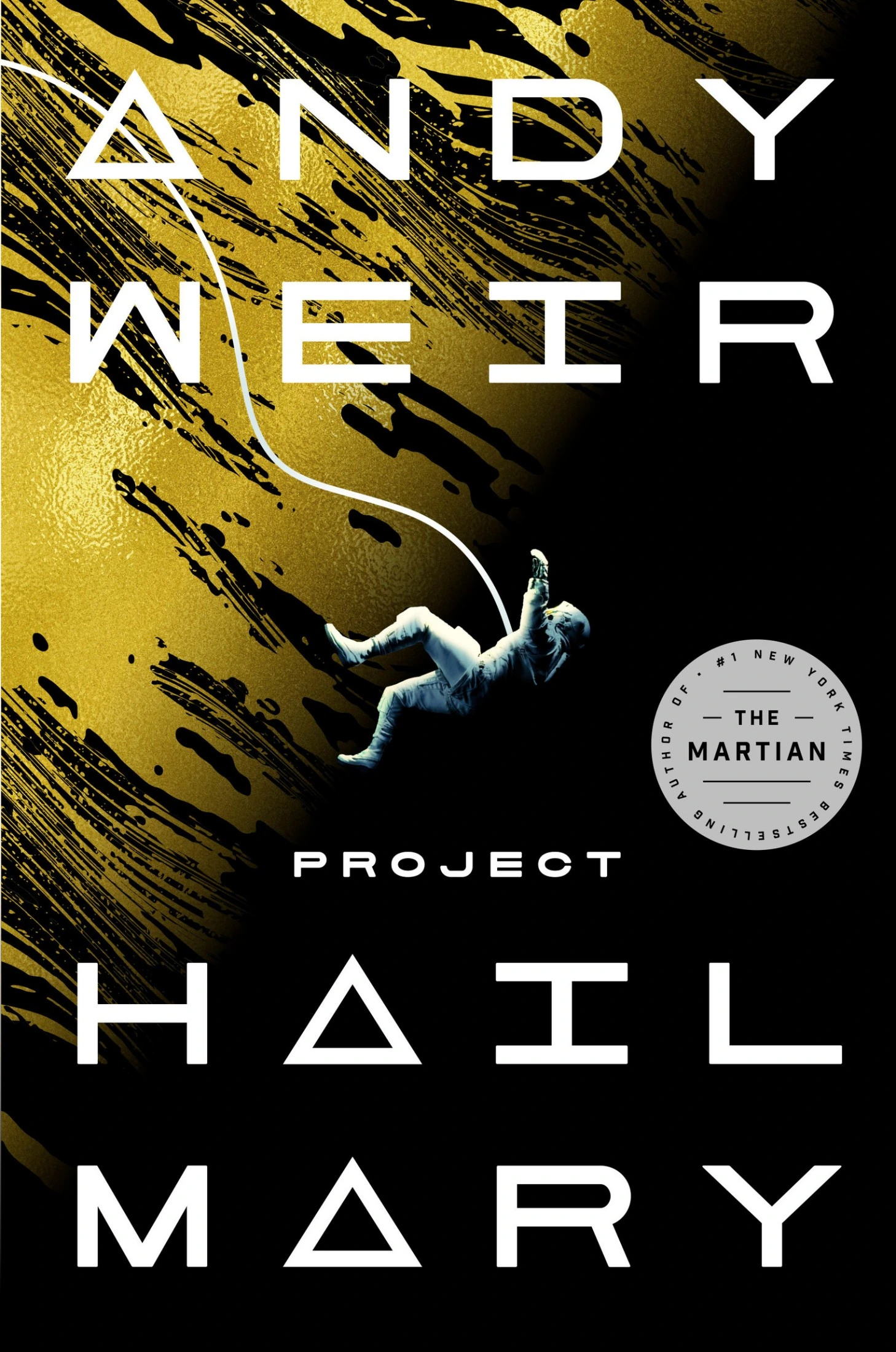
Project Hail Mary
An amnesiac scientist sent to a distant star to stop an organism draining Earth's Sun discovers an alien ally, develops a biological defense, and ultimately chooses to rescue his friend while autonomous probes carry the cure toward Earth.
Overview
Andy Weir's Project Hail Mary begins with a man awakening in a spacecraft's medical compartment with no memory of his identity, companions, or destination. The ship's automated medical system has kept him alive through a long coma, but the other two crew members are dead. He tests his surroundings as a scientist would, discovers that his apparent gravity is the consequence of a spacecraft's acceleration, and gradually remembers that his name is Ryland Grace. He once researched molecular biology and subsequently taught middle school. The star outside is not the Sun. Grace has been sent to Tau Ceti, a distant system that may contain the answer to a threat capable of destroying human civilization. His immediate objective is to learn what makes that star different from Earth's, then return the answer in small autonomous probes. The Hail Mary itself was built as a one-way mission.
The novel tells two related stories in a deliberately staggered order. The Tau Ceti investigation unfolds after Grace wakes, while recollections reconstruct the years in which the mission was conceived and built. At first these retrospective scenes supply scientific context and the names of the people he has lost. Later they expose the political choices and coercion concealed by his memory. The present-day narrator can perform experiments, pilot machinery, and explain theories long before he knows why he occupies the ship. The reader therefore acquires information alongside him until a late flashback discloses something that he, in the present, has not yet remembered. That distinction is crucial to the novel's treatment of heroism: the successful mission does not prove its principal investigator volunteered for it.
The danger begins with the Petrova line, an anomalous infrared emission running between the Sun and Venus. Researchers connect it to a microscopic organism eventually named Astrophage. Astrophage absorbs enormous amounts of energy from stars and can store that energy through unusual cellular processes, while maintaining a constant temperature of 96.415 degrees Celsius. The organism travels to carbon-dioxide-rich planets to reproduce and sends its offspring back toward a nearby star. Grace's experiments with single cells establish the relevant life cycle and overturn his earlier professional claim that alien life need not follow familiar water-based biology. Astrophage contains recognizable cellular machinery, but its extraordinarily efficient energy handling makes it capable of draining the Sun's light output. As a growing infestation reduces the radiation reaching Earth, the consequences extend far beyond astronomy. Crops will fail, temperatures will fall, and population losses may become enormous long before any distant expedition can send back a solution.
Eva Stratt directs Earth's response with exceptional international authority. She recruits scientists and engineers without regard for conventional career standing, including Grace and imprisoned solar engineer Robert Redell. Dimitri Komorov works out how the organism's stored energy can support spin-drive propulsion through directed infrared radiation. The project requires industrial-scale cultivation of Astrophage, prompting Redell to propose black heat-absorbing panels across an enormous area of the Sahara Desert. Dr. Lokken develops an artificial-gravity system that separates ship sections on long cables, allowing established laboratory instruments to work without continual redesign for weightlessness. Dr. Lamai's automated medical system and research on rare coma-resistant genetic traits provide a way to transport a human crew across years of flight. Steve Hatch creates the four autonomous, Astrophage-powered data probes later called John, Paul, George, and Ringo. Those probes are meant to return discoveries to Earth after the crew's one-way expedition ends.
The enormous scientific effort does not eliminate the cost of waiting for an answer. François Leclerc predicts widespread famine and catastrophic mortality during the decades required for the mission and the return of its data. Stratt authorizes a dangerous short-term intervention in which nuclear detonations release methane from Antarctic ice to slow cooling by increasing the greenhouse effect. The resulting environmental damage is accepted as a temporary alternative to even worse losses. Scientific planning and political authority are inseparable throughout this part of the book. Stratt can bring rival nations together and obtain equipment, research, and expertise that no ordinary administrator could command, but she is also willing to sacrifice environmental stability, legal rights, and individual autonomy for a higher probability of collective survival. The narrative makes her effective without portraying her methods as morally neutral.
The Hail Mary's objective is Tau Ceti because its stellar luminosity has remained stable despite an Astrophage-associated infrared line. When Grace arrives, he discovers a much larger artificial craft, identified by his instruments as Blip-A. Its crew appears to use Astrophage-based propulsion but communicates through controlled light flashes and exchanged physical models rather than human radio conventions. Grace receives an impossibly strong material he calls xenonite and a model connecting Tau Ceti with 40 Eridani. He responds with a marker for Sol, establishing that the two visitors are investigating parallel catastrophes. The alien ship attaches a pressure-controlled tunnel to the Hail Mary. Grace finally meets Rocky, a five-limbed, hard-shelled being without eyes who perceives the world largely through sound and speaks in musical chords. Each initially lacks the vocabulary even to describe the other's senses.
The incompatible biology of their encounter cannot be solved by goodwill alone. Rocky lives in a superheated, pressurized ammonia atmosphere; Grace requires a much cooler oxygen-containing one. Xenonite allows them to build adjoining environments separated by transparent barriers, and Rocky's engineering makes new passages and laboratory access possible. Grace uses sound recordings and frequency analysis to map Rocky's polyphonic language into a gradually improving English dictionary. Rocky knows how to manufacture remarkable materials and construct highly reliable mechanisms, while Grace brings a more developed understanding of computers, microbiology, and relativistic physics. Their collaboration is grounded in the exchange of imperfect but complementary expertise. Neither civilization possesses a complete account of the threat, and their advances require learning how to ask questions that make sense to both species.
Rocky is the lone survivor of an Eridian crew originally numbering twenty-three. Grace infers that cosmic radiation killed the other Eridians because their home planet's dense atmosphere and magnetic field had left them unfamiliar with the danger. Rocky survived in part because of his location near protective Astrophage reserves. The same environmental differences explain the civilizations' divergent technical development. Erid's hot oceans made cultivation of Astrophage much easier than on Earth. Its mission designers also failed to account for relativity, grossly overestimating the fuel necessary to reach Tau Ceti. The error leaves the Blip-A with millions of kilograms of Astrophage to spare. When Rocky discovers that Grace expects to die after transmitting data because his own ship cannot return home, he offers the extra fuel. The offer turns a mission designed to end with its crew's deaths into the possibility of rescue for both worlds and for Grace himself.
Grace and Rocky target the third planet of Tau Ceti, which they call Adrian after Rocky's mate. Adrian is a dense, green-banded world with a carbon-dioxide-rich atmosphere and unexpected methane. Sampling the Astrophage movement above it reveals an ecological discrepancy: there are roughly equal numbers of cells traveling toward and away from the planet, despite reproduction supposedly producing a net increase in returning cells. Microscopy exposes numerous other organisms sharing the region with Astrophage. Grace and Rocky infer that Adrian may be the organism's original ecosystem and that a natural predator is consuming it. Their first captured sample does not demonstrate a predator, however. Infrared observations reveal an active Astrophage breeding layer deeper in Adrian's upper atmosphere, too low for a spacecraft to approach safely at orbital velocity.
To reach that layer, they manufacture a ten-kilometer xenonite chain and a sealed collection sphere. Grace slows the Hail Mary beneath orbital speed while tilting its Astrophage engines to hold position above the planet, then descends outside the ship to recover the specimen with a link-separating winch. The sample is retrieved, but intense infrared radiation reflected from Adrian's atmosphere melts part of a fuel bay. Exposed Astrophage instinctively heads for the planet, producing uncontrollable acceleration and a violent spin. Grace jettisons fuel compartments but becomes trapped beneath his dislodged pilot seat and cannot breathe. Rocky enters the human atmosphere to free him despite the near-certain damage to his heat-regulating organs. Grace then struggles to return Rocky to his native environment, severely injuring himself when he vents superheated ammonia into the airlock. Both survive only through improvised repairs, medical automation, and each other's willingness to accept personal danger.
The sample ultimately yields a voracious microbial predator that Grace names Taumoeba. The discovery is not yet a cure. Taumoeba thrives in the conditions around Adrian but does not consume Astrophage in laboratory reconstructions of Venus's or Erid's infected third planet, Threeworld. Nor is the mission's own machinery safe from the new organism. Escaped Taumoeba penetrates damaged equipment and devours nearly all the Hail Mary's Astrophage fuel, leaving the ship powerless in an orbit near Adrian. Rocky restores electrical generation with an isolated fuel reserve. Grace retrieves the four self-contained return probes, whose Astrophage has escaped contamination, and Rocky converts three into external engines. Their improvised propulsion eventually carries the Hail Mary back to the Blip-A. The incident shows that an apparently successful biological discovery can create a new engineering emergency when laboratory containment fails.
The cause of Taumoeba's failure under Venusian and Threeworld conditions is unexpectedly specific. Grace experiments with atmospheric gases independently and finds that molecular nitrogen, although largely harmless to humans and Eridians, kills the predator. Instead of changing the planets' atmospheres, he proposes artificially selecting Taumoeba that can withstand gradually higher nitrogen concentrations. Rocky manufactures precise breeder chambers, and repeated generations produce progressively more resistant organisms. The partners ultimately develop Taumoeba-82.5, which can reproduce and kill Astrophage under simulated conditions for both affected planets. They independently test the organism in the target gas mixtures and temperatures. Grace also cleans and sterilizes the Hail Mary's fuel compartments after their first infestation, while Rocky fabricates replacement tanks where lost capacity would make the trip home too long for Grace's available food. The project succeeds through biological selection and practical engineering, not a single unexplained scientific revelation.
Meanwhile, Grace's final memories disclose why he was on the mission at all. The original science specialist, Martin DuBois, and his alternate, Annie Shapiro, died when an error supplied a milligram instead of a nanogram of Astrophage during a hazardous generator experiment shortly before launch. There was insufficient time to train another scientist, and Stratt had quietly ensured that Grace, a rare coma-resistant individual, knew the vessel and its mission in case he was needed. Grace refused to board what he believed was a suicide mission. Despite Yáo's insistence that service must be voluntary, Stratt imprisoned Grace, ordered him sedated for the launch, and arranged for a drug-induced period of retrograde amnesia after arrival. Grace's earlier belief that he volunteered is false. Recovering the truth does not remove his responsibility for the people on Earth, but it forces him to recognize that his current efforts grew from an initial violation of his consent. His friendship with Rocky will later place a genuinely free and costly choice before him.
After testing the selected Taumoeba, the companions arrange to transport colonies separately to Earth and Erid. They include sealed miniature farms in the four beetles and exchange gifts representing their respective sciences: Rocky receives a human laptop and reference material, while Grace carries xenonite. Rocky replenishes Grace's fuel and the two ships depart. Grace's journey toward Earth initially seems secure. He has sufficient Astrophage, plans to seed Venus with Taumoeba, and can use the beetles if his own return fails. But another contamination episode reveals a dangerous flaw in their breeding process. The selected Taumoeba can move through xenonite, unlike the original strain, because their evolution under nitrogen exposure also favored escape into that material's molecular structure. Ordinary metals and plastics can contain the organism, but Rocky's ship uses xenonite extensively, including around fuel storage. Grace verifies this effect experimentally and realizes his friend may lose all propulsion after their separation.
When the Blip-A's engine emissions disappear, Grace faces a choice Stratt never allowed him to make. He could return to Earth and personally deliver his solution, or send the four autonomous beetles home and attempt to rescue Rocky. He cannot undertake both interstellar journeys because the ship lacks enough food, and Eridian food contains heavy metals toxic to humans. He launches the beetles toward Earth, turns the Hail Mary around, and searches for the powerless Blip-A. He uses the ship's powerful infrared drive emissions as an improvised radar source and the Petrovascope as a detector, gradually locating a vessel whose last position is uncertain by millions of kilometers. He finds Rocky alive but injured and stranded, reconnects the vessels, and offers to take his friend and the cure to Erid. Rocky is distressed by the prospect that the rescue will condemn Grace to starvation, then suggests an alternative food source: the Taumoeba biomass that consumed his fuel. Grace recognizes that this life-form, unlike Eridian food, may be compatible with human digestion.
The final chapter takes place years later on Erid and does not present Grace's return to Earth. Taumoeba kept him alive but initially failed to provide necessary vitamins and other nutrients, leading to severe deficiencies and illness. Eridian scientists eventually use the medical and biological information Grace brought to synthesize the missing nutrients and cultivate food, including muscle tissue cloned from Grace himself. He lives in a human-compatible dome, remains close to Rocky, and has grown older under Erid's heavy gravity. His new home is physically limiting but socially supportive. He has been offered help to refuel and repair the Hail Mary if he wishes to return, yet a second long solitary voyage is unappealing and he has made a life on Erid.
Rocky brings the decisive news that astronomers have measured Sol at its former full luminosity. The observed recovery strongly supports the conclusion that the beetles arrived and people on Earth implemented an effective response to Astrophage. It does not reveal the number of survivors, the damage caused by decades of famine or conflict, or the fate of Stratt. Grace's personal return remains unresolved, and he makes no immediate decision to leave. Instead, he walks to his classroom, where young Eridians await instruction in science. This final image connects the teacher introduced in his suppressed memories with the person he has chosen to become. His scientific success matters on a planetary scale, but the ending also recognizes the value of companionship, meaningful work, and a voluntarily chosen obligation to another life.
Main Characters
- Ryland Grace: A former molecular biologist and middle-school teacher who wakes aboard the Hail Mary with erased memories; his scientific training and eventual voluntary rescue of Rocky distinguish his later choices from his coerced assignment.
- Rocky: An eyeless, five-limbed Eridian engineer who survived the deaths of twenty-two crewmates and joins Grace in the search for an Astrophage predator, repeatedly placing friendship above his personal safety.
- Eva Stratt: The internationally empowered director of Project Hail Mary who organizes global research and makes extreme climate and personnel decisions, including forcing Grace onto the mission and suppressing his memory.
- Commander Yáo: Commander of the original Hail Mary crew who insists on voluntary participation and dies during the outward coma journey.
- Olesya Ilyukhina: The Hail Mary's prime engineer, an energetic Russian astronaut who dies on the way to Tau Ceti.
- Martin DuBois: The original mission science specialist, a meticulous biologist with extensive scientific training, killed in a prelaunch Astrophage accident.
- Annie Shapiro: DuBois's alternate scientific specialist and his partner, who dies alongside him in the same accident.
- Dimitri Komorov: Russian scientist responsible for developing the principles of the photon-based spin-drive propulsion system.
- Robert Redell: Solar-energy specialist recruited from prison to design the vast Sahara Astrophage-breeding operation.
- François Leclerc: Climatologist who calculates the likely famine and population losses caused by the Sun's declining luminosity and develops a desperate temporary climate intervention.
- Dr. Lokken: Engineer responsible for the Hail Mary's rotating cable-centrifuge configuration, enabling laboratory work under artificial gravity.
- Dr. Lamai: Physician and researcher who develops the long-duration coma treatment, automated medical care, and screens for coma-resistant genetic traits.
- Steve Hatch: Engineer who develops the four autonomous Beatles-named probes meant to transport findings back to Earth.
Central Themes
- Scientific discovery through controlled experimentation, mistaken hypotheses, and revised models
- Cooperation between intelligent species with different senses, physiology, and technical traditions
- Survival and the unintended ecological consequences of changing a living organism
- The difference between imposed sacrifice and an informed, voluntary choice
- Friendship, trust, and reciprocal responsibility across incompatible habitats
Mood & Atmosphere
An intellectually detailed interstellar survival story combining technical problem-solving, loneliness, first-contact discovery, rising biological danger, grief, humor, and an ultimately hopeful but qualified ending.
Source Edition
Project Hail Mary: A Novel (2021), Random House Publishing Group. How sources are recorded.