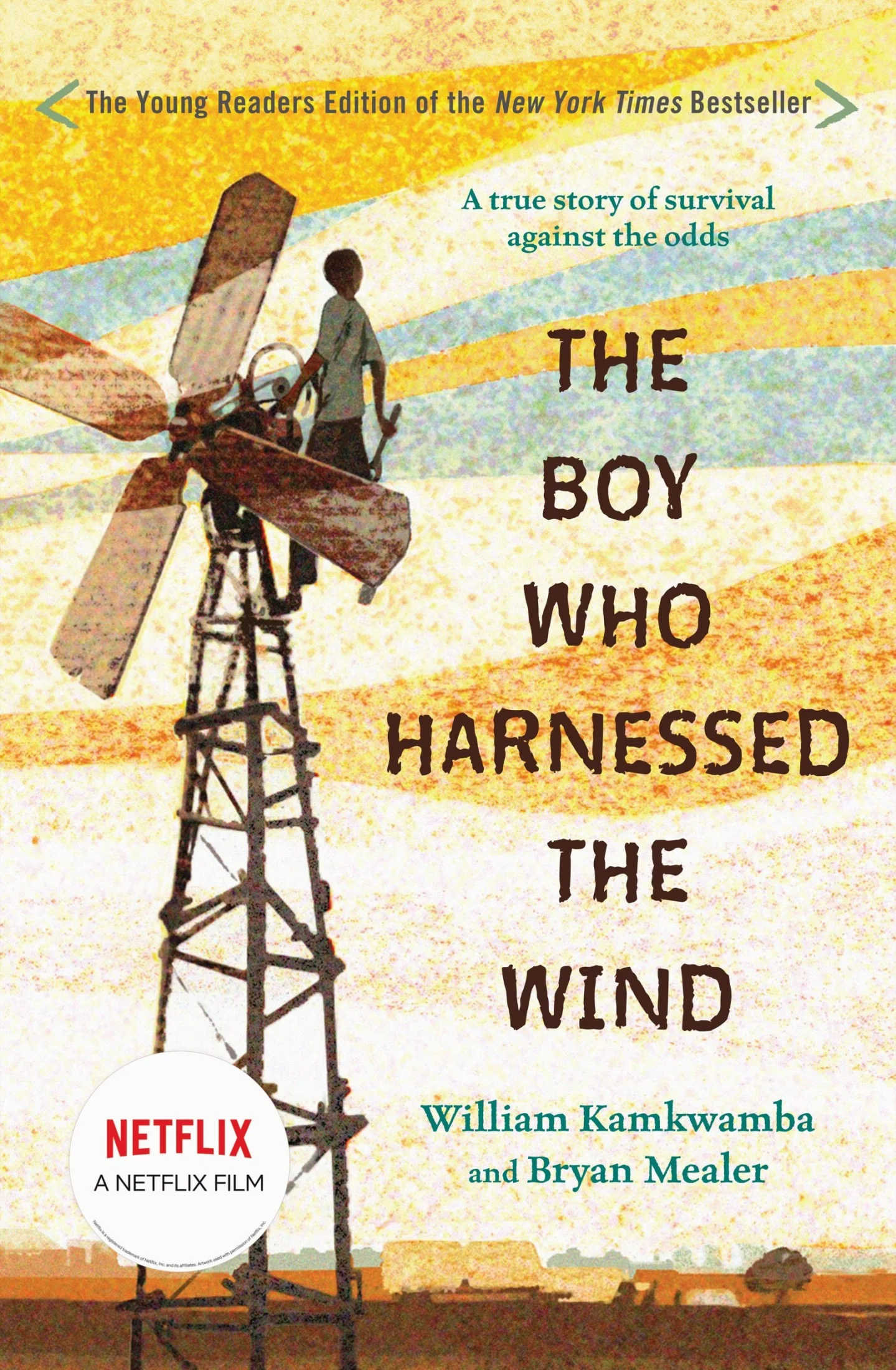
The Boy Who Harnessed the Wind
Young Readers Edition
In the 2015 Young Readers adaptation of his memoir, William Kamkwamba recounts childhood and famine in Malawi, a self-taught wind-powered electrical invention, and the later educational and community projects made possible by collaboration and support.
Overview
The Boy Who Harnessed the Wind: Young Readers Edition is William Kamkwamba's account, written with Bryan Mealer and illustrated by Anna Hymas, of growing up in rural Malawi, surviving the 2001–02 famine, and learning enough science to generate electricity from wind. This is the adapted Young Readers Edition, not a complete textual representation of the original adult memoir published in 2009. The book opens with William high on the tower of his homemade windmill, preparing to show an assembled crowd that it can light a bulb. It then returns to childhood to explain the family, village, conditions, and chain of experiments behind that moment.
William lives in Masitala, near the trading center of Wimbe, with his father, mother, and six sisters. The extended family depends on maize farming, whose annual cycle requires difficult communal work and careful purchases of seed and fertilizer. His cousin Geoffrey, the son of Uncle John, and Gilbert, the son of local chief Albert Wimbe, are his closest friends. The children make vehicles and games from discarded materials, displaying the resourcefulness William later applies to machinery. At the same time, his understanding of the world is shaped by accounts of witch doctors, masked Gule Wamkulu dancers, family folklore, and his father's Presbyterian faith. After frightening experiences with an alleged curse and a false promise of magical strength, he increasingly values observed causes over claims of supernatural intervention.
Grief and insecurity arrive before William's scientific breakthrough. Uncle John dies suddenly of tuberculosis in 1997, leaving Geoffrey fatherless and William's father without a farming partner. Uncle Socrates moves into the family community with a spotted dog, Khamba, who becomes William's trusted hunting companion. William devises traps and tools from bicycle parts, tree bark, rubber, and scrap metal, while he and Geoffrey develop a more systematic interest in mechanics by opening and repairing radios. A bicycle dynamo fascinates them: turning a wheel can produce the current needed for a lamp and, when connected appropriately, a radio. William begins dreaming of having light to study by at night, but his hopes depend initially on passing the Standard Eight examinations and entering a school with science facilities.
The family's situation changes drastically after a poor 2001 harvest. In William's recollection, fertilizer becomes unaffordable after changes in government support, heavy rains and flooding are followed by drought, and only five bags of maize remain in the family's store. William hears that government emergency maize reserves have been sold, while market prices rise beyond the reach of many families. The Kamkwambas sell goats, stop eating breakfast, and finally reduce their food to one modest evening meal. His mother uses the last flour to bake zigumu cakes and sells them to finance further food purchases. William takes a dangerous journey to a government maize depot in Chamama, where desperate crowds crush together and he receives less grain than he paid for. During Christmas 2001, he and his cousin Charity cook discarded goat skin, sharing some with Khamba. The narrative presents the famine through specific domestic experiences and reports heard by William; it is not an independent investigation assigning all responsibility for the crisis.
The famine interrupts William's education. He is assigned to poorly equipped Kachokolo Secondary, where overcrowded classrooms, inadequate books, and hunger make learning difficult. In February 2002 he must stop attending because his parents cannot pay the fees. At home, food becomes scarce enough that Geoffrey develops severe malnutrition. Cholera spreads, and death is a constant presence. William cannot spare enough food to save Khamba. After a failed attempt to hunt with the weakened dog, he and Charity tie Khamba to a tree in the forest and leave him. They later find him dead and bury him secretly, an act that leaves William deeply guilty. Recovery comes gradually when green maize, known as dowe, and pumpkins become ready in March. The full harvest eventually replenishes food stores, but it does not restore the family's finances or provide the school fees William needs.
Unable to remain in class, William visits a small library at Wimbe Primary, where librarian Edith Sikelo helps him find books and Gilbert shares school notes. Reading in English is difficult, so he studies diagrams closely, checks words in dictionaries, and learns incrementally from Malawi Junior Integrated Science, Explaining Physics, and Using Energy. The books explain dynamos, motors, batteries, electromagnets, and turbines. A photograph of windmills prompts an insight: wind-driven blades could turn a generator, providing electricity without grid service. William also imagines eventually pumping water so his family can grow food during dry months, but at this point irrigation is only a plan. With Geoffrey's help, he constructs a small wind-driven model from plastic, a discarded cassette motor, and rubber from a worn shoe. It powers a radio. He then begins salvaging a tractor fan, a shock-absorber shaft, and bearings from an abandoned tobacco-estate scrapyard for a larger device.
William briefly returns to school after the famine but cannot meet its fees even when his father sells their tobacco crop and petitions the teachers for more time. He turns to his engineering project, repurposing an old broken bicycle, cutting PVC pipe into long blades, paying a welder with money earned loading wood, and accepting Gilbert's help in purchasing bolts and, eventually, a bicycle dynamo. His neighbors mock the scrap-metal contraption, but Geoffrey and Gilbert help him erect a wooden tower. An initial test snaps the chain and sends excessive voltage into his father's radio. William modifies the circuit, and the three boys finally raise the machine onto a fifteen-foot tower. A gathered crowd watches as the wind turns its blades and illuminates a bulb. William subsequently runs a wire to his bedroom so he can read after dark. The first windmill is an electricity-generating experiment and household light source, not yet a functioning irrigation system.
Further improvements require as much experimentation as the original construction. William devises a step-up transformer to charge mobile phones, acquires a car battery to store energy, uses a diode to charge it from the generator, and installs car bulbs, parallel wiring, and homemade switches. Poorly insulated wires and a damaged grass roof create fire hazards; a makeshift circuit breaker helps prevent a dangerous short from causing a blaze. Repeated chain failures injure William's hands before a more dependable pulley-and-belt system is fitted. He also experiments with a short-range radio transmitter, a hand-operated water pump that proves too difficult to use, and an unsuccessful attempt to make biogas from goat manure. These failures show both the limits of his resources and the difference between an imagined application and a working technology. During renewed drought in 2006, some residents accuse the windmill of driving away the rain, and William fears they may destroy it.
William's achievements gain broader notice when he builds a second small windmill for a science club at Wimbe Primary. Visiting education officials alert Dr. Hartford Mchazime, who examines the larger windmill and brings local journalists to interview William. A Daily Times article travels from software engineer Soyapi Mumba to blogger Mike McKay and then to TED organizer Emeka Okafor. Mchazime also helps William return to school at Madisi Secondary. In 2007 William flies to TEDGlobal in Arusha, where Tom Rielly introduces him to the Internet and other technology, and host Chris Anderson helps him describe his windmill to an audience that responds with a standing ovation. Supporters fund improved batteries, solar equipment, safer wiring, and further education. William moves to the African Bible College and Christian Academy, with help from Gerry Douglas and tutor Blessings Chikakula. Donations support relatives' school fees, safer housing, and better household facilities.
The memoir carefully distinguishes the water projects that follow this recognition. A drilled borehole and solar-powered pump supply clean water and irrigation for the family's maize fields, allowing a second annual crop. During school holidays, William separately builds a larger wind-powered pump, the Green Machine, over the old shallow well to water his mother's vegetable garden. These later systems, and the solar lighting that spreads through households, should not be attributed to the first windmill at its initial demonstration. On a December 2007 trip to the United States, William visits a wind farm near Palm Springs and considers the possibilities of engineering on a much greater scale.
In the epilogue, written from a 2014 perspective, William receives a scholarship to the African Leadership Academy in South Africa, graduates with his family present, and describes collaborating with Bryan Mealer on the original memoir published in September 2009. He attends Dartmouth College, where he works on practical engineering projects including solar-powered secure phone charging, and graduates in 2014. He plans a design internship at IDEO in San Francisco before returning to Malawi. Through the Moving Windmills Project, in partnership with buildOn and other organizations, he helps rebuild and equip Wimbe Primary, expands the library, brings solar electricity and offline educational resources to Kachokolo, and supports his sisters, friends, and family businesses. Other aims remain proposals, including affordable community power and well-drilling systems and an innovation hub in Lilongwe. The work concludes with William's desire to provide others with the educational access, collaborators, and resources that made his achievements possible. Individual ingenuity matters in the memoir, but so do family labor, food security, public infrastructure, institutions, and sustained communal support.
Main Characters
- William Kamkwamba: narrator, science enthusiast, and inventor from Masitala
- Trywell Kamkwamba: William's father, a farmer who supports the household and eventually his windmill project
- William's mother: family farmer and baker whose work helps the household survive the famine
- Geoffrey: William's cousin and fellow radio experimenter, son of Uncle John
- Gilbert: William's closest friend, son of Chief Wimbe, who helps purchase construction materials
- Khamba: dog brought by Uncle Socrates who becomes William's hunting companion
- Edith Sikelo: teacher and librarian who provides access to books
- Hartford Mchazime: education official who connects William with media and further schooling
- Tom Rielly: TED organizer who helps mobilize education and engineering support
- Bryan Mealer: journalist and coauthor who helps document William's experiences
Central Themes
- Famine, agriculture, and household food security
- Independent learning and barriers to education
- Practical science, engineering, and iterative failure
- Family, friendship, and community support
- Infrastructure access, local development, and future opportunities
Mood & Atmosphere
First-person recollection of family life, severe famine, grief, technical experiments, and widening educational and community opportunities.
Source Edition
The Boy Who Harnessed the Wind: Young Readers Edition (2015), Penguin Young Readers Group. The 2015 illustrated Young Readers adaptation published by Penguin Young Readers Group (e-book ISBN 9781101637425), not the 2009 original adult memoir. Print catalogue identifier: Young Readers paperback ISBN 9780147510426; former adult paperback ISBN 9780061730337 retained in gold audit provenance. Illustrator Anna Hymas is not a third coauthor. How sources are recorded.