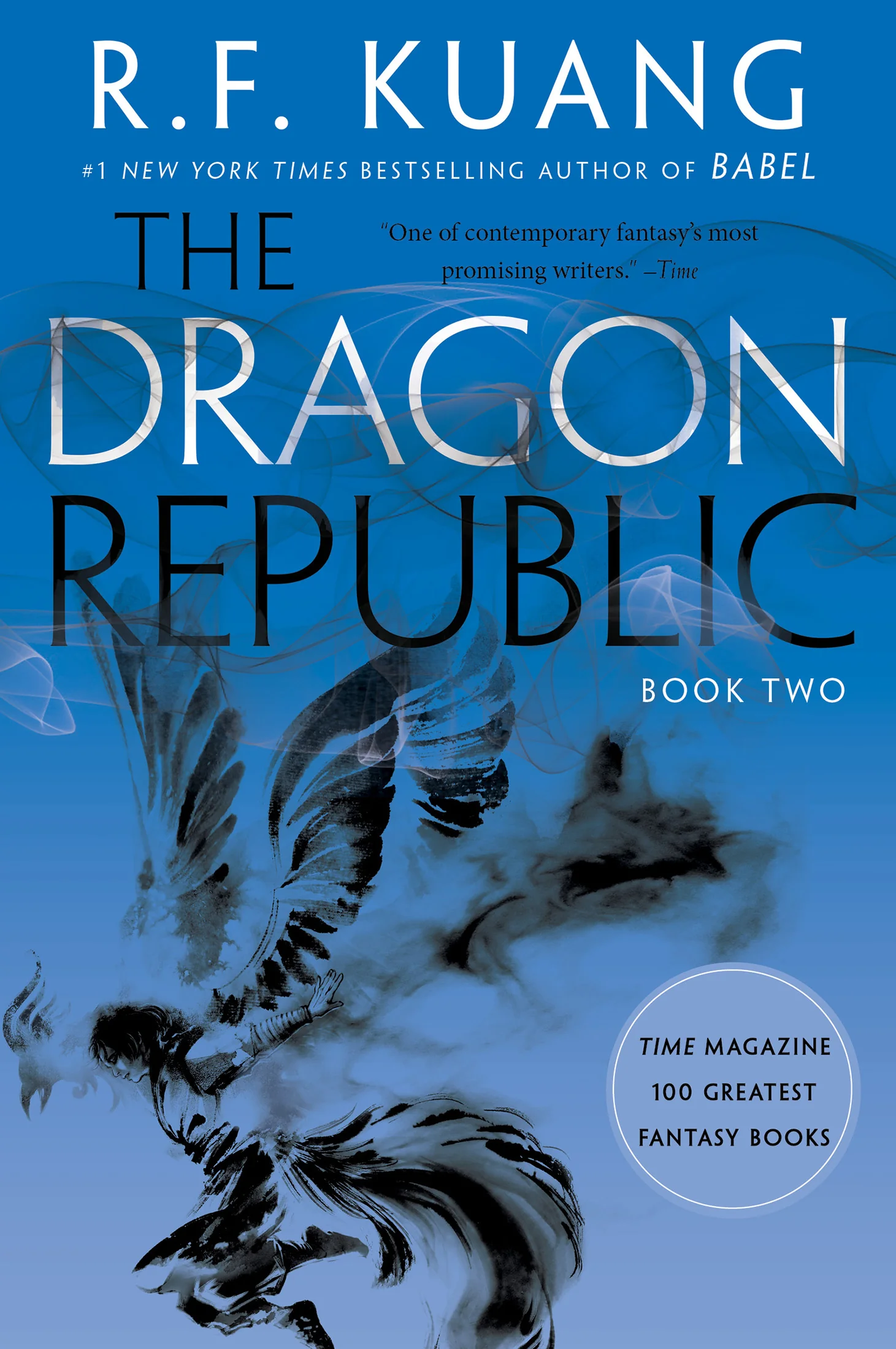
The Dragon Republic
Rin joins Yin Vaisra's revolution against Su Daji, regains control of the Phoenix through a bond with Kitay, and survives the Red Cliffs only to be betrayed by Nezha and the foreign-backed Republic she helped establish, prompting her to lead a southern rebellion.
Overview
In the aftermath of the Third Poppy War, the destruction of Mugen has not secured peace for the Nikara Empire. Fang Runin, known as Rin, survives as the last Speerly and leads the Cike, the Empire's former unit of shamans. Their dead commander Altan appointed her to succeed him, but Rin's loyalty to his memory is inseparable from grief, opium dependence, and the Phoenix's demands for violence. She is wanted by Empress Su Daji, whom she blames for allowing Federation researchers to torture the Speerlies and for betraying Altan. Working out of the pirate city Ankhiluun, Rin accepts assassinations from Chiang Moag in exchange for ships and supplies needed to reach the Empress. Her campaign begins as a private war of revenge and develops into a civil conflict over Nikan's government, class structure, and dependence on foreign power.
Rin proves unfit to lead without serious consequences. During an assignment in Adlaga, Daji appears unexpectedly at a public celebration. Rin abandons the plan to kill magistrate Yang Yuanfu, responds violently to traumatic memories, and loses control of the Phoenix. She burns Unegen, one of the Cike members trying to protect her. Chaghan has to drug her to end the attack. Yuanfu is killed by Suni during the confusion, but Unegen and physician Enki leave the unit. The remaining shamans stay together out of solidarity, even as they question Rin's command. Moag then refuses to honor their completed contract and sends them on another mission. Rin finds her old friend Chen Kitay working for the pirate ruler under house arrest. Kitay denounces her destruction of the Mugenese homeland and inflicts a burn on her hand in an angry attempt to make her confront the victims' pain. Their former friendship cannot restore the moral agreement they once had.
Moag's second assignment is an ambush. An advanced vessel incapacitates the Cike with measures designed for their individual powers and takes them to the Dragon Province's warship Seagrim. The officer who receives them is Yin Nezha, the Sinegard classmate Rin believed had died during the Federation's siege of Khurdalain. Nezha was spared because he was the Dragon Warlord's son. His father, Yin Vaisra, has bought the Cike from Moag to recruit Rin for a rebellion against Daji. Vaisra offers a republic in place of the existing provincial and imperial order, with his own disciplined navy as its military foundation. Rin understands that his resources offer her best opportunity to kill the Empress. She enters his service despite having little choice and despite Kitay's refusal to join another war.
Vaisra soon becomes an authority figure whom Rin wants to please. He forbids her use of opium and forces her through withdrawal, restoring some of her ability to control the Phoenix. He returns Altan's trident and presents her as a successor who can achieve what Altan could not. Rin increasingly associates his approval with personal recovery, even when his decisions are coercive. Traveling with the Dragon Army, she also sees that the nominal peace after the invasion conceals famine, refugees, scattered Federation troops, and devastated landscapes. Nezha blames Daji for disastrous flooding in the provinces. Rin knows the Cike caused the dam breach under Altan's orders and follows Chaghan's advice to conceal it. Her commitment to the rebellion is therefore founded partly on a history she cannot safely tell her new allies.
At the Warlords' summit in Lusan, Vaisra presents Rin to Daji as a bound and drugged prisoner. The plan is for the opium to wear off and Rin to kill the Empress while other Cike infiltrate the palace. Daji instead takes her to a private garden and offers a political defense of her wartime concessions to Mugen: she believed parts of the Empire had to be sacrificed to avert a wider catastrophe. She also warns that the Hesperian Consortium intends to dominate Nikan. Rin rejects her account and attacks, but Daji calls on the goddess Nüwa to impose psychic illusions of Speer and the living Altan. Chaghan interrupts the visions long enough for Rin to escape. Rin then returns for Vaisra after Master Jun wounds him, and the Cike flee with the Warlord. Daji survives. The failed assassination nevertheless announces the Dragon Army's revolt and forces the provinces to choose sides.
Back in Arlong, Rin discovers that Daji planted a Seal in her mind that blocks access to the Phoenix. Her attempts with Chaghan to remove it fail because the enchantment exploits the memories of Altan she cannot relinquish. Without fire, Rin fears becoming useless to Vaisra. Venka, a former Sinegard classmate who survived sexual violence during the invasion and has lasting injuries, insists that Rin can still serve as a conventional soldier. Meanwhile Vaisra assembles southern provincial allies, proposes a blockade of grain to the north, and waits for foreign support. Kitay objects to the prospect of starving civilians, especially after Jinzha reveals that Hare Province's harvests have already been deliberately undermined. The promise of a democratic republic begins to conflict with the means chosen to establish it.
The Hesperian delegation arrives under General Tarcquet, accompanied by missionaries and scientific investigators from the Gray Company. Lady Saikhara, Nezha's mother, helped arrange the visit. The Consortium will not commit full forces until Vaisra demonstrates that his rebellion can win. It nevertheless expects access to Rin. Sister Petra treats her as a specimen of supernatural Chaos, arguing that the Divine Architect requires the suppression of forces the Hesperians consider irrational. Her examinations revive Rin's memories of imprisonment under the Mugenese scientist Shiro. Petra's descriptions of Nikara inferiority and her insistence that the Hesperians must guide Nikan expose a colonial program beneath the language of religious service and scientific investigation. The seemingly kind novice Brother Augus shares the same assumptions about Nikara dependence and spiritual error.
The civil war becomes a campaign against civilians as well as armies. Imperial agents poison the Murui's tributaries, killing animals, threatening farmland, and destroying the water shaman Aratsha. The Cike trace the poison to a former mission in Hare Province. There Kitay encounters their former classmate Niang, who has helped prepare the contamination as retaliation for Republican grain restrictions. He kills her as she threatens the raiding party. The campaign then captures Radan and other towns through bombardment, compelled votes, and confiscation of resources. At Xiashang, Rin uses the Ram Warlord's infant child as a hostage and demands executions after discovering Federation soldiers fighting alongside Nikara forces. Jinzha rejects her proposed mass punishment, demotes her, and dissolves the Cike as a separate command. Her anger alienates allies even as the Republic's violence exposes the distance between popular consent and military conquest.
The northern advance collapses when Jinzha refuses Kitay's advice to retreat from the approaches to Boyang. The Imperial Navy has laid underwater mines and prepared smaller vessels for the constricted lake, while Republican crews are exhausted and vulnerable. In the battle, Captain Salkhi and many others die. Feylen, a former Cike shaman overwhelmed by the Wind God since his release from the Chuluu Korikh, tears apart ships with hurricane-force winds. Chaghan and Qara cannot contain him. Rin and Kitay are swept over a waterfall and survive with the twins' help. Nezha displays a hidden power over water during the fighting, but his refusal to rely upon it remains a point of contention between him and Rin.
The survivors encounter Ketreyid shamans led by the Sorqan Sira, a northern elder who once helped the Trifecta of Daji, Jiang, and Riga reach the gods. The Ketreyids subsequently suffered a massacre when the three Nikara shamans used their new abilities to consolidate political rule, killing the elder's daughter Tseveri. Rin also learns that Chaghan and Qara's mother helped create the Cike as an experiment whose members the twins were expected to monitor. The Sorqan Sira considers Rin dangerous but recognizes Daji's Seal as evidence that the Empress fears her. A painful spiritual ritual draws the Seal's malignant influence out of Rin's mind and forces her to confront the ways she has idealized Altan, but it does not entirely remove the barrier to the Phoenix. The elder instead offers a method by which Kitay can act as Rin's spiritual anchor, calling the god through their joined consciousness. Kitay volunteers, and the ritual links their lives, pain, and physical survival. Rin gains controlled access to fire; Kitay assumes a permanent share of its cost.
The Ketreyid alliance ends violently before Rin and Kitay can leave. Bekter, the Sorqan Sira's son, stages a coup driven by resentment of his mother's restraint toward Nikara shamans and a desire for revenge over Tseveri. He frees and arms the Gray Company missionaries. A terrified Augus shoots the Sorqan Sira, then fires at Chaghan. Qara intercepts the shot and dies in her brother's arms, using a final spiritual exchange to prevent their bond from killing him as well. Rin burns Augus to death. Bekter escapes, determined to turn the Ketreyids against the Naimads. Chaghan returns north to warn his people, leaving Rin and Kitay to make their own way back to Arlong. The episode gives a concrete form to the competing approaches to shamanism: the Ketreyids demand control through inherited knowledge, the Hesperians condemn it as evil, and Rin sees divine power as both the source of her freedom and a threat to everyone near her.
Rin and Kitay return to Arlong after a difficult journey. Vaisra restores her position when she demonstrates controlled fire, but she and Nezha grow further apart. Nezha finally explains the childhood incident at the Nine Curves River: a dragon killed his younger brother Mingzha and forced a bond on Nezha that heals his wounds and keeps him alive while causing unbearable suffering. Rin treats his refusal to use this power as a failure of wartime duty, while Nezha resents her willingness to demand the same submission to a god that has harmed her. The earlier opening scene thus becomes central to their conflict: Nezha's divine power is not a secret advantage he has freely withheld, but a form of captivity. Rin, who also knows what it is to lose control to the Phoenix, nonetheless struggles to recognize that his suffering may differ from hers.
Arlong is also filling with southern refugees fleeing renewed Federation attacks. Rin encounters her foster brother Kesegi and Auntie Fang among the hungry and poorly sheltered migrants. Kesegi condemns her for leaving him behind in Tikany and never writing. Vaisra's leadership concentrates forces on Dragon Province rather than securing the south, and officials keep refugees out of the protected city. Southern Warlords offer Rin the chance to lead their own resistance, arguing that Vaisra and the Hesperians exploited the Federation wars to weaken Nikan before claiming power. Their proposed conspiracy is not conclusively established, but Kitay comes to regard it as plausible in light of the Dragon Army's long preparation and the Consortium's conduct. Rin initially refuses to abandon Vaisra or the friends still in his service. When she sees a Hesperian soldier assault a Nikara refugee girl, however, she kills him and hides his body. The action she considers necessary also creates grounds for the foreign commanders to demand punishment.
The final battle approaches with Ang Tsolin's defection to Daji's fleet and the destruction of Jinzha's northern command. Rin helps obstruct the river, and Kitay and Ramsa devise a set of explosive traps. Kitay also constructs wings that allow Rin to use the Phoenix's heat to fly. With Venka acting as her archer, Rin attacks the Imperial Navy's linked vessels from above, breaking their formation and opening a path for Nezha's ships. She discovers that enemy ground troops are entering the poorly defended valleys where the southern refugees have been left exposed, a consequence of the generals' concentration on the harbor. Rin warns the defenders with fire in the sky. Aboard a Republican ship, she and Nezha defeat Chang En, who had commanded the Imperial force; Nezha personally executes him. Feylen then arrives, turning the battle into another catastrophe.
Rin lures Feylen toward the explosives embedded in a cliff and triggers an avalanche that buries him. Neither she nor her companions recover a body, so his permanent death is not independently established. Injured and nearly drowned, Rin is saved by Nezha using the dragon's strength. She suppresses the god's violent aftereffects by forcing opium on him. At this decisive moment an immense Hesperian fleet appears over the horizon, ensuring that Vaisra's force will survive the Imperial assault. Daji approaches Rin on the shore after the battle. Rin resists Nüwa and grievously injures the Empress, nearly killing her, but falters when Daji reveals more of the Trifecta's past. She admits the massacre of the Ketreyids and presents her concessions to Mugen as an attempt to preserve a vulnerable imperial core. She also shows Rin the Hesperian assault she experienced as a child, when a Mugenese soldier came to her aid, and identifies the western powers as Nikan's central long-term danger. The evidence of Daji's trauma complicates Rin's certainty about who deserves her allegiance without excusing the Empress's atrocities. Daji escapes. Rin cannot determine whether she freely allowed it or was manipulated.
The victory at Arlong does not end the civil war. Several provinces remain hostile, and the Hesperian fleet now occupies Nikan's principal defensive port. Vaisra stages a victory procession that resembles the ceremonial rule of the dynasty he claims to replace. He orders Rin to execute the captured Ang Tsolin for betraying the Republic. Rin complies, despite her growing realization that Vaisra treats allies as instruments to be discarded. She hides Daji's survival from Nezha and arranges for the surviving Cike to flee before the Gray Company can claim them. Nezha, meanwhile, warns Rin that the Hesperians want to register and suppress all shamans and abolish the transmission of their knowledge. Rin rejects any ban on her powers. During what seems a final private moment of reconciliation on the water, Nezha stabs her in the back and delivers her into captivity.
Imprisoned and sedated at the palace, Rin learns that Saikhara brought the Hesperians partly in hopes that their investigators could cure Nezha's dragon affliction. She is made to watch Vaisra's forces execute Baji and Suni with Hesperian firearms. Vaisra informs her that she is no longer useful now that his regime has the Consortium's fleets, and he prepares to hand her to Petra and Tarcquet for experimentation. The soldier Rin killed has been found, but Vaisra's decision also reflects his broader agreement to suppress shamanism. Rin accuses him of deliberately endangering his sons in pursuit of a shamanic weapon. His answer suggests ruthless calculation without establishing all the particulars she alleges. Kitay uses their anchor bond to communicate through wounds cut into their skin, finds her room, and comes to free her. Unable to open a wrist restraint in time, he crushes her hand to release it, sharing her pain. Ramsa sacrifices himself with explosives to distract guards, and Venka helps them flee. Baji, Suni, and Ramsa are dead; Chaghan has already gone north, leaving Rin's former unit effectively destroyed.
Moag answers Rin's earlier warning through Sarana and the Red Junk ships, providing a means of escape from Arlong. Nezha sees the fugitives pass but does not sound the alarm, leaving his precise intentions open to interpretation. The survivors discover that Vaisra is suppressing southern Warlords and refugee resistance and has accepted Hesperian demands for asymmetric trade rights, military bases, missionary access, an opium market, and direct oversight of his government. His promised republic has exchanged military independence for foreign support. The Monkey Warlord Gurubai escapes the crackdown and argues that the marginalized south could mobilize many more soldiers than Vaisra expects. Rin, badly injured and possibly facing permanent loss of the use of her hand, rejects hiding in Ankhiluun. She agrees to command a southern uprising against the Republic, the Consortium, and the northern aristocracy she believes they protect. Kitay doubts they can win with untrained refugees and peasants, but he remains spiritually bound to her and chooses to stay.
The ending is a decision to begin another war, not the success of that war. Rin has ceased to believe that submitting to Altan's memory, the Phoenix's compulsion, or Vaisra's authority can exempt her from responsibility for the people she kills. Yet her proposed independence contains an unresolved contradiction. She wants to lead the people whom the Republic abandoned, while also calculating that the south's large population offers lives she can expend against a technologically superior enemy. Her love for Nezha turns into a desire to destroy him, and the Phoenix welcomes her anger. The novel repeatedly makes military necessity the language used to excuse civilian suffering: Daji uses it to defend concessions and massacre, Vaisra to justify starvation and foreign occupation, and Rin to defend revenge and an approaching people's war. Kitay's permanent bond with Rin offers a personal limit on her destructive freedom, but it cannot guarantee what she will choose. As the second novel closes, Daji is alive, the Republic is increasingly dependent on Hesperia, and Rin's new campaign against Nezha and Vaisra remains entirely ahead of her.
Main Characters
- Fang Runin (Rin): Last surviving Speerly and Phoenix shaman; leads the Cike, serves Vaisra, regains fire through Kitay's spiritual bond, and ultimately chooses to command a southern rebellion.
- Chen Kitay: Rin's Sinegard friend and gifted strategist who condemns the Mugen genocide, becomes her soul-bound anchor, designs military inventions, and risks his life and body to rescue her.
- Yin Nezha: Dragon Warlord's son and Rin's former rival, whose involuntary bond with a dragon explains his painful water powers and who ultimately betrays Rin while remaining with his family.
- Yin Vaisra: Dragon Warlord and architect of the republic who recruits Rin to overthrow Daji, solicits Hesperian military support, and ultimately delivers Rin to foreign investigators.
- Su Daji: Empress and host of the goddess Nüwa; uses coercive illusions, survives Rin's attacks, and presents her compromises with Mugen as attempts to protect Nikan against greater threats.
- Chiang Moag: Pirate ruler of Ankhiluun who first exploits the Cike's labor, sells them to Vaisra, and later helps Rin escape after she warns of his plan to kill her.
- Chaghan: Ketreyid Seer and Cike member who tries to control Rin's destructive impulses, reveals his people’s role in the Cike, and returns north after his sister's death.
- Qara: Shaman and Chaghan's spiritually linked sister who saves the survivors of Boyang and dies protecting him during Bekter's coup.
- Venka: Former Sinegard cadet who survived Federation sexual violence, trains to fight despite impaired arm function, and joins Rin as an archer and ally during her escape.
- Yin Jinzha: Nezha's older brother and Republican naval commander whose aggressive northern campaign leads to disaster at Boyang; his fate remains uncertain when the Empire insinuates his death.
- Ang Tsolin: Snake Warlord who initially advocates neutrality, later defects to Daji, and is captured and publicly executed at Vaisra's order.
- Sister Petra: Gray Company researcher whose examinations of Rin support the Hesperian program to classify and suppress shamans as manifestations of Chaos.
- General Josephus Tarcquet: Hesperian military commander whose delayed intervention decisively strengthens Vaisra's army and imposes foreign power through the Consortium.
- Ramsa: Young explosives specialist who helps devise Rin's flying harness and the trap for Feylen, then dies creating a diversion for her escape.
- Baji and Suni: Surviving Cike fighters who remain loyal to Rin through the civil war and are executed by Vaisra's forces and Hesperian soldiers.
- Sorqan Sira: Ketreyid elder who seeks to prevent another Trifecta and teaches Kitay and Rin an anchor bond; murdered during her son Bekter's coup.
- Feylen: Former Cike shaman consumed by the Wind God, used by Daji against the Republic and buried under a cliff collapse without a recovered body.
- Kesegi: Rin's foster brother whose suffering among the displaced southerners challenges her belief that she has protected people like him.
- Gurubai: Monkey Warlord who survives Vaisra's repression and persuades Rin to lead the next southern resistance.
Central Themes
- Military necessity used to rationalize civilian casualties, starvation, genocide, and political repression
- Foreign intervention, unequal trade, and the loss of national sovereignty
- The concentration of political and military authority beneath promises of republican government
- Spiritual captivity, addiction, and consent to the use of divine power
- Trauma, grief, and the vulnerability of people seeking authoritative leaders
Mood & Atmosphere
Violent and politically tense, combining naval warfare, displacement, psychological trauma, religious and scientific coercion, and a sequence of costly betrayals.
Source Edition
The Dragon Republic (2020), HarperCollins. How sources are recorded.