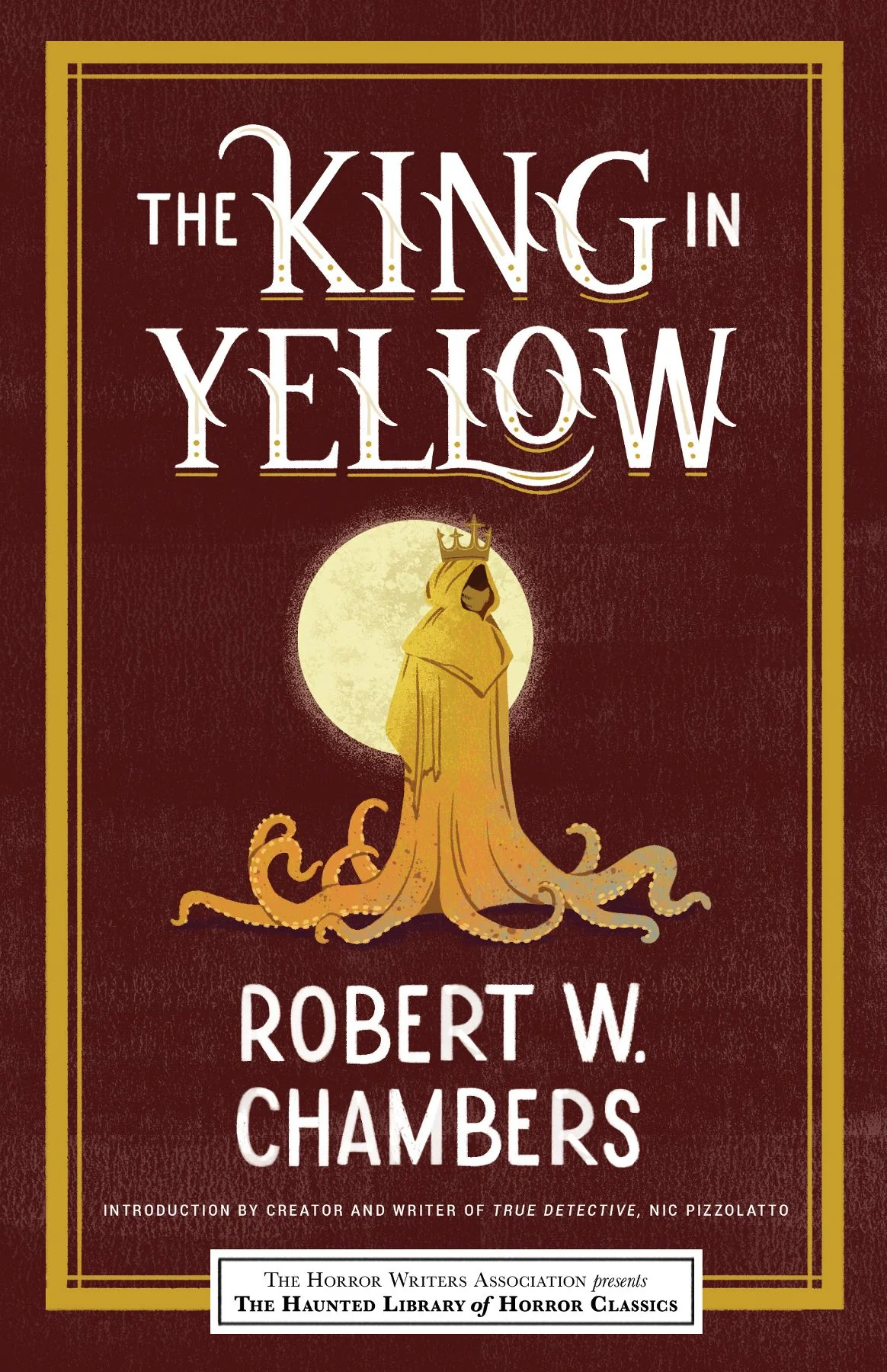
Chapter 1 Introduction
Nic Pizzolatto reflects on his personal journey with 'The King in Yellow,' a book that left an indelible mark on him as a teenager. Reading only a few stories, he was captivated by their haunting melody, a lingering presence in his mind. Years later, he integrated the concept of the King in Yellow into his own work, a Gothic police procedural, where the idea of a story driving characters to madness served as a powerful metaphor for the obsessive nature of detective work and the chaotic world around them.
Drawing parallels between the themes of 'The King in Yellow' and the contemporary landscape of cultural memes and viral narratives, Pizzolatto argues that the play's influence, which drives characters to madness, mirrors the way modern media can manipulate and warp perceptions, often leading to extreme emotional states. He emphasizes the power of language and storytelling, highlighting how the precise arrangement of words can evoke specific responses, whether rage, fear, or profound beauty.
Pizzolatto delves into the occult significance of the King in Yellow, noting that some practitioners in the Typhonian and Voudon traditions view Hastur and the King in Yellow as actual entities, channeled through sensitive artists. These occultists believe that their rituals can communicate with these entities and maintain the gates between dimensions. Acknowledging the brutal and chaotic nature of the 20th century, Pizzolatto suggests that the rise of such beliefs and practices might be a response to the unprecedented transformations and horrors of the era.
Reflecting on the book's impact, Pizzolatto praises the unique and haunting quality of Chambers's prose, particularly its meta-textual elements and disorienting vision of the world. He notes that the stories' power lies in their suggestion and implication, creating a sense of nuanced madness that is difficult to capture visually or in adaptations. The introduction concludes with a reflection on the human yearning present in the stories—a primal, undefined longing for deliverance, encapsulated in the evocative lines about Carcosa and the black stars.
Key Events
- Pizzolatto reflects on his initial encounter with 'The King in Yellow' as a teenager.
- He incorporates the concept of the King in Yellow into his own work, a Gothic police procedural.
- Pizzolatto draws parallels between the play's influence and modern media's manipulation of perceptions.
- He discusses the occult significance of the King in Yellow and the rituals of certain practitioners.
Characters Introduced
- Nic Pizzolatto
Themes
- The power of language and storytelling to evoke specific emotional responses
- The influence of media and cultural narratives on perception
- Occult beliefs and practices in relation to the King in Yellow
- Human yearning and the search for deliverance in a chaotic world
Chapter 2 The Repairer of Reputations
Futuristic 1920s America is depicted through a lens of technological advancements, social reforms, and a pervasive military presence. Hildred Castaigne, recovering from a serious fall from a horse, becomes obsessed with a mysterious book, The King in Yellow, which stirs deep and unsettling ambitions within him.
Hildred visits Mr. Wilde, a deformed yet brilliant man known as the Repairer of Reputations. Wilde, with his extensive network of informants, reveals a grand scheme to establish a new imperial dynasty. Hildred, driven by his newfound ambitions and the book’s influence, becomes deeply entangled in Wilde’s plans.
Tensions rise as Hildred confronts his cousin Louis, who is about to marry Constance Hawberk. Believing himself to be the rightful heir to a mystical throne, Hildred demands that Louis renounce his claim and forbid the marriage. The confrontation escalates into violence, leading to Hildred’s arrest and commitment to an asylum. His grand illusions of power and dominion shatter, leaving him in a state of profound madness.
Key Events
- Hildred visits Mr. Wilde and learns about his network of informants.
- Hildred confronts his cousin Louis about renouncing his claim to the throne.
- Hildred's plans unravel, leading to his arrest and commitment to an asylum.
Characters Introduced
- Mr. Wilde
- Constance Hawberk
- Vance
Themes
- Ambition and Power
- Madness and Obsession
- The Manipulative Power of Literature
Chapter 3 The Mask
Alec visits Boris Yvain, a talented sculptor, who demonstrates a peculiar chemical process that turns living things into marble. Boris, fascinated by this discovery, decides to keep it secret, fearing its potential misuse. The relationship between Boris, Geneviève, and Alec is explored, revealing underlying tensions and a complex emotional dynamic.
Alec, who harbors feelings for Geneviève, becomes increasingly distressed when she falls ill with a mysterious fever. Her condition worsens, and during a fever-induced delirium, she confesses her love for Alec, causing a significant shift in the trio's dynamics. Boris, understanding the situation, shows a deep sense of loyalty and compassion, but the revelation takes a toll on Alec's mental health.
Alec falls ill himself, and upon recovering, he learns that both Boris and Geneviève have died under tragic circumstances. Jack Scott, their friend, recounts the events leading to their deaths, including Geneviève's suicide and Boris's subsequent self-inflicted death. Alec inherits the house and some of Boris's sculptures, but he is haunted by the memories and the supernatural elements surrounding their deaths.
Two years later, Alec returns to Paris and eventually enters the marble room where Geneviève lies, only to find her seemingly coming back to life. The chapter ends with a sense of unresolved tension and the possibility of supernatural occurrences, leaving the reader questioning the nature of reality and the influence of The King in Yellow.
Key Events
- Boris demonstrates a chemical process that turns living things into marble.
- Geneviève falls ill with a mysterious fever and confesses her love for Alec during delirium.
- Boris and Geneviève die tragically, with Geneviève committing suicide and Boris shooting himself.
- Alec returns to the house and finds Geneviève seemingly coming back to life.
Characters Introduced
- Alec
- Boris Yvain
- Geneviève
- Jack Scott
Themes
- Supernatural transformations and their consequences
- Complex emotional relationships and their impact
- The power of secrets and revelations
- The haunting effects of forbidden knowledge
Chapter 4 In the Court of the Dragon
Still reeling from the tragic deaths of Boris and Geneviève, the narrator seeks solace in the familiar surroundings of the Church of St. Barnabé. During vespers, the usually serene organ music takes on a sinister tone, creating a sense of unease that deepens with each discordant note. The narrator, already worn out from recent physical and mental troubles, feels increasingly agitated by the music and the strange behavior of the organist.
Throughout the sermon, the narrator repeatedly sees the organist, a slender man with a pale face, entering and exiting the organ gallery. Each appearance is more unsettling, culminating in a malevolent look that deeply disturbs the narrator. Unable to concentrate on the sermon, he leaves the church, seeking solace in the bustling streets of Paris. However, the organist continues to follow him, his presence growing more threatening with each encounter.
Fleeing through various parts of the city, the narrator feels an overwhelming sense of dread and a long-forgotten guilt resurfacing. Eventually, he returns to his home in the Court of the Dragon, a narrow, unsavoury passage. Just as he thinks he has escaped, the organist appears again, and the narrator realizes that he cannot evade his fate. The chapter ends with the narrator facing the organist in the dark, enclosed space of the Court of the Dragon, as the presence of the King in Yellow looms over him, bringing a sense of inevitable doom.
Key Events
- The narrator notices a sinister change in the organ music during vespers.
- The narrator repeatedly sees the organist, who sends him a malevolent look.
- The narrator flees through Paris, pursued by the organist.
- The narrator returns to his home in the Court of the Dragon, where he confronts the organist.
Themes
- Supernatural influence and ominous music
- Guilty conscience and unresolved past
- Inescapable fate and the King in Yellow
Chapter 5 The Yellow Sign
Jack Scott, the narrator, feels an inexplicable aversion to a man he sees in the churchyard, likening him to a coffin-worm. This man's presence disrupts Scott's work, causing him to spoil a painting and feel increasingly unsettled. Later, his model, Tessie, arrives and shares a recurring nightmare involving a hearse and a driver with a white, soft face, which she believes is the same man from the churchyard.
Scott attempts to reassure Tessie, but his own dream about being in a coffin and seeing her face in a window adds to the unease. Their conversation and shared experiences deepen their bond, leading to a romantic confession from Tessie. Scott, despite his reservations, reciprocates her feelings, recognizing the complexity and potential consequences of their relationship.
The next day, Scott's wrists are badly sprained, preventing him from painting. While searching for a book, he discovers a copy of The King in Yellow, a book he has always avoided due to its ominous reputation. Despite his warnings, Tessie opens the book and reads from it, leading to a profound and disturbing transformation in her demeanor. Scott, compelled to understand, reads the book as well, and they become entranced by its contents, discussing the King and the Pallid Mask in a trance-like state.
As night falls, the atmosphere grows increasingly ominous. The sound of a hearse approaches, and the man from the churchyard enters the building. Scott and Tessie, now fully under the book's influence, are powerless to resist. The man, who is revealed to be a decomposed corpse, takes the Yellow Sign from Scott and strikes him, leading to Tessie's death. Scott, realizing the gravity of the situation, writes a final confession, acknowledging that he is dying and that the King in Yellow has claimed another victim.
Key Events
- Scott's aversion to the man in the churchyard disrupts his work.
- Tessie shares a recurring nightmare involving a hearse and the churchyard man.
- Scott and Tessie confess their feelings for each other.
- Tessie opens The King in Yellow, leading to a profound transformation.
- Scott reads the book and becomes entranced by its contents.
- The churchyard man, a decomposed corpse, enters the building and takes the Yellow Sign, leading to Tessie's death.
Themes
- The influence of The King in Yellow
- The psychological impact of shared nightmares
- The consequences of forbidden knowledge
- The fragility of sanity
Chapter 6 The Demoiselle D’ys
Lost on the desolate moors of Finistère, Philip struggles to find his way back to Kerselec. As the sun sets, he encounters a mysterious girl, Jeanne d’Ys, who rescues him from his predicament. Jeanne, accompanied by two falconers, Raoul and Hastur, offers Philip shelter at her château, and he gratefully accepts, feeling a growing attraction to her.
At the château, Philip is surprised to find himself dressed in medieval hunting garb, and the language and customs of the place seem to belong to a bygone era. Jeanne d’Ys explains that she has lived a secluded life on the moors, knowing little of the outside world. Over breakfast, they grow closer, and Philip confesses his love for her, which she reciprocates. He promises to stay for a week and to return often, despite the strange and enchanting nature of the place.
Jeanne d’Ys introduces Philip to the art of falconry, explaining the intricate training methods and the old language used in the practice. Their bond deepens as they share this knowledge. During a visit to the falcons, a viper appears, and Philip, protecting Jeanne, is bitten. He collapses, and when he regains consciousness, he finds himself alone amidst the ruins of the château, with only a warm, fragrant glove as evidence of Jeanne’s existence. A stone shrine reveals that Jeanne d’Ys died in 1573, suggesting that Philip has experienced a supernatural encounter.
Key Events
- Philip gets lost on the moors and is rescued by Jeanne d’Ys.
- Jeanne d’Ys offers Philip shelter at her château, where he is dressed in medieval garb.
- Philip and Jeanne d’Ys confess their love for each other.
- Philip is bitten by a viper while protecting Jeanne, and upon regaining consciousness, finds the château in ruins.
- A shrine reveals that Jeanne d’Ys died in 1573.
Characters Introduced
- Jeanne d’Ys
- Pelagie
- Sieur Piriou Louis
- Glemarec René
Themes
- Supernatural encounters
- Love and sacrifice
- Isolation and seclusion
- Medieval mystique and enchantment
Chapter 7 The Prophets’ Paradise
Surrounded by gilded flagons, dull jewelled arms, tarnished frames, and canvases, the narrator is ensconced in his studio, a cocoon of artistic and material richness. A mysterious figure visits, urging him to seek his love beyond the confines of his studio, but the narrator insists that his world is complete within these walls. Their dialogue highlights the narrator's isolation and his stubborn adherence to his inner world, despite the external world's calls to action.
In a series of vignettes, the narrator's inner turmoil and the supernatural or allegorical elements that permeate his thoughts are explored. He clings to the 'Phantom of the Past,' who resists his pleas to stay, symbolizing the futility of clinging to the past. In another scene, the narrator enters a field of flowers, where a woman pours blood on the flowers, proclaiming that she has killed the one she loved, representing sacrifice and loss.
The narrator encounters a bridge guarded by a keeper, who initially refuses entry to all, including the narrator. However, when the narrator returns, the keeper allows him to pass, suggesting a moment of grace or a shift in destiny. In a crowded street, the narrator stands with Pierrot, a jester, and is accused of being robbed. When Truth reveals a mirror instead of a purse, the narrator is left to question the nature of truth and illusion, reflecting on the blurred lines between reality and deception.
The chapter concludes with a poignant exchange between the narrator and Love, where the narrator is given jewels to dishonor his beloved, but she rejects them, asking to be taught patience. This interaction underscores the purity and depth of true love, which transcends material temptations and honors the waiting and anticipation inherent in genuine affection.
Key Events
- The narrator refuses to leave his studio, despite the visitor's urging to seek his love in the world.
- The narrator clings to the 'Phantom of the Past,' who resists staying, symbolizing the struggle with the past.
- The narrator witnesses a woman pouring blood on white flowers, claiming she has killed her love, representing sacrifice and loss.
- The narrator is allowed to cross a bridge that few can pass, indicating a shift in his destiny.
- The narrator is falsely accused of being robbed in a crowd, but Truth reveals a mirror, highlighting the theme of illusion versus reality.
- The narrator is given jewels to dishonor his beloved, but she rejects them, emphasizing the purity of true love.
Characters Introduced
- Death
- Love
Themes
- Artistic Isolation and Inner Richness
- The Futility of Clinging to the Past
- Sacrifice and Loss
- Destiny and Change
- Illusion vs. Reality
- True Love and Patience
Chapter 8 The Street of the Four Winds
Severn, a solitary painter, finds a gaunt and starving cat on his doorstep. Despite her wary demeanor, he coaxes her inside, offering milk and bread. As the cat eats, Severn engages in a gentle monologue, speculating about her past and the identity of her owner, marked by a rose-colored, silver-clasped garter around her neck. His musings reveal his imaginative and empathetic nature, as he envisions the beauty and grace of the cat's mistress, whom he names Sylvia Elven, based on the inscription on the garter. He contemplates the contrast between the cat's current state and the luxurious items that adorn her, drawing parallels to his own past experiences in the town of Elven, where he faced a significant personal loss.
Determined to return the cat to her owner, Severn carries her through the dark and winding corridors of the building, eventually reaching a closed door in the north wing. Upon entering the dark room, he lights a candle and discovers a vast, ornate chamber filled with luxurious furnishings. As he explores, he finds the cat's mistress lying in bed, pale and lifeless. Realizing that she is dead, Severn is overcome with a mix of shock and sorrow. He whispers to her, calling her by name, and kisses her on the mouth, a gesture that suggests a deep, unresolved connection. The chapter ends with Severn sitting through the night, holding the cat, as the sky begins to pale over the Street of the Four Winds.
Key Events
- Severn encounters and feeds a starving cat on his doorstep.
- Severn speculates about the cat's owner, naming her Sylvia Elven.
- Severn returns the cat to her mistress, discovering that the mistress is dead.
- Severn kisses the dead woman, suggesting a deep, unresolved connection.
Characters Introduced
- Sylvia Elven
Themes
- Imagination and empathy in the face of solitude
- Contrast between luxury and decay
- Unresolved grief and past connections
Chapter 9 The Street of the First Shell
The besieged city of Paris is tense and foreboding, with the Prussian bombardment intensifying. Trent, a painter, is invited to dinner by his friend West, who has just become engaged to Colette. Before leaving, Trent encounters a gamin who tries to rob him, but he overpowers the child and lets him go. At dinner, the group discusses the ongoing siege and the upcoming sortie. Feeling a sense of duty, Trent decides to join the American Ambulance to assist in the sortie. The conversation turns to Hartman, an American artist suspected of being a spy. Trent is called to the American Legation to identify Hartman, and upon learning that Hartman is the father of Sylvia's child, he is devastated. Despite his anger, Trent agrees to help Hartman, recognizing the child's safety. Trent joins the sortie, experiencing the chaos and brutality of the battle, including killing a man in close combat. Overwhelmed, he loses consciousness and later retreats with the remnants of the army, witnessing the devastation and suffering of the people. Upon returning to Paris, he finds the city in disarray, with buildings destroyed and the streets filled with refugees and looters. Braith and West, fearing for Trent and Sylvia, seek shelter in a cellar. They manage to escape the pillagers and reunite with Trent, who is frantic with worry about Sylvia. The bombardment has severely damaged their building, and the concierge is dead. Trent rushes to their apartment, finding Sylvia and their newborn child alive but in distress. The chapter ends with Trent embracing Sylvia and their child, a moment of tenderness amidst the chaos.
Key Events
- Trent and Sylvia experience the intensifying Prussian bombardment.
- Trent is invited to dinner by West, who is newly engaged to Colette.
- Trent learns that Hartman is the father of Sylvia's child.
- Trent joins the sortie and experiences the horrors of battle, including killing an enemy soldier.
- Trent returns to Paris to find the city in chaos and his building damaged.
- Trent finds Sylvia and their newborn child alive and embraces them.
Characters Introduced
- Captain Southwark
- The Secretary of the American Legation
- Philippe
Themes
- The brutal impact of war on civilians
- Duty and sacrifice in times of crisis
- The complexity of love and loyalty
- Survival and resilience in the face of adversity
Chapter 10 The Street of Our Lady of the Fields
A detailed description of the Street of Our Lady of the Fields sets the scene, a quiet and respectable street in Paris. Dr. Byram and Hastings visit a pension on the street, where they are greeted by Madame Marotte and her poodle. Despite the presence of a nearby convent, which Dr. Byram disapproves of, they decide to stay. Hastings meets a young woman named Valentine, who is friendly but enigmatic, and he becomes intrigued by her.
The next day, Hastings feels homesick and meets Valentine in the Luxembourg Gardens. They chat, and Hastings is captivated by her charm and beauty. Valentine, however, is cautious and hints at a secret she wishes to keep hidden. Hastings promises not to speak of her to anyone, including his friend Clifford, who has introduced them. Valentine confides in Hastings, expressing her fear of being judged by his purity and moral standards.
Hastings and Clifford's friendship deepens, but Hastings remains naive about the bohemian lifestyle of the Latin Quarter. During a fishing trip to La Roche, Hastings observes the flirtatious behavior of the group but enjoys the outing. Later, he finds Clifford in a drunken state and helps him, feeling concerned about his friend's well-being. The next morning, Hastings and Valentine spend a day together in the countryside, sharing intimate moments and deepening their bond. Valentine reveals her fears and vulnerabilities, and Hastings, in his innocence, remains supportive and loving.
Key Events
- Dr. Byram and Hastings choose a pension on the Street of Our Lady of the Fields.
- Hastings meets Valentine in the Luxembourg Gardens and becomes intrigued by her.
- Valentine confides in Hastings about her fears and secrets.
- Hastings and Clifford's friendship deepens, but Hastings remains unaware of the bohemian lifestyle.
- Hastings and Valentine spend a day together in the countryside, sharing intimate moments.
Characters Introduced
- Valentine Tissot
- Madame Marotte
Themes
- Innocence and Experience
- Secrecy and Trust
- Moral Integrity vs. Bohemian Lifestyle
Chapter 11 Rue Barrée
A poetic introduction sets a tone of longing and desire. Selby, a new student at the Académie Julian, is introduced to the boisterous and competitive environment of the studio. Clifford, known for his easygoing nature and international connections, quickly endears himself to Selby, who is eager to fit in and make friends.
Selby’s curiosity is piqued when he hears about Rue Barrée, a mysterious and elusive girl who has captured the hearts of many in the Latin Quarter. Despite her cold demeanor, she has a profound effect on the students, including Clifford, who has recently fallen for her. Selby, intrigued, begins to notice Rue Barrée around the city, and his interest in her grows.
One Sunday, Selby encounters Rue Barrée at the flower market, where she is considering buying a rose-bush. Impulsively, he buys a large quantity of flowers and arranges for the gardener to send the rose-bush to Rue Barrée. This act of kindness, though misguided, deepens Selby’s fascination with her and sets the stage for further interactions.
Clifford’s infatuation with Rue Barrée is detailed, along with his attempts to win her affection. Despite his efforts, she remains distant and ultimately rejects his proposal of marriage. Clifford’s heartbreak is palpable, but he finds solace in the fact that Rue Barrée’s demeanor towards him has softened. Meanwhile, Selby’s jealousy of Clifford’s relationship with Rue Barrée becomes evident, and he begins to drink heavily, leading to a series of drunken adventures that culminate in a late-night visit to Rue Barrée’s home.
In a moment of drunken determination, Selby climbs into Rue Barrée’s balcony and enters her room. The encounter is tense and silent, with both of them struggling with the intensity of the moment. Rue Barrée, though visibly affected, remains composed. Selby, sobering up, leaves with a rose, and Rue Barrée follows him downstairs, allowing him to leave through the front door.
Key Events
- Selby is introduced to the boisterous environment of the Académie Julian.
- Selby buys flowers for Rue Barrée, sending the rose-bush to her.
- Clifford proposes to Rue Barrée, who rejects him but softens her demeanor towards him.
- Selby, driven by jealousy and drink, climbs into Rue Barrée’s balcony and enters her room.
Characters Introduced
- Richard Elliott
- Stanley Rowden
- Rue Barrée
Themes
- Unrequited love
- Jealousy and rivalry
- The allure of the mysterious
- Desire versus self-control