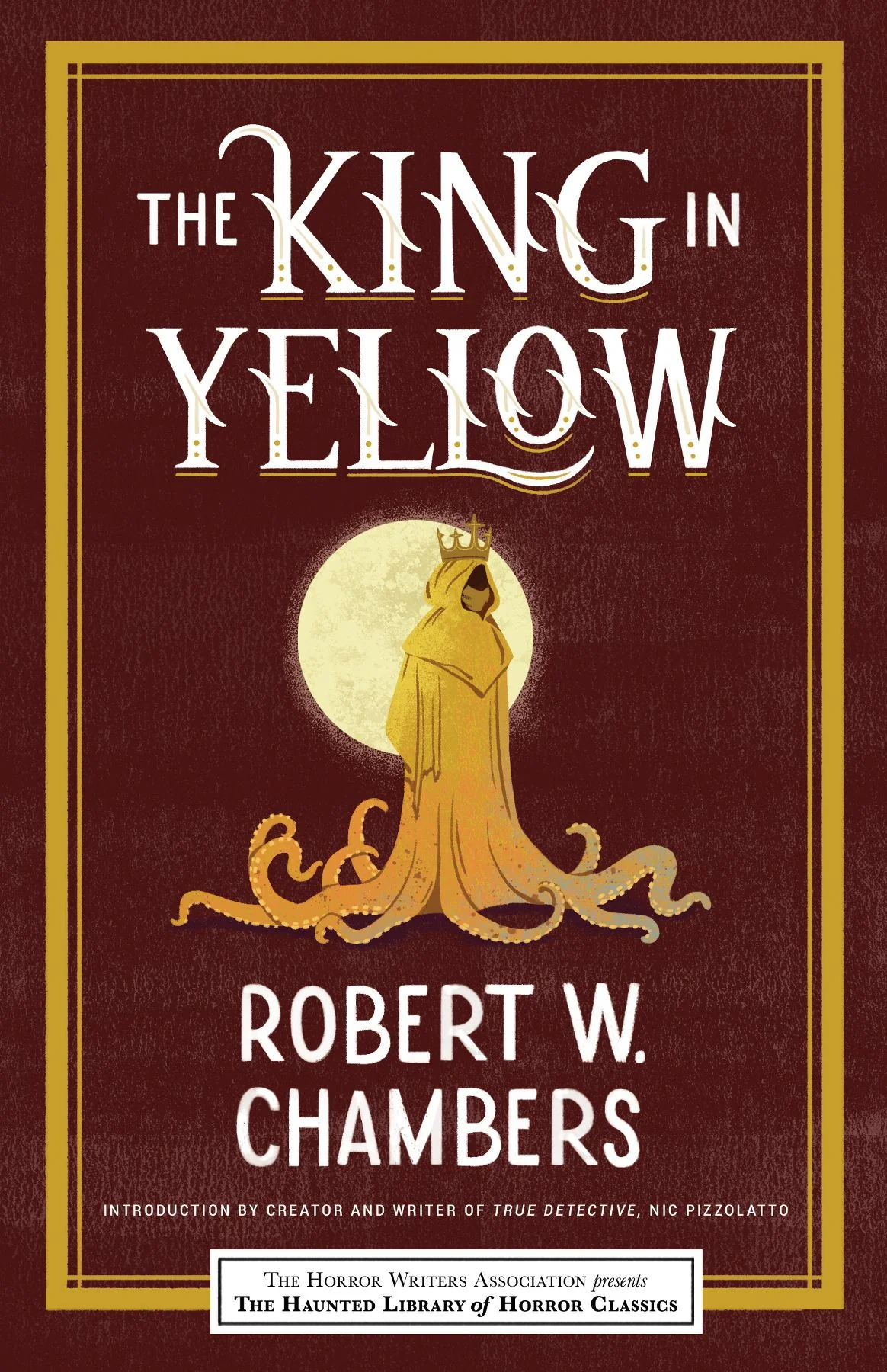
The King in Yellow
Across ten distinct stories, The King in Yellow moves from a mysterious play, supernatural terror and uncertain perception to allegory, romance, and tales of love and moral choice among artists in Paris.
Overview
Robert W. Chambers's The King in Yellow contains ten stories, preceded in this edition by an introduction and a dedication that quotes Cassilda's Song from a fictional play. The opening four stories feature the play, the Yellow Sign, and references to Carcosa, but do not constitute a single continuous plot. The remaining tales shift toward historical fantasy, allegory, and the lives of artists in Paris.
In "The Repairer of Reputations," Hildred Castaigne comes to believe that a manuscript and the forbidden play establish his right to an American throne. He plots against his cousin Louis's intended marriage and joins Mr. Wilde's blackmail schemes. The people he assumes have been murdered appear alive when he is arrested; an editor's note records his later death in an asylum. In "The Mask," Boris Yvain creates a solution that turns living things into marble. After Geneviève is petrified and Boris kills himself, Alec eventually sees the petrification reverse and Geneviève revive.
"In the Court of the Dragon" follows an unnamed narrator disturbed by reading the play. An apparent pursuit by a hostile organist shifts between Paris streets, a possible dream during a church service, and a vision of Carcosa. In "The Yellow Sign," an artist called Mr. Scott and his model Tessie Reardon are troubled by visions of a hearse and a disturbing churchyard watchman. The watchman takes a clasp bearing the Yellow Sign; Tessie dies, and Scott is dying as he writes. A doctor says the watchman's corpse appears to have been dead for months.
In "The Demoiselle D’ys," Philip falls in love with Jeanne d’Ys on the Breton moors, then wakes among ruins with an inscription stating that she died for love of him in 1573. Her still-warm glove remains. "The Prophets’ Paradise" contains eight brief, separately titled allegories about memory, sacrifice, destiny, truth, death, and love.
The final four stories concern artists and relationships in and around Paris. In "The Street of the Four Winds," Severn follows a starving cat to a woman named Sylvia whom he recognizes from his past, then finds her dead. In "The Street of the First Shell," Jack Trent survives a disastrous French sortie during the Prussian siege of Paris and returns to accept the child his wife Sylvia had with Hartman before their marriage. In "The Street of Our Lady of the Fields," Hastings falls in love with Valentine Tissot without understanding her fear of social judgment; their story ends on a train with her past and their future unresolved. In "Rue Barrée," Selby anonymously gives a poor young woman a rosebush, then enters her room while drunk, recognizes his shame, and silently leaves with a rose she offers him. The collection has no single overarching resolution.
Main Characters
- Hildred Castaigne (The Repairer of Reputations): an unreliable narrator convinced of his royal destiny.
- Alec (The Mask): a painter who witnesses Geneviève's return from petrification.
- Boris Yvain (The Mask): an artist who creates the petrifying solution.
- Geneviève (The Mask): Boris's partner, who is petrified and eventually revives.
- Mr. Scott (The Yellow Sign): an artist who encounters the watchman and the Yellow Sign.
- Tessie Reardon (The Yellow Sign): Scott's model, whose dreams foreshadow the fatal encounter.
- Philip (The Demoiselle D’ys): a traveler who encounters Jeanne on the Breton moors.
- Jeanne d’Ys (The Demoiselle D’ys): a falconer whose shrine bears the date 1573.
- Severn (The Street of the Four Winds): a painter who recognizes a dead woman from his past.
- Jack Trent (The Street of the First Shell): a painter and soldier who accepts his wife's child.
- Sylvia (The Street of the First Shell): Trent's wife and the mother of Hartman's child.
- Hastings (The Street of Our Lady of the Fields): a young American art student in love with Valentine.
- Valentine Tissot (The Street of Our Lady of the Fields): a woman who fears the consequences of her reputation.
- Selby (Rue Barrée): an art student whose impulsive intrusion ends in restraint.
- Rue Barrée (Rue Barrée): the unnamed object of Selby's affection, called after a street barrier.
Central Themes
- Forbidden art, unreliable perception, and supernatural dread
- Love, jealousy, and fear of rejection
- Death, loss, and uncertain returns
- Reputation, social judgment, and moral choice
- Artistic communities and civilian life in Paris
Mood & Atmosphere
Ominous and psychologically unsettling in the opening supernatural stories; alternately melancholy, romantic, tragic, and comic in the later tales.
Source Edition
The King in Yellow: Haunted Library of Horror Classics, Sourcebooks. How sources are recorded.