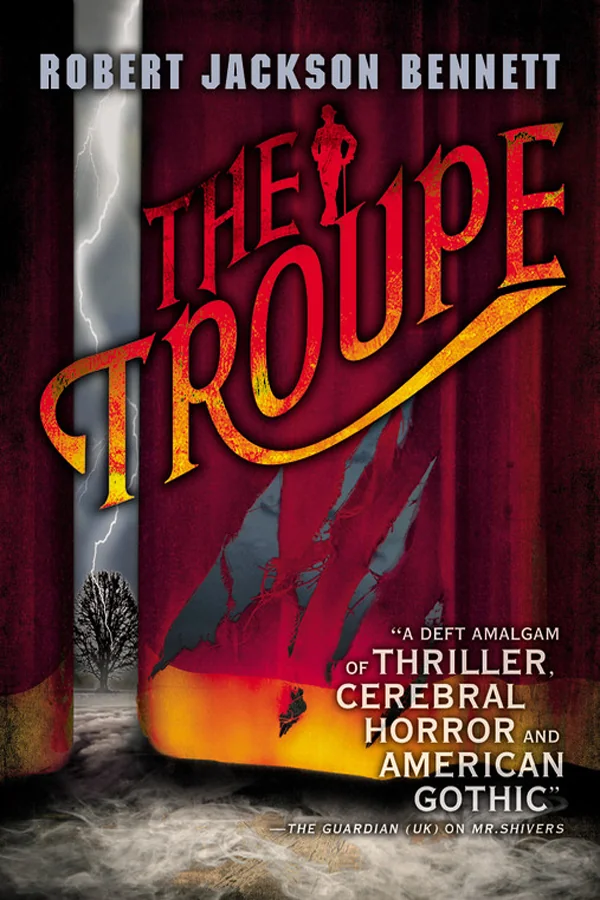
Part One: The Sticks Chapter 1: A Departure
Sixteen-year-old pianist George Carole abruptly resigns from Otterman's Vaudeville Theater in Ohio, alarming the musicians and management. His exceptional accompaniment has attracted demanding performers to the otherwise obscure theater, and several upcoming acts have agreed to appear specifically because he will play for them. George enjoys his colleagues' attempts to persuade him to stay, but refuses to explain his departure or reconsider it.
Irina, the elderly violist, correctly connects his decision to news that the Silenus Troupe has bypassed Otterman's and is performing in Parma. George took the house pianist's position seven months earlier because Silenus had appeared there before and might return. Since then, he has continually sought news of the troupe. He shows Irina an old playbill from its visit to his hometown, Rinton, when he was prevented from seeing the performance.
Asked about Silenus's previous appearance at Otterman's, Irina can vaguely recall a puppeteer, a dancer and a strongwoman, but cannot remember the final act. George says that dozens of other witnesses have the same difficulty: they remember fragments of the opening performances and almost nothing of Silenus himself. Their uncertainty has intensified his determination to see the show. Irina warns that his talent and the praise he receives have made him reckless, and that abandoning a secure position may have serious consequences. George insists that he would risk everything for this opportunity.
The troupe is due to leave Parma the following day, so George rejects the manager Van Hoever's offers to keep him temporarily. He collects his wages, packs his belongings, settles his rent and boards a train. As it leaves, his anxiety gives way to excitement. He is pursuing Silenus not simply as an admirer, but because he suspects that the elusive impresario is his father.
Key Events
- George quits Otterman's despite his importance to its orchestra and visiting performers.
- Irina identifies news of the Silenus Troupe's appearance in Parma as the reason for his departure.
- George explains that witnesses cannot clearly remember the troupe's final act.
- He ignores Irina's warning, collects his wages and leaves before the troupe can move on.
- George's private reason for seeking Silenus is revealed: he believes the performer may be his father.
Characters Appearing
- George Carole
- Irina
- Van Hoever
- Tofty Thresinger
- Victor
- Catherine
- Chet
- Archie
Themes
- Talent and pride
- The search for a father
- Memory and unexplained experience
Chapter 2: The Men in Gray
George arrives in Parma to find the town unsettled by unnatural darkness. The sky seems out of step with the hour, shadows multiply, and familiar streets and rooms appear to contain additional passages and corners. George recognizes the sensation from the Silenus Troupe's visit to Rinton. He wonders whether the performers cause these disturbances, then dismisses his fear and reassures himself that his accomplishments will impress the man he hopes to claim as his father.
Following the train conductor's directions, George approaches the hotel nearest the theater. Before reaching it, he notices sound fading and colors becoming dull. A glimpse of a gray sleeve and a black-gloved hand at an upstairs window confirms his fear that other people have tracked Silenus there.
George recalls an encounter during his earlier search. After asking about Silenus at another theater in Freightly, he met an immaculate man in gray whose presence brought an oppressive silence that nobody else seemed to notice. The stranger claimed to be a fellow admirer, but could not describe the act and offered to pay George for information about Silenus's movements. He also remarked that George looked familiar. As he left, he extinguished a streetlamp with a casual touch. Only afterward did George realize that the stranger had supplied neither his name nor a hotel room number.
Since that meeting, George has noticed similarly dressed men sitting motionless through performances at Otterman's, accompanied by the same unnatural silence. The effect outside the Parma hotel is much stronger, leading him to believe that many of them are inside. He suspects that they are waiting for the troupe to return from the evening performance and mean Silenus harm. Seeing that the show should already be underway, George leaves his hiding place and heads to the theater to warn the performers.
Key Events
- Parma's distorted light and multiplying shadows remind George of the troupe's visit to Rinton.
- An oppressive silence and muted colors surround the hotel where he expects Silenus to be staying.
- George recalls a man in gray who sought information about Silenus and extinguished a lamp by touching its pole.
- He connects the men he has seen watching Otterman's performances with those now inside the hotel.
- Believing the troupe is in danger, George goes to the theater to warn it.
Characters Appearing
- George Carole
- The men in gray
Themes
- Threats concealed by ordinary appearances
- Heightened perception
- Family hopes and apprehension
Chapter 3: “A man of mechanism and wit, of ingenuity never before seen…”
At the Pantheon Theater, George finds the Silenus Troupe listed for the second half of the evening's program. Seeing the same illustration of Silenus that appears on his cherished Rinton playbill, he becomes so excited that he forgets the men waiting at the hotel. He briefly mistakes the intermission crowd for a departing audience, then secures a seat at the back with his suitcase. The evening seems unusually slow to other patrons as well as to him.
While waiting, George imagines Silenus welcoming him as a son and teaching him to become a great performer. George's mother died giving birth to him, and his grandmother raised him in a town that stigmatized his uncertain parentage. He hopes that discovering an extraordinary father will compensate for those losses. When Silenus finally appears, his commanding presence and apparent facial resemblance to George strengthen those hopes.
Silenus introduces Professor Kingsley Tyburn and his three puppets, Denny, Berry and Mary-Ann. Their routine begins with conventional jokes, then becomes disturbing when the puppets ask to leave their boxes and become real people. Calling Tyburn their father, they insist that their ability to speak, perceive and desire should count as life. They describe remaining awake in darkness whenever their boxes are closed. Tyburn refuses to release them and orders a return to comedy.
As the exchange changes, George notices that the painted farmhouse behind the performers appears increasingly solid. Two nearby spectators describe entirely different backdrops, one a circus and the other a strange lakeside scene. Tyburn removes the tablecloth and handles the boxes to reveal no visible mechanism, while the puppets continue speaking and moving with his hands in view. Their final jokes sound unhappy, leaving the audience impressed but uneasy.
After Tyburn leaves, Silenus introduces Colette de Verdicere with a story about rescuing a displaced Persian princess. George initially continues searching the shadows for Silenus, but the young woman's entrance immediately diverts his attention.
Key Events
- George reaches the Pantheon during intermission and momentarily forgets his warning about the hotel.
- He sees Silenus for the first time and believes they resemble one another.
- Tyburn's puppets interrupt their comedy to demand freedom and recognition as real beings.
- Audience members perceive incompatible scenes in the backdrop, and the puppets move without any visible mechanism.
- Silenus introduces Colette, whose appearance distracts George from his search for his father.
Characters Appearing
- George Carole
- Heironomo Silenus
- Professor Kingsley Tyburn
- Denny
- Berry
- Mary-Ann
- Colette de Verdicere
Themes
- Expectations of parenthood
- The boundary between performance and reality
- Dependence and confinement
Chapter 4: The Chorale
George is captivated by Colette as she dances, sings and plays a concertina. Her words seem to move between English and another language, combining enjoyment of the world with warnings that its time is limited. She sends ribbons and glitter over the audience, then leaves George longing for her return.
Silenus next presents Frances Beatty, claiming to have discovered her working in a foundry. Contrary to George's expectations of a strongwoman, she is thin, tightly wrapped in colored bandages and almost expressionless. She bends steel bands to spell Ohio, tears the door from an iron safe, folds a train wheel, manipulates girders and balances stone statues. Her effortless strength astonishes the spectators, but her stiff movements and indifference to their applause make George uncertain whether she is human or some kind of automaton.
For the final act, Silenus conducts Colette and an unnamed blond cellist in a piece he calls the Chorale. Before playing, the cellist appears to notice George despite the bright stage lights. The difficult, beautiful music absorbs George until he detects a second, quieter melody running alongside it. He cannot identify its source, although it feels familiar.
The performers' colors become unnaturally bright, and George discovers that everyone around him is motionless and unresponsive. The orchestra is similarly entranced. As the hidden song intensifies, he feels invisible forces meeting within the theater, which briefly seems to vanish and return with sharpened colors and an insubstantial quality. He tries unsuccessfully to wake nearby spectators.
Voices join the second song, awakening fragments of an earlier experience: a field and forest, root-shaped faces on sticks, and a barrow where a voice sings through cracks in the stone beside an inexplicable light. George feels as though he can see beyond the world itself. The music finally ends, but the audience remains silent and immobile. Silenus and the two musicians bow and leave without acknowledgment. Silenus dismissively lights a cigar in defiance of the theater's smoking rule before following them backstage.
Key Events
- Colette's dance and song fascinate George, while her lyrics refer to the world's approaching end.
- Frances performs extraordinary feats of strength with mechanical stillness and little apparent effort.
- Silenus conducts Colette and a cellist in the Chorale.
- George hears a second song while the rest of the audience falls into an unresponsive trance.
- The hidden music recalls his childhood experience of a singing voice and light inside a barrow.
- The performers leave after the Chorale while the audience remains motionless.
Characters Appearing
- George Carole
- Heironomo Silenus
- Colette de Verdicere
- Frances Beatty
- The blond cellist
Themes
- Desire and distraction
- Music and altered perception
- Recovering buried memories
Chapter 5: Heironomo Silenus
The audience gradually emerges from its trance and leaves during the final comic act. Outside, George notices that Parma's oppressive darkness has lifted and the spectators seem brighter and quietly exhilarated. Still disturbed by the childhood memories the music revived, he slips backstage to seek answers from Silenus.
Frances catches him listening to the troupe and holds him while Silenus questions him. The impresario's coarse, suspicious behavior disappoints George's hopes of a welcoming father. Silenus is particularly concerned that George remained awake during the Chorale. When George warns that men in gray are waiting at the hotel, Silenus painfully grips his throat and interrogates him about possible hostile intentions. He concludes that George believes his own account, but remains concerned that an enemy may have manipulated him.
Silenus sends the cellist Stanley, who communicates with a chalkboard, to the station with Colette, Frances and the props. He and the armed Kingsley take George to investigate the hotel. As they approach, George hears the overwhelming silence of the gray men, now spread across the neighborhood. Using a special monocle, Silenus confirms that the creatures have surrounded them. He calls them wolves and describes them as hungry absences in Creation. Their proximity troubles him because the recently performed song should have kept them away.
Silenus orders his companions to walk without running and never look directly at the pursuers. One wolf appears under a streetlamp and tries to entice George away, calling Silenus a liar and Kingsley a dying man. It notices a resemblance between George and Silenus and speculates about their relationship.
At a shop window, Silenus gives George the lightning-glass monocle to track the wolves through walls. He mixes blood, earth and saliva, draws around their reflections and pulls the three joined images from the glass. After instructing these temporary beings to run across town, he sends them toward the pursuers as decoys. The wolves chase the reflections while the three real fugitives hide. George notices Kingsley looking at the creatures despite the warning.
Angry at being threatened and endangered after trying to help, George initially refuses to continue with Silenus. Silenus argues that the wolves now associate George with the troupe and offers the same imperfect protection he gives his other companions. George reluctantly agrees. They take a streetcar to the station while Kingsley looks increasingly ill, and distant howling confirms that the wolves remain in Parma.
Key Events
- George finds the audience altered after the Chorale and goes backstage seeking an explanation.
- Silenus interrogates him harshly, then takes him and the armed Kingsley to investigate his warning.
- The wolves surround them despite the protection Silenus expected from the song.
- A wolf tries to lure George away and remarks on his resemblance to Silenus.
- Silenus animates their reflections and sends them away as decoys, allowing the three to escape.
- George joins Silenus at the station because the wolves now consider him connected to the troupe.
Characters Appearing
- George Carole
- Heironomo Silenus
- Professor Kingsley Tyburn
- Frances Beatty
- Colette de Verdicere
- Stanley
- The wolves
Themes
- Disappointment in an idealized parent
- Protection and coercion
- Survival through deception
Chapter 6: “He sees what he wants to see.”
At the station, Colette objects that taking George along will exceed the troupe's travel budget. He buys his own ticket to Alberteen, Illinois. Stanley returns his abandoned suitcase with its clothes carefully refolded and says through his chalkboard that an old injury prevents him from speaking. He is kind to George but seems troubled by headaches in his presence. Kingsley, still visibly unwell, insists that his three figures are marionettes rather than ordinary puppets.
On the train, Silenus excludes George from a private discussion. Frances briefly joins the boy and explains that she cannot sleep, however hard she tries. Her feats are real, and the strain regularly damages her hands. George glimpses writing beneath her bandages, but she covers it and jokingly attributes her strength to gritting her teeth. She warns that Silenus's interest in him may be dangerous: the impresario can be clever yet narrow-minded, accepting what he wants to believe without recognizing the harm he causes.
Later, Silenus and Stanley question George privately. Afraid to reveal his belief about their relationship, George claims that he warned the troupe simply because he heard the gray men discussing Silenus. He asks whether Silenus remembers visiting Rinton, but the man's uncertainty crushes his hope that Silenus will recall his mother.
George then describes the childhood experience revived by the Chorale. After being bullied at school, he played alone among dry creeks and placed roots shaped like faces on sticks around his territory. The faces repeatedly turned toward a wooded hill. Investigating, he discovered a hollow dell where singing came through a crack between stones. A small light moved on the rock without any visible source. As he reached toward it, immense pressure immobilized him and he heard many voices apparently working upon forces beyond his perception. Touching the light brought the sensation of something vast entering him before he lost consciousness. He later awoke by the creek, found the hill apparently solid and the roots normally arranged, and eventually dismissed the experience as a dream.
Silenus and Stanley are deeply disturbed but withhold an explanation. Silenus asks George to travel with the troupe for three weeks while he investigates, offering protection and eventually agreeing to pay twenty dollars a week for assistance. George must obey Colette when Silenus and Stanley leave on unexplained errands, remain close at other times, and immediately report the wolves' silence. George accepts, although Silenus still refuses to define his work as anything beyond a performance.
Key Events
- George pays his fare, and Stanley attributes his inability to speak to an old injury.
- Frances reveals that she never sleeps and that her real feats of strength repeatedly injure her hands.
- Frances cautions George against Silenus's selective understanding of events and people.
- George recounts finding a singing light in a childhood hideout and feeling an overwhelming force enter him.
- Silenus postpones his explanation and hires George for three weeks under strict protective rules.
Characters Appearing
- George Carole
- Heironomo Silenus
- Stanley
- Frances Beatty
- Colette de Verdicere
- Professor Kingsley Tyburn
- Benny Russell, recalled
Themes
- Selective belief and its consequences
- Childhood isolation
- Unequal bargains for protection and knowledge
Chapter 7: Colette de Verdicere of the Zahand Dynasty, Princess of the Kush Steppes
At the Alberteen hotel, Silenus examines the hallway until an ornate black door appears between ordinary rooms. Inside is the same office where the troupe left its luggage in Parma, complete with a heavy black trunk and a window showing cold stars. George cannot understand how the room has moved between hotels. Colette reinforces the troupe's rule against questions, and Silenus tells him to conceal his wages from her. Before retiring, George notices Silenus's burned soles and overhears Kingsley discussing with his marionettes whether they will ever leave the darkness and how much more will be required.
The following afternoon, the office door is gone and Silenus and Stanley are away. Colette supervises George while playing billiards. She is a skilled, forceful player whose smoking, drinking and practical manner differ sharply from his image of the dancer onstage. His attempts to impress her with cultural knowledge receive little response, and her account of Persia includes implausible geography that he readily accepts.
When local men complain about her presence, the hotel owner attempts to expel her under his rule against Black guests. Colette adopts a French accent and presents herself as Persian royalty, using an ornate amulet to support the performance. George awkwardly assists by pretending to understand her French. The men reverse themselves, then patronizingly offer to teach her billiards. She feigns incompetence, wins money from them and endures their intrusive attention before sending them away.
Afterward, George finds her making herself vomit to counter the alcohol she accepted. Their conversation turns to home. Colette insists that she is from Persia but alternately says she misses it and is better off with Silenus. George similarly remembers both his grandmother's care and her controlling anger. Her furious response to the troupe's departure from Rinton, followed by her showing him Silenus's photograph, gave him the clue that prompted his search.
Colette wants to perform at New York's Palace Theater and resents the troupe's concentration on small towns. George's suggestion that success simply requires effort and contacts exposes his inexperience beside her four years of touring. Silenus and Stanley then return through a storm carrying the locked trunk. Silenus refuses to explain their errand. Exhausted, Stanley tells George only that they found something, but not what they wanted, and asks him to help carry the trunk upstairs.
Key Events
- George discovers that Silenus's office and the troupe's luggage can appear inside another hotel.
- He notices Silenus's burned feet and hears Kingsley continuing a private conversation with his marionettes.
- Colette defeats an attempt to expel her under the hotel's racist policy by performing her identity as Persian royalty.
- She tricks the local men at billiards, then discusses her dissatisfaction with small-town touring and her ambition to play the Palace.
- George recalls how his grandmother's anger and Silenus's photograph began his search.
- Silenus and Stanley return from an unexplained errand with the locked trunk.
Characters Appearing
- George Carole
- Heironomo Silenus
- Stanley
- Colette de Verdicere
- Professor Kingsley Tyburn, overheard
- Denny, overheard
- Berry, overheard
- Mary-Ann, overheard
- George’s grandmother, recalled
Themes
- Racism and strategic self-presentation
- Ambition and unequal opportunity
- Idealized memories of home
Chapter 8: The First Rehearsal
George's first rehearsal day consists largely of carrying luggage, props and messages, work from which his talent had previously exempted him. He discovers that Kingsley's heavy backdrop can be blank, then display the farmhouse again with a boy resembling George peering through its window. Silenus dismisses the image as the backdrop playing a trick.
The troupe's behavior creates further unease. Frances waits motionless when unoccupied and once calls George Bill. Kingsley keeps his marionettes close, reads jokes and Scripture to them, and appears to weep over their boxes. When George enters Kingsley's dark dressing room on an errand, a hostile voice orders him away. Frances explains that the figures are becoming harder to control.
Colette manages rehearsals and revises the acts, including asking Kingsley to shorten the discussion of whether the puppets are real. Kingsley initially objects that it is their favorite passage. George volunteers at the piano when the local accompaniment proves inadequate, earning Colette's practical approval rather than the admiration he expects. Silenus spends much of the day pursuing undisclosed research and grows increasingly irritable. George once notices what looks like snow on his shoulders despite the lack of recent snowfall in town.
Stanley quietly repairs the tensions Silenus causes and offers George undemanding companionship. George enjoys listening to him practice unfamiliar music, although Stanley says that he only performs the one song in the show. When Stanley shifts position, George sees that his soles are burned black like Silenus's. Stanley notices his stare and covers them.
The performances succeed. Hearing the Chorale again revives George's memory of the hollow hill without overwhelming him as before, and the troupe leaves each audience stunned and unusually happy. Colette eventually proposes retaining George as a regular accompanist. She disbelieves his claim to be self-taught, but Silenus accepts it with a detached interest that unsettles him. Over the following weeks, the troupe repeats its routine in Milton and Hayburn. Kingsley's health worsens, and Silenus and Stanley continue their unexplained Sunday excursions with the locked trunk.
Key Events
- George discovers that the backdrop changes its image and appears to respond to him.
- Frances mistakenly calls him Bill, while Kingsley's attachment to his increasingly unruly marionettes troubles him.
- George's playing improves rehearsals and leads Colette to suggest keeping him as accompanist.
- Stanley's kindness contrasts with Silenus's temper, and George notices the same burns on both men's feet.
- The troupe continues through Milton and Hayburn as Kingsley declines and the secret trunk excursions continue.
Characters Appearing
- George Carole
- Heironomo Silenus
- Stanley
- Colette de Verdicere
- Frances Beatty
- Professor Kingsley Tyburn
- Kingsley’s marionettes
Themes
- Unrecognized labor
- Care within a secretive group
- Talent and unexplained origins
Chapter 9: A Meeting of Shepherds
Near the end of his agreed three weeks, George becomes increasingly frustrated by Silenus's refusal to explain the troupe's work. After being publicly rebuked for asking questions, he leaves the Hayburn hotel alone at night. He gets lost in a snowstorm and shelters in a coal cellar beside an unusual courtyard with a fountain depicting four figures in chariots.
The storm suddenly stops within the courtyard while continuing outside it. Four strangers arrive from separate directions: Notus, a man in orange; Eurus, a woman in blue; Boreas, a large white-bearded man; and a young woman in green. Their formal meeting concerns how they intend to shape the weather during their periods of authority. Boreas boasts of the blizzard he has assembled and the freezing winds he plans to release. His companions criticize one another's work, then unite against the young woman because people prefer her gentle weather to their extremes.
Unable to tolerate their cruelty, George emerges and defends her. The strangers are astonished that he can see and enter their meeting place. They vote to kill him for intruding, with Boreas preparing to act. The young woman intervenes, examines George and detects something ancient and hidden within him. She claims patronage over him as a musician, a protection the others reluctantly acknowledge. They leave after warning that disgraceful conduct could still have dangerous consequences.
The young woman guides George back through the city, keeping the snow away as they walk. She urges him to distinguish appearances from how the world actually works. Something inside him seems to be singing faintly, older even than she is, and may allow him to perceive places ordinarily inaccessible to people. George connects her observation with his memory of the light inside the hill.
He says that Silenus is his father, prompting her to describe the impresario as powerful and hunted. She has noticed rain and clouds subtly drawn toward him, as though he carries something enormously heavy. The same pull brings her to the troupe's hotel and explains Boreas's complaint that his storm was drifting toward Hayburn.
She tells George that his unprompted kindness earned her protection, privately gives him her name and promises to come if he calls while she is near. She kisses his cheek as a blessing and vanishes into the wind. George returns to his room but withholds the encounter when Silenus and Stanley arrive. Instead, Silenus announces that the three weeks are over and takes George out to learn how the world was made.
Key Events
- George leaves the hotel in anger and accidentally enters the private meeting place of four beings who direct the weather.
- He defends the young woman in green against her relatives, provoking their decision to kill him.
- She saves him by claiming patronage and identifies an ancient, quietly singing presence within him.
- She explains that Silenus's mysterious burden attracts clouds and rain.
- The young woman blesses George and offers help before returning him to the hotel.
- Silenus finally agrees to explain the troupe's larger purpose.
Characters Appearing
- George Carole
- Heironomo Silenus
- Stanley
- Boreas
- Eurus
- Notus
- The young woman in green
Themes
- Kindness toward strangers
- Power and vulnerability
- Perception beyond appearances
Chapter 10: “In the beginning…”
Silenus and Stanley take George into the empty theater, where Silenus reveals that Kingsley's changing backdrop is chimera skin capable of projecting images and sensations. He forces it to cooperate in illustrating a story, cautioning George that the account is an imperfect explanation of something larger.
According to Silenus, the Creator sang the world into existence within an original nothingness, then departed. The surrounding darkness resented this intrusion, became conscious and began consuming Creation. When the Creator failed to return, people discovered surviving echoes of the First Song in remote places. Performing those fragments renewed both listeners and the threatened world, allowing them to resist the darkness. Some places had already been lost beyond recovery, so traveling performers assumed responsibility for preserving what remained and passing the song onward.
Silenus identifies the troupe's final act with part of that First Song. Its listeners briefly perceive their connection to the whole of Creation, then carry its renewing influence into the world. The wolves are manifestations of the hostile nothingness, wearing human appearances and seeking to stop the performances by killing those who preserve the song. Their presence drains light, color and sound. Silenus cannot explain why the recent performance failed to keep them away from the Parma hotel.
Vaudeville provides an efficient cover for this work because its circuits let the troupe reach large audiences across the country. It also conceals Silenus and Stanley's search for missing fragments. George connects these expeditions with their locked trunk, but Silenus refuses to disclose the mechanics of collecting or performing the song, insisting that only Stanley may share those secrets.
To demonstrate the danger, Silenus leads George and Stanley to a neglected district whose thin, unreal atmosphere resembles what George noticed before earlier performances. He explains that the troupe travels to such places to repair the damage, although pursuing wolves can temporarily worsen it. After removing their shoes and joining hands, they enter a deep shadow in a ruined building.
Beyond it lies a freezing, lifeless expanse of broken stone with distorted distances and scattered openings to other places. Silenus calls it a consumed portion of the world that their current song cannot restore. Their recent exposure to the song provides enough protection to survive a brief visit. George is horrified by both the loss and Silenus's apparent expectation that the wolves will eventually win. When they return, George finds his own soles blackened like those of his companions. Stanley acknowledges that George now shares their experience.
Key Events
- Silenus reveals the backdrop's nature and uses it to illustrate his account of Creation.
- He explains that fragments of the First Song renew the world and protect it against the wolves.
- George learns that touring also conceals a search for missing portions of the song.
- Silenus refuses to explain the locked trunk or the private mechanics of the work.
- The three enter a shadow and visit a frozen region that Silenus says the darkness has consumed.
- George returns with the same blackened soles as Silenus and Stanley.
Characters Appearing
- George Carole
- Heironomo Silenus
- Stanley
Themes
- Responsibility for preserving the world
- Incomplete explanations and restricted knowledge
- Experiencing the consequences of loss
Chapter 11: “Her name was Alice Carole.”
Back in Silenus's office, George asks why the Creator abandoned the world. Silenus repeats that his illustrated account is only a story, but argues that the Creator's absence and the losses suffered by its creatures cannot be justified. Stanley disagrees, suggesting that the remaining song may be a deliberate means of survival and that they cannot judge intentions they do not understand. Their bitter exchange exposes a longstanding disagreement.
Silenus then explains his interest in George. The light George touched in childhood was a fragment of the First Song, now contained within him. Silenus and Stanley once detected a large fragment near Rinton but fled when wolves interrupted their search. Returning years later, they found it missing. Silenus connects George's extraordinary musicianship, unusual perception and resistance to the Chorale's trance with the fragment he unknowingly absorbed. He considers it exceptionally powerful.
George is frightened by Silenus's willingness to discuss obtaining the fragment with a knife. Silenus says that he will not kill an innocent boy, but his research has not revealed a safe extraction method. He has also investigated George's ancestry because, in his understanding, only his own extended bloodline can carry the song safely. George's resemblance to that family seems significant, yet Silenus has found no recorded relatives in Ohio.
His apparent failure to recognize the connection enrages George. George names his mother, Alice Carole, and recounts his grandmother's account of the eighteen-year-old Alice visiting Silenus during the troupe's first stay in Rinton. He accuses Silenus of abandoning her, forgetting her and failing to acknowledge the son whose birth killed her. Instead of responding as George expects, Silenus angrily ejects him from the office and orders him not to leave.
George begins packing, but Colette urges him to wait for an explanation. She affirms his exceptional playing and tells him that the troupe benefits from his presence. Encouraged by her sympathy, he reveals that he believes Silenus is his father. Colette's response changes from shock to fury: she accuses both of them of concealing the existence of Silenus's child and pounds on the office door.
After she withdraws, George decides to hear Silenus out rather than leave during the storm, although he remains determined not to beg for acceptance. Silenus finally opens the door and summons him back inside.
Key Events
- Silenus and Stanley dispute whether the Creator abandoned the world or left the song to sustain it.
- Silenus identifies George as the carrier of the missing Rinton fragment and links it to his unusual abilities.
- He says he has found no safe way to remove it and believes George must belong to the song-bearing bloodline.
- George names Alice Carole and angrily declares his belief that Silenus is his father.
- Silenus expels him from the office, while Colette reacts with unexpected fury when George tells her.
- George postpones leaving and returns when Silenus summons him.
Characters Appearing
- George Carole
- Heironomo Silenus
- Stanley
- Colette de Verdicere
- Alice Carole, discussed
- George’s grandmother, recalled
Themes
- Abandonment and parental responsibility
- Faith amid suffering
- The unequal value assigned to a person and his power
Chapter 12: “Are you coming or not?”
George returns to find Stanley shaken and Silenus nursing a badly swollen eye. He infers that Stanley must have struck him, but neither man explains. Silenus now says that he remembers Alice and asks about her death. George explains that his grandmother identified a member of the troupe as his father and then connected Silenus's newspaper photograph with their family resemblance.
Silenus says he would have returned had he known about George, initially citing the rarity of their bloodline rather than a desire for a child. George challenges that answer and the neglect that damaged his family. Silenus acknowledges that nothing can compensate for Alice's fate. He also praises George's courage and ability in leaving home, supporting himself and finding the troupe. He says that he had never fathered a child and had believed it impossible.
Silenus asks George to remain, both because of the song fragment and because he wants a relationship with him. George agrees on condition that he can leave if mistreated. Silenus promises to try, but insists that George will face higher expectations and more work to prevent accusations of favoritism. Their agreement ends in an awkward handshake. Stanley, in contrast, welcomes George with tears and a prolonged embrace.
The next day, Silenus announces to the troupe that George is his previously unknown son. Kingsley worries about preferential pay or authority. Frances is unusually upset and repeatedly asks what happened to George's mother. Colette remains cold and refuses to engage with either of them.
After the meeting, Colette confronts George about the advantages his position appears to give him. She says that the other performers stay because Silenus provides something they cannot obtain elsewhere, whereas George could leave and prosper independently. George answers that he also needs something unique from Silenus: a father. Colette questions whether the man actually fulfills that role. Before George can answer, Silenus calls for him, and he leaves to join him.
Key Events
- George finds Silenus injured and Stanley visibly distressed, without an explanation of what occurred.
- Silenus accepts George's account, acknowledges the harm surrounding Alice's death and asks him to stay.
- George agrees to remain under demanding rules while retaining the right to leave if abused.
- The announcement provokes anxiety from Kingsley, distress from Frances and resentment from Colette.
- Colette challenges George to consider whether Silenus is truly providing the fatherhood he seeks.
Characters Appearing
- George Carole
- Heironomo Silenus
- Stanley
- Colette de Verdicere
- Frances Beatty
- Professor Kingsley Tyburn
- Alice Carole, discussed
Themes
- Recognition and the limits of apology
- Family obligations and unequal expectations
- Belonging under conditions of dependence
Part Two: The Big Time Chapter 13: The Long Tour
The winter tour becomes exhausting and repetitive. Dirty trains, poor food, cold rooms, vermin and the pressures of performance erode George's health. February seems to continue indefinitely. Silenus explains that they are traveling through damaged regions where time itself has become distorted, and that the song gradually restores these places. Their inhabitants generally fail to recognize the changes.
Colette's earlier resentment softens as she sees how badly George is struggling. She permits him to sleep when rehearsals allow and shields him from Silenus's demands, although she maintains a distance from his romantic interest. Her own disputes with Silenus continue. Frances remains angry about his treatment of George and Alice. When an iron band tears her sleeve, George sees an intricate design covering her arm. Silenus gently tries to protect her, but she rejects the attention.
Kingsley deteriorates further, temporarily straightening for each performance before collapsing into pain once the curtain falls. He refuses medical help and claims to rely on his own remedies. George begins to wonder how long the company can continue and whether its work has any attainable endpoint.
Knowing that he carries the First Song changes George's awareness of it. He feels responses to rain and wind and suspects that the fragment wants to become whole. He still cannot determine how the troupe invokes the hidden song or how Silenus and Stanley collect its other pieces during their exhausting excursions.
Silenus grants George greater access to his traveling office, including its appearance in an emergency. There George finds him studying unusual books in search of a way to remove the fragment safely. He also sees a map containing countries and regions absent from ordinary geography; Silenus says that these places can be reached by approaching correctly.
The troupe moves from the Keith-Albee circuit to the smaller Loews circuit. Silenus spends hours negotiating flexible itineraries suited to its purposes. George accompanies him hoping for conversation about music or their family, but hears mainly complaints about the business and bitter advice about life. Despite finally traveling beside the man he sought, George feels increasingly distant from him.
Key Events
- George suffers through the prolonged winter tour and learns that time is distorted in fading regions.
- Colette begins protecting him from exhaustion, while Frances continues to resent Silenus.
- Kingsley's health declines despite his ability to maintain his act onstage.
- George senses the song fragment reacting to the world and suspects it wants to be reunited with the rest.
- Silenus expands George's access to the office and continues researching safe removal of the fragment.
- The troupe changes circuits, but George's opportunities for a personal relationship with Silenus remain limited.
Characters Appearing
- George Carole
- Heironomo Silenus
- Stanley
- Colette de Verdicere
- Frances Beatty
- Professor Kingsley Tyburn
Themes
- The physical cost of touring
- Emotional distance within a family
- Obligation without a clear endpoint
Chapter 14: Stage Time
George tries to gain greater standing in the troupe by displaying difficult music, criticizing Kingsley's act and dressing conspicuously in the orchestra pit. Each effort causes irritation. Stanley responds with kindness, buying him suitable new suits as part of a pattern of small gifts. When Silenus confronts George about his behavior, George finally asks for stage time. Silenus refuses, citing the crowded program and then the danger of exposing a carrier of the song to the wolves' attention. He is particularly adamant that George cannot join the final act.
Resentful, George deliberately alters his accompaniment during Colette's dance to demonstrate how much she depends on him. She punches him afterward, and he resumes playing correctly. Still desperate for applause, he secretly auditions at a shabby theater under a false name. The audience boos his Mendelssohn concerto and pelts him with rotten tomatoes. Humiliated, he retreats to a bar.
Silenus finds him there, reassures him that the venue was wrong for his music and promises that he and Stanley will eventually teach George more about performing. He calls George his son and says that he cannot bear the thought of him being hurt. On the way back, George reveals that it is his birthday. A music box from Silenus and performance gloves from Stanley briefly improve his sense of belonging.
Two weeks later, a spectator from the audition tells George that the audience actually admired his playing but had been paid to boo him. His description identifies Silenus as the organizer. George realizes that the comforting encounter in the bar followed a humiliation Silenus deliberately arranged. He rushes to confront him, but Stanley intercepts him. Stanley acknowledges the wrongdoing while reminding George of his own calculated sabotage of Colette, and offers to speak to Silenus himself.
Stanley takes George onto the hotel roof to see distant Chicago. He explains how silence helps him appreciate moments other people hurry through and urges George to notice what is pleasant despite their difficulties. He also asks George to believe that his father loves him, while attributing Silenus's limitations to a lifetime consumed by their struggle. George reluctantly agrees to let him intervene. Stanley's unusually lingering touch leaves him uncomfortable and uncertain.
Colette interrupts with news that Kingsley is too ill to leave his bed. The troupe finds him pale, sweating and barely conscious. He again refuses a doctor, insists on having his marionettes beside him and falls asleep clutching one of their boxes.
Key Events
- Silenus refuses George stage time because of scheduling and the risk of exposing his song fragment.
- George intentionally disrupts Colette's performance and is struck by her afterward.
- A disastrous secret audition appears to confirm his doubts until Silenus comforts him.
- George later learns that Silenus paid the audience to humiliate him.
- Stanley prevents an immediate confrontation and offers a quieter form of support on the hotel roof.
- Kingsley's condition becomes severe, but he refuses treatment and clings to his marionettes.
Characters Appearing
- George Carole
- Heironomo Silenus
- Stanley
- Colette de Verdicere
- Professor Kingsley Tyburn
- Frances Beatty
Themes
- Recognition and wounded pride
- Manipulation justified as protection
- Appreciating companionship amid hardship
Chapter 15: Franny’s Secret
With Kingsley unable to perform, Silenus replaces his act and assigns George to nurse him. Kingsley speaks wistfully about fatherhood, saying that children are life's true fulfillment and that Silenus does not appreciate his good fortune. He admits that he was married and had a child, but falls asleep before explaining further.
In the hallway, Frances asks whether Kingsley has died and confidently predicts that he soon will. When George questions her certainty, she invites him into her room and reveals that she formerly told genuine fortunes in a joint act with Silenus. He stopped the act after people began asking about matters such as investments and gambling. She describes herself as standing outside time, able to see what lies ahead.
Frances predicts that animals will eat Kingsley at night. Her own eventual death, she says, will be her second: she sees herself unnamed, laughing beside strange dark water while holding something heavy. She cannot see George's death, but sees him alone and weeping after everything else has ended. Beyond that, she perceives no further time. George becomes increasingly disturbed by her calm delivery.
She explains that she already died and was brought back, apparently through an arrangement with her husband. Her earlier identity and most of her memories are lost; she says that she chose the name Frances Beatty because she no longer remembers who she was. Removing her upper clothing, she shows George the intricate marks covering her body. She says that individual symbols sustain her heart, lungs, spine, internal organs and mind. Their excessive power also allows her extraordinary feats of strength, although those feats hurt her.
Frances describes an exhausted, dulled existence in which she cannot sleep and no longer knows who controls her. George is overwhelmed by both the revelation and his embarrassed physical response to her exposed body. At his request she dresses, then returns to her detached state. As he leaves, she again calls him Bill. George withdraws to his room shaken and ashamed, uncertain how to understand what she has told and shown him.
Key Events
- George nurses Kingsley while Silenus takes over the opening act.
- Frances reveals her claimed ability to see the future and predicts Kingsley's violent death.
- She describes a future in which George remains alone after the end of everything else.
- Frances says that she has already died and that symbols on her body sustain her present existence.
- Her account connects her strength, lost identity and inability to sleep, leaving George deeply unsettled.
Characters Appearing
- George Carole
- Professor Kingsley Tyburn
- Frances Beatty
Themes
- The costs of restoring life
- Foreknowledge and helplessness
- Memory and personal identity
Chapter 16: The Professor’s Miracle
George keeps Frances's revelation to himself and avoids her, ashamed of his reaction. Her apparent lack of concern makes him suspect that she has already forgotten the encounter. Meanwhile, Kingsley becomes delirious, repeatedly describing injured or malformed children and weeping without remembering the episodes afterward.
During a lucid interval, Kingsley identifies himself as Kingsley Harrison, formerly a lawyer in a small Maryland town. His wife was Lucille. He explains that they struggled to conceive, then learned late in her pregnancy that the baby had severe developmental abnormalities. According to Kingsley, the doctor recommended ending the pregnancy and expected the child to die, but the couple refused and prepared to care for it or bury it with a name.
The baby survived birth. Kingsley describes feeding it by bottle and keeping it in a dark closet because the doctor had warned that light could kill it. Lucille became increasingly distressed and reluctant to care for the child. One day Kingsley returned to find that she had dressed it for christening and taken it into the sunshine, where it died. Interpreting her action as the deliberate killing of their child, he used his professional connections to have her imprisoned.
Grief eventually led him to seek Silenus, whose extraordinary abilities offered hope of another child. Silenus agreed to explain a method but refused to perform it himself or accept responsibility for the choice. In return, Kingsley would join the troupe and contribute his legal skills. As his medicine takes effect, Kingsley says that the process demanded pain and sacrifice, and that seeing the wolves in Parma drove him to take increasingly drastic measures and give too much of himself.
After Kingsley falls asleep, George feels watched and notices that one marionette box may be slightly open. Remembering that he has never seen Kingsley with any ordinary children, he begins to suspect a connection between the figures and Silenus's bargain. Frightened, he tries to dismiss the story as delirium and leaves without opening the box.
Key Events
- Kingsley's worsening illness includes delirious visions of damaged children.
- He reveals his true surname, earlier legal career and marriage to Lucille.
- He recounts their child's severe disabilities, death after exposure to sunlight and Lucille's imprisonment at his insistence.
- Kingsley says that Silenus taught him a painful method of obtaining children in exchange for joining the troupe.
- He links his increasingly desperate actions to seeing the wolves, while George suspects that the marionettes are connected to the bargain.
Characters Appearing
- George Carole
- Professor Kingsley Tyburn
- Lucille Harrison, recalled
- Kingsley and Lucille’s child, recalled
Themes
- Grief and the desire for parenthood
- Conflicting responses to suffering
- Responsibility for a desperate bargain
Chapter 17: “We are all hanged men.”
Leaving Kingsley's room, George follows a passage from Silenus's office into a stone tower that, Silenus says, moves around the world beneath the moon's highest point. There Silenus and Stanley use an old gallows beam, inscribed stones and an unusual map to locate fragments of the First Song. Moonlight identifies the fragments, while moving stones represent wolves. The pattern shows the creatures already surrounding the next pieces the troupe hopes to collect.
Their ability to anticipate the troupe, combined with their resistance to recent performances, alarms Silenus. Stanley suggests invoking old agreements with the beings who supplied their observatory and instruments. Silenus refuses, warning that those former associates are skilled at exploiting contracts and would welcome an opportunity to kill him.
George raises Kingsley's illness and Frances's revelations. Silenus claims that Frances's husband unsuccessfully restored her after death, then entrusted her to him for further help before dying himself. He says he has been unable either to complete or reverse the process. Challenged about Kingsley's past, he distinguishes usefulness to their mission from moral goodness and insists that preserving the song outweighs the failings of individual performers.
George asks whether their struggle will ever end. Silenus and Stanley say that it offers only continued survival, and Silenus admits that he expects the untiring wolves eventually to prevail. To explain why he persists, he recalls Michael Feenan, an Irish prisoner condemned to hang. Despite a badly broken leg, Feenan painstakingly constructed a brace so that he could walk to the scaffold under his own power. Silenus took from him the conviction that how people approach an unavoidable end still matters. The beam used in their instrument came from Feenan's gallows.
Silenus then shows George that his traveling office is suspended amid the consumed, lifeless regions of the world, keeping the threatened fate of Creation constantly before him. Yet his promise to protect George provokes another argument: George cannot tell whether he is valued as a son or merely as a carrier of the song. He finally confronts Silenus about the sabotaged audition. Silenus defends it as necessary discipline, and George leaves furious at being controlled.
Back in his room, George drinks from his water pitcher before noticing the taste of Kingsley's laudanum. As he collapses, he sees that the dresser drawers have been pulled out into a staircase, apparently allowing someone very small to reach the pitcher. He loses consciousness before he can act.
Key Events
- The moonlit instrument shows wolves waiting around the next fragments of the song.
- Silenus rejects Stanley's proposal to seek help through old, dangerous agreements.
- Silenus gives his account of Frances's condition and defends employing Kingsley for the mission's benefit.
- The story of Michael Feenan explains Silenus's determination to continue despite expecting eventual defeat.
- George confronts Silenus about his calculated humiliation and leaves feeling treated as a possession.
- George drinks drugged water and collapses after noticing a small person's apparent route to the pitcher.
Characters Appearing
- George Carole
- Heironomo Silenus
- Stanley
- Michael Feenan, recalled
Themes
- Dignity in the face of an unavoidable end
- Moral compromises made for survival
- Protection as a justification for control
Chapter 18: Blessings
George wakes the next morning with a painful head injury and the effects of the drug still lingering. Outside his locked room, sheets cover the windows and the hallway lamps have been destroyed. Deep scratches around the bottom of his door show that small, handlike claws tried to reach him while he was unconscious.
Upstairs, he finds Kingsley motionless in a blood-soaked bed. An open wound in his side reveals evidence that something has eaten his flesh and damaged a rib. The three marionette boxes are empty. Voices speaking from different parts of the hotel announce that George has found their father. The figures emerge and describe Kingsley giving them parts of himself, comparing their creation to Eve's formation from Adam. They say that he fed them too much, making them whole and free, but also resent their confinement in his boxes.
The marionettes believe Kingsley is sleeping and threaten to kill George for disturbing him. Their voices seem to share a single intelligence. With the rest of the troupe at rehearsal, George has no immediate help. He retreats along the hall until he remembers Silenus's promise that the office door will appear in an emergency. Mimicking Silenus's method of inspecting successive doors, he brings it into view and escapes inside.
Unable to force the door, the creatures threaten to ambush and mutilate Colette when she returns. George searches for a weapon, then forms a plan using the bay window. He makes them promise to spare her, opens the office door and dives through the window into the freezing lost region outside. His clothing freezes to the stone as he lands, leaving him trapped.
The marionettes follow, but George's gamble works: unlike him, they do not carry the renewing protection of the First Song. Their limbs freeze and break as they try to reach him. They continue struggling and calling for Kingsley until all three are destroyed, exposing decayed matter inside their wooden bodies.
George survives the attack but remains caught in his frozen clothes. Before he can work out how to return, the office window begins to dissolve and move away with Silenus's shifting room. George watches its light disappear into the distance, leaving him alone in the desolate landscape.
Key Events
- George discovers signs that small attackers tried to enter his locked room after drugging him.
- He finds Kingsley dead and learns that the freed marionettes were sustained with their creator's own flesh and life.
- The creatures pursue him, then threaten Colette when he escapes through Silenus's office door.
- George lures them through the bay window into the lost region, where the cold destroys them.
- The traveling office moves away before George can escape, stranding him in the wastes.
Characters Appearing
- George Carole
- Professor Kingsley Tyburn, dead
- Denny
- Berry
- Mary-Ann
Themes
- Possessive love and destructive dependence
- Using knowledge under threat
- The consequences of a desperate escape
Chapter 19: An Unexpected Return
George tears himself free of his frozen clothes and wanders barefoot through the lost region. Movement and distance behave unpredictably, while ruined structures and unexplained shadows suggest dangers he avoids investigating. Remembering the opening through which Silenus first brought him there, he searches the lights in the cliffs and confirms that they lead to shadows in damaged parts of the ordinary world.
After passing several unpromising exits, George recognizes a curtain and familiar backdrop from Otterman's. He crawls through, expecting help from his former colleagues. Instead, he finds the theater burned and deserted, with a collapsed balcony, damaged stage and an open wound in the roof. The destruction explains why a passage into the lost region could form there.
Onstage stand makeshift figures dressed to resemble Silenus, Stanley, Colette, Frances and Kingsley. Beside a campfire are notes, railway timetables and marked maps whose locations correspond to fragments identified by Silenus's instrument. George realizes that the unknown occupant is studying the troupe and its mission. At his old piano, he discovers a sixth figure imitating his own clothes and posture.
Approaching voices and the wolves' oppressive silence drive him backstage. In his haste, he dislodges the globe and hat forming the Silenus figure's head. His original exit has already closed, apparently repaired by the song fragment he carries, and fallen timbers obstruct the loading door.
As George seeks another route, he overhears two wolves discussing an absent companion. They find his attachment to his human appearance, colored clothing, research and possible personal name disturbing, but connect these changes to something he has undertaken for them. George cannot yet understand the conversation. The wolves notice the altered dummy and smell an intruder.
George reaches Van Hoever's office, intending to escape through its window, but discovers a mutilated woman's body behind the desk. Her cloth-wrapped hand identifies her as Irina. The shock leaves him unable to move. A wolf enters as darkness, forms itself into a gray-coated man and recognizes George as someone it has been instructed to watch for.
Key Events
- George discovers that openings in the lost region lead back into weakened places in the ordinary world.
- He escapes into Otterman's, only to find it burned, deserted and occupied by someone investigating the troupe.
- Figures representing all six performers and maps of the song fragments reveal the extent of that investigation.
- Two wolves arrive and discuss a companion whose behavior is becoming increasingly human.
- George's passage has closed and another exit is blocked; searching the manager's office, he finds Irina dead.
- A wolf catches him and identifies him as a person it was told to watch for.
Characters Appearing
- George Carole
- Two wolves
- Irina, dead
Themes
- The destruction of a former refuge
- Enemy surveillance and changing behavior
- Loss beyond personal expectations
Chapter 20: George Meets a Fan
Two wolves hold George captive in the ruined theater and demand to know how Silenus carries the Light. George refuses to betray the troupe and invents a claim that it is hidden in Silenus's hat. When the wolves prepare to burn him, a third wolf, dressed in red, intervenes. This newcomer has assembled the distorted replicas of the performers to study their act. He is delighted to meet their pianist and treats George as an expert who can correct his reconstruction, although he acknowledges that his research is intended to help the wolves destroy the troupe.
The wolf in red reveals a tiny fragment of Light inside his chest. The wolves found it in Arctic ice, and he swallowed it to discover its nature. Instead of destroying him, it gave him an individual consciousness, preferences, and a painful awareness of his own existence. It also makes him sensitive to the troupe's presence and protects nearby wolves from the Light. George realizes this explains their enemies' resistance to the First Song and ability to anticipate the troupe's movements. Fortunately for him, the wolf mistakes the strong presence of the song within George for residue from repeated performances.
As the wolf questions him about identity and the fear of existence, George describes his attraction to Colette and Stanley's kindness without naming them. The wolf suggests that Stanley's affection is romantic, leaving George disturbed by a possibility he had never considered. The wolf also observes that the troupe now rushes between towns instead of performing long enough to protect each place. He suspects they are primarily collecting the Light, a suggestion that troubles George's understanding of their mission.
The other wolves report their captive to a greater power, which decides to examine him personally. George calls for Zephyrus. Before help arrives, the theater seems to become the ocean floor beneath the world. His mind represents an otherwise incomprehensible encounter as an immense, ancient creature emerging from the darkness. The sight threatens to destroy him. A violent storm interrupts the manifestation and tears open the theater, allowing George to hide among the rubble. Silenus strangles one wolf with the curtains while Franny overpowers the other with her bare hands. The wolf in red has fled backstage with his notes.
Zephyrus appears as a young woman rather than the child George remembers. She explains that she heard his call, recognized that the threat exceeded her strength, and carried Silenus and Franny to help him. Silenus identifies her as a Cardinal. When George tries to describe the creature beneath the world, Silenus becomes alarmed. George's eyes begin to bleed, and he collapses while still imagining the creature searching for him.
Key Events
- George withholds the troupe's secret while two wolves threaten to torture him.
- The wolf in red reveals that swallowing a fragment of the Light gave him individuality and protects nearby wolves from the song.
- The wolf's observations raise doubts about Stanley's motives and Silenus's pursuit of the song.
- The wolves summon their immense superior to inspect George, and he calls for Zephyrus.
- Zephyrus brings Silenus and Franny, whose intervention frees George from the theater.
- Exposure to the creature leaves George bleeding from the eyes and unconscious.
Characters Appearing
- George Carole
- The wolf in red
- The reedy-voiced wolf
- The fat wolf
- The wolves' immense leader
- Zephyrus
- Heironomo Silenus
- Franny
Themes
- The fear of individual existence
- Interpreting affection under suspicion
- Loyalty and reciprocal help
Chapter 21: In Which a Song Is Changed
George briefly wakes while Zephyrus carries him and Silenus through the clouds. Later, in a theater storage room near Toledo, he hears someone singing the First Song with a slight alteration. He experiences a vision of his grandmother's house when its oak tree was younger: a figure beneath the tree sings to a girl at the upstairs window. When he fully recovers, his injuries and the dark stains on his skin have disappeared. Silenus explains that they are hiding from the wolves' spies and that Zephyrus is one of the Cardinal Winds responsible for a season's weather.
George recounts Kingsley's death and the puppets' attack. Silenus explains that he taught Kingsley to give separate physical existence to aspects of himself in exchange for joining the troupe. Kingsley wanted substitutes for the children he had lost. Instead of using hair or fingernails, he supplied pieces of his own rib, following the biblical creation of Eve. Seeing the wolves' true forms in Parma infected him with despair, leading him to sacrifice more of himself until the puppets could live independently and he died. Silenus admits that leaving Kingsley in control was a mistake. Colette has remained behind to arrange his burial. Silenus also corrects Kingsley's account of his wife: she was executed after he arranged her prosecution, not merely imprisoned. His stage name, Tyburn, commemorated his guilt.
George explains the wolf in red's discoveries. Silenus compares its protection to inoculation, while Stanley suggests that it can shield only a limited number of wolves. Destroying the wolf's physical form would not necessarily solve the problem, since the wolves are not ordinary mortal beings. Silenus identifies the immense creature George saw as the First Darkness, the original entity of which the other wolves are parts, while acknowledging that much of his understanding has been conjectural.
At Stanley's insistence, Silenus admits that George's condition had already become irreversible. To restore him, they changed the First Song and thereby changed reality itself. Such alterations consume portions of the song permanently, reducing the force that sustains Creation. George has been saved at that cost. Silenus forbids him to experiment with the fragment inside him. Stanley, noticeably more exhausted than Silenus, insists that George deserves the truth.
George apologizes for his earlier anger, and Silenus accepts responsibility for failing to protect him from Kingsley. Asked about George's mother, Silenus says he remembers too little. He admits that he has considered changing the song to recover loved ones, but Stanley and his own commitment to collecting it have restrained him. George recalls the wolf's claim that the troupe now prioritizes gathering the song over protecting the world, but suppresses his doubts. Silenus cannot tell him what they will do next.
Key Events
- An altered performance of the First Song restores George's health and removes the stains from the gray lands.
- Silenus explains the puppets' creation and how the wolves' despair drove Kingsley to destroy himself.
- George learns that Kingsley's wife was executed after the prosecution he arranged.
- Silenus identifies the creature beneath the world as the First Darkness.
- Stanley forces Silenus to reveal that changing reality permanently consumes part of the First Song.
- Silenus admits his temptation to recover lost loved ones, while George leaves his doubts about the troupe's mission unspoken.
Characters Appearing
- George Carole
- Heironomo Silenus
- Stanley
- Zephyrus
Themes
- The cost of changing reality
- Despair and self-destruction
- Responsibility for concealed danger
Part Three: The Chasers Chapter 22: A Very Funny People
Silenus insists on a dinner to celebrate George's rescue and commemorate Kingsley, although the troupe is exhausted and Franny's hands are injured. Stanley presses him to seek help from the beings who supplied his tower. Silenus fears their hostility and says he would need an exceptional bribe. George proposes creating false versions of the troupe to distract the wolves, and Stanley points out that these potential allies could make stronger, longer-lasting illusions than Silenus can.
Colette argues that they may have to disband. Kingsley's death has left a gap in the act, and their budget cannot support the interruption required to develop a replacement. When Stanley appeals to their mission, she answers that it belongs to him and Silenus, who have kept the others poorly informed. Silenus warns that her ambition to succeed alone in New York will encounter barriers that talent cannot remove. Their argument unfolds beside an elderly couple loudly objecting to being served by a Black waiter. Colette finally tells the man to be quiet, and the manager demands to know how she was admitted. Silenus tries to protect her by presenting her as Persian royalty, but she refuses to repeat the story and leaves.
George later finds Colette practicing dangerous turns on a rooftop chimney. She reveals that she is from New Orleans, the daughter of a white father and a Black mother. Her supposed royal amulet is a pawnshop purchase. Silenus discovered her performing in the street and invented her princess identity so she could work beyond the poorly paid Black theater circuit. She resents having to impersonate someone else and doubts that the deception will withstand New York audiences. Bert Williams's success gives her hope that talent might overcome the restrictions placed on Black performers. She also suspects that Stanley and Silenus are related, though she admits she does not know.
George praises the beauty and emotional force of her dancing, then tries to kiss her. Colette stops him. His declaration of love only increases her distress: she tells him he is in love with the performer he saw onstage and does not really know her. After she leaves, George recalls attending a minstrel show with her and failing to understand her discomfort. He now recognizes the cruelty of the caricatures and the humiliation she must have endured beside him. He accepts that his admiration has not given him an understanding of her life.
Key Events
- Stanley urges Silenus to obtain help creating decoys that could draw the wolves away from the song's remaining fragments.
- Colette proposes disbanding because of financial pressure and the loss of Kingsley's act.
- Racist treatment at the restaurant exposes the limits of Silenus's protection and Colette's invented identity.
- Colette tells George about her New Orleans family and the purpose of her Persian-princess disguise.
- Colette rejects George's romantic advance and distinguishes herself from the performer he idealizes.
- George reconsiders her reaction to a minstrel show and recognizes how little he understood her experience.
Characters Appearing
- George Carole
- Heironomo Silenus
- Stanley
- Colette
- Franny
- The restaurant manager
- The elderly diners
- The waiter
Themes
- Racism in entertainment and public life
- Protective deception and personal identity
- Romantic idealization
Chapter 23: The Water of Life
Silenus takes George to an old cemetery in New York despite Stanley's objections that the boy has not recovered. At the station, Stanley offers George his old pocket watch. Still disturbed by the wolf's suggestion about Stanley's affection and angry over Colette's rejection, George refuses it and tells him to stop giving presents or caring for him. As the train departs, George sees Stanley wiping away tears.
Silenus is seeking Finn MacCog, who was buried in 1796 with his prized possessions and his headstone concealed above his coffin. Using the fragment of the First Song inside George, Silenus draws echoes of dead people from the accumulated time in the cemetery. These are traces of former lives, not restored living people. Most insist on the limited identities they held in life and cannot help. While they search, George tells Silenus about Colette. Silenus advises him to leave her alone and angrily rejects his criticism of her invented identity, explaining that deception can be necessary to survive the cruelty she encounters.
An echo of Joseph Blakely recognizes Silenus as William and recalls their past association. Silenus trades news of Freddy, a former dancer who eventually married and settled in New Jersey, for the location of MacCog's grave. Joseph says it lies near the place where they buried Silenus's wife. Silenus reluctantly brings George to the grave of Anne Marie Sillenes, who died in 1862. He says she died of cancer. The dates deepen George's uncertainty about Silenus's age, while Silenus's grief turns into contempt for the names and roles through which people give their lives meaning.
George finally confronts him with the wolf in red's account of their abbreviated performances. Silenus admits that the troupe now sings mainly to protect itself while gathering the remaining song. He hopes that recovering the complete First Song will reveal the Creator's intentions and perhaps call the Creator back to repair the world. He considers that possibility worth the places lost to darkness during the search. Stanley does not know about the change, which predates his arrival, and Silenus urges George to keep the secret. George is appalled that their stated mission has concealed this gamble with other people's lives.
Silenus begins excavating MacCog's grave, but George refuses to assist. Silenus eventually retrieves a glowing bottle of uisce beatha, the water of life, an exceptionally rare whisky made before the darkness came. He intends to offer it to the powerful gourmands whose help Stanley recommended. The discovery provides the bribe he needs to approach them, though it does nothing to resolve George's doubts about his purpose.
Key Events
- George rejects Stanley's pocket watch and his affection, leaving Stanley in tears.
- Silenus uses the song within George to question echoes of the dead about Finn MacCog's concealed grave.
- Joseph Blakely identifies Silenus as William and directs him toward the grave of his wife, Anne Marie Sillenes.
- Silenus admits that collecting the complete song has taken priority over protecting the world through sustained performances.
- He hopes to summon the Creator and asks George to conceal this purpose from Stanley.
- Silenus steals a bottle of ancient uisce beatha to use as a gift in negotiations for help.
Characters Appearing
- George Carole
- Heironomo Silenus
- Stanley
- Archibald Ehberts, as an echo
- Joseph Blakely, as an echo
- The cemetery echoes
Themes
- Cruelty toward offered care
- Grief and the wish to repair the world
- Sacrificing present lives for a promised rescue
Chapter 24: The Midnight Visitor
Silenus announces that the troupe will perform for demanding potential allies and present the gift he has obtained. He instructs everyone to move the props into his office, since their destination cannot be reached by train, and to prepare their best clothes. George must also leave his hiding place in the theater and move to Colette's hotel, where Silenus's door has appeared.
Unable to sleep, George looks for Silenus and discovers him brushing Franny's hair. Their manner is unexpectedly intimate. Franny says she is angry with him but cannot remember why, then sees George in the mirror and calls him Bill. Silenus turns pale and reacts furiously when George asks why he is there. George asks for whisky as an excuse, takes the bottle Silenus offers, and retreats. Behind him, Franny speaks wistfully about Bill, and Silenus answers that he once knew him.
George drinks heavily and decides to make another elaborate declaration to Colette. Following her perfume through the hotel, he pauses near her room to rehearse a speech he can no longer remember. Before he returns to the door, a short, mustached man emerges. George recognizes Silenus and follows him far enough to establish that the room he has left is separate from his office. The perfume is now stronger along Silenus's route.
George concludes that Silenus has been visiting Colette as her lover. He reinterprets their arguments, private meetings, and familiar manner as evidence of an affair, and assumes that Colette rejected him because he is her lover's son. This remains George's conclusion from what he has observed, rather than an explanation obtained from either of them. Overwhelmed, he returns to his room and drinks more bourbon.
Key Events
- The troupe prepares to visit potential allies through Silenus's office rather than by train.
- George witnesses Silenus tenderly brushing Franny's hair and hears her call him Bill.
- Silenus reacts angrily to George's intrusion and gives him a bottle of whisky.
- While preparing another appeal to Colette, George sees Silenus leave the room he believes is hers.
- George concludes that Colette and Silenus are lovers and retreats in distress.
Characters Appearing
- George Carole
- Heironomo Silenus
- Franny
- Colette
- Stanley
Themes
- Concealed relationships
- Jealousy and inference
- Alcohol and impaired judgment
Chapter 25: The House on the Hill
Before sunrise, Silenus leads the troupe to an isolated crossroads to seek the fairies' attention. He burns ancient tarred wood, holds a crow bone in his mouth, and hangs a double-sided mirror from a tree. These tokens suggest powers that the vain, distant fairies might consider worthy of notice. He warns the others to use deferential titles, endure insults, refuse all gifts, and avoid drawing attention to the fairies' masks. The fairies are immortal but have suffered injuries over their long lives and conceal their damaged faces.
A masked herald arrives and addresses Silenus with elaborate titles. He says that the lady of Heartache's Founding has ordered Silenus admitted whenever he appears, despite his apparent attempts to avoid her. The troupe discovers that the crossroads has become a road through a bitterly cold, unfamiliar landscape. The herald leads them to an enormous mansion on a hill. Its collection of paintings records immense spans of time, from beautiful ancient worlds through darkness to disturbing later images. Franny repeatedly feels that she has been there before, though Silenus denies it.
In the crowded court, Lady Ofelia greets Silenus with hostility. She reveals that this is his third visit, surprising Stanley, and accuses him of responsibility for her mother's loss. Silenus expresses regret but insists that her mother knowingly accepted the risks of their agreement and that the bargain still had to be fulfilled after her death. Ofelia threatens grotesque punishments, but Silenus maintains that retaliation would be unjustified.
He produces the glowing bottle of uisce beatha and offers it as a gesture of goodwill. When he appears ready to withdraw it, Ofelia agrees to bargain. In exchange for the bottle, she promises not to harm him in retaliation for what happened to her mother and also agrees to provide the help he requests. She recalls drinking the whisky in her mother's court when the world was young, then puts it away.
Ofelia takes an interest in George and Colette, stressing their youth and questioning how Silenus acquired them. She invites them to tour the house with her, while directing Silenus to negotiate with her seneschal. Silenus cannot find a polite way to refuse. George and Colette leave with Ofelia and her attendants as the others watch uneasily.
Key Events
- Silenus summons the fairies at a crossroads and explains the rules governing gifts, courtesy, and masks.
- A herald admits the troupe to Heartache's Founding, where Franny feels an unexplained familiarity.
- Ofelia accuses Silenus of causing her mother's loss, while he insists their bargain was voluntary.
- The uisce beatha secures Ofelia's promise not to retaliate for her mother and her agreement to assist him.
- Ofelia separates George and Colette from the others by taking them on a tour.
Characters Appearing
- George Carole
- Heironomo Silenus
- Stanley
- Colette
- Franny
- Ofelia
- The herald of Heartache’s Founding
- Ofelia’s seneschal
- Ofelia’s attendants
Themes
- Binding agreements and concealed dangers
- Status and the appearance of power
- Grief and revenge
Chapter 26: Suggestion and Assumption
Ofelia shows George and Colette her collections and explains that she burns artworks when they cease to interest her rather than let anyone else possess them. Her intimate questions and accounts of extravagant feasts disturb both visitors. She identifies a portrait of her mother, Titania, and says that she cannot tell whether Silenus deceived her or she chose to be deceived. Expecting eventual destruction by the darkness, Ofelia and her court have committed themselves to unrestrained pleasure. They will drink all the rare whisky that evening rather than preserve it.
Ofelia's attendants separate George from Colette. Ofelia offers him endless recognition for his talent, but he insists that he can earn success himself. She then offers to make Colette desire him. Though tempted, George refuses because an imposed attachment would turn Colette into a puppet rather than give him real love. Ofelia cruelly emphasizes Colette's intimacy with Silenus and offers to hurt him on George's behalf. George again refuses. Colette returns from her own encounter shaken, but will not say what the attendants proposed.
Back in the parlor, Ofelia learns that Silenus needs doubles to distract his pursuers. She proposes botkines and instructs each troupe member to gather mud, twigs, vines, and other materials and make a representation of themselves. The figures must embody their makers' self-images, since the enchantment relies on suggestion and the observer's assumptions rather than exact duplication.
In the changing firelight, the crude figures seem almost human but reveal unsettling differences. Colette's is taller and less muscular, with an uncertain complexion. Stanley's looks younger and stronger. George, who meant to depict sadness and loneliness, sees anger in his double. Franny has made a slender young red-haired woman whom she says she remembers. Silenus's figure remains difficult to distinguish in the shadows.
After consulting Silenus about their destinations, Ofelia sends the botkines away. She says that by the next day they will appear near guarded fragments of the song and lure the wolves into pursuit. She also agrees to make the road out of Heartache's Founding lead wherever Silenus needs to go. With the practical bargain arranged, she asks for the promised performance.
Key Events
- Ofelia describes a court devoted to excess because it expects the world to end.
- George refuses offers of effortless fame, Colette's magically compelled love, and revenge against Silenus.
- Each performer constructs a botkine from natural materials according to their self-image.
- The doubles reveal differences between the troupe members' appearances and their perceptions of themselves.
- Ofelia dispatches the decoys to distract the wolves and offers a road to Silenus's next destination.
Characters Appearing
- George Carole
- Colette
- Ofelia
- Ofelia’s attendants
- Heironomo Silenus
- Stanley
- Franny
- Ofelia’s seneschal
Themes
- Consent and the limits of desire
- Self-image and perception
- Pleasure in the face of anticipated destruction
Chapter 27: “He has harmed me grievously.”
Ofelia chooses George and Colette to perform together without preparation. George must play Ravel's Le Gibet while Colette invents a dance to accompany it. The difficult music and her improvisation produce a performance that moves the court. George briefly experiences the artistic partnership he has wanted, but Colette leaves the floor without speaking to him. The troupe declines the feast and retires, warned by Stanley that Ofelia has watchers.
Despite that warning, George visits Colette's room. He tells her that he knows Silenus has been forcing her into a sexual relationship in exchange for her place in the troupe and promises to rescue her. Colette rejects his account. She says that she approached Silenus freely because she admired and liked him. George's insistence that she must have been deceived exposes his unwillingness to accept her choice. She tells him to stop seeing only what he wants, orders him to leave, and makes clear that she wants no further discussion.
In the hallway, George encounters Franny in an unusually lucid state. She questions the name he uses for her and says that the apparently dreamlike fairy realm has made the world feel real for the first time in years. George follows her to the feast and overhears her offering Silenus to Ofelia. When Ofelia cites her promise not to retaliate for her mother's death, Franny points out that she could instead act on Franny's behalf. She says that Silenus has grievously harmed her and asks to make him experience the long confusion and suffering he caused. Ofelia recognizes something about her identity and accepts that she has grounds for revenge.
Ofelia agrees to punish Silenus after first fulfilling her promise to help him obtain the next piece of the song. George now knows that a trap awaits him, but chooses not to warn him. He lists Silenus's failures toward Kingsley, Franny, Ofelia, the troupe, and Colette, continuing to regard Colette as wronged despite her denial. He tells himself that removing Silenus will let him restore the troupe's proper mission. Believing himself the only other person able to bear the First Song, he imagines taking Silenus's place. His reasoning presents the decision as a duty, but his jealousy over Colette remains central to it.
Key Events
- George and Colette perform an improvised duet of piano and dance for the fairy court.
- Colette confirms that her relationship with Silenus is her own choice and rejects George's attempted rescue.
- Franny becomes lucid in Heartache's Founding and seeks punishment for Silenus.
- Ofelia accepts Franny's grievance as a way to act without violating the promise concerning her mother.
- George overhears the bargain but decides to withhold a warning and replace Silenus as leader.
Characters Appearing
- George Carole
- Colette
- Ofelia
- Franny
- Heironomo Silenus
- Stanley
- Ofelia’s attendants
Themes
- Consent and possessive assumptions
- Revenge through contractual loopholes
- Self-justification and jealousy
Chapter 28: The Little Black Island
Silenus hurries the troupe away from Heartache's Founding, intending to collect two fragments of the First Song while the wolves pursue their doubles. Ofelia has arranged for the road to emerge beside Lake Logehrin in northern New York, where a fragment lies on a small island near the dam. George notices that Franny remains unusually alert. He still does not warn Silenus about the bargain he overheard.
At the lake, George hears a deep note from the island and senses the weight of the undiscovered fragment. Silenus brings his office door into a boulder, retrieves the steamer trunk, and carries it across the shallows with Stanley. While they work, Franny bitterly calls them cowards who cannot embrace what they love because they are preoccupied with the darkness. She also lashes out at Colette, saying that the sight of her is a torment.
The harvesting produces an overwhelming response in the fragment inside George. He begins to sense how much of the First Song the two men have already gathered. The disturbance ends in a strangled cry. When they return, Stanley is barely able to stand and collapses against the trunk, while Silenus explains that the new fragment was exceptionally large.
Silenus approaches Franny to ask what is wrong, but laughter rises around them and the fairy court emerges from the trees. Ofelia says that her agreement to help has been completed. Her promise concerning her mother's death does not prevent her from punishing Silenus for harm done to someone else. Franny identifies herself as the injured person, rejects the name Franny, and addresses Silenus as Bill.
Silenus falls to his knees and calls her Annie. She says that part of her has remained conscious throughout the waking death he imposed on her. George connects her name with the grave he visited and realizes that Franny is Silenus's wife.
Key Events
- Ofelia's road delivers the troupe to the song fragment on an island in Lake Logehrin.
- Silenus and Stanley harvest an exceptionally large fragment, leaving Stanley severely exhausted.
- Franny criticizes both men and expresses hostility toward Colette.
- The fairy court follows them and invokes Franny's grievance against Silenus.
- Franny rejects her assumed name, and George recognizes her as Silenus's wife, Annie.
Characters Appearing
- George Carole
- Heironomo Silenus
- Stanley
- Colette
- Franny / Annie Sillenes
- Ofelia
- The fairy court
Themes
- The concealed cost of a mission
- Recovered identity
- The limits of contractual protection
Chapter 29: Anne Marie Sillenes
Franny confirms that she is Anne Sillenes, Silenus's wife, and that he chose the name Franny Beatty for her from a newspaper. After cancer killed her, he brought her body to Titania, whose symbols restored movement and strength. The restoration failed to return her fully to herself. For decades she endured a confused waking existence, with a small part of her conscious beneath it. Returning to the fairy court restored her memories. She blames Silenus for refusing to let her die when he saw what had happened.
Silenus admits that he could not bear to lose her again. Annie also confronts him about George and Colette. He initially denies her accusation, then acknowledges having moved on to another relationship while Annie remained beside him. He says her death caused him to redirect the troupe toward assembling the complete First Song, hoping to call back the Creator and repair everything. Annie rejects his belief that every loss can be solved. She still loves him, but wants him to understand her suffering.
Ofelia orders her servants to beat Silenus and cut his throat. Annie protests that she requested suffering, not death. Ofelia exploits the wording of their agreement: she promised that he would know Annie's pain, and can make that pain anything she chooses by attacking Annie as well. Her servants seize Annie and carry her toward an abandoned train car near the dam, where she will again lose clarity outside the fairy realm. Silenus tries to distinguish Titania's voluntary sacrifice while obtaining the song-detecting instruments from murder, but Ofelia condemns the hope he gave her mother and intends to eat him as an act of revenge.
Silenus obtains Ofelia's promise not to harm his companions and requests a final drink. When he opens the steamer trunk, George discovers that it contains bottles of restoratives and liquor rather than the First Song. Ofelia and her seneschal inspect his wine and substitute their own glass. George confesses that he knew of Annie's intended revenge and withheld a warning. Silenus accepts responsibility for failing to earn his trust and apologizes to Colette for concealing Annie's identity. As he pours, George glimpses something fall from the cork into the glass, but cannot tell what Silenus intends.
After drinking, Silenus walks toward Ofelia while her servants strike him repeatedly with clubs. He continues despite broken limbs and devastating injuries, insisting on approaching the person ordering his death. Finally, a servant cuts his throat. He makes one last effort to rise before falling still, while George, Colette, and Stanley watch helplessly.
Key Events
- Annie explains that Titania's restoration left her trapped in a confused existence that Silenus could not bring himself to end.
- Silenus admits that Annie's death drove his secret effort to recall the Creator.
- Ofelia twists the promise to make Silenus know Annie's pain into permission to torture and kill him.
- Annie is seized and taken toward an abandoned train car, while Silenus bargains for the others' safety.
- The trunk is revealed to contain restoratives rather than the song; George notices an unexplained addition to Silenus's last drink.
- George admits withholding a warning, and Silenus apologizes before enduring the fairies' fatal attack.
Characters Appearing
- George Carole
- Heironomo Silenus / Bill Sillenes
- Annie Sillenes
- Colette
- Stanley
- Ofelia
- Ofelia’s seneschal
- The fairy court
Themes
- Grief and the refusal to release a loved one
- The cruelty of a literal bargain
- Guilt and belated accountability
Chapter 30: The Light
Ofelia sends Silenus's body away to be prepared for the court's feast. She then reveals the second part of her betrayal: the botkines return to the lakeshore, bringing the wolves behind them. Ofelia has arranged to let the wolves consume the world while leaving selected places for the fairies' final celebration. She considers handing the survivors over consistent with her promise not to harm them herself. The fairy court withdraws, leaving George, Colette, and Stanley surrounded.
The wolves demand the Light and threaten to torture George. Colette offers to retrieve it from Silenus's office, claiming that all three must carry its weight. A wolf tears the magical door from its hinges to prevent an escape through it. Inside, Colette directs the others to Kingsley's rolled backdrop. As they unfurl it, she asks it to help and display a brilliant light. The three shelter underneath while the wolves recoil from the glare, allowing them to move toward the woods. When the wolves abandon their human forms, the light no longer stops them. One tears the backdrop, separating Stanley from George and Colette.
Colette pulls George into a rocky hollow and asks their remaining piece of backdrop to camouflage them. The disguise conceals them visually, but George realizes the wolves can still smell them. The wolf in red finds their hiding place and joins them quietly. He says that although existence is painful and bewildering, he has decided that he wants it to continue. He now opposes his brothers' desire to end it.
The wolf removes the fragment of Light from within himself and gives it to George. As George absorbs it, he experiences a few seconds of a lost place: a girl with an injured arm building a tower of stones beside the sea. The wolf has treasured this glimpse of another life and asks George to protect it. Without the fragment, his face begins to lose its individuality and his bright coat starts to fade.
He offers to draw the pursuing wolves away, while warning that losing the Light may also make him revert and betray them. He nevertheless leaves the hiding place and calls the others down the hill on a false trail. George and Colette remain concealed with a brief chance to act, but neither knows how to use it.
Key Events
- Ofelia returns the botkines with the wolves following and reveals her bargain for a final fairy celebration before the world's destruction.
- Colette uses Kingsley's backdrop to blind the wolves and move the three survivors toward the woods.
- An attack tears the backdrop and separates Stanley from George and Colette.
- The wolf in red finds the hidden pair and declares that he wants existence to continue.
- He gives George his fragment of the First Song, sacrificing the source of his individuality.
- The wolf leads his brothers away, though he cannot guarantee that he will remain loyal without the Light.
Characters Appearing
- George Carole
- Colette
- Stanley
- Ofelia
- The wolf in red
- The wolves
- The fairy court
Themes
- Self-interest at the cost of the world
- Improvisation as a means of survival
- The choice to preserve existence
Chapter 31: “You are the most beautiful thing I have ever seen.”
Annie lies in the abandoned train car after the fairies have beaten her and cut her throat. The symbols animating her body prevent these injuries from killing her, but her memories are already slipping away. Stanley reaches the locked car and passes her a note asking her to perform a difficult task involving it. A second note names George and Colette. Though broken and frightened of losing herself again, Annie agrees to try. She sets her damaged arm and begins kicking through a weak point in the floor.
Outside, Stanley takes a length of chain and wraps himself in his torn piece of the backdrop. He knows that Silenus's standing instruction has always been to preserve himself and flee, but refuses to keep doing so. He can find George directly and climbs the hillside to the hidden pair. Through prepared notes, he tells them to move as high up the hill as possible and promises a distraction. He gives George a final card, embraces him, kisses his forehead, and runs downhill.
George and Colette hear the First Song and see Stanley singing as he runs. The wolves identify the Light as being inside him. George realizes that the song has not been stored in a trunk or carried by Silenus: Stanley has borne it himself. Since the ability passes through families, this also overturns his assumption about his parentage. He recalls Stanley's constant care, gifts, and reassurance that his father loves him. The final note says that George is the most beautiful thing Stanley has ever seen and that he loves him. George reaches the devastating conclusion that Stanley is his father, just as the wolves pursue him.
George tries to run after Stanley. Colette restrains him and insists they obey his instructions, but George will not stop struggling. She knocks him unconscious with a stone, carries him over her shoulder, and begins moving uphill toward safety.
Key Events
- Stanley asks the injured Annie to help save George and Colette before her memories disappear again.
- Annie begins breaking through the train car's floor while Stanley takes a chain and returns to the hillside.
- Stanley tells George and Colette to climb higher and leaves George a declaration of love.
- His singing reveals that he carries the First Song within himself.
- George concludes that Stanley is his father and tries to follow him into the pursuing wolves.
- Colette knocks George unconscious and carries him uphill as Stanley instructed.
Characters Appearing
- Annie Sillenes
- Stanley
- George Carole
- Colette
- The wolves
Themes
- Recognizing parental love
- Sacrifice in place of self-preservation
- Acting despite physical and mental injury
Chapter 32: “What will happen will happen.”
While unconscious, George again sees his grandmother's house in an earlier time, with its oak tree much smaller than he remembers. The figure singing beneath the tree is a young Stanley, and the girl who runs outside to meet him is Alice Carole. George watches his parents embrace. Stanley communicates through a sketchpad even then, explaining that his great-uncle fears the First Song will be stolen. Alice identifies this relative as the stern man she has met, and Stanley says that he is grieving his wife. Their conversation establishes that Silenus is Stanley's great-uncle.
Stanley and Alice discuss his inevitable departure with the traveling troupe. He asks her to come with him, but she cannot decide. They resolve to enjoy the time they have together. A second image of Alice appears beside George and explains that he is witnessing echoes produced by the First Song, not a dream or an encounter after his own death. Time and space are contained within the song, so it can recreate both a past event and a person. Stanley is singing about the woman he loved and their child while drawing the wolves away.
Alice's echo confirms that Stanley is George's father. She recalls how Silenus's control burdened Stanley, just as her mother's control restricted her. Their relationship briefly gave Stanley a home and Alice the adventure she wanted. George regrets his treatment of Stanley and wishes he had known the truth. Alice assures him that Stanley knows he would love him if circumstances were different.
George also admits that he has blamed himself for Alice's death in childbirth. She rejects that guilt, saying that she lived, loved, and bore a son without regretting her life. She embraces him and expresses pride in him. When he asks whether everything will be all right, she does not offer false reassurance. She says that he and his father must bear what will happen, and that she is proud of what they will do. From within the song, she can see what lies ahead. George asks to see it, closes his eyes at her instruction, and wakes.
Key Events
- George witnesses an echo of Stanley and Alice Carole's courtship outside his grandmother's house.
- The scene identifies Silenus as Stanley's great-uncle.
- Alice's echo explains that Stanley's current singing has brought George into these memories.
- She confirms Stanley's paternity and rejects George's guilt over her death in childbirth.
- Alice prepares George to face the approaching events without promising that everyone will be safe.
Characters Appearing
- George Carole
- Alice Carole, as an echo
- Stanley, within an echo
Themes
- Release from misplaced guilt
- The recovery of family history
- Love without a promise of safety
Chapter 33: A Man Very Bad at Dying
Back at Heartache's Founding, Ofelia and her court have eaten Silenus. Despite the elaborate preparation of the meal, she finds that completing her revenge has not given her the satisfaction she expected. Her seneschal then complains of a cold discomfort in his stomach. He begins coughing blood, and the affliction rapidly spreads through the court. Other fairies bleed from their skin and eyes, while Ofelia's mask falls away during her coughing.
The blood collects unnaturally at Ofelia's feet. A hand rises from the pool, followed by Silenus, restored and naked. He explains that he concealed maenad's honey in the cork of his wine. Its regenerative properties allow recovery even from dismemberment, and dilution with wine delayed its effect until after the fairies had consumed him. The restoration has proceeded through their bodies, leaving the court dying around him.
Silenus takes a cigar and confronts Ofelia. She admits she should never have granted his last request. He offers to shorten her suffering if she tells him what she has done with his companions.
Key Events
- Ofelia discovers that eating Silenus has not fulfilled her expectations of revenge.
- The fairy court begins bleeding as Silenus's regeneration takes effect inside those who consumed him.
- Silenus emerges from the collected blood and explains the delayed action of maenad's honey hidden in the cork.
- He demands to know where Ofelia has sent the surviving troupe members.
Characters Appearing
- Ofelia
- Ofelia’s seneschal
- Heironomo Silenus
- The fairy court
Themes
- The failure of revenge to provide satisfaction
- Survival through concealed preparation
- The consequences of predatory appetite
Chapter 34: In Which Burdens Are Laid Down
Annie crawls through the train car's floor and tries to raise its front axle onto her shoulders. Her first attempt fails. As her identity continues to slip away, she hears Stanley singing and realizes that his part of the plan has begun. She understands that lifting and moving the car will destroy her, but chooses to make the attempt so that her remaining moments can help the others. The symbols keep her body functioning as she raises the car and drags it uphill toward the end of the dam.
Her memories dissolve while she moves. She repeats her name, gradually confusing Annie Sillenes with Franny Beatty, and recalls her courtship with Silenus as though it belonged to another woman. She remembers his gifts, proposal, and wish to abandon his long duty and grow old with her. Eventually she no longer recognizes the memories as her own, but continues because she knows the task matters.
Stanley meanwhile leads as many wolves as possible into the valley below the dam. Performing the song is painful, and its constant pressure explains why he cannot ordinarily speak without releasing it. At a tree near the river, he briefly senses a figure on the water and a touch against his face, but sees no one when the moment passes. He climbs the tree and chains himself to it while the wolves gather below. They begin summoning the First Darkness through a widening shadow in the river.
Annie finally reaches the high ground beside the dam. Unable to lift and throw the train car, she jumps with it, allowing its weight to smash into the structure. The impact tears open the dam, releasing a vast flood into the wolves gathered beneath it. Stanley sees her fall with the car and realizes that the resulting wave is far greater than he expected. His chain and the tree cannot protect him from its force.
As the flood approaches, Stanley accepts that he may have sacrificed himself. His chief concern is George, whose safety gives the act meaning after the years in which his duty kept them apart. He also feels the prospect of relief from the unbearable weight of carrying the song.
Key Events
- Annie decides to move the train car despite knowing that the effort will destroy her body.
- She drags it uphill while her memories and sense of identity fade.
- Stanley draws the wolves beneath the dam and chains himself to a tree.
- The wolves begin bringing the First Darkness through the river.
- Annie jumps with the train car and breaks the dam, flooding the valley.
- Stanley realizes the wave will overwhelm his protection but accepts the risk for George's sake.
Characters Appearing
- Annie Sillenes
- Stanley
- The wolves
- The First Darkness
Themes
- Sacrifice despite the loss of identity
- Parental love and chosen responsibility
- Release from an unbearable duty
Chapter 35: The Hanged Man
The flood destroys the wolves' physical forms, and George wakes safely above its reach with Colette. He tells her that Stanley is his father and follows the presence of the song into the wrecked woods. He finds Stanley hanging upside down from the tree, trapped by the chain and gravely injured. George lowers him to the riverbank, takes his hand, and finally acknowledges him as his father.
Stanley warns that something is coming. The river freezes around a deepening shadow as the First Darkness continues forcing its way into Creation despite the flood. Stanley pulls George close and breathes the collected First Song into him. Alongside its immense history, George receives memories that explain the deception about his parentage. Silenus wanted to send him away because their resemblance threatened to expose Stanley as the hidden bearer. Stanley himself proposed allowing George to believe Silenus was his father so that his son could remain with them safely.
Other echoes show Stanley buying George presents to make up for missed birthdays and grieving after George rejected the pocket watch. In despair, Stanley nearly released the song, then instead smashed the watch and immediately regretted it. He gathered its broken pieces and kept them. These memories reveal the love George misread and the cost of Stanley's silence.
The transferred song joins the large fragment George has carried since childhood. Across the surrounding region, water, animals, clouds, and household objects turn toward him as though the world's center has shifted. Stanley dies after completing the transfer. George retrieves the broken watch from his pocket while the First Darkness emerges from the river.
When the great wolf lunges, George commands it to stop and freezes the world. He possesses nearly all of the First Song, enough to perceive and reshape Creation, though he cannot destroy the darkness itself. The great wolf recognizes the power of the voice that first made the world, and the lesser wolves gather around it. George considers a change fundamental enough to require beginning again.
He kisses his father's cheek and starts singing an altered song. Rather than merely repelling the wolves, he dismantles Creation. Sky, living things, stars, land, oceans, sun, moon, and finally time disappear. George continues despite his grief until the world has been reduced to nothing.
Key Events
- George finds the dying Stanley and finally acknowledges him as his father.
- Stanley transfers the collected First Song and memories of his concealed parenthood into George.
- George learns that Stanley proposed the false paternity to keep him close without exposing the song's bearer.
- The memory of the rejected and broken watch reveals Stanley's despair and regret.
- Stanley dies, while George's combined fragments give him power to reshape Creation.
- Unable to destroy the First Darkness directly, George sings the existing world and time out of existence.
Characters Appearing
- George Carole
- Stanley
- Colette
- Heironomo Silenus, within an echo
- The First Darkness
- The wolves
Themes
- The recognition of love after concealment
- Inheritance and responsibility
- The limits of power over death
Chapter 36: The Second Song
George stands in the darkness with the wolves as his audience and begins a new song. He establishes that the world exists and must eventually end, while preserving the uncertainty, longing, and desire for meaning that shape its inhabitants. He then reconstructs Creation and its history, restoring its landscapes and lives moment by moment. The great wolf senses that the apparently familiar world is being built differently around its children.
When George reaches the moment before Stanley climbs the tree, he pauses. In the frozen scene, he tells his father that he could prevent the flood and make a home where they could live together and speak freely. Yet he recognizes that creating the past he wishes for would not give him the life they actually shared. He accepts their limited time, apologizes for his cruelty, and kisses Stanley's cheek before allowing the moment to pass as it did before.
As he consumes the First Song in rebuilding the world, George wonders whether he can discern a purpose or another intelligence within it. The few portions he still lacks prevent certainty. He considers that earlier beings may also have found the song and remade the world, but cannot know whether that is true. He accepts that the origin and intention of Creation remain beyond him.
George restores the valley with Stanley dead at his feet, but keeps time suspended for a final negotiation. He reveals his decisive change: the lesser wolves have become real human beings, each carrying a tiny part of the song. They are now mortal and will eventually be consumed by the darkness they once belonged to. The transformed wolves react with horror. The First Darkness, faced with losing its own children and remaining divided forever, experiences a reason to hesitate.
George acknowledges that Creation pains the darkness just as the darkness terrifies those within Creation. He asks for time in exchange for resolving the threat to its children. The great wolf initially refuses, but realizes it must choose rather than simply devour. It finally asks how much time George wants. George answers, but the amount is not disclosed.
Key Events
- George rebuilds Creation while preserving its history and the mortality of its inhabitants.
- He pauses before Stanley's sacrifice but refuses to replace their real past with a personally desired alternative.
- The missing portions of the song leave the Creator's existence and intentions unresolved.
- George makes the lesser wolves human and mortal, forcing the First Darkness to confront the loss of its own children.
- He negotiates for time, with the duration left unstated.
Characters Appearing
- George Carole
- Stanley, within reconstructed history
- The First Darkness
- The wolves
Themes
- Accepting loss without rewriting personal history
- The uncertainty of ultimate meaning
- Creating empathy through shared vulnerability
Chapter 37: Pater Omnipotens Aeterna Deus
When the world resumes, Colette finds Silenus alive beside Stanley's body and George, whose consciousness has not yet returned. George wakes holding the repaired family watch. He confirms that Stanley passed the song to him, but tells Silenus that he consumed everything he held to remake Creation. Silenus is devastated by the loss of the song and demands to know whether George saw the Creator or learned why the world exists. George accepts that he cannot know. He explains to Colette that he bargained with the First Darkness for time during which the world will be left alone. She chooses not to learn how long.
Zephyrus arrives after sensing George's danger and disappearance. Colette recognizes her affection for him and offers to answer her questions about George in exchange for advice about places where a Black performer could find an audience. Meanwhile, George, Silenus, and Colette bury Stanley on a hilltop. George marks the grave with Stanley's name, his place as a beloved father, and the Latin inscription he saw on Annie's gravestone. He says that knowing what he meant to Stanley is enough.
George explains that Annie died while breaking the dam. He did not undo her death because she wanted rest, and her final act saved them. Silenus admits that his original hope of restoring her eventually became an obsession with possessing the explanation for Creation. George reminds him of the places lost while he pursued that goal, but also rejects his claim that everything their family did was meaningless.
Silenus explains the remaining deceptions. He is an older relative who could never carry the song himself; the methods that prolonged his life also made him sterile. Stanley's different appearance, reinforced by hair coloring and clothing, concealed their relationship. Stanley and Alice had been separated when the wolves forced the troupe to flee Rinton, and constant travel and the immense song inside him impaired his memory. The trunk's restoratives helped revive him after absorbing new fragments. During performances, he only needed to hum while playing the cello, allowing Silenus's conspicuous conducting to draw attention away from the true bearer.
Silenus decides to begin searching again for echoes and another willing carrier. George refuses to accompany him. He reveals that his reconstruction also restored the places and people the wolves had swallowed, including ancient losses and those caused by Silenus's neglect. The expanded world will remain protected for the time he secured. Silenus nevertheless insists on continuing his search for an answer. After private farewells with Colette, he disappears into his office to resume his travels.
George and Colette return to ordinary travel, and George decides to go home to Rinton. He explains that the wolves could be changed because, unlike at the first creation, they witnessed his act of making the world. They encounter the former wolf in red, now a real man. As part of the bargain, many wolves returned to their former state, while those who wished to remain human were allowed to do so. Colette declines both Silenus's invitation and George's offer to come home with him. She plans to abandon her princess identity and seek a larger audience elsewhere. Zephyrus carries her away, and Colette encourages George to speak with his patron when she returns.
Key Events
- George returns with the repaired watch and reveals that he used the song to obtain a period of safety for the world.
- The survivors bury Stanley, and George confirms that Annie died saving them at the dam.
- Silenus explains his sterility, Stanley's disguised family resemblance, the restoratives, and the hidden humming behind the fourth act.
- George reveals that he restored the places and lives the darkness had erased.
- Silenus resumes his search for the song and an explanation, while George chooses to return home.
- The former wolf in red remains human by choice, while Colette leaves with Zephyrus to pursue her own career.
Characters Appearing
- George Carole
- Heironomo Silenus
- Colette
- Zephyrus
- The former wolf in red
Themes
- Accepting uncertainty and continuing to seek certainty
- Honoring the dead without reversing their choices
- Independent futures after a shared ordeal
Chapter 38: The Singers
George returns to Rinton, where his changed manner and unexplained prosperity become subjects of gossip. His grandmother welcomes him, and he buys a home nearby. Instead of the restless, ambitious boy the town remembers, he appears quiet and attentive to the world around him. Speculation about gambling, scandal, or madness fails to account for his peaceful conduct.
He eventually marries an unnamed blond woman who travels for much of the year. Remarks about her work helping western fields, together with the exceptionally favorable weather in George's garden, suggest a connection to his wind patron without explicitly identifying his wife. His vegetables regularly win prizes. When Edwin Crouts asks him to become the church pianist and questions his vaudeville past, George gives only an ambiguous refusal. He is never heard to play the piano again.
The birth of his daughter brings joy, but also makes his grief visible. Teaching her with a small blackboard and showing her Stanley's repaired watch recall the father he understood too late. The child delights in the watch while George responds with a sadness the neighbors cannot fully explain. Over time, the town becomes more sympathetic toward the unusual household.
On Sunday mornings, George and his daughter tend the garden while his wife sleeps. He sings a beautiful recurring song whose echoes seem independent of where it is heard. Neighbors arrange their walks to listen, though they struggle to describe it convincingly to others. Sometimes his daughter puts down her tools and sings with him.
Key Events
- George settles near his grandmother in Rinton and leaves his public performing ambitions behind.
- He marries an unnamed, frequently traveling blond woman and becomes known for his unusually successful garden.
- George declines the church pianist's position and is never heard playing the piano again.
- His daughter's blackboard lessons and the family watch reveal his continuing grief for Stanley.
- Neighbors gather to hear George's mysterious garden song, which his daughter sometimes joins.
Characters Appearing
- George Carole
- Mrs. Carole
- George’s unnamed wife
- George’s daughter
- Edwin Crouts
- Eleanor Clay
- The residents of Rinton
Themes
- A private life after public ambition
- Parenthood and remembered loss
- The continuation of music across generations