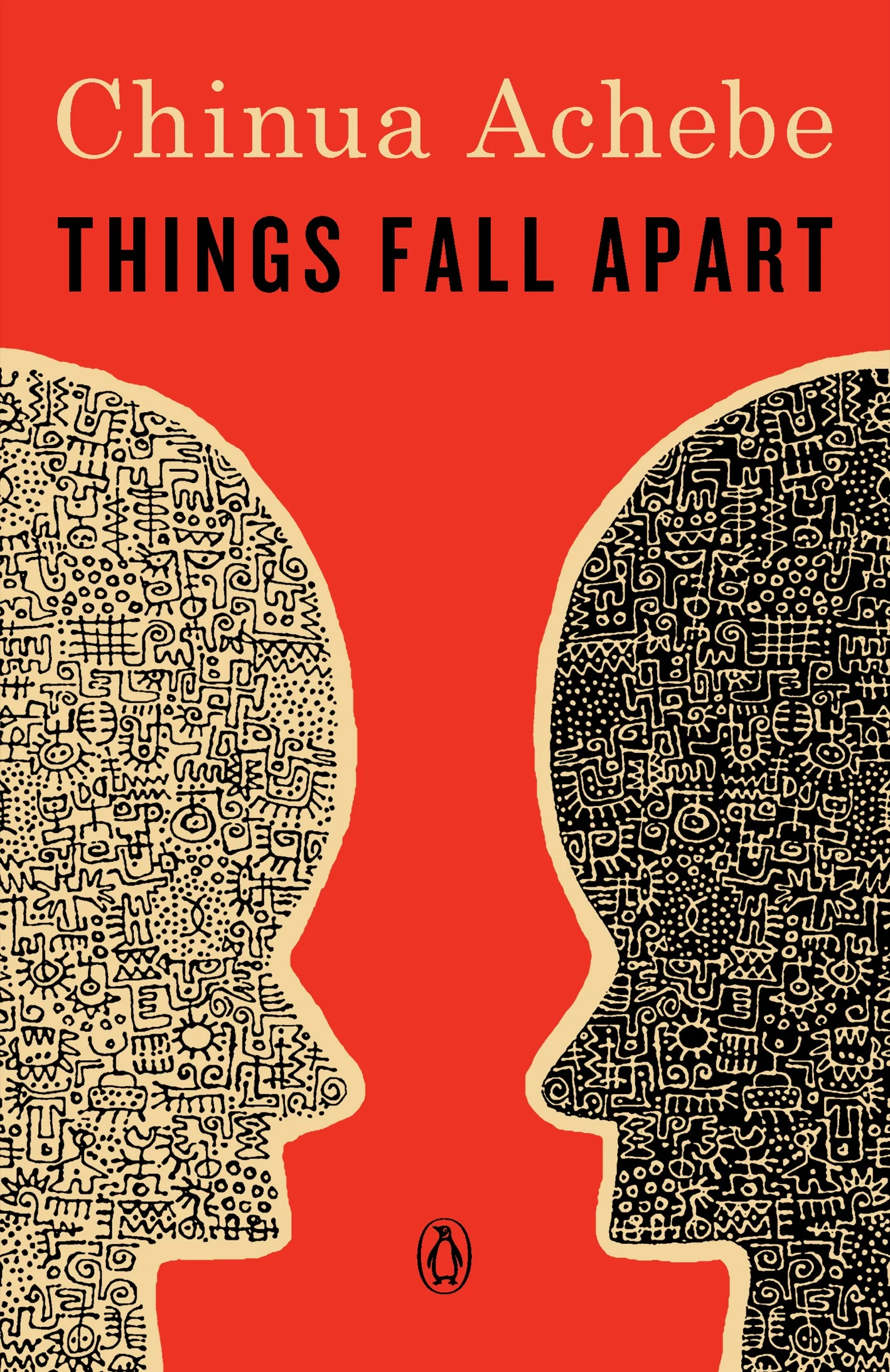
Things Fall Apart
Okonkwo, a respected but often violent Igbo farmer and warrior, returns from seven years of exile to find Umuofia divided by Christianity and colonial rule, kills a court messenger when his clan will not fight, and dies by suicide.
Overview
In Umuofia, a group of nine Igbo villages, Okonkwo earns respect through wrestling, farming and warfare. His father, Unoka, was a musician who accumulated debts and died without titles, and Okonkwo is determined not to resemble him. He builds a prosperous household with three wives, several children and two titles, but his fear of weakness contributes to his anger and violence. The novel also depicts the clan's own institutions through harvest festivals, marriage negotiations, the egwugwu's resolution of disputes, oral stories, and obligations to family and the earth goddess Ani.
When a woman from Umuofia is killed in Mbaino, the neighboring village sends a young girl and Ikemefuna, a boy, to prevent war. Ikemefuna is placed in Okonkwo's household, where he becomes close to Nwoye, Okonkwo's eldest son. After three years the Oracle orders Ikemefuna killed. The elder Ezeudu warns Okonkwo not to participate because Ikemefuna calls him father. Nevertheless, when the wounded boy runs toward him, Okonkwo kills him for fear of appearing weak. The loss disturbs Nwoye and recalls his distress at hearing the cries of twins abandoned in the forest under clan custom. In Okonkwo's household, his second wife Ekwefi is devoted to Ezinma, her only surviving child after nine others died. Ezinma's illnesses and the family's responses to the belief that she is an ogbanje show the importance of care, fear and religious interpretation within domestic life.
At Ezeudu's funeral, Okonkwo's gun accidentally kills the dead man's sixteen-year-old son. Killing a clansman, even inadvertently, is an offense against the earth goddess. Okonkwo must spend seven years in exile in Mbanta, the home of his mother's kin. His compound in Umuofia is destroyed to cleanse the land. His friend Obierika protects his yams and manages their sale and sharecropping. In Mbanta, Okonkwo's uncle Uchendu helps the family establish a new home and reminds Okonkwo that his motherland offers refuge in misfortune, although Okonkwo remains preoccupied with the standing he has lost.
During the exile, Obierika reports that people of Abame killed a white stranger who arrived on a bicycle after consulting their Oracle. Foreign armed men and their followers later attacked Abame's market, killing almost everyone present. Christian missionaries then arrive in Mbanta and Umuofia. The missionaries survive after Mbanta's elders give them land in the Evil Forest. The church attracts some people excluded or troubled by local customs, including an osu outcast community and Nneka, who has had four sets of twins abandoned. Nwoye is drawn to a Christian hymn that seems to address the loss of Ikemefuna and the abandoned twins. After Okonkwo beats him for attending church, Nwoye leaves his father's household and pursues a Christian education in Umuofia.
By the time Okonkwo returns, the new institutions have changed Umuofia. A trading store brings income, while a colonial court and its kotma messengers impose unfamiliar laws, imprisonment and forced labor. The mission has also gained converts among titled men. Mr. Brown, a white missionary, has promoted accommodation and discussed religious beliefs with Akunna, who explains Chukwu and the lesser deities. Brown establishes a school and hospital. Nwoye, now called Isaac, attends teacher training at Umuru. Okonkwo wants to recover his authority and resist the foreigners, but Obierika warns that clan members who have joined the church and government would oppose a war.
When the uncompromising Reverend James Smith succeeds Mr. Brown, tensions worsen. Enoch, a confrontational Christian convert, publicly tears the mask from an egwugwu, a grave sacrilege. The assembled egwugwu burn Enoch's compound and destroy the church, although their leader Ajofia orders that Smith be spared. The District Commissioner responds by inviting six Umuofia leaders, including Okonkwo, to a supposed discussion, then arresting them. Though he orders the prisoners treated respectfully, court messengers shave, starve, humiliate and beat them. The Commissioner demands two hundred bags of cowries; the messengers collect two hundred and fifty, secretly keeping the extra fifty.
After the fine is paid, Okonkwo attends a large village meeting to debate resistance. When five court messengers arrive to halt the meeting, he beheads their leader. The others escape, and the crowd does not join him. Concluding that Umuofia will not fight, he leaves. In the final chapter, the Commissioner comes with armed men to Okonkwo's compound and finds that Okonkwo has hanged himself from a tree. Because the clan regards suicide as an offense against the Earth, Obierika and the others cannot touch or bury the body themselves; only outsiders may do so, after which cleansing sacrifices are intended. Obierika blames the Commissioner for Okonkwo's death. The Commissioner orders his messengers to cut the body down and bring it and the men to court, but the burial is not shown. Instead of attending to the body, he thinks of reducing Okonkwo's life to a paragraph in the colonial book he plans to write, The Pacification of the Primitive Tribes of the Lower Niger.
Main Characters
- Okonkwo: A prosperous Umuofia farmer, wrestler and warrior whose fear of failure and weakness shapes his treatment of his family and his response to colonial rule.
- Unoka: Okonkwo's late father, a skilled flute player whose poverty, debts and lack of titles become a source of shame to his son.
- Nwoye, later Isaac: Okonkwo's eldest son, troubled by Ikemefuna's killing and the abandonment of twins, who joins Christianity and studies with the missionaries.
- Ikemefuna: A boy surrendered by Mbaino to avert war, taken into Okonkwo's household and later killed on the Oracle's order despite his close ties to the family.
- Ekwefi: Okonkwo's second wife, who has lost nine children and is devoted to her surviving daughter Ezinma.
- Ezinma: Ekwefi's daughter, particularly close to her mother and understood by Okonkwo, who wants her to marry after his return to Umuofia.
- Obierika: Okonkwo's friend who protects his property during exile, questions certain clan practices and explains Umuofia's growing political divisions.
- Uchendu: Okonkwo's maternal uncle in Mbanta, who provides refuge and counsels him about kinship and enduring hardship.
- Mr. Brown: A Christian missionary who avoids direct confrontation with the clan's religion, talks with Akunna and establishes a school and hospital.
- Reverend James Smith: Mr. Brown's rigid successor, whose support for confrontational converts precedes the destruction of the church.
- The District Commissioner: A colonial official who judges local cases, arrests the six Umuofia leaders and finally considers reducing Okonkwo's life to a paragraph in his proposed book.
Central Themes
- Status, masculinity and the fear of resembling one's father
- Igbo kinship, religious belief, communal justice and disagreement within the clan
- Parenthood, grief and the consequences of violence
- Christian conversion, exclusion and conflicting accounts of spiritual authority
- Colonial legal power, economic change and the weakening of collective political action
Mood & Atmosphere
The early chapters combine communal ceremony and domestic life with fear, conflict and sudden violence. The exile chapters introduce loss and changing loyalties. The return to Umuofia becomes increasingly tense as religious and political divisions sharpen. The ending is tragic, followed by the Commissioner's detached consideration of how to describe Okonkwo.
Source Edition
Things Fall Apart (2017), Penguin Publishing Group. How sources are recorded.