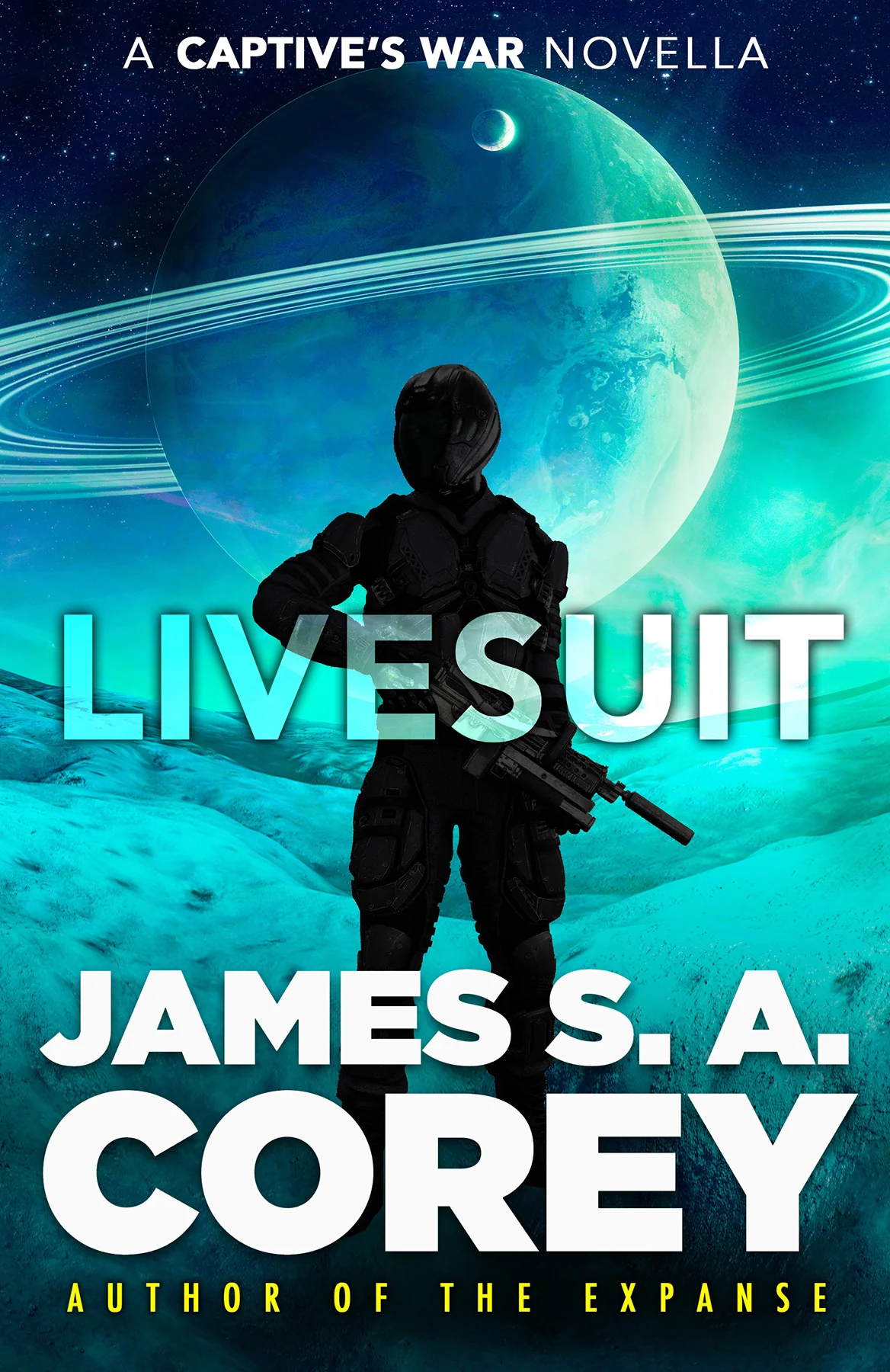
Livesuit
In a nonlinear account of livesuit infantry service, Kirin Foss rescues civilians and endures progressive bodily replacement, then discovers changes in his friend Piotr that make him question whether either man will ever leave his suit.
Overview
Livesuit follows Kirin Foss, a livesuit infantry soldier in humanity's far-reaching war against an alliance of alien enemies. The narrative moves backward and forward through a single long chapter, contrasting military operations with his life before enlistment. On Kaladon, Kirin works in mobile medical rescue alongside his friend Piotr and lives with Mina Caulson, a hospice worker. Reports of the destruction of Aumpaena and the capture or killing of civilians convince Piotr that rescue work is not enough, and he signs up for an eight-year subjective military tour. Kirin subsequently joins the same intake, though the novella does not show a decisive enlistment conversation or confirm that his motives exactly match Piotr's.
At training, Sergeant Huang explains that the livesuit bonds to a soldier's skin and supplies protection, movement, nutrition, waste removal, communication, medication, and battlefield repair. It depends on the human body for a usable framework and on human judgment for unfamiliar problems. Huang says the suit can be removed when a tour ends. Kirin's first combat operation is led by Simeon through the ruins of Lapis City, alongside Piotr, Ross, Corval, Gleaner, and others. As missions accumulate, the suits prevent soldiers from removing their helmets, regulate bodily sensations and moods, and replace flesh lost to injuries.
The opening operation is Kirin's twenty-eighth. Under Corval's command, his team attacks a bridge-like alien growth straddling a river of bromine and hydrocarbons. An organism in the river crushes Kirin's left ankle and pulls him underwater, but the suit suppresses his pain and supplies the mechanical strength needed to keep fighting. Gleaner and Ross help him escape, the charges destroy the structure, and the team evacuates. A scan later shows the suit replacing his ruined foot and lower leg. Previous wounds have already left suit material in his spine and liver. Kirin continues serving while the changes advance beyond his immediate awareness.
Relativistic travel and the distortions of brane-slip make the war's timeline hard to reconstruct and separate Kirin from civilian life. A delayed, partly censored message from Mina shows that she has grown older; she fondly recalls watching a drama called Silent Horses with him, although he cannot remember sharing it with her. Kirin obtains the recording and does not recognize it. When he tries to answer, a security official tells him that Mina died at age fifty-eight and had been associated with an anti-military faction. Kirin cannot confirm that account. He later finds that the recording has been erased from his suit, leaving both the memory discrepancy and the censorship unexplained.
In an earlier mission, when Kirin has completed roughly a dozen operations, Simeon's strike team attempts to liberate prisoners in the Lirebas system before they can be executed. An explosion kills Simeon, Hamze, and Jones. Piotr is gravely injured while fighting the large alien attackers; after his final spoken order, he communicates only by suit text. Corval initially freezes, and Kirin directs the survivors until Corval resumes command. With little ammunition remaining, they destroy a defensive turret, enter the holding pens, and stop the killing. The liberated prisoners cheer while many captives and three members of the rescue team lie dead. Later, Command transfers Corval, Ross, and Noor, promotes Kirin, and introduces new soldiers, including Eric Santos. Santos's subdued manner contrasts sharply with the outgoing Corval's account of him, a difference the novella does not explain.
In the final scene, Kirin seeks help for phantom pain and discovers that replacement tissue now extends above his left knee. Piotr arrives to discuss reenlisting but cannot complete a familiar expression from their time as rescue workers. Increasingly disturbed, Kirin places him in the medical scanner. Much of Piotr's upper head appears to have been replaced by livesuit material, but the scan also shows surviving jawbone, teeth, and predominantly organic throat tissue. Kirin stops the scan before examining the rest of his body. He fears Piotr may have died, wonders whether Control could be supplying his words, and suspects the suits were never designed to come off. None of those possibilities is independently confirmed. After briefly asking whether soldiers are actually permitted to go home, Kirin conceals his suspicion behind a comment about reenlistment bonuses. He agrees with Piotr's assertion that they are fighting for the good side, and the novella ends without resolving who or what is speaking for Piotr, or whether either man will leave the suit.
Main Characters
- Kirin Foss - a former medical rescue worker from Kaladon who becomes a livesuit infantry soldier, survives severe injuries, and comes to question his military's promises.
- Piotr - Kirin's former rescue partner, the first of the two to enlist, who loses ordinary speech after an injury at Lirebas and later shows disturbing physical and memory changes.
- Mina Caulson - Kirin's former partner and a hospice worker whose delayed, censored message and reported death reveal the distance between his service and civilian life.
- Estebán Corval - an experienced livesuit soldier, initially a group leader under Simeon and later team commander, who is reassigned after the twenty-eighth operation.
- Deborah Ross - a soldier from Kirin's intake, a close comrade during combat, and the person whose invitation to meet as civilians keeps open the idea of returning to ordinary life.
- Simeon - the experienced strike team leader killed during the Lirebas prisoner-rescue mission.
- Gleaner - a recurring teammate who helps extract Kirin from the river and remains with him after the later team reassignment.
- Eric Santos - an incoming soldier whose withdrawn behavior and imperfect recollection of Corval contrast with how Corval remembered him.
Central Themes
- Physical survival and the uncertain continuity of personal identity
- Military duty, sacrifice, and the costs of institutional control
- Time dilation, separation, and the loss of familiar civilian life
- Restricted information, memory uncertainty, and censorship
- The difference between visible heroism and bodily harm
Mood & Atmosphere
Nonlinear battlefield action interspersed with grief, recollection, and increasing uncertainty about bodily autonomy and military service.
Source Edition
Livesuit (2024), Orbit. How sources are recorded.