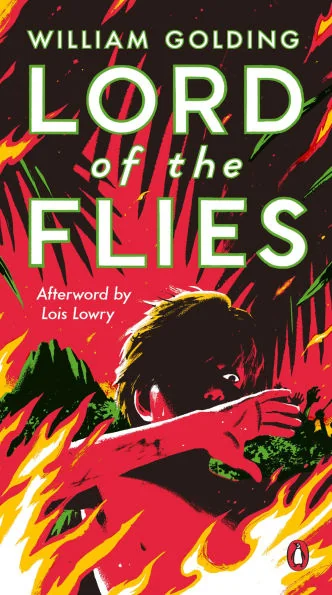
Lord of the Flies
After British schoolboys elect Ralph to organize their rescue, Jack's competing hunting tribe turns fear into violence, kills Simon and Piggy, and pursues Ralph until smoke from its destructive forest fire attracts a naval officer.
Overview
A plane carrying British schoolboys fleeing a war is shot down, leaving them without adult supervision on an apparently uninhabited tropical island. Ralph meets Piggy, whose practical suggestions supply the first means of organization. Piggy identifies a conch shell and explains that blowing it will bring the scattered boys together. The children elect Ralph chief, partly because he appears authoritative with the shell, while Jack Merridew, the disappointed leader of the choir, takes charge of the choirboys as hunters. Ralph, Jack and Simon confirm that the island is surrounded by sea. For a time, adventure seems possible. Yet Ralph publicly discloses Piggy's disliked nickname and excludes him from the expedition, establishing that the new order does not treat every boy equally.
Ralph's principal objective is rescue, which requires a signal fire on the mountain. The first attempt exposes the gap between collective enthusiasm and competent cooperation. The boys seize Piggy's spectacles to ignite a large bonfire, then let the flames spread into the forest. A littlun with a birthmark who has reported seeing a frightening snake-like creature disappears after the fire; his death is feared but never confirmed by a recovered body or direct account. Ralph establishes speaking rules using the conch, and the boys repeatedly agree to collect water, build shelters and tend the fire. They seldom sustain their commitments. Ralph and Simon work on shelters largely alone while Jack grows preoccupied with tracking pigs. The younger boys are frightened by nightmares, and even Jack privately admits feeling hunted in the forest. Simon's help with the littluns and his habit of withdrawing to a private clearing establish a quieter alternative to the competing leaders' concerns.
Jack paints his face to conceal himself from pigs, but the disguise also releases him from embarrassment and social inhibition. His hunters finally kill a pig after abandoning their watch on the mountain. While the signal fire is out, a ship passes the island without discovering them. Ralph treats the missed rescue opportunity as a serious failure; Jack celebrates the kill and attacks Piggy when challenged, breaking one lens of his glasses. His apology concerns the fire, not the assault. Ralph calls an assembly to restore rules about water, sanitation, shelters and smoke. Instead, the meeting is consumed by arguments about a beast. One littlun's nocturnal sighting proves to be Simon moving in the forest, while another child imagines a creature coming from the sea. Piggy suggests that people may be the real source of fear. Simon struggles to express the possibility that the beast is connected with the boys themselves. The meeting collapses when Jack rejects the authority of the conch and leads the boys into a mock hunt. Ralph does not call them back because he fears they may no longer obey.
A battle in the adult war creates the thing that gives these fears an apparently physical form. A dead parachutist falls onto the mountain, where the wind moves his body and canopy. Sam and Eric see the figure in darkness and mistake it for a terrifying animal. Their report leads Ralph and Jack to search Castle Rock, a defensible headland that interests Jack for its rocks and narrow entrance, before turning toward the mountain. On the journey Ralph wounds a boar and takes pride in his success. He also joins the hunters in a reenactment that becomes a genuinely violent attack on Robert, complicating any simple opposition between Ralph's decency and Jack's aggression. Later Ralph, Jack and Roger glimpse the wind-driven corpse at night and flee, believing they have encountered the beast. The reader already knows what they saw, but the boys do not.
Jack uses their fear to challenge Ralph in another conch assembly, accusing him of cowardice and asking the boys to remove him as chief. No hands go up. Jack leaves in humiliation and declares a separate hunting group. Since the boys now fear the mountain, Piggy proposes moving the signal fire to the beach, even though its smoke will be less visible. The reduced party struggles to maintain it as boys drift toward Jack. Jack appoints himself chief of the new tribe, hunts a sow that is nursing piglets and directs a prolonged, brutal killing. The hunters mount its severed head on a pointed stick in Simon's clearing as a gift meant to appease the beast. Exhausted and ill, Simon experiences the head, surrounded by flies, as speaking to him. In this subjective vision, the Lord of the Flies claims to be part of the boys, beyond the reach of their spears. The episode joins Simon's earlier suspicion of internal evil to the ritual violence he has witnessed; it is not independent proof that the severed head literally speaks.
Jack's painted hunters seize burning branches from Ralph's new beach fire and invite the rest of the boys to a feast. At the feast Jack offers meat, amusement and supposed protection from the beast, while Ralph insists that leadership and the rescue signal remain important. Piggy and Ralph eat with the group. When a violent storm arrives, Jack turns the gathering into a rhythmic hunting dance. Ralph and Piggy join the circle, seeking the security it seems to provide. Meanwhile Simon has climbed the mountain, discovered the decomposing airman, freed the parachute from its snagged lines and begun the difficult descent to tell the boys the truth. He emerges from the forest trying to speak about the dead man, but the frenzied group closes on him, beats and bites him, and kills him at the water's edge. The storm carries the parachutist out to sea, and the rising tide later takes Simon's body. A supposed beast has been exposed as a corpse, yet the real killing has been committed by the boys who feared it.
Ralph recognizes Simon's death as murder and is horrified by his own participation. Piggy calls it an accident, emphasizes the storm and fear, and encourages everyone to conceal their involvement. Jack's tribe occupies Castle Rock, fortifies its narrow entrance and punishes Wilfred without an explanation. Roger finds the arbitrary exercise of power increasingly attractive. The rival groups are not simply divided into those who are afraid and those who are not: Jack's hunters continue to believe that the beast may assume disguises, and they rely on offerings and rituals even after Simon's death. Jack, Roger and Maurice raid Ralph's shelter at night. Although the raiders initially talk of stealing fire, they take Piggy's spectacles instead. Piggy loses most of his ability to see, and Ralph's remaining companions lose their means of lighting another rescue signal. The conch remains where it was, still intact but increasingly unable to secure obedience.
Ralph, Piggy and the twins go to Castle Rock to demand the spectacles. Piggy carries the conch, hoping to convince Jack to act justly even without a reason to fear him. Jack refuses, fights Ralph and orders Sam and Eric bound. Piggy appeals for rules, cooperation and rescue rather than killing. Roger deliberately releases a massive boulder from above the entrance, crushing Piggy and breaking the conch into fragments. Piggy falls to the rocks below and dies; the sea carries away his body. Jack immediately declares himself chief, deliberately throws a spear that wounds Ralph and orders the tribe against him. Ralph escapes, but the twins are coerced into Jack's group. There is no longer a meaningful assembly at which Ralph can challenge the hunters' decisions.
Ralph hides alone, carrying a stick taken from the pig's skull. The coerced twins warn him that the tribe intends to hunt him and that Roger has sharpened a stick at both ends, indicating that capture may end in a staged killing. Jack and Roger force a twin to reveal Ralph's hiding place. The hunters drop boulders onto a thicket, probe it with spears and finally set the forest ablaze to flush Ralph into the open. Their search line pursues him through the burning island until he stumbles onto the beach expecting death. There he finds a British naval officer, whose ship has spotted the smoke from the fire set by the hunters. When the officer questions the boys, Ralph acknowledges that two have been killed. Jack, still carrying Piggy's broken spectacles, does not contest Ralph's claim to be chief. The officer invokes The Coral Island as an image of what organized British boys should have achieved. Ralph remembers their early hopes and weeps for Simon, Piggy and the destruction of their innocence. The other boys cry as well. The novel ends with the officer turning away to look at his cruiser; it does not narrate the boys boarding it.
The conch's authority depended on the boys accepting rules, not on the shell itself. Piggy's spectacles made the signal fire possible but also became an object that could be seized by force. Jack's hunting supplied food and status while his control of fear encouraged allegiance and violence. Simon's death demonstrates the danger of treating collective conviction as proof, and Ralph's participation makes the ethical conflict broader than an innocent leader opposed to a vicious rival. The final fire obtains rescue precisely because it was lit to pursue and kill another boy. The officer's military uniform, weapons and warship place the violence on the island alongside the organized violence of the adult world. His appearance ends the immediate danger, but does not establish that the society to which the boys return has escaped the impulses the novel has exposed.
Main Characters
- Ralph: The elected chief who tries to maintain assemblies and a rescue signal, yet joins the violent hunt of Robert and the crowd that kills Simon before recognizing the boys' moral collapse.
- Piggy: Ralph's practical adviser and advocate of rules and rescue. His spectacles enable fire-making; Jack's hunters steal them and Roger's boulder kills him as he appeals for reason.
- Jack Merridew: The choir leader turned hunter who challenges Ralph, establishes a separate tribe, uses meat and fear to command followers, and ultimately orders the hunt for Ralph.
- Simon: A boy who assists younger children and questions the idea of an external beast. He learns that the feared figure is a dead parachutist but is killed while trying to report it.
- Roger: A hunter whose initial inhibition against hurting a littlun gives way to deliberate cruelty. He kills Piggy by releasing a boulder and participates in the coercion of the twins.
- Sam and Eric: Twins who maintain the signal fire, mistake the parachutist for a beast, support Ralph for much of the novel and are eventually captured and forced into Jack's tribe.
- Percival and the littluns: Younger boys whose nightmares and reliance on the older boys show the group's failure to provide security; Percival cannot recall the address he once recited by heart.
- The naval officer: The adult who arrives after seeing smoke from the hunters' fire, confronts evidence of two deaths and ends the pursuit while embodying the wider world at war.
Central Themes
- Rules and legitimacy: The elected chief and conch govern only while the group accepts their authority; violence and fear ultimately displace the assembly.
- Fear and evidence: Reports of a beast expand from nightmares and mistaken sightings into claims the boys act upon, even as the actual mountain figure is a dead airman.
- Collective violence and individual responsibility: Ralph and Piggy participate in the fatal dance and later respond differently to the question of culpability.
- Power over necessities: Piggy's spectacles enable both the rescue signal and the hunters' cooking fires, making them a practical instrument of control.
- Violence and social status: Jack's hunting achievements and food distribution attract followers, while Roger discovers that his new leaders tolerate unaccountable cruelty.
Mood & Atmosphere
Initially adventurous and sunlit, then increasingly anxious, hostile and claustrophobic as the boys abandon collective responsibilities. The deaths of Simon and Piggy make the final chapters violent and mournful; the naval rescue ends the pursuit without resolving Ralph's grief.
Source Edition
Lord of the Flies (1959), Penguin Publishing Group. How sources are recorded.