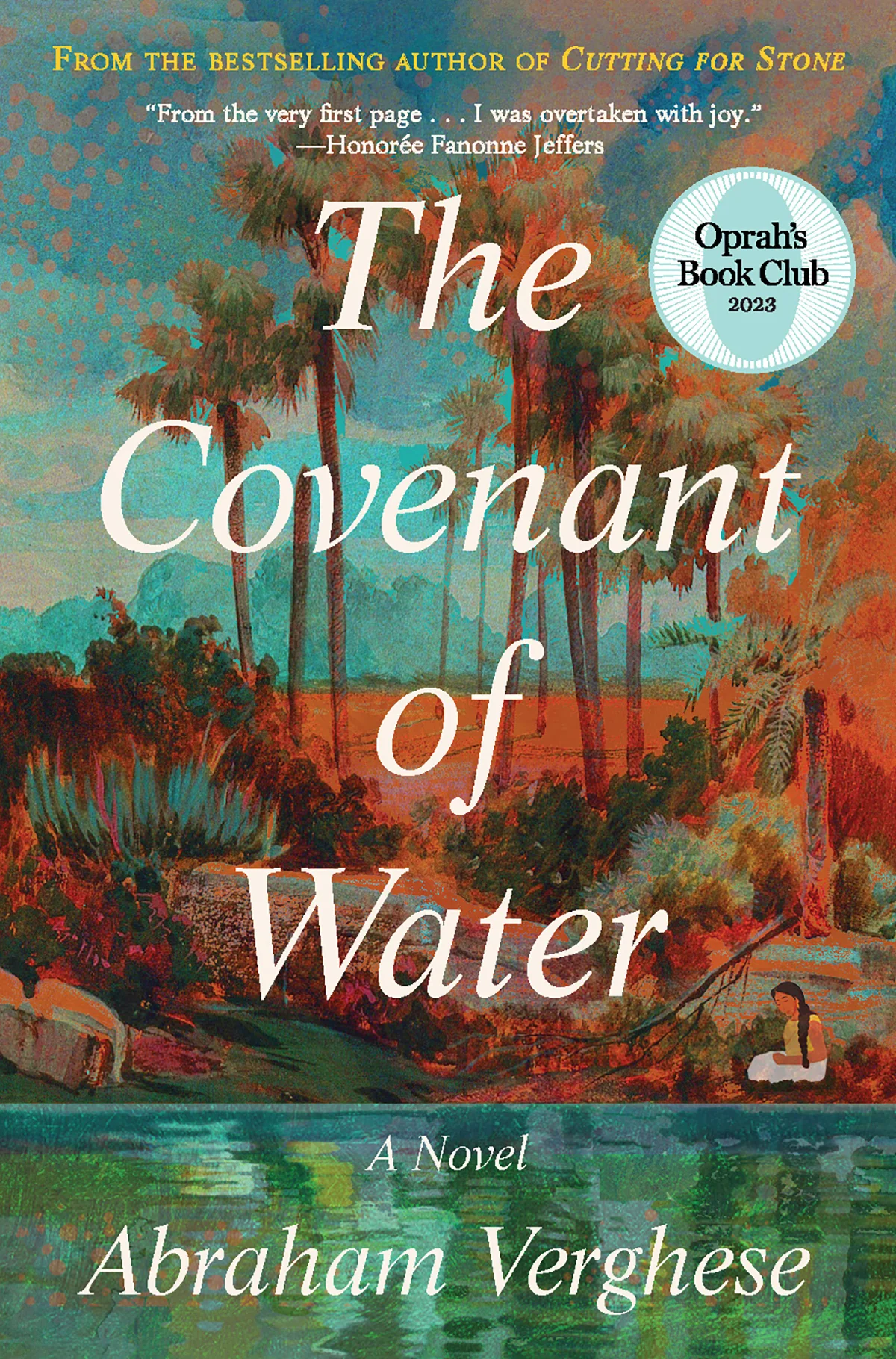
The Covenant of Water
Across three generations in South India, a family's unexplained drownings lead a physician to a suspected inherited disorder of the acoustic nerves, while loss, leprosy stigma, and concealed parentage culminate in a daughter's silent encounter with the mother she believed dead.
Overview
In 1900 in Travancore, a twelve-year-old girl is married to a forty-year-old widower and brought to his estate, Parambil. She becomes known as Big Ammachi and comes to love his young son JoJo as her own. The boy drowns in a shallow rain-filled ditch after falling from a vine, despite his family's habitual avoidance of water. Her husband then reveals a genealogical record, the Water Tree, that marks repeated drownings across generations, sometimes accompanied by deafness, dizziness, or imbalance. Neither he nor Big Ammachi knows whether the family is suffering a disease or a curse. The loss of JoJo shapes her determination to protect her children. Her daughter Baby Mol has a congenital thyroid-related developmental disorder that the physician Rune Orqvist distinguishes from the mysterious water-linked Condition. Much later Big Ammachi gives birth to Philipose, who is strongly drawn to water although entering it makes him disoriented.
A parallel narrative follows Digby Kilgour, a Scottish physician who loses his mother to suicide, faces professional barriers in Glasgow, and begins practicing at a British colonial hospital in Madras in 1933. He becomes troubled by the unequal treatment of Indian patients. The fatal hemorrhage of the young hockey player Jeb, following an operation by senior surgeon Claude Arnold, leads to an inquiry that Digby risks his career to support. Digby also begins a relationship with Claude's wife, Celeste. A fire in Digby's bungalow kills Celeste and badly burns his hands, threatening his ability to operate. At Saint Bridget's Leprosarium, founded by Swedish physician Rune Orqvist, Rune performs staged reconstructive surgery. Nine-year-old Elsie Thetanatt helps Digby recover hand movement through drawing; together they draw a portrait that alters how he remembers his mother's death. After Rune dies, Digby eventually helps develop a hill estate named Gwendolyn Gardens with the assistance of the Mylins and Cromwell. Rune's work with people excluded because of leprosy remains a model for him.
Philipose grows up at Parambil under Big Ammachi's protection and the care of Shamuel, the estate foreman. The household also reflects wider inequalities: Shamuel's son Joppan faces caste discrimination even though he and Philipose are close friends. Philipose loves literature and learns from the retired teacher Koshy Saar, but impaired hearing and balance trouble undermine his attempt to study at Madras Christian College. He returns to Parambil, helps organize relief during wartime food shortages, and becomes a columnist writing as the Ordinary Man. He renews his acquaintance with Elsie, now a gifted artist, and they marry in 1945. Their mutual affection does not eliminate conflict: Philipose's fears and possessiveness restrict Elsie's movements and artistic independence. Their prematurely born son Ninan survives infancy but dies in 1949 after falling onto a pointed branch of the family's plavu tree. Philipose badly injures both ankles trying to recover the child's body. His pain treatment turns into dependence on opium, and he and Elsie become estranged amid grief and blame.
In 1950, Elsie travels with Franz and Lena Mylin to Gwendolyn Gardens and reconnects with Digby, whom she helped years earlier. He makes room for her grief, and his own experiences of loss and his artistic recovery help them grow close. Elsie discovers sculpture as a way to work through her anger, and they become lovers. A letter reporting that Baby Mol is dangerously ill persuades Elsie to return temporarily to Parambil. A destructive monsoon traps her there and severs communication. She learns she is pregnant, and leprosy becomes clinically apparent and progresses during the pregnancy. In 1951 she survives a convulsion, difficult birth, and severe hemorrhage, giving birth to Mariamma. Philipose initially believes the child is his because of one encounter while he was affected by opium. Elsie, however, identifies Digby as Mariamma's father. Believing both disease exposure and social exclusion would endanger her daughter, Elsie leaves clothing beside the river to make her family think she has drowned. Digby meets her secretly downstream. She refuses to bring Mariamma to his estate and instead disappears into Saint Bridget's with Digby, trusting Big Ammachi, Baby Mol, Philipose, and Anna Chedethi to raise the child.
As Mariamma grows up at Parambil, Philipose recovers from addiction and devotes himself to her, while Big Ammachi continues trying to bring medical care to the community. Following fundraising at the Maramon Convention and the donation of Parambil land, a hospital is planned, although its eventual opening is delayed by administrative and financial problems. Big Ammachi and Baby Mol die together after Baby Mol's worsening illness. Mariamma trains as a physician in Madras, survives sexual coercion by a professor, and finds a demanding mentor in researcher Dr. Uma Ramasamy. She also loves Lenin, the son of Lizzi and Kora, whose difficult childhood and later radicalization draw him into the Naxalite movement. Their relationship is strained by Lenin's commitment to political violence and Mariamma's refusal to abandon medicine.
In 1974, Philipose sees an anonymous sculpture at an auction that resembles Elsie's work and begins to suspect she survived. He boards a train to Madras to learn more, but the train plunges into water after a bridge disaster. Although he escapes his compartment, he attempts to help a struggling child and dies by drowning; the fate of the child he reached for is not established. Mariamma and Uma examine his brain and discover small acoustic neuromas on both sides. With the Water Tree and its record of hearing loss and water disorientation, neurologist Dr. Das suspects a familial variant of neurofibromatosis. This is a medical hypothesis supported by the findings, not a fully confirmed genetic diagnosis. Mariamma understands how injury to the balance pathways could explain the family's dangerous disorientation in water. She pursues neurological surgery, helps open the Parambil hospital, and makes the Condition public so other affected families can contribute histories. She also considers whether it might affect behavior, but that additional conjecture is not demonstrated.
In 1977, Lenin reappears at Saint Bridget's, critically ill with raised intracranial pressure and suspected acoustic-nerve tumor. Mariamma performs a temporary ventricular drainage procedure, then helps arrange his transfer to Vellore for urgent neurosurgery. The surgeons remove much, but not all, of the tumor, and Lenin recovers sufficiently to speak and walk. He remains wanted by the authorities and is taken to prison; no final legal outcome is provided. Claims that his tumor caused his militant politics are speculation rather than established fact. Meanwhile Mariamma reads Philipose's journals and discovers that, despite his early assumption of paternity, he knew she was not his biological daughter and consciously chose to love and raise her. A distinctive pale streak in her hair, matched by a photograph of Digby's mother, brings her back to Saint Bridget's to question Digby. There she learns that he is her biological father and that Elsie is alive.
The book's last chapters return to 1950–51 to show how Digby and Elsie became lovers, why she staged her drowning, and how he chose to remain with her at Saint Bridget's. By 1977 treatment has ended Elsie's active leprosy but cannot restore damaged nerves, hand function, or sight. She has continued making drawings and sculptures, including many small clay forms made by touch. Fear of exposure ended an attempt to exhibit her work anonymously. Digby tells Mariamma that Elsie had secretly returned to Parambil dressed as a beggar, hoping to glimpse her daughter, until blindness made those visits impossible. Mariamma now has to reconcile Philipose's unwavering care, Elsie's protective but devastating decision, and Digby's painful separation from his only child. She cannot yet decide whether to speak to Elsie, and Digby cannot tell her whether Elsie would want the secret broken. In the final scene Elsie approaches the window of Digby's bungalow for her accustomed gesture of placing her hands on its glass. Digby steps aside, and Mariamma places her palms against the pane opposite her mother's. The novel ends with this silent contact, not a spoken reunion or a resolved future. Its recurring water imagery connects the family's losses, acts of care, secrecy, and consequences across generations.
Main Characters
- Big Ammachi - a matriarch at Parambil who preserves the family's Water Tree, raises Philipose and helps raise Mariamma, and campaigns for local medical care
- Big Appachen - Big Ammachi's husband, whose family history of drownings and restricted upbringing informs the Water Tree
- Baby Mol - Big Ammachi's daughter with a congenital thyroid-related disability, cherished within the family and deeply affected by its losses
- Philipose - Big Ammachi's son, a writer with hearing and balance problems who marries Elsie, loses Ninan, recovers from opium dependence and knowingly raises Mariamma
- Elsie Thetanatt - a sculptor and Mariamma's mother whose leprosy becomes apparent during pregnancy and who stages her death to protect her child
- Mariamma - a physician and aspiring neurosurgeon who investigates the family's medical history and learns the truth about her parentage
- Digby Kilgour - a Scottish surgeon whose burned hands are reconstructed at Saint Bridget's; Elsie's partner and Mariamma's biological father
- Rune Orqvist - the surgeon who founds Saint Bridget's Leprosarium and reconstructs Digby's injured hands
- Lenin - son of Lizzi and Kora, a former seminarian and Naxalite whom Mariamma loves and later treats for a life-threatening acoustic-nerve tumor
- Shamuel - Parambil's foreman, whose practical care and family ties to Big Ammachi and Philipose anchor the estate
- Joppan - Shamuel's son and Philipose's childhood friend who becomes a transport entrepreneur, confronts caste inequality and later manages Parambil
- Uplift Master - a reformer and petition writer who organizes public initiatives and helps advance the Parambil hospital
- Anna Chedethi - a household helper who nurses Mariamma as an infant and provides continuing care at Parambil
- Cromwell - Digby's Badaga estate partner and confidant who helps conceal Elsie's survival and assumes responsibility for Gwendolyn Gardens
Central Themes
- Family formed through care as well as biological parentage
- Medical uncertainty, heredity and the limitations of treatment
- Grief, addiction and recovery
- The harms of leprosy stigma and social exclusion
- Caste, colonial power and gendered restrictions
Mood & Atmosphere
Alternates domestic family life in Travancore and Kerala with surgical practice, political conflict, disability, loss and recovery. Its concluding family revelation is intimate but deliberately unresolved.
Source Edition
The Covenant of Water (2023), Grove Atlantic. How sources are recorded.