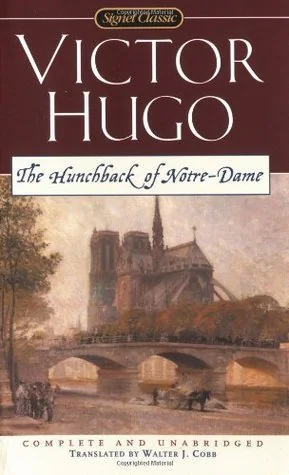
In medieval Paris, Esmeralda is falsely condemned after Claude Frollo stabs the captain she loves; Quasimodo rescues her into Notre-Dame, but a failed attempt to remove her from sanctuary leads to execution, betrayal and the deaths of her mother and Frollo.
Overview
Victor Hugo's novel follows intertwined lives in Paris in 1482. During the Feast of Fools, the poet Pierre Gringoire struggles to stage his morality play before a distracted crowd, and the deformed, deaf bellringer Quasimodo is acclaimed Pope of Fools. A young dancer known as La Esmeralda performs in the streets with her trained goat Djali. Claude Frollo, the archdeacon who adopted Quasimodo as an abandoned child, has become consumed by a desire to control Esmeralda. He participates in an attempt to abduct her, but Captain Phoebus de Châteaupers intervenes. After his arrest, a defective court hearing in which both Quasimodo and the auditor are deaf results in his sentence to be flogged and exposed on the pillory. Claude Frollo passes without helping him, while Esmeralda offers him water despite the crowd's mockery. She also saves Gringoire from execution by the Court of Miracles through a nominal marriage, while refusing marital intimacy.
Alongside these events, Hugo's narrator examines Notre-Dame's Romanesque and Gothic architecture, the arrangement of medieval Paris into City, University and Town, and the ways successive generations have altered or damaged historic buildings. Frollo's encounter with a disguised King Louis XI leads into the narrator's essay on printing and architecture, which argues that reproducible books are displacing monumental buildings as the principal medium for collective human expression. These essays are integral to Hugo's account of Paris's built environment and cultural history.
Phoebus, who is betrothed to Fleur-de-Lys, attracts Esmeralda without intending to marry her. Fleur-de-Lys discovers the dancer's attachment when Djali arranges letters to spell Phoebus's name. Frollo becomes more jealous after learning of Gringoire's unconsummated marriage and Phoebus's secret meeting with Esmeralda. He also describes himself as both spider and fly in an image of fate that reflects his attempt to excuse his obsession. In disguise, Frollo accompanies Phoebus to their meeting and hides nearby. He interrupts their encounter and stabs the captain. Esmeralda faints and is accused of the attack. A gold coin secretly replaced with a dry leaf by a landlady's child, along with Djali's trained tricks, is treated by the court as evidence of witchcraft. Esmeralda's denial and account of a pursuing priest are ignored. Under torture she falsely confesses to witchcraft and murder, and both she and Djali are sentenced to be hanged. Phoebus survives but avoids participating in the trial or correcting the false belief that he died. When he returns to Fleur-de-Lys, he fabricates a duel to account for his stab wound.
When Esmeralda is brought to Notre-Dame for public penance before execution, Frollo privately offers rescue if she submits to him. She refuses and then sees Phoebus alive on Fleur-de-Lys's balcony, but the captain withdraws rather than aid her. Quasimodo suddenly carries Esmeralda into the cathedral under its right of sanctuary. He shelters and feeds her, gives her a whistle he can hear, and repeatedly attempts to protect her even as she remains attached to Phoebus. When Quasimodo asks Phoebus to visit her, the captain, believing her dead, refuses and kicks the bellringer. Esmeralda later takes a withered bouquet from a beautiful cracked vase instead of the fresh flowers in a plain earthenware pot, while Quasimodo continues to care for her. The narrator does not establish that this choice is deliberate. Frollo, who has learned she is alive, enters the refuge and tries to assault her, but Quasimodo answers the whistle and intervenes. The bellringer's loyalty to his adoptive father prevents him from killing the priest.
After mistakenly believing Esmeralda had died, Frollo does not repent of his actions; learning she survived revives his obsession and jealousy of Quasimodo. With Parliament moving to reclaim her from sanctuary, Frollo and Gringoire arrange for the Court of Miracles to enter the cathedral and take her away. The outcasts intend to rescue her, although some also hope to plunder the church. Quasimodo cannot hear their declarations and mistakes them for enemies. He defends the building with beams, stones and molten lead and kills Jehan Frollo, Claude's younger brother, during an attempt to scale the gallery. Louis XI at first mistakes the disturbance for a revolt against a feudal bailiff. When he learns that the crowd is besieging Notre-Dame, he orders troops to suppress them and commands Esmeralda's execution despite sanctuary. His willingness to release Gringoire contrasts with his indifference to a bishop imprisoned for fourteen years. The royal cavalry, led by Phoebus, routs the attackers and kills Clopin Trouillefou among others.
During the fighting, Gringoire and Frollo remove Esmeralda and Djali through a private cathedral exit and cross the river by boat. Gringoire disappears with Djali, and Frollo again tries to force Esmeralda to accept him. Having learned of Jehan's death in the siege, Frollo acknowledges his own responsibility but also blames Esmeralda. When she refuses, he leaves her with Sister Gudule, a recluse who believes itinerant people stole her infant daughter. A matching pair of embroidered shoes reveals that Esmeralda is Gudule's missing child Agnès. Gudule breaks the bars of her cell to shelter her daughter from the royal officers, but Esmeralda's cry to the departing Phoebus exposes her hiding place. Gudule dies resisting the executioner, and Esmeralda is hanged.
Quasimodo searches for the missing Esmeralda, then follows Frollo to a cathedral tower and witnesses her execution. Seeing the archdeacon laugh, he pushes him over the parapet; Frollo falls to his death. Quasimodo then disappears. Gringoire survives with Djali and succeeds as a dramatist, while Phoebus eventually marries. Many months later, two skeletons discovered embracing in a Montfaucon charnel house, identified by Esmeralda's clothing and amulet and the other's deformed spine, strongly suggest that Quasimodo died beside her remains. The conclusion does not document his death directly or name Phoebus's eventual bride.
Main Characters
- Quasimodo - The deaf bellringer adopted by Frollo, whose gratitude for Esmeralda's compassion leads him to protect her within Notre-Dame.
- La Esmeralda (Agnès) - A street dancer falsely convicted of killing Phoebus and of sorcery, who later learns that the recluse Gudule is her mother.
- Claude Frollo - The archdeacon and adoptive father of Quasimodo, whose obsession with Esmeralda results in her attempted abduction, wrongful prosecution and repeated coercion.
- Pierre Gringoire - A struggling poet saved by Esmeralda's nominal marriage who coordinates the outcasts' plan and ultimately flees with Djali.
- Phoebus de Châteaupers - A captain betrothed to Fleur-de-Lys who rescues Esmeralda from abduction, survives Frollo's stabbing, avoids the trial and later marries.
- Paquette la Chantefleurie (Sister Gudule) - The recluse who mourns a lost daughter, recognizes Esmeralda as Agnès, and dies trying to prevent her arrest.
- Jehan Frollo - Claude's younger brother, a student who joins the outcasts and is killed by Quasimodo during the attack on Notre-Dame.
- Clopin Trouillefou - The leader of the Court of Miracles who attempts to rescue Esmeralda and dies fighting the royal troops.
- Fleur-de-Lys de Gondelaurier - The captain's betrothed, who realizes Esmeralda loves him and later sees her under sentence of death.
- King Louis XI - The monarch who orders the cathedral siege suppressed and authorizes Esmeralda's execution despite her sanctuary.
Central Themes
- Obsession, coercion and possessive desire
- Compassion and social exclusion
- Judicial injustice, torture and superstition
- Sanctuary and conflict between ecclesiastical and royal power
- Miscommunication, gratitude and divided loyalties
Mood & Atmosphere
Tragic and often violent, contrasting medieval Parisian festivals, public spectacle and historic architecture with confinement, coercion, judicial cruelty and conflict.
Source Edition
The Hunchback of Notre Dame, Project Gutenberg. Project Gutenberg #2610, unabridged Isabel Florence Hapgood translation, 11 books and 59 narrative chapters; original 52-chapter Lowell Bair adaptation and provenance retained in historical archive. Gutenberg ebook ID is not an ISBN. How sources are recorded.