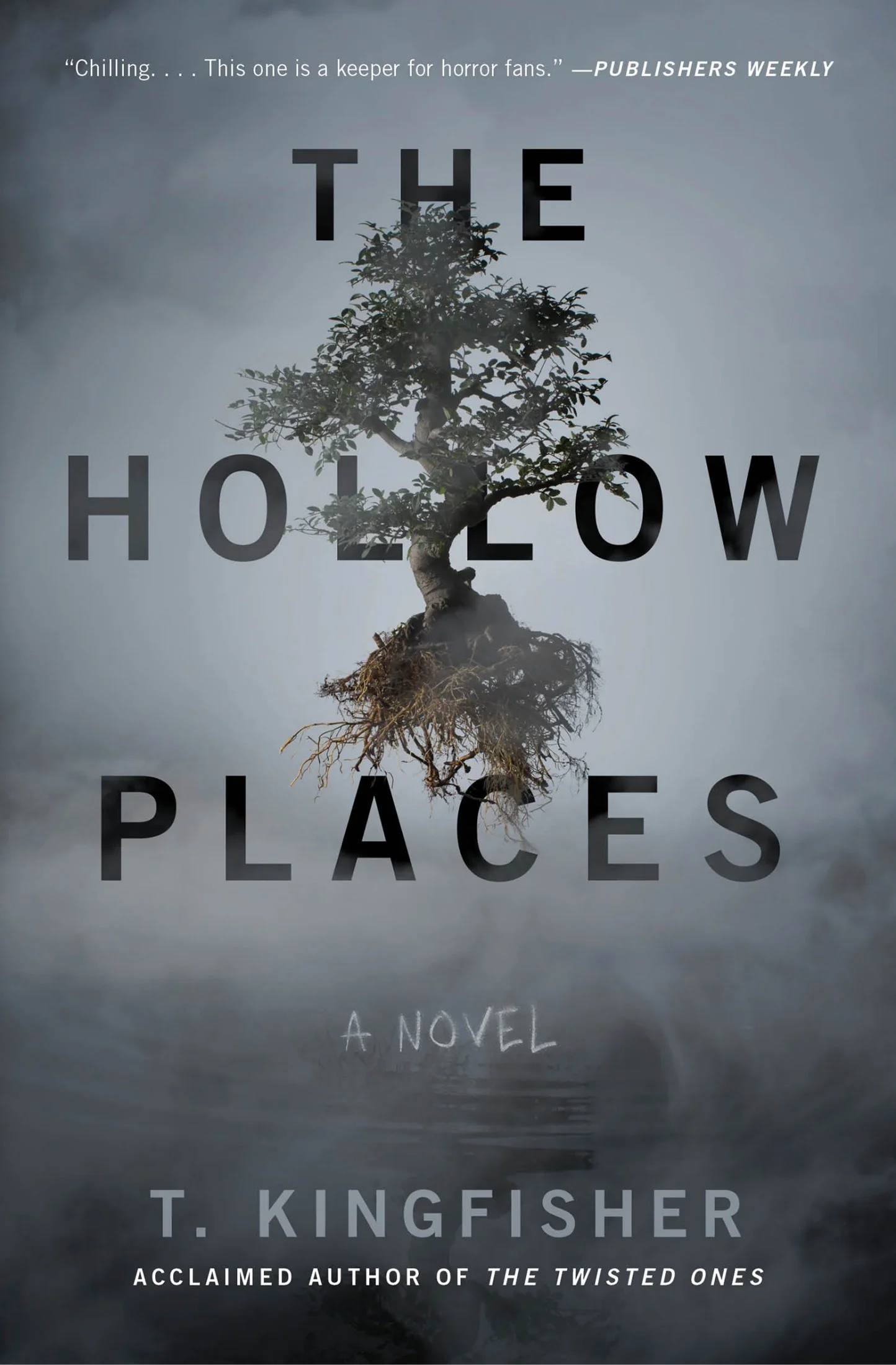
The Hollow Places
A Novel
After her divorce brings her to Uncle Earl's eccentric museum, Kara and her friend Simon discover a doorway to a deadly world of willows, survive its inhabitants, and must stop a small carved otter from reopening the passage through animated taxidermy.
Overview
After divorcing Mark, thirty-four-year-old graphic designer Kara, nicknamed Carrot, cannot afford to live independently and dreads moving in with her difficult mother. Her affectionate Uncle Earl offers her a room in the Glory to God Museum of Natural Wonders, Curiosities, and Taxidermy in Hog Chapel, North Carolina. Kara grew up among its improbable specimens and dubious curiosities, including Prince, a mounted elk she has loved since childhood. Earl's failing knees and back make her help useful. She begins cataloging the collection and becomes friends with Simon, a flamboyant barista who works next door at the Black Hen coffee shop. Simon has unusual visual perception involving one eye, which doctors have tentatively associated with chimerism. When Earl goes away for knee surgery and recuperation, Kara is left running the museum. A shipment from Earl's friend Woody Morwood has recently brought a small two-sided wooden corpse-otter carving, which Kara puts near the museum's enormous taxidermied river otter.
A hole appears in the drywall beside that display. Kara assumes a tourist damaged it, but when Simon helps open the wall for repair they find an impossible concrete corridor where ordinary building structure should be. They explore a circular area, rusted doors, and a room containing a long-dead man on a cot. Simon is reluctant to call the police because of an outstanding Florida warrant involving LSD, and neither can explain the corridor. They also discover that the opening has drywall on the museum side but thick concrete on the other. Simon unbolts an old exterior door and they emerge from the underground passage into daylight, although it is night in Hog Chapel.
Outside is an eerily quiet river crowded with nearly identical grassy bunker islands, willow thickets, and unexplained funnel-shaped depressions in wet sand. Simon bolts their entry door, and they mark the shore so they can return. Other bunkers are closed, flooded, or unlike the one connecting to the museum. They find an apparently abandoned school bus marked for Byricopa County, with unfamiliar lettering. A storm drives them inside. Simon warns Kara away from the passenger seats, and they soon discover children moving beneath the vinyl upholstery, as though trapped on the far side of ordinary reality. Simon also senses the woman who drove the bus, but perceives her as farther away and strangely inside out. They flee, only to discover that rising floodwater has erased their landmark. Unable to distinguish their entrance from the other bunkers before dark, they hide from a mysterious human-looking boatman and take shelter underground. The walls bear the warnings 'They Can Hear You Thinking' and 'Pray They Are Hungry,' with spent ammunition nearby.
In a deeper chamber, they find abandoned cots and supplies. They consider whether the river functions as a meeting place for multiple worlds, but have not yet established the nature of any other portal. At dawn, they see silver and amber figures made from the negative spaces between willow branches. These fleeting shapes seem indifferent to them and are not necessarily the predatory beings. A separate, dark, heavy presence passes through the trees and sends the shapes away. Searching the previous occupants' lockers, Kara and Simon obtain food and clothing, a Bible with unfamiliar books, a magazine with strange cultural references, and an expedition log. The rations are marked as property of the UNA government. The log describes a group entering the 'vacuae' and occupying an already abandoned fortification. These are material clues that other people, perhaps from another world, have crossed the landscape.
Thirsty and still lost, the two hear a deep humming like a distant gong and meet Martin Sturdivant, an emaciated former park ranger partly submerged in a flooded bunker. He says he entered through a kudzu-covered opening and never found it again. The river country touches many places; the willows are connected to powerful, poorly understood beings he calls 'They.' Thinking about Them seems to attract attention. Sturdivant explains that hungry beings consume victims, while others sometimes transform, disassemble, or keep people alive in grotesquely altered conditions. He believes the concrete bunkers offer relative protection because willow roots cannot readily penetrate them, although accumulated dirt threatens that refuge. The beautiful ephemeral figures are effects of willowlight, while the greater humming beings are something more dangerous. Sturdivant himself has been left alive with his lower body dismantled and his organs floating around him. Kara and Simon flee in terror.
Their search takes them past a wrecked ship. An enormous, nearly invisible, humming entity approaches, appearing to exist partly behind the visible world. They hide in the wreck, and Simon urges Kara to stop thinking about it. She finds that focusing intensely on mundane resentments, rather than fear of the being, helps it lose track of them. At last they recognize Simon's toolbox in their original bunker and pass through the still-open corridor into the museum. They shut the bunker door and patch the opening with drywall, batik, and heavy display cases. Kara lies about taking Simon to an emergency room to explain why the museum and coffee shop were closed. Though home, both have nightmares, and their improvised patch feels inadequate. Kara repeatedly finds the corpse-otter carving out of place and returns it to the museum displays without recognizing its agency.
Kara researches the strange name Byricopa and the Latin roots of 'vacuae,' and tests other museum walls, finding only ordinary insulation. The alternative Bible contains a soldier's handwritten diary in its margins. His military unit crossed a controlled opening with decontamination procedures, occupied an abandoned bunker, and lost its commander. The commander was later found with funnel-shaped wounds matching the depressions in the river's sand, showing that the apparently innocuous pits were evidence of the beings' attacks. The unit was joined by Singer, a researcher from yet another world whose expedition had been devastated. Singer warned that the entities could move beyond ordinary human dimensions and might hear thoughts. In later diary entries, the soldiers shoot a terrifying intruder only to recognize it as one of Singer's missing companions, horribly transformed but identifiable by his tattoo and dental fillings. When Marco, Steen, and Petrov are attacked while attempting to reach the expedition's return point, their bodies are unraveled or cut away. Singer survives with the diarist by inflicting pain and temporarily overwhelming their attention, making the beings lose track of them. The diary ends with their plan to attempt escape again. Their fate is never confirmed.
Meanwhile, Kara dreams of returning to the corridor and wakes with raw fingers. When she discovers that her nails contain plaster dust and the patched wall is gouged, she realizes she has been trying to break it open in her sleep. Simon ties her wrist to her bed to interrupt the behavior, but both are later drawn into the willow world during sleep. Kara approaches the raft-bound boatman, who is revealed as a shrieking, distorted creature with white roots connecting his legs to the boat. Simon awakens in pain and saves her. The boatman attacks the bunker's door with a pole, nearly tearing it from its hinges, while Kara badly injures her knee in their escape. They suspect the world is calling them back, but cannot say whether the boatman or the humming beings cause it. Simon installs a sheet-metal barrier over the portal and moves the huge wooden Bigfoot statue in front. Kara puts the repeatedly displaced corpse-otter carving in a taxidermy case containing an albino raccoon and other small animals.
Although the new barrier stays intact, that display case is found smashed, and the albino raccoon and a stuffed fisher disappear. Beau, the museum cat, later fights something pale at Kara's bedroom door; she finds the mutilated, already stuffed raccoon behind a cabinet. Kara tries to explain it as a rat infestation. Her ex-husband Mark also admits he became involved with Riley before their divorce, but Kara no longer wants the confrontation he expects. After Kara reads the expedition's final entries, willowlight appears on the museum's ground floor. The missing fisher attacks and bites her. She beats it with a cane, aggravating her knee, and sees the corpse-otter carving move inside its chest. She realizes the object was likely responsible for the original opening and had been struggling to return to the other world. It may also have influenced their sleepwalking, but that mechanism remains uncertain.
The carving abandons the damaged fisher and animates the huge river otter. Its activity sends silver light through the museum, causing other mounted animals and skeletal exhibits to move. The otter forces Bigfoot aside, tears through the sheet metal, and reopens the passage. When Beau challenges it, the monster pursues Kara into her bedroom. Prince, the beloved elk head, unexpectedly bends and impales the otter with his antlers, allowing Kara and Beau to escape. Other animated exhibits interfere as the otter chases Kara upstairs. Rather than leave the carving in her world, Kara decides to lure it back through the portal, hoping its drive to return will end the danger. She reaches the willow landscape, but the plants entangle her, and the otter follows her into the river, where its aquatic agility gives it the advantage. It cuts open her calf. The humming entities also approach. Kara retreats into a flooded bunker, but its door is rusted open and cannot protect her. There she finds Sturdivant again. He releases Kara and throws her clear, then grapples with the otter, tangling it in his own exposed organs. Kara escapes without learning whether Sturdivant survives or whether the carving is destroyed.
The beings pursue Kara as she struggles through the river. The same conical cavities that marked the sand and killed the expedition commander now open in water beside her. She glimpses something enormous pressing through the skin of reality overhead. Remembering Singer's account of pain disrupting the hunters' focus, she deliberately slams her weight onto her already ruined knee. The agony makes her thoughts go blank, and the entity misses, leaving a deep funnel in the sand inches away. Kara limps back into the correct bunker and falls through the museum opening at dawn. The willowlight has vanished, and the animated taxidermy is still again. Simon later closes her wounds as best he can.
Kara calls Woody Morwood, who confesses that he found the carving on a Danube island riddled with openings. He burned the willows there and sent the object far away, wrongly believing it would become harmless if separated from the plants. He had warned Earl in a book shipped with the artifacts, but the warning was never read. Its precise origin and the wider relationship among the willows, the carving, and the predatory beings remain hypotheses. Woody explains that some openings close when their empty space fills with the surrounding medium. Guided by this possibility, Kara and Simon stack forty bags of quick-setting concrete inside the corridor, wet them to form a barrier, then fill the actual boundary of the portal with mesh and spackle rather than merely covering it. As they work, the wall reconstitutes itself on the museum side. Two weeks later, Kara tests it and photographs ordinary drywall and studs; Simon no longer sees the anomalous depth. Their particular opening is closed, though another breach somewhere remains possible.
Kara is left with nightmares, panic at silver reflections and ordinary willows, and an injured knee for which she cannot afford the recommended surgery. Earl returns after recovering from his own operation. Kara continues living in the museum, working on its catalog and spending time with Simon, who understands what she experienced; Woody later visits. She reflects that Prince and the other preserved creatures, animated by a hostile force, nevertheless fought to protect her. She wonders whether years of being cared for in Earl's museum gave them some memory of affection, but does not claim to know. Prince's mounted head remains tilted, cane toads have been scattered throughout the building, and Kara has the frightening Feejee Mermaid sent away. The final state is not complete certainty about the willow world or freedom from trauma. It is the verified closure of one portal, the survival of Kara and Simon, and Kara's decision to remain in the home where Earl, her friends, and even the taxidermied exhibits have offered her protection.
Main Characters
- Kara (Carrot): divorced graphic designer, museum caretaker, narrator and survivor who is badly injured defending her home
- Simon: Black Hen barista, Kara's friend and fellow explorer, whose unusual eyesight sometimes detects phenomena she cannot see
- Uncle Earl: Kara's kindhearted uncle and owner of the Wonder Museum, recovering from knee surgery during the central events
- Beau (Beauregard): museum cat who fights the animated raccoon and giant otter
- Martin Sturdivant: former park ranger trapped and grotesquely altered in the willow world, who later helps Kara escape
- Woody Morwood: collector who sent Earl the dangerous corpse-otter carving after finding it on a Danube island
- Singer: researcher from another world whose warnings survive in an expedition member's Bible journal
- Mark: Kara's former husband, whose relationship with Riley becomes unimportant beside the new danger
Central Themes
- The security and responsibility of home
- Friendship and mutual aid during crisis
- The inadequacy of ordinary perception and explanations
- The persistence of psychological and physical trauma
- Threats crossing apparently stable boundaries
Mood & Atmosphere
The narrative contrasts comic, affectionate depictions of small-town museum life with claustrophobic concrete passages, unsettling willow-filled landscapes, extreme bodily horror, and the persistent uncertainty of being observed by beings outside ordinary perception.
Source Edition
The Hollow Places: A Novel (2020), Gallery Books. How sources are recorded.