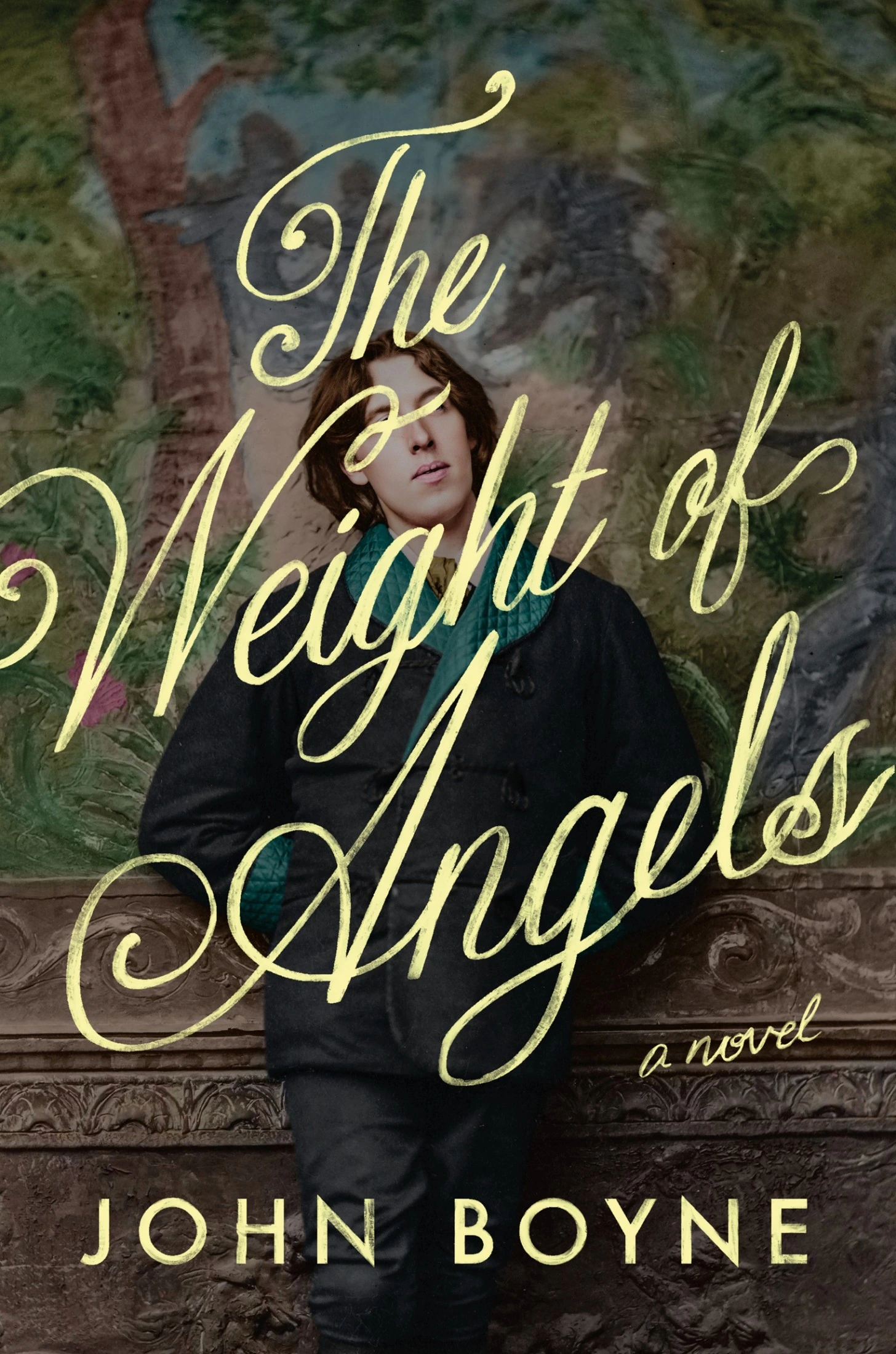
The Weight of Angels
After refusing to sue the Marquess of Queensberry in 1895, a fictional Oscar Wilde survives into the 1950s, loses the man he loves, and ultimately uses his literary standing to advance the decriminalization of homosexual relationships.
Overview
John Boyne's The Weight of Angels imagines a life Oscar Wilde did not lead. In March 1895 the writer receives the Marquess of Queensberry's notorious accusation at the Albemarle Club but, after considering the legal dangers, refuses Lord Alfred Douglas's insistence that he prosecute Queensberry for libel. The historical Wilde did pursue that case, was prosecuted and imprisoned, and died in 1900. In Boyne's novel, refusing to sue preserves Wilde's liberty, reputation, and capacity to continue writing. It does not make him more faithful or less vulnerable to grief. The story follows this fictional Wilde across almost six further decades, eventually showing an elderly writer whose public position gives him an opportunity to contest the laws that might once have destroyed him.
The book is organized as a prologue, nine chapters covering periods from 1896 through 1952, and an epilogue set on the day of Elizabeth II's coronation in 1953. Most chapters move through dated scenes separated by years, so considerable portions of Wilde's imagined career take place between the episodes shown. Letters, newspaper articles, reviews, a film-script extract, and other documents sometimes take over the narration. Their contrasting accounts demonstrate the difference between what Wilde experiences, what witnesses believe, and what institutions choose to record. The invented theatrical works, literary prizes, political interventions, and personal encounters operate inside an alternative history that retains many recognizable events and historical figures but changes their relationship to Wilde's life.
Early in this version, it is Bosie rather than Wilde who suffers a criminal trial, imprisonment, and premature death. Wilde remains successful while Bosie's imprisonment leaves him physically damaged and estranged from his former life. Wilde is with Bosie when he dies in Paris in November 1900. Boyne transfers the authorship of The Ballad of Reading Gaol to Bosie, leaving Wilde to pursue publication of his dead lover's poem. The reversal is not merely a changed biographical detail. Wilde repeatedly encounters the work, seeks recognition for it, and revisits Bosie's grave long after his own fame has expanded. His public survival entails carrying the memory of another man's destruction. The chapter also establishes the lasting damage within Wilde's marriage. Constance dies in 1898, and he continues to regret that his affection for her did not translate into the everyday consideration she deserved.
An encounter with Edgar Parsival, nicknamed Parsnip, during a visit to Borstal gives the novel an early ethical distinction that later becomes important. Parsnip is a teenage former sex worker who describes exploitation by customers and brutality within the institution confining him. Wilde is disturbed by his testimony because the social and economic power exercised over such boys implicates the habits of his own younger life. The novel does not make every sexual encounter between men equivalent. Gus Boone, whom Wilde meets in 1906, is an adult schoolteacher who becomes his loving and freely consenting partner. By contrast, the boys bought and passed among wealthy men in Wilde's and André Gide's social circles do not possess comparable freedom or power. Wilde's reluctance to confront that difference is one of the central moral limitations the story assigns him.
With Gus, Wilde discovers a form of companionship he had previously endangered through ambition and desire. They create a home together at Berkeley Square, supported by Gus's father Albert, the housekeeper Nancy, and later Esha and Advik, the widow and son of the adult Parsnip, who dies while serving in the First World War. Wilde's decision to help Parsnip's family fulfills a promise and shows that he can respond to vulnerability with sustained care. The family they construct is unconventional but stable. Yet Wilde also experiences domestic contentment as a possible threat to his artistic vitality. Instead of appreciating the life he has, he comes to seek excitement through an affair with Fionn Rillington, an aspiring actor whose beauty and ambition make him dependent on Wilde's patronage. Wilde allows the affair to distort casting decisions and professional relationships. His behavior repeats the betrayal of Constance even while he tells himself that he understands its consequences.
The war provides another account of what Wilde's continued life costs him. His son Cyril enlists and is killed; his younger son Vyvyan also loses his wife. Wilde's grief creates an unexpected point of connection with Rudyard Kipling after Kipling's son dies. Nancy reveals that she has lost Angelica, a woman with whom she maintained a hidden lifelong relationship. These episodes connect private bereavement to public demands for patriotism, conformity, and silence. Wilde is resistant to government-sponsored propaganda but not consistently willing to exercise his influence on other political questions. He initially approaches the women's suffrage movement with a mixture of sympathy and vanity, and his commitment deepens only gradually through encounters with Emmeline Pankhurst and events such as Emily Wilding Davison's death.
The central personal disaster follows when Gus learns that Wilde has been unfaithful for years. Gus leaves Berkeley Square in anguish, drinks heavily, and enters a male brothel in Soho on the night police raid it. Arrested for gross indecency, he loses his school career and is sentenced to thirty months in prison. Wilde's infidelity causes the rupture, but the law turns a private crisis into criminal punishment and public ruin. Nancy and Albert abandon Wilde's household, while Gus refuses his attempts to communicate. On the day Gus is due to be released, Wilde learns that he has died by suicide. The small sum Gus requested from him beforehand takes on a terrible significance. Wilde's responsibility is neither limited to the criminal law nor reducible to his own behavior alone. Boyne depicts the intertwined consequences of betrayal, shame, imprisonment, and the impossibility of returning unmarked to ordinary life.
Wilde's subsequent decades are shaped by a refusal to forget Gus and by an uneven movement from grief toward public action. He supports the publication of E. M. Forster's Maurice, despite the risks the manuscript poses to its author's reputation, and finally succeeds in bringing Bosie's Ballad to readers. Thelma Furness draws Wilde back into social life. Through her circle, he approaches Winston Churchill about repealing Britain's laws against homosexual acts. The fictional political partnership proceeds slowly. At Chartwell, Wilde and Churchill meet Magnus Hirschfeld, who describes Nazi assaults on his institute and the destruction of his research. Their discussions introduce disagreements about tactics: whether change requires a spectacular public march, careful legislative compromise, or a work of art persuasive enough to change public sentiment. Churchill asks Wilde to write a play about love between men.
These conversations occur alongside the rise of Nazism and the worsening European crisis. Wilde receives a Nobel Prize, acquires a peerage, moves among royals and politicians, and visits Bosie's Paris grave, but no honor releases him from remorse. The play Their Blood Is upon Them is eventually completed, and a production is planned with Laurence Olivier and Vivien Leigh. Its opening on 1 September 1939 is canceled when war begins. The interruption is consequential: Wilde's anticipated contribution to reform is displaced by a catastrophe on a scale he initially fails to foresee. Churchill's attention turns to the defense of Britain, while Wilde, now elderly, is persuaded to spend the war in Los Angeles.
Wilde's American years introduce a different artistic community and expose the limits of his earlier celebrity. He becomes friends with Katharine Hepburn and writes the screenplay for The Countess Collapses, a comedy about theatrical casting and misplaced ambition. The project succeeds, and he wins an Academy Award for his screenplay, a distinction that brings both pleasure and another occasion for rivalry with George Bernard Shaw. His encounter with Fionn at a Hollywood party is less gratifying. The once handsome young actor is now a failed performer working as a waiter, married with children, and still convinced that Wilde damaged his prospects. Wilde admits that his affair contributed to Gus's tragedy but refuses to accept every accusation about Fionn's failed career. The scene offers no comforting agreement about where their responsibilities begin and end. It instead demonstrates how differently the participants have understood the same relationship.
In the postwar years, Churchill persuades Wilde that his own experience may be more effective than the abandoned play. At the Cheltenham literary festival in 1949, Wilde openly describes Gus as his lover and calls for the decriminalization of consensual relationships. Newspapers react in divergent ways. Some record his confession and the audience's sympathy with care; others distort his words, conceal Gus's identity, or invent lurid allegations. The sequence illustrates how the historical record of a public declaration can be shaped by editorial prejudice. It also marks a change from the man who had declined the 1895 trial to avoid public scrutiny and, decades later, rejected a journalist's invitation to campaign on behalf of the imprisoned Gus. The later Wilde finally accepts the personal cost of speaking openly.
One last private revelation precedes the political climax. Albert Boone, dying of cancer, invites Wilde to see him after their long estrangement. He confesses that Gus had forgiven Wilde before his death, but that Albert withheld the message because he wanted Wilde to suffer. The two men reconcile, and Wilde later welcomes Albert to live out his final days in the home where they once shared happier years. The confession does not erase Wilde's culpability; he tells Albert that the guilt remains deserved. Forgiveness changes his knowledge of Gus's feelings without undoing his actions or their consequences.
In May 1952, with Churchill returned to office, Wilde addresses 199 members of Parliament at Claridge's before a proposed vote on decriminalization. He abandons the prepared literary speech and recounts the relationships that have defined his life. He acknowledges his betrayal of Constance and Gus, rejects the idea that consensual male love should be criminal, and asks lawmakers to give others the ordinary liberty he and Gus never possessed. He collapses before completing his appeal. The final chapter ends there, withholding the result and even Wilde's survival.
The epilogue supplies both answers. Wilde survives the collapse and attends the parliamentary vote, which in Boyne's imagined Britain passes by 332 votes to 293. Journalists call the reform Oscar's Law, while Wilde privately calls it Gus's Law. The distinction matters: the achievement is associated publicly with Wilde's prominence, but he understands its personal significance through the man who could not live to benefit from it. At Elizabeth II's 1953 coronation he is too frail to attend the ceremony but is welcomed to a palace luncheon with Nancy. Conversations with a young footman, the queen, and her child suggest that new generations will inherit the freedoms Wilde helped secure. This fictional legislative outcome must not be confused with the later history of reform in the United Kingdom.
Returning home that night, Wilde looks over the writing of his long life with satisfaction. Constance then appears as a young woman, and they finally share the dance he refused her while she lived. She takes his hand toward an apparent afterlife, where he senses a gathering of people welcoming him. He hopes Gus is waiting, but Boyne leaves that reunion uncertain. The encounter strongly implies Wilde's death without a conventional deathbed account. His life ends not with the exposure and imprisonment he escaped in 1895, but with the consequences of his choices fully remembered and his efforts at political reform accomplished. The novel's counterfactual does not make Wilde innocent or all-powerful. It asks what an artist who lived long enough to confront his own damage might have done with his reputation, and what would remain unresolved even after a public victory.
Main Characters
- Oscar Wilde: The fictional surviving playwright whose refusal to prosecute Queensberry preserves his career but whose infidelity and subsequent public advocacy shape the imagined twentieth century.
- Augustus Boone (Gus): Schoolteacher and Wilde's longtime partner, whose imprisonment after a Soho police raid and subsequent death by suicide become the central sources of Wilde's remorse and reform campaign.
- Constance Wilde: Wilde's wife and mother of his sons, who dies in 1898 and whose memory returns in his final imagined encounter.
- Lord Alfred Douglas (Bosie): Wilde's tempestuous former lover, imprisoned and dead by 1900 in Boyne's alternate history, where he writes The Ballad of Reading Gaol.
- Albert Boone: Gus's devoted father, estranged from Wilde after the conviction, who later reveals Gus's forgiveness before his own death.
- Fionn Rillington: Aspiring actor whose years-long affair with Wilde breaks his relationship with Gus and compromises his theatrical judgment.
- Edgar Parsival (Parsnip): Exploited young sex worker who later becomes a serviceman and whose death leaves his family in Wilde's care.
- Esha Malesha and Advik: Parsnip's widow and son, who become lasting members of Wilde's household; Esha manages his affairs and Advik becomes a surrogate family member.
- Nancy: Wilde's longtime housekeeper whose own concealed female partnership informs her understanding of his relationships and who becomes his close companion in old age.
- Winston Churchill: An imagined political collaborator who encourages Wilde's public advocacy and advances the successful 1952 legislation.
- Thelma Furness: A socially connected American woman who helps Wilde recover from his isolation and introduces him to political opportunities.
- Katharine Hepburn: Wilde's Hollywood friend and collaborator who persuades him to write the successful screenplay The Countess Collapses.
Central Themes
- The difference between surviving a historical catastrophe and escaping responsibility for personal conduct
- Consensual adult love, the criminalization of homosexual acts, and the harmful consequences of stigma
- The exploitation of vulnerable boys under conditions of unequal power and economic need
- Infidelity, self-deception, moral accountability, and forgiveness that does not remove guilt
- Literary prestige as both a personal ambition and a potential source of social influence
Mood & Atmosphere
An episodic, frequently comic account of literary and political society that develops through bereavement, private guilt, public controversy, and a speculative political victory.
Source Edition
The Weight of Angels, Henry Holt and Co.. How sources are recorded.